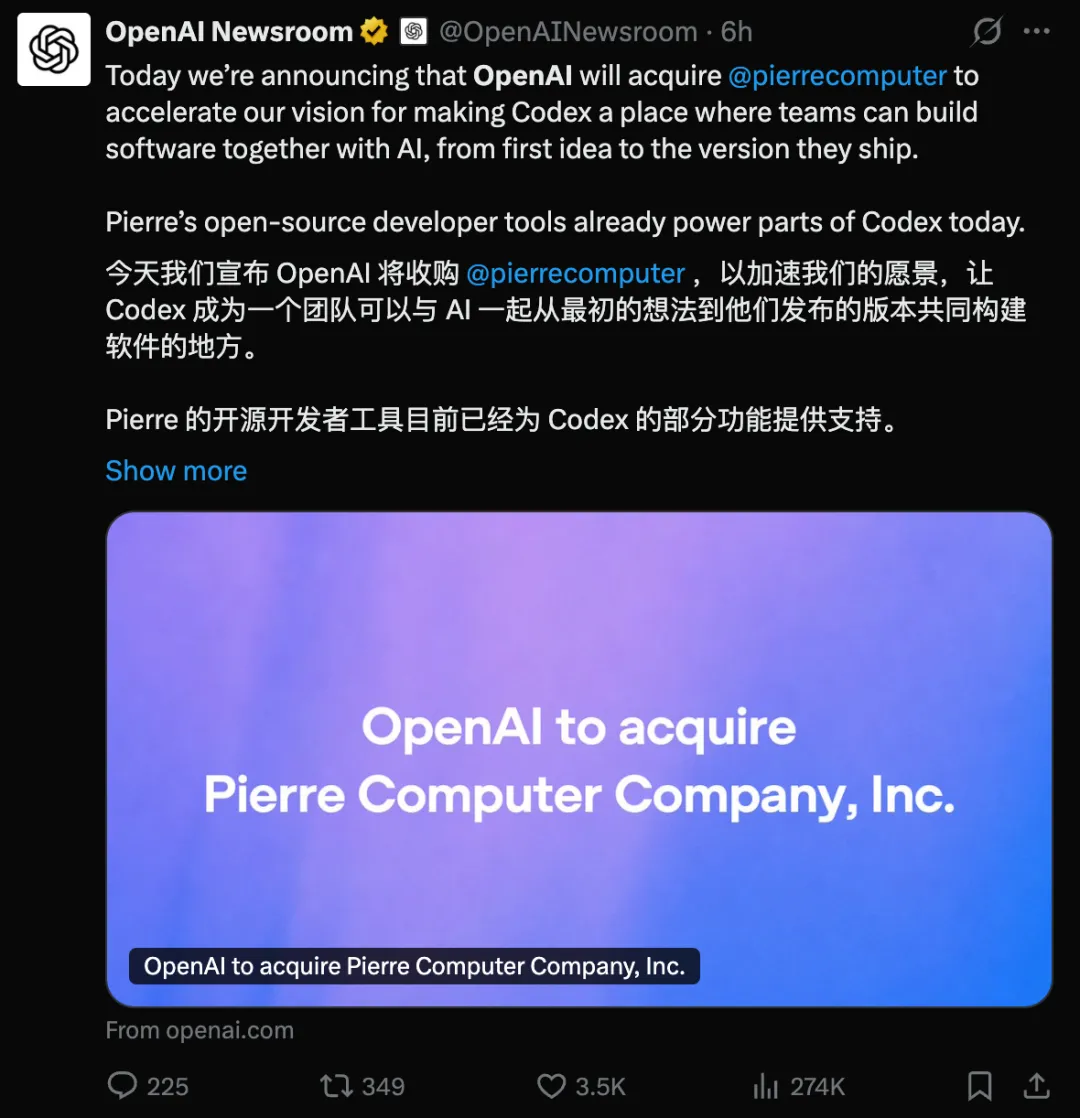
OpenAI has just announced its acquisition of Pierre Computer Company.
OpenAI said the acquisition was to accelerate a vision for Codex to be a team building software with AI, "from the initial idea to the final release".
At the same time, Pierre's official account also posted a video shot on the basketball court announcing his joining OpenAI. In the video, they said, "The good news is that we're still making a product we love".
OpenAI wants to work with Pierre to set standards for modern software development, covering "from the creation of the first branch of the smart body, to the deployment of code online, to a wonderful time around the world". The announcement also states that OpenAI wants Codex to connect the code that enterprises deliver with the decisions made by employees.
According to the official announcement, Pierre has previously created Code Storage, a code-hosting service, and a series of open-source developer tools, in which Trees and Diffs, two open-source libraries, have been used for document browsing and code difference review interfaces for Codex applications.
The acquisition aims to further improve Git workflows that developers are familiar with, allowing it to better adapt to the new model of interaction between humans and AI programming intelligent agents.
OpenAI pledges that Pierre's open-source project will continue to be open-source, and existing customers will continue to use Code Storage, with related capabilities to be gradually integrated into the Codex in the future.
Where Pierre is sacred
Pierre's co-founder and CEO is Jacob Thornton. The front-end developer is probably unfamiliar to him, as he is one of the co-authors of Bootstrap. The front-end framework was born within Twitter and became one of the world's most popular CSS frameworks, almost an entry-level tool for a generation of Web developers.
Another co-founder is Ian Ownbey. According to investment databases such as Dealroom, Pierre was founded in 2023 with a team size of between 11 and 50 people.
Open Pierre's website pierre.computer, and you'll see a very short, retrospective page from the 1990s. There's only one word on the page that introduces the company:
Yes, there is so much content on the official website.
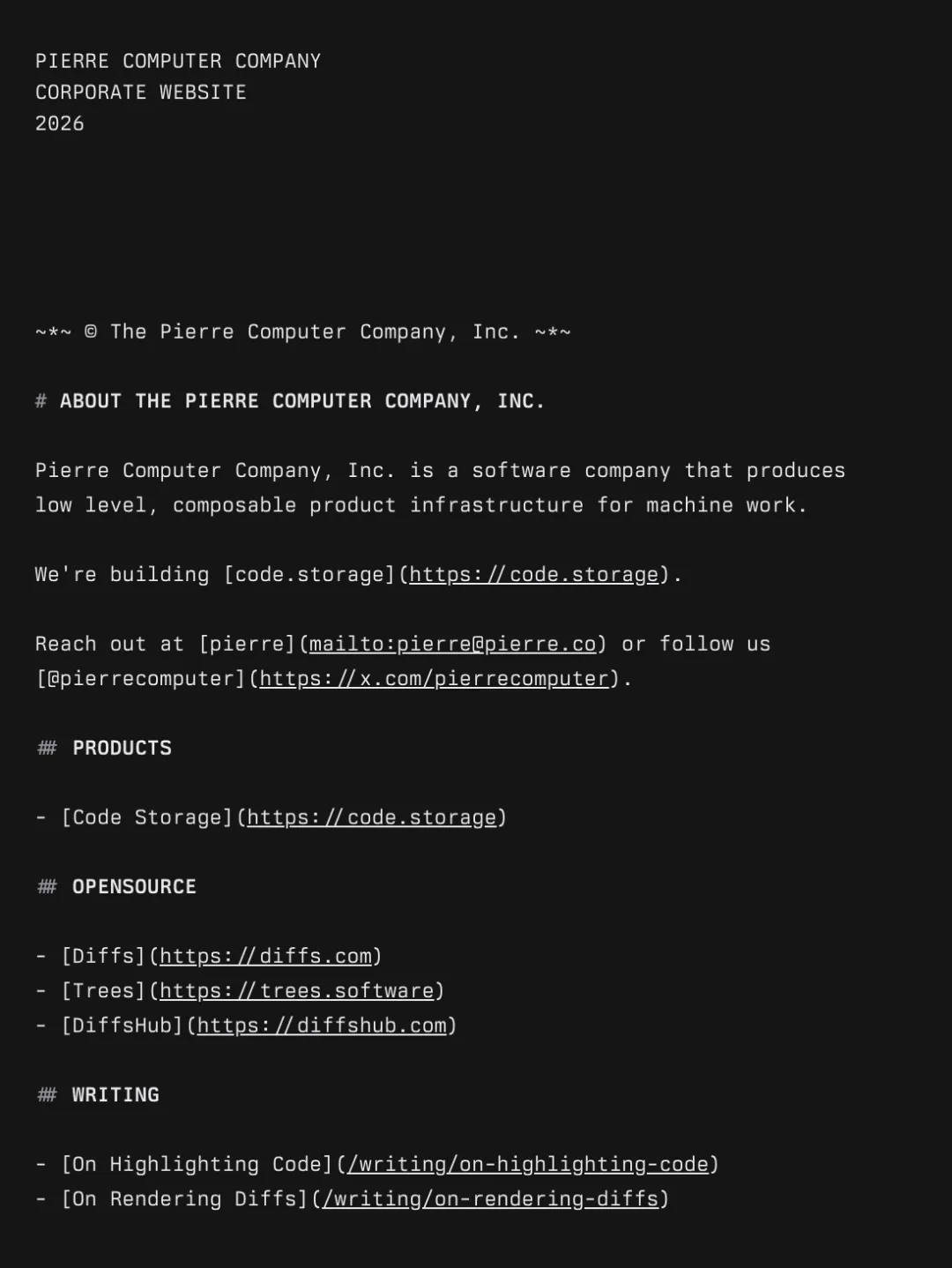
Pierre's product line is not much, a commercial product with three open-source projects:
Code Storage: Commercialization of mainstream products and AI-oriented Git hosting infrastructure
Diffs: Code difference rendering library
Trees: Project Documents Tree browsing library
DiffsHub: Open source project based on Diffs
Code Storage is Pierre's core product, positioning it as the industry's largest workload of workload storage codes and other machine-generated products.
It supports up to 32TB of storage capacity in a single warehouse, with no limit on the number of warehouses and total storage space. Both Git requests and API requests are unlimited in speed, the single warehouse is capable of handling more than 500 Git requests per second, API requests peak over 15,000 times per second, supports more than 30 concurrent write-ups, and provides 99.99% availability SLA.
These indicators are behind the pace at which AI programming is changing the production of code. Human engineers may only submit a few codes a day, whereas AI smart bodies can create dozens of branches in a minute while sending a large number of read-write requests. The limited flow and access control processes of traditional Git hosted platforms revolve mainly around the habits of human developers. When programming smart bodies become high-frequency users, the original infrastructure needs to change as well.
Code Storage is exactly what it's for. Technically, it's a three-phase Git-based submission protocol, combined with a "radiation-based" majority-quorum architecture that supports high read and write while ensuring data durability and consistency. Developers can either operate the SDK warehouse directly through TypeScript, Python, Go, or clone and push along the native Git protocol, and be bi-directional with GitHub, GitBit, Bucket. This means that developers don't have to completely change the existing workflow, interacting with AI-optimized code storage services.
The pricing method also takes into account the characteristics of AI programming. Hot data accessed within 7 days is charged $0.005 per hour per GB; cold data not accessed for more than 7 days is reduced to $0.0002, 25 times the difference between the two.
In the AI programming scenario, the intelligent body can quickly generate large amounts of code, branches, and intermediate products, many of which are read or modified only once or twice, and then put on hold for a long time. By charging for layered cold-heat data, Code Storage attempts to make this high-frequency generation, low-frequency access mode of code storage more cost-effective.
If Code Storage solves "where the code is", Trees and Diffs solve "how people understand code".
Trees allows developers to quickly browse and locate project files, and Diffs makes the code change. OpenAI specifically praised the two libraries in its announcement, saying they "allow developers to easily review and browse large amounts of code while maintaining excellent performance".
Diffs also has a very practical editing mode. The reviewer finds problems in the diff view so that the line can be changed directly from its original location without cutting back on the editor. The newly released Highlights can update the grammar in real-time when the developer typed, or when the code is outfitted in a smart body format.
When AI code exploded
From what Pierre has done, it is easy to see that the acquisition of OpenAI is actually a sign of a growing concern.
AI writes code much faster than humans. But when code is written, someone always looks at it, assesses it, and takes responsibility for it. When an engineer commands several intelligent objects simultaneously, the daily diff may be several times greater than in the past.
Review and distribution links are becoming a real bottleneck in the AI programming era.
OpenAI highlighted this in its announcement, saying that "Git's use is another important link to how developers review code". Pierre's tools can be seen, largely because they help people "read a lot of code quickly".
Another worthy signal is OpenAI's reference to "linking enterprise-delivered code to decisions made by employees". Git can record changes in code, but it's difficult to record the discussions and exchanges behind the changes. As more code is created by AI, the reasons behind the changes become more difficult to trace and more important than ever.
Of course, the acquisition itself does not mean that Codex will become a completely new code platform tomorrow. Transactions also require regulatory approval and integration takes time. OpenAI's current commitment is that open source projects continue to be open source.
In retrospect, the competition for AI programming tools is going down a notch. Over the past decade, the storage, tracking and management of code has been firmly dominated by platforms such as GitHub.
So here's the question. If most of the code in the future was written by AI, reviewed by AI, on the platforms of AI companies, would developers still need GitHub today?
Welcome to the comments section to discuss your views.
© THE