“ Power control genes and a Physical AI pathway from the DLR lab to the industrial site.
In the 1990s, researchers at the German Space Center (DLR) focused on a very new problem: the ability of robots to perceive objects they are touching just like humans do.
At the time, mainstream industrial robots only recognized coordinates. Given the target location, the controller pushed the joints past along the insert trajectory, and any contact encountered along the way was seen as interference, slight trajectory deviation, and heavy workpiece scrapping. To make the robot understand this contact, the hardware had to replace a sensor base.
At the time, DLR's solution was fairly straightforward, incorporating force-matrix sensors into each joint. The joint itself knew how much force it was under, and after the signal was relayed, the upper control was no longer rigidly adhering to the preset position, but modified to block the control of the robot's reactions to the outside force. The robot was abstracted into a rigidly adjustable spring, which when the outside force came, it retreated and the force pulled it back to its original position.
The two technologies, located in different layers of scientific research and industry, formed the common starting point of the force-controlled mechanical arm for more than two decades, and gave birth to several force-controlled research institutions and enterprises.
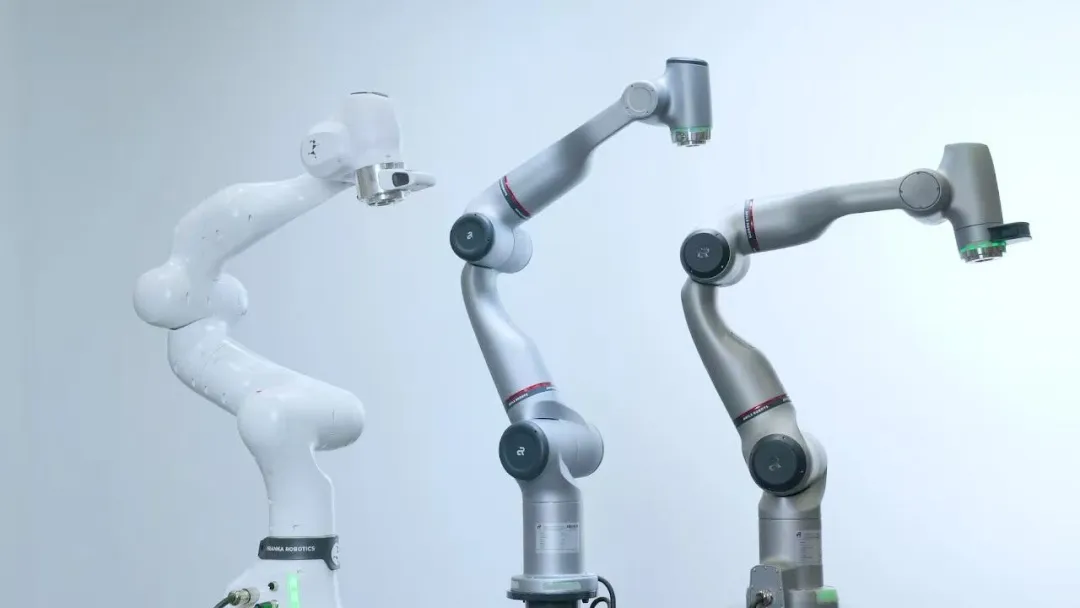
In November 2023, Franka Emika was acquired by Thinking Robotics and renamed Franka Robotics. The same company originated from DLR, headquartered in Germany, and is now a joint venture between two companies. One is the parent manufacturer of deep-field industrial automation and precision assembly, and the other is an open platform brand for long-term service universities and research institutions. The acquisition puts them into the same R&D spectrum and allows Power Control to have a complete product line from scientific research to industry for the first time.
Because the value of power control is being redefined by academia and industry in the wave of physical intelligence, power control is no longer a feature on the list today, but from the lab to the production line, and thinking goes further, the real problem is that in the wave of physical intelligence, power control is irreplaceable in what scenarios, how the data generated by real contact flows back into model alternatives, and whether the next deployment can be replicated with the same set of interfaces and power control bases.
The Physical AI methodology of mind-boggling robots revolves around this problem. It uses force-control as the basis of physical interaction, using high-value industrial scenarios as a closed-loop gateway, allowing real contact to generate data, data-replicating models, and models to enter new scenarios.
01.
Power control: Why Physical AI is a must
For the output line, power control is essential, not because a variable is missing in the paper, but because the position control at the moment of contact has failed, and the output line cannot wait for the algorithm to complete this lesson.
The role here is to provide real-time error space in the contact process when robots are unable to advance all tracks in different environments. Power control platforms are accessed here not as an isolated location, but as an industrial node that continuously generates data and interacts with production systems in real time.
The range controller assembly line of Volkswagen takes power control to another dimension: mass production rate. The range controller flexible assembly line, built for Volkswagen, the entire line is equipped with 10 robots, 18 flexible automated chemical plants, covering material grabbing, automatic connectors, automatic thread beams, assembly of parts units, UPH (output per hour) increased by 30% compared to the industry average.
String beams and plug connectors are typical contact-intensive flexible tasks, with a 30% UPH improvement that means that the power control capability of SILING is not sacrificed under actual pulse pressure, and smooth control and production efficiency can be established at the same time. The production line also uses a modular design, and the product manufacturing module can complete the entire line shift in 15 minutes, indicating that this power control capability is not customized for a single model, but has multi-model replicability.
This case from the public rightly answers the question of why voltage control is a must-have option for Physical AI. Power control guarantees operational reliability in unstructured environments. For the thinking robot, therefore, voltage control is no longer a part of the parameters table, but is a physical prerequisite for the continuous rotation of the data-generating, data-replicating models and models into the application cycle.
This is also the core logic behind the introduction of Physical AI. The founder and CEO of Agile Robots, Dr. Chen Zhengqiang, said: "Physical intelligence is not simply about embedding large models into a body of robots, it requires the collaboration of models, bodies, executive agencies, perceptual systems and application scenarios, and it requires large-scale deployments through high-value applications to form a continuous cycle of application-driven data-driven modeling and application-driven hardware".
02.
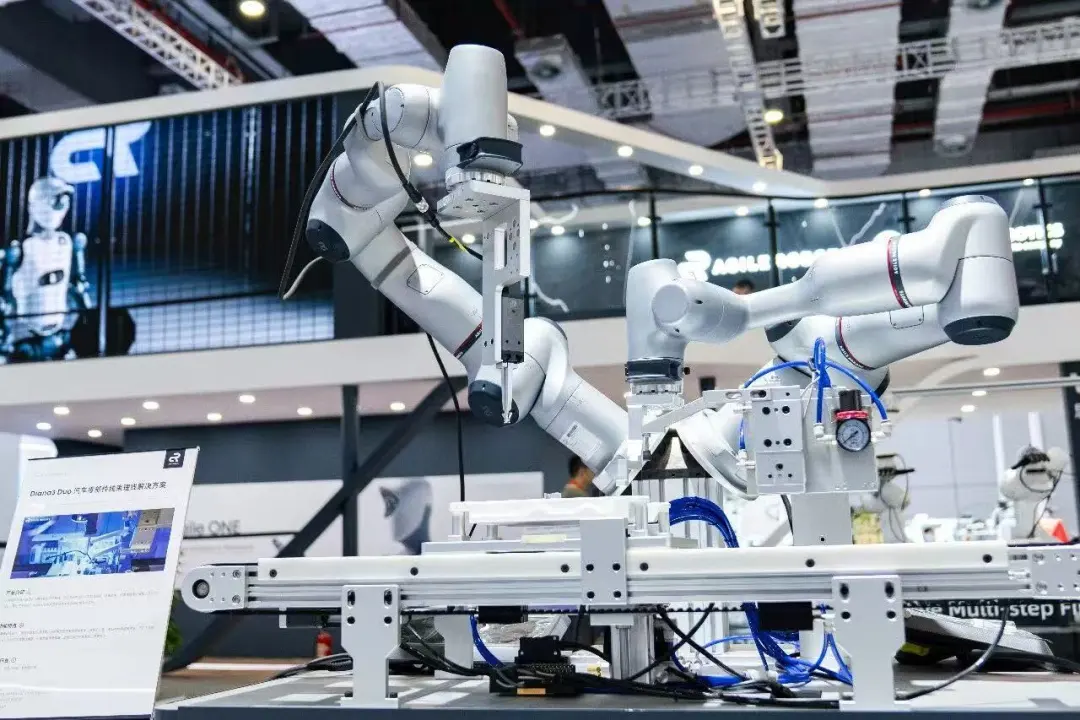
Diana 7, a power control platform for physical AI
The dynamic control gene, derived from DLR, and Diana 7, is the most complete expression of this gene in the industrial scene. Diana 7 has a rated load of 7 kg, a working radius of 923 mm, a repetitive positioning accuracy of ±0.05 mm, a dynamic control relative accuracy of 0.5 N, a control frequency of 1 kHz, a 7-frequency redundant structure, and a full-joint matrix sensing. This group of parameters belongs to the first ladder in the industrial collaboration mechanical arm, but really distinguishes it from the same product, which is the design logic behind these parameters.
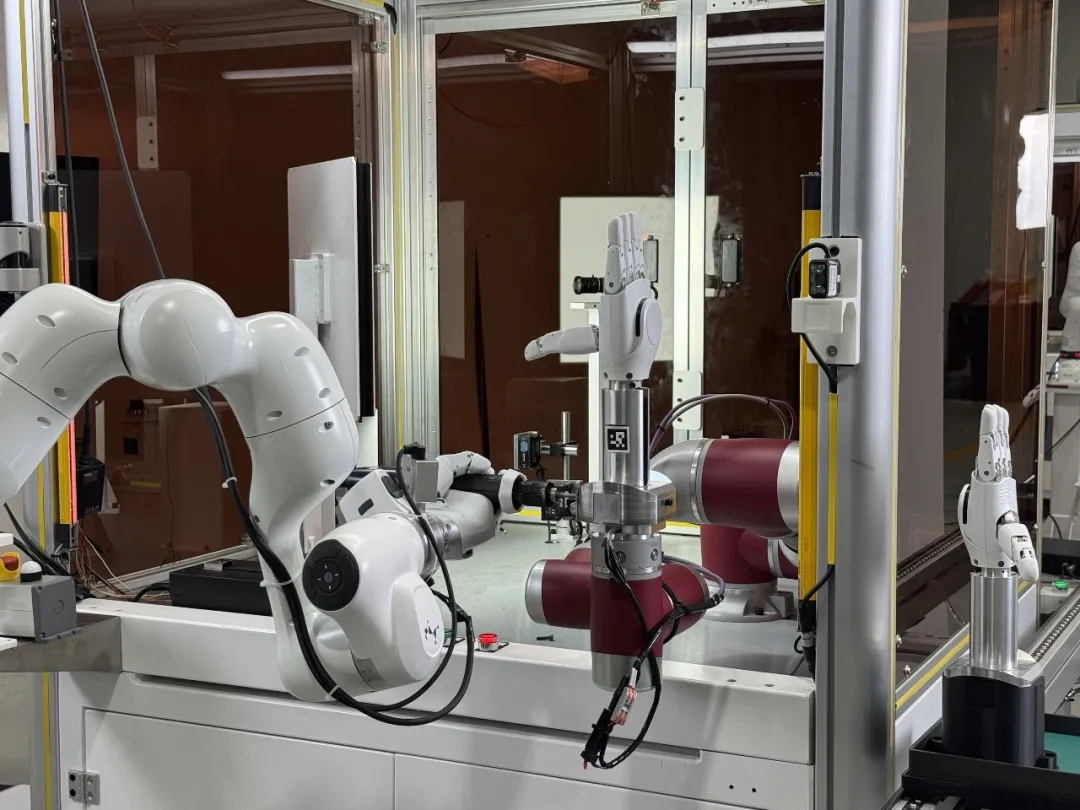
The all-joint torque sensor is the starting point of this logic. The seven joints of the Diana 7 have all built-in torque sensors, which means that the robot is able to sense the torque on each joint in real time, rather than just installing a force sensor at the end. The difference is that the end-joint torque sensor can only sense what the hand touches, while the all-joint torque sensor allows the robot to sense the impact state of the entire arm when interacting with the environment.
In precision assembly scenarios, this means that the robot can judge whether the input is too large, whether the parts are stagnant, whether the posture needs to be fine tuned.
In February 2025, the company announced that it fully supports the Franka Control Interface (FCI), which enables it to bypass the software abstraction layer, send position, speed and torque instructions directly to the joint space or Descartes space at 1 kHz frequency, and integrate with the ecosystem of ROS 2.
FR3 defines the benchmark of open control in the scientific research scene, with the same set of FCI interfaces pushing this benchmark to an industrial scale of 7kg of load and 923mm of working radius, the two forming a complementary relationship. The algorithms verified by the research team on FR3 can be directly migrated to run on the industrial body of the Diana 7 without the need to rebuild the control layer in the middle.
The work of the University of Hamburg's Multimodal Intelligent Systems Assessment Laboratory can serve as a stepping stone to this migration pathway. The team used Diana 7 to perform tasks such as quadratic restoration, modifiable object operation and human-machine collaboration assistance, one of which evaluated directly the platform's attributes: using all-nutrient matrix sensing to collect a large amount of real-world pulse-sensing information for multimodal model training. This research-end algorithm accumulated due to the unification of the FCI interface and the existing pathway to the industrial end. Diana 7's open interface and power sensing capabilities made it a similarly deeply developed data adoption and data integration test platform in the scientific research scene.
03.
"Diana 3" allows for greater scope of power control
Diana 3's positioning is very clear: entry-level pricing, industrial-grade power control, 3kg of load, 772mm working radius, 7 frequency redundancy structures, full-junction matrix sensing, smooth control, repeat positioning accuracy ±0.05mm, and power control relative accuracy 0.5N. These core indicators are at the same level as the Diana 7.
In the robotics industry, entry-level often means compromise on core performance. Reducing freedom, removing torque sensing, reducing control frequency. However, the Diana 3 retains a complete torque control gene. The same torque sensing, the same smooth control, the same FCI interface. It reduces load and price thresholds, not capacity thresholds.
Diana 3 is aimed at those scenarios that require power control capabilities but do not require high loads. Small parts in precision operation studies are captured and assembled, sample processing and displacement operations in laboratory automation, delivery and positioning of devices in medical research assisted, and connector extraction and assembly of electronic components in small complex operations. The common features of these tasks are low load requirements but very high requirements for power control accuracy.
For example, in the laboratory, it is often necessary for robots to carry out operations such as crawling, opening the lid, moving the liquid. The torque torque of the lid, the pressure of the displacer, and the looseness of the handle of the test tube require precise force control.
Traditional position control robots are not suited for this type of task, as the torque torque of the test tube cover varies by batch, and the pressure flow of the moving fluid needs to be adjusted according to fluid volume dynamics. The full-joint torque sensing and smooth control capabilities of the Diana 3 allow it to sense these force signals in real time and dynamically adjust the movements.
Interface uniformity is another key advantage of Diana 3. Diana 3 shares the same set of development interfaces with Diana 7. This means that researchers can migrate the code, toolchain and research results accumulated on Diana 7 directly to Diana 3, without having to re-learn an interface set, and without having to maintain two control logic sets for different entities.
For teams looking to efficiently allocate research resources and rapidly conduct power control research, Diana 3 offers lighter deployment options while keeping power control accuracy and system openness at the same time.04.
Building a Physical AI double-directional closed loop
It can be seen that the DLR queries of thirty years ago in the Diana series did not just take a path out of the rubber industry or rubber research, but formed two intertwined paths: one that leads to the power-control hardware base of universities and research institutions, and one that leads to an industrial site such as the Volkswagen domain control production line.

The two paths are not parallel, but collaborative. The scientific end provides algorithmic validation and problem exposure, the engineering end provides productalization and stability, the industrial end provides real constraints and batch data, and then flows back into the next round of scientific topics and engineering iterations.
The role of the Diana series at the scientific end of the spectrum is not to be a demonstration cabinet, but to be the foundation of the hardware that can be developed, collected and verified. Because these forces control strategies, calibration methods and data collection processes, which are repeatedly modulated in the laboratory, do not stop in the papers, but enter the engineering era of the Diana series, and then with the same set of forces controls entering the industrial scene, accepting the same set of nodes, efficiency and long-term running tests. New demands in the industrial field will also flow back in the form of new scientific research topics.
This bi-directional circuit can be established, and there is a often overlooked premise: interface unification. The Franka and Diana series share the same set of developmental interfaces and power control genes. For the research team, this means that there is no disruption between the entry-level kernel and the industrial kernel; for Intel, this means that the coverage of the research base is enlarged and the input sources of the reverse circuit are increased.
So the Diana series isn't just a single parameter leader, it's essentially a set of power control genes that support scientific verification, engineering iteration and industrial deployment, and the transfer costs between the three are low enough, data flows smooth enough, scenarios replicate fast enough. The parameters can be aligned next round, single-point cases can be copied, but a team can finish a paper on Diana's interface, build a good toolchain, write code, and then move the same set of controls to the industrial core to run, and the transfer costs fall into the user's own development process.
This also explains the significance of the two-way power pump, the two-way industrial shutter, the scientific end of which allows Diana to remain developmental and problem-sensitive, and the industrial end allows power control to continue generating data and demand in real rhythms and real contact. The longer the two bite, the lower the migration cost of the next round of scene switching, and the more smooth the shutter rotates.
05.
A set of power control genes, an open interface, algorithms to verify the complete link to industrial landing
Today's answer to the question posed by DLR researchers thirty years ago is not in papers, but in the hands of the mass-market wiring unit and the team of more power-control algorithms that are being verified on the machine.
Today, force control is no longer the end of the list of functions, but Physical AI is an integral part of a physically intelligent closed loop. It enables robots to have the ability to get close to the neural system, to sense small external forces, to judge contact states, to execute smooth controls, and to modify movements in real time in dynamic environments. When algorithms leave the laboratory, they have entered the real world with complex production lines, and control has become the underlying language that connects scientific research, engineering, and industrial landing. It determines whether robots can truly transition from the computing world into the physical world, and therefore, become a distant focus of the scientific community and industry, leading to the future of AI-Physical research.