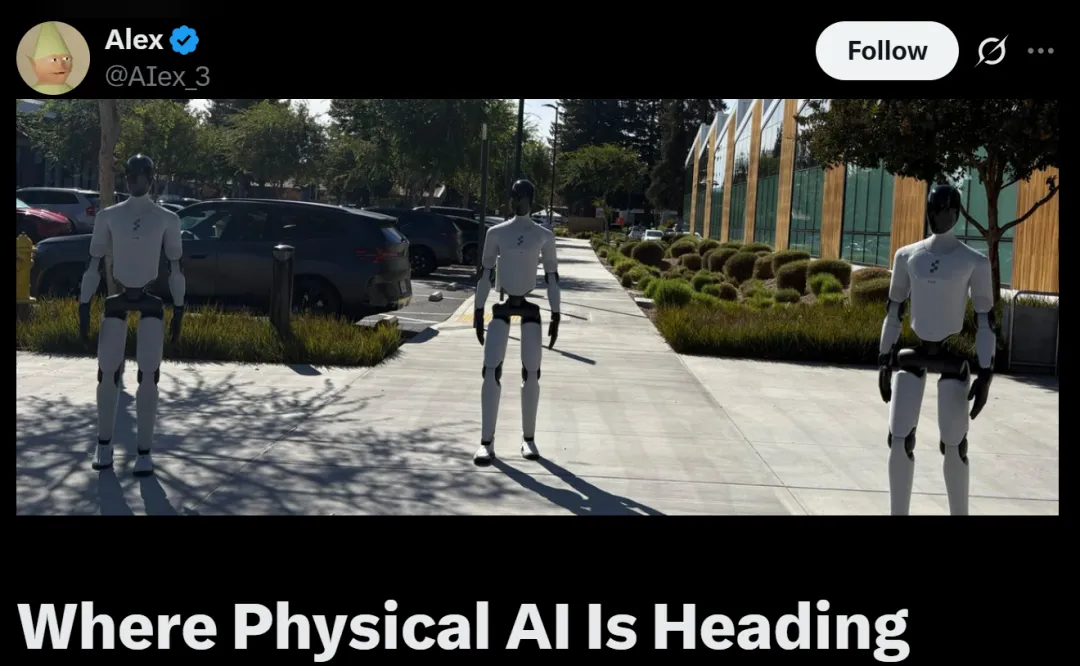
Physical AI startups are competing to build the best robot base models. I think most of them will eventually lose to a handful of super-large cloud companies in this competition.
It's a little bit.
The data:Simulation will replace human demonstration as the primary source of basic robot model training data.
Hardware:Skilled hands will prevail in the short term, while the form evolved in simulation will dominate in the long term.
Adopted by:When the cost of a robot's failure is lower than its human cost savings, robots using a robot-based model will be deployed, which is why the robot is a service model.
Industry:Computation determines the outcome of the model competition, and therefore a handful of US super-massive cloud computing companies will win the competition, coexisting with an open ecosystem composed mainly of Chinese participants.
When a model becomes a standardized commodity, deployment is a shield.
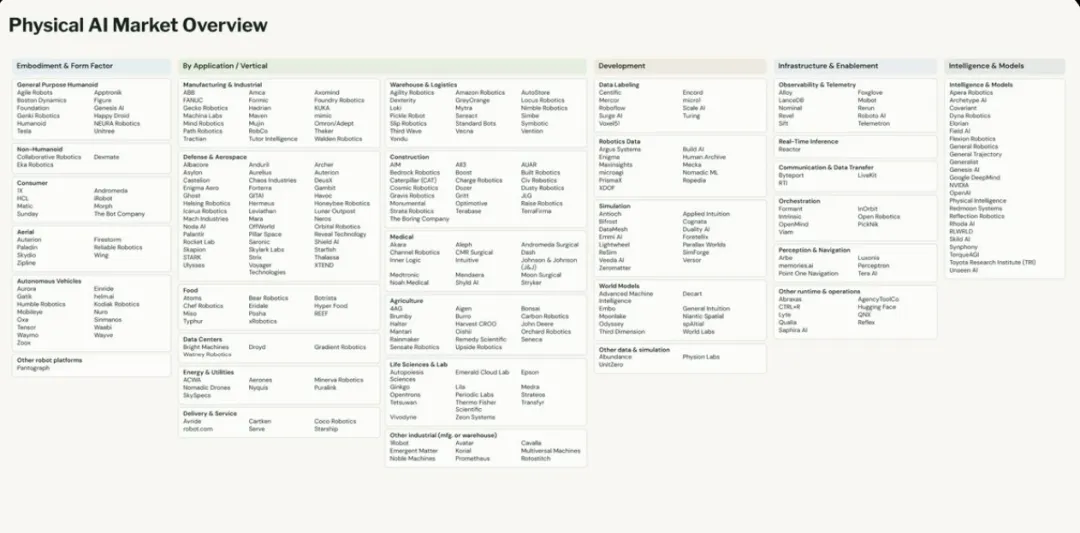
The current state of the physical AI market.
Part 1: Data, training and learning
Physical AI will progress gradually in different fields along the path of development of LLM
Just four years ago, GPT-3.5 only had some of the ability to write simple code, which is virtually nothing compared to today's GPT-6 Astra and Claude Opus 5.5's ability to program, view and reason intelligently. The benchmarks for these models are getting closer and closer with each release and, now covering areas such as legal reasoning, programming, academic knowledge, and mathematics, see Stanford AI Index 2026.
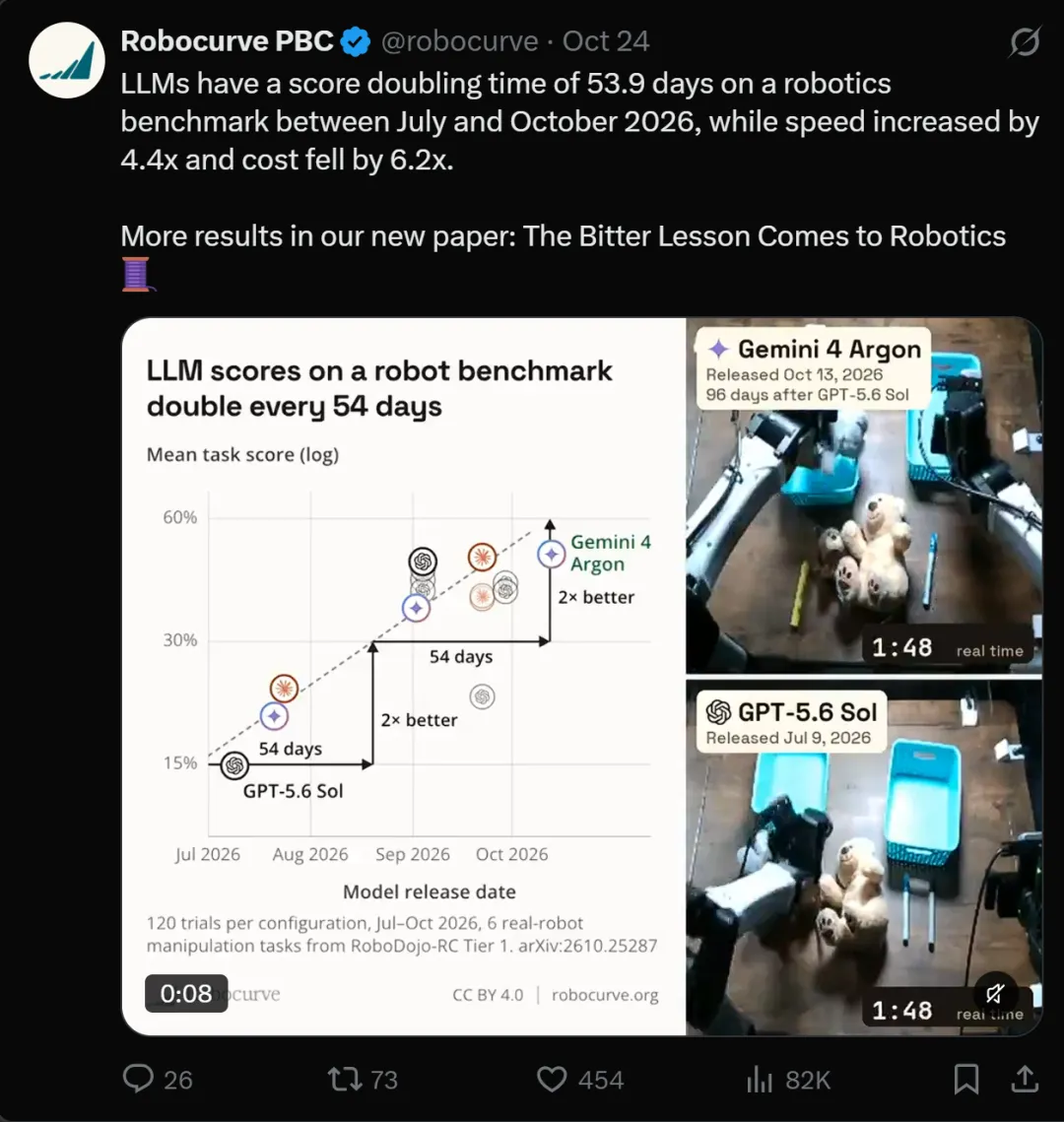
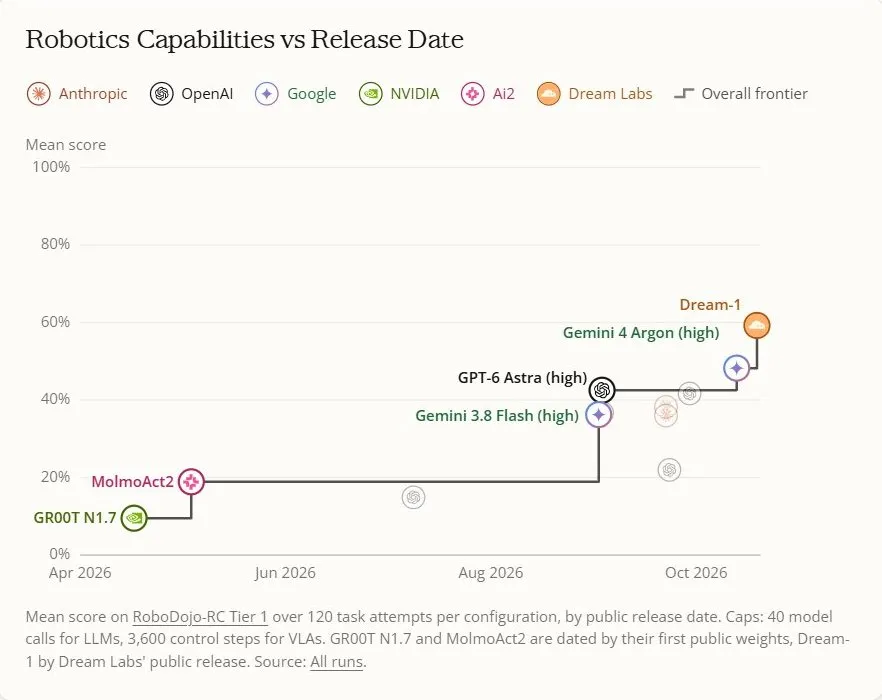
Even with a code-as-policy approach, leading edge LLM robots such as GPT-6 Astra can compete directly with robot-based models. In Robocurve's real-machine test, Astra scored 42.5%, while NVIDIA's GR00T N1.7 scored 9.5%. In RoboDojo's simulator, it scored 22.5%, up from 6.9% of π0.5.
In the future that I envision, hypothetical models such as π2.0, GPT Robo-3.5 and Claude Robo-3.5 will be able to weld custom parts like humans and adapt to a wide range of parametric changes. Progress has been made in different areas: in less than three years, the ability to develop from crawling and placement to the complete production of an intentional cup of enriched coffee, followed by the possibility of zero-sample cable sorting and custom parts sewing. With each type of task attacked, it can also help the model handle tasks that were previously out-of-distributed, just as in the field of robotics, the use of multivariate data training has improved the generalization of new environments and new tasks. However, unlike LLM, there is no Internet-sized data set available for learning in the field of robotics, which is why it is so important to discuss simulation and data synthesis.
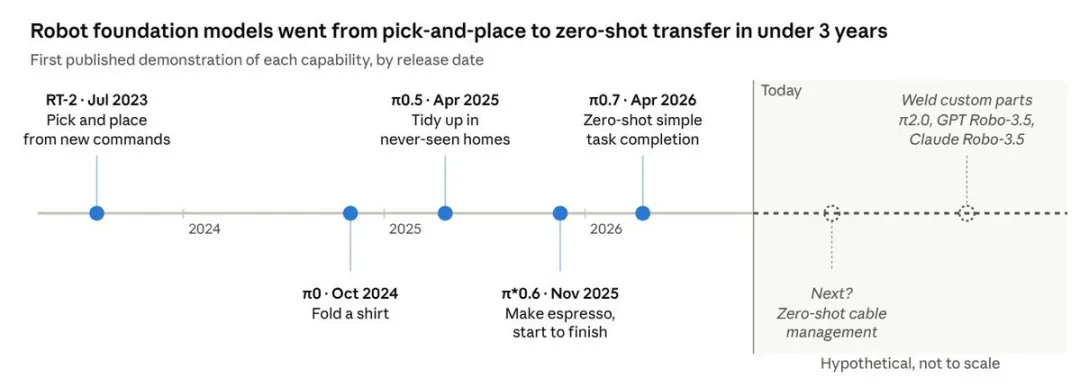
Since the end of 2024, the front-end general robot model will be able to complete a more difficult task about every six months.
Simulation will be the main source of data generation for the foundation model of robots
Using synthetic data training models is not new. In post-LLM training using RL, rewards are usually calculated by a programmatic verifier, such as DeepSeek-R1; tracks or episodes can also be assessed by an independent LLM, such as RLAIF, and these tracks or episodes are also generated by the LLM itself. I believe that as simulators narrow the sim-to-real gap through more accurate physical engines, deformable grids, and higher visual reliability, physical AI will also shift to this paradigm.
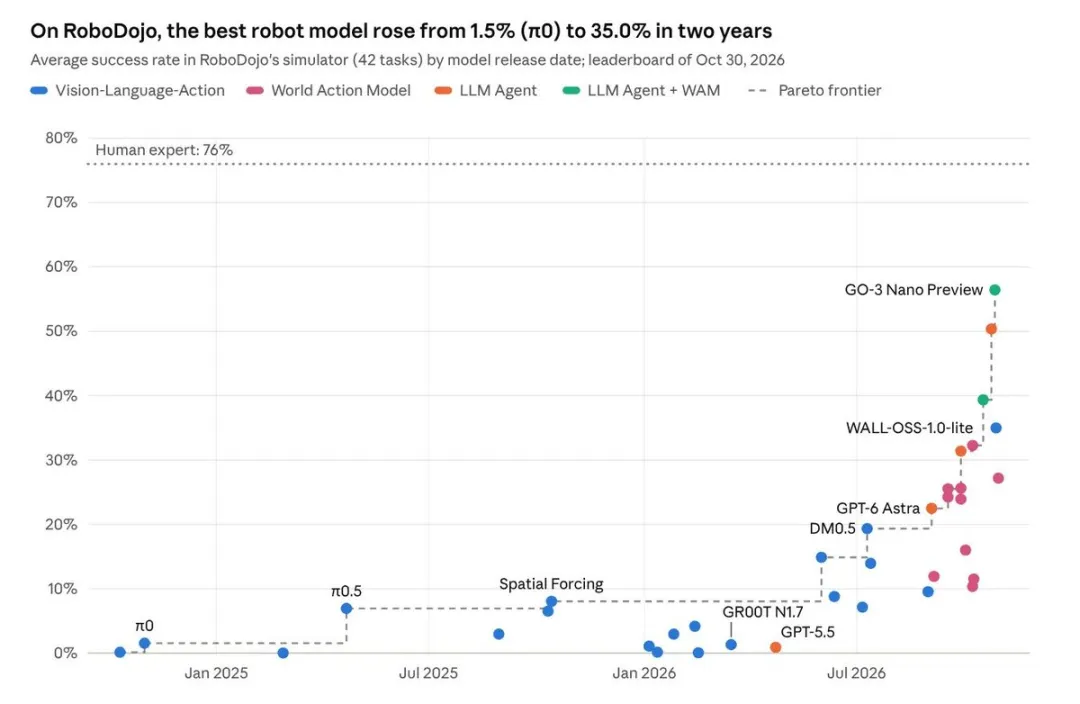
The performance of the front-end model on the RoboDojo Complete Simulation benchmark: the performance of the best end-to-end strategy increased from 1.5% to 35% in two years.
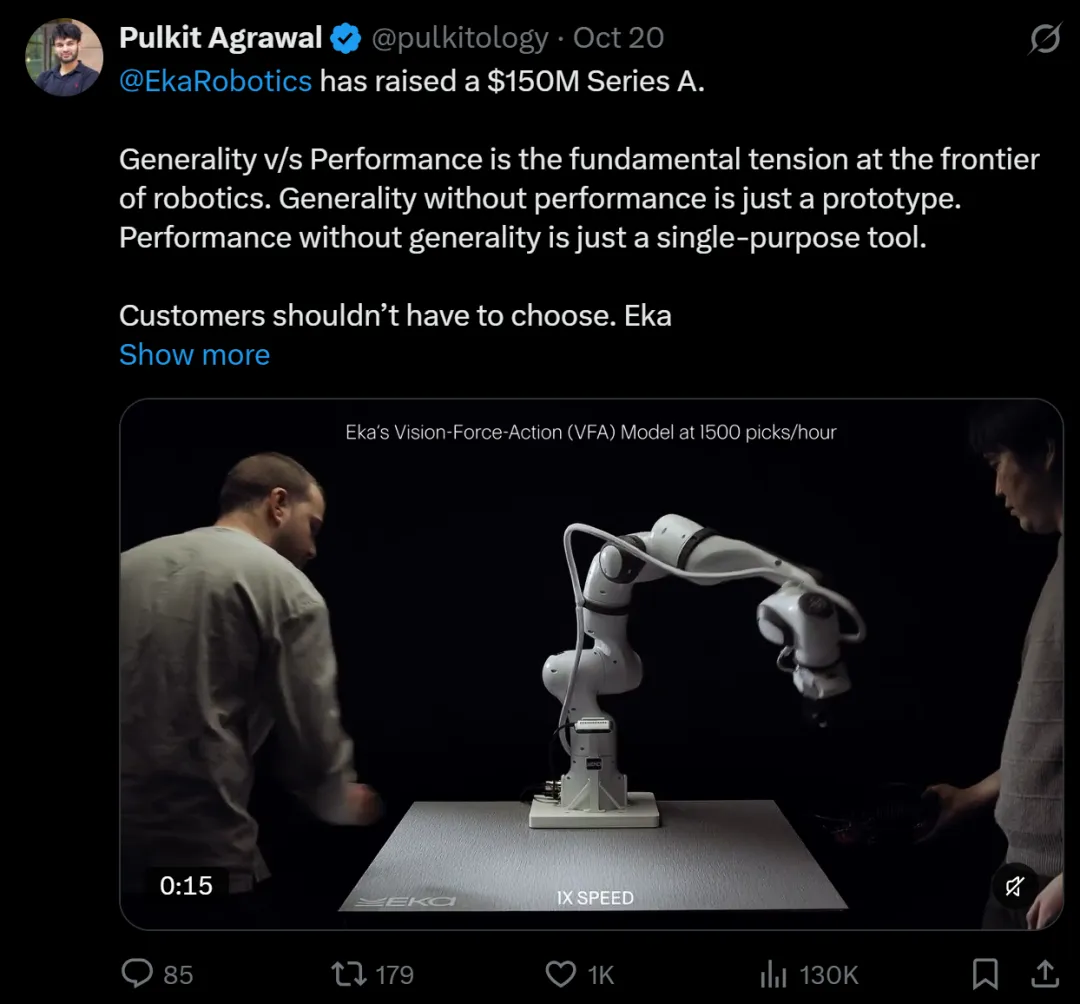
Recently published results have pointed in this direction. Eka Robotics trains its visual torque steering model in physical simulation through RL rather than using human samples, see Eka Robotics. The MolmoBot of Ai2 is trained entirely in simulation and can run zero samples on real robots without any real-world data or tweaks. In terms of crawling and placement benchmarks, the MolmoBot even surpasses the Physical Intelligence π0.5 that uses large-scale real-sample training, see Ai2.
Front-end models are increasingly able to create environments themselves. World Labs' Marble-like world models can convert an image into an explorable 3D world, see World Labs; GPT-6 Astra can convert a single reference image into an editable 3D scene in Blender by writing and altering the Blender Python code. Researchers are already using Astra to reconstruct real indoor scenes from ordinary video to create editable 3D environments, see AHa-3D. This naturally points to a future: automatically creating environments for synthetic data generation and compilation.
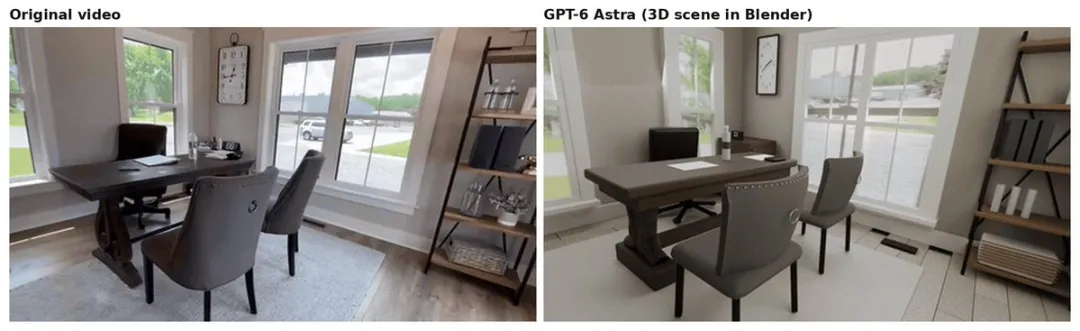
Using the GPT-6 Astra, real scenes in 2D video are reconstructed into 3D scenes in Blender.
This is the first time this has happened.
One of the main bottlenecks of the pipeline is rewards, along with accurate physical assets and physical engines. When the relevant results can be accurately expressed, simulation makes success or failure easier to verify.RLs can learn from these scarce success signals, but in long missions, such signals make exploration and credit allocation difficult. Reliable intermediate feedback to rate task progress along the way can significantly improve learning efficiency. However, front-end labs cannot rely solely on hiring experts to write rewards for each task, so the field is shifting to a model like Flora.

This system, recently released by NVIDIA, is capable of automatically rewarding progress and results for intensive human and robotic video tagging. The question remains whether these rewards are accurate enough because RLs are very good at using flawed rewards and strategies that can get high scores without completing tasks.
Part Two: Physical shapes and hardware design
Intelligent Hands will be the main end-user platform for operating tasks
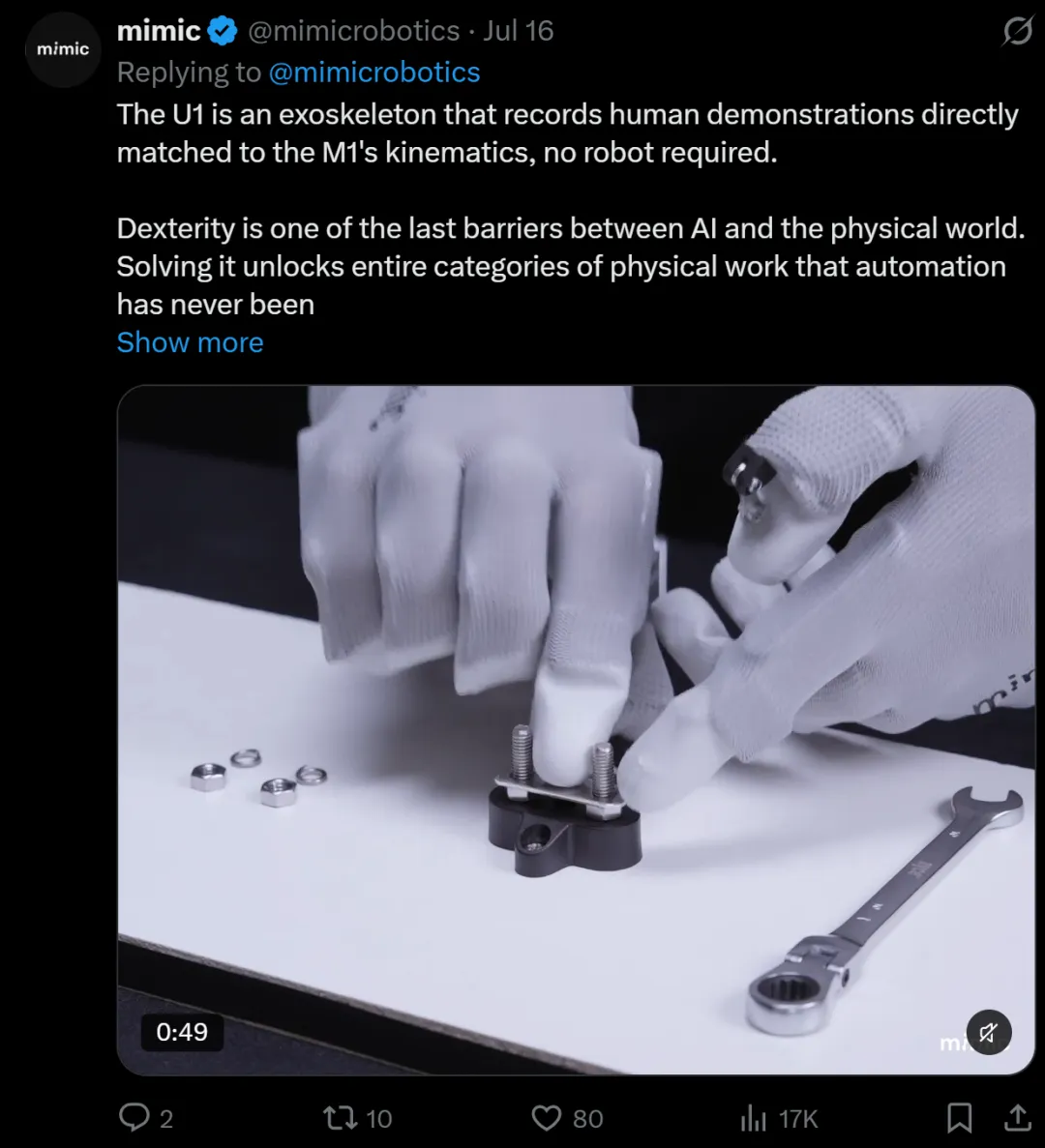
One obvious reason for supporting agility is that the world's interactive interfaces are designed for human hands, so it makes sense to make agility the end-user platform for operating tasks. A less obvious reason is that most of the most advanced robot base models currently use real-world data for pre-training, usually human first-person view data, or data collected directly by remote robots. Startups such as Intelligence Factory@HumanArchiveai@HumanArchiveai@mimicrobotics and Preload are already using manual data optimization that includes touch sensors.
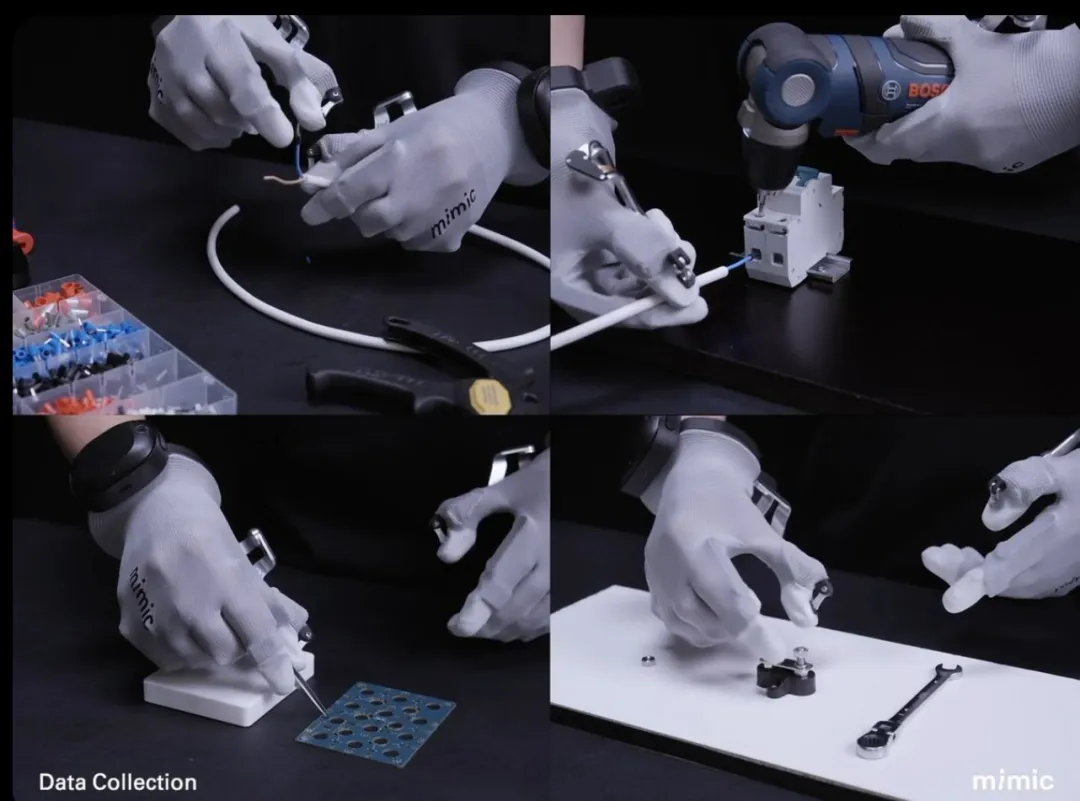
Mimic's wearable U1 data collection gloves have finger-touch sensing capabilities.
Current research suggests that data collected from human hands can be re-directed to robotic hands by gesture estimates at the kinesiological level. In real first-person video, only hand tracking itself is about 25×31 mm in error, see EgoExo4D challenge; re-direction to another end-user also introduces an additional 1×14 mm error at the fingertips, see T-800 and Teleopit. In high-contact, high-precision operations, these mm-level errors are very important.
Thus, much work remains to be done: how to get the right hand to handle the required number of cycles, as well as research and conversion. For example, the Wuji Hand is a 20-degree driver with a production standard of 300,000 crawling cycles, see Humanoids Daily. According to the selection rate calculation of about 9,600 crawling cycles per day by humans, a Wuji Hand will be damaged for about a month. Other designs are also in development, such as the biomechanical-inspired hand design.
Mass production will significantly reduce the cost of General Humanoid and mobile operating robots
The price of the general-purpose platform is much lower than it was a few years ago. The Dexmate's wheeled Humanoid Vega 1 Pro is priced at $75,000, and the fixed-arm Vega 1 U is priced at $42,000, both of which do not include the end-user. Unitree's H2 Humanoid, the base model without a functional arm, is priced at $29,900, while the H2 Plus is priced at $100,000.
Continued mutation with growing demand will further reduce the cost of mass production. Bank of America estimates that the listing cost of Humanoid materials manufactured in China in 2025 is $35,000, and is expected to fall below $17,000 by 2030, see Bank of America Institute. In addition, Humanoid may eventually participate in its own manufacturing, further amplifying these gains. In this case, raw materials and resources will obviously become bottlenecks.
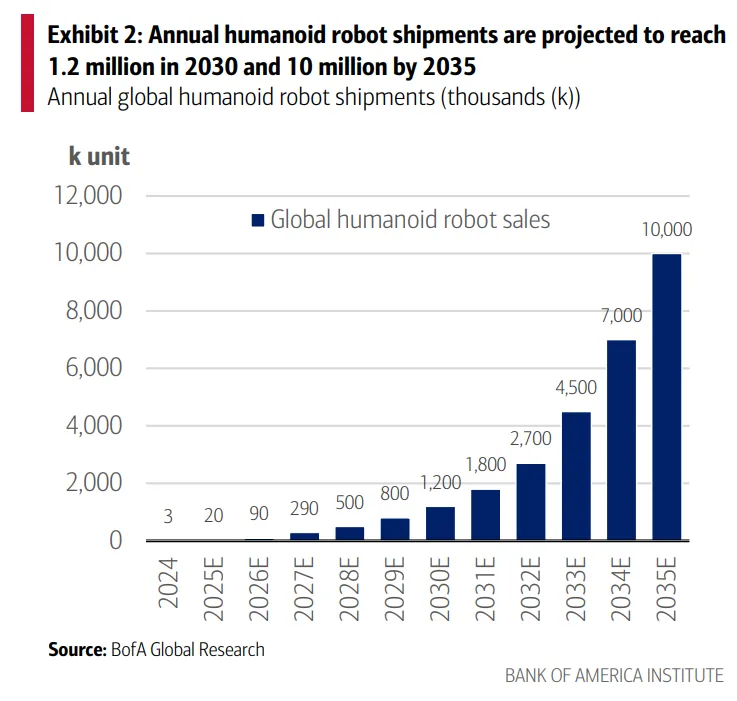
Humanoid predicts annual shipments by 2035.
Hardware and robotic models will be designed in conjunction with evolutionary methods to find economical and efficient body shapes
If simulation becomes the dominant force in the future, then we can expect that evaluation, testing and development will take place in simulation to a greater extent than it does today. Currently, the deployment of robotic base models tends not to use simulation entirely, but to directly collect real-world data and model modeling and deployment based on that data. However, in an accurate simulation world, the only significant cost would be computation. Considering that we are already building an LLM infrastructure that is extremely demanding for computation, see Bloomberg, we will use these facilities.
From a simulation perspective, I imagine that in the future we will use evolutionary methods to design robotic shapes to find the most cost-effective, fastest, and fastest shape-forms to complete specific tasks. In fact, current research has demonstrated the synergy of shape-forms in simulation, see Strgar & Kriegman, ICLR 2026, but it has not yet been combined with the foundation model of robots.
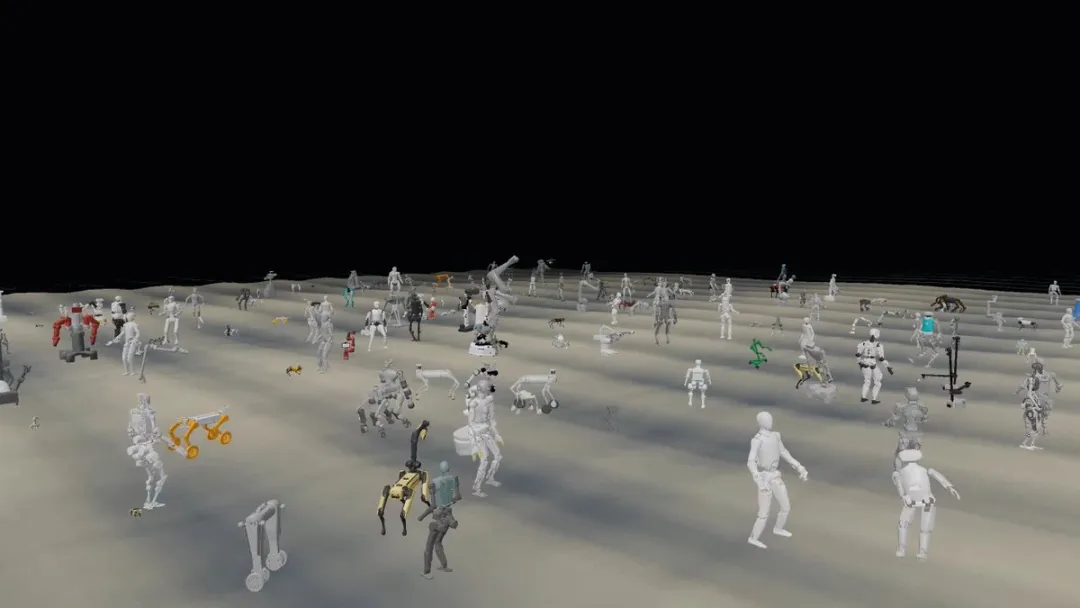
Multiple body shapes run on the same end-to-end motion model in simulation. Source:
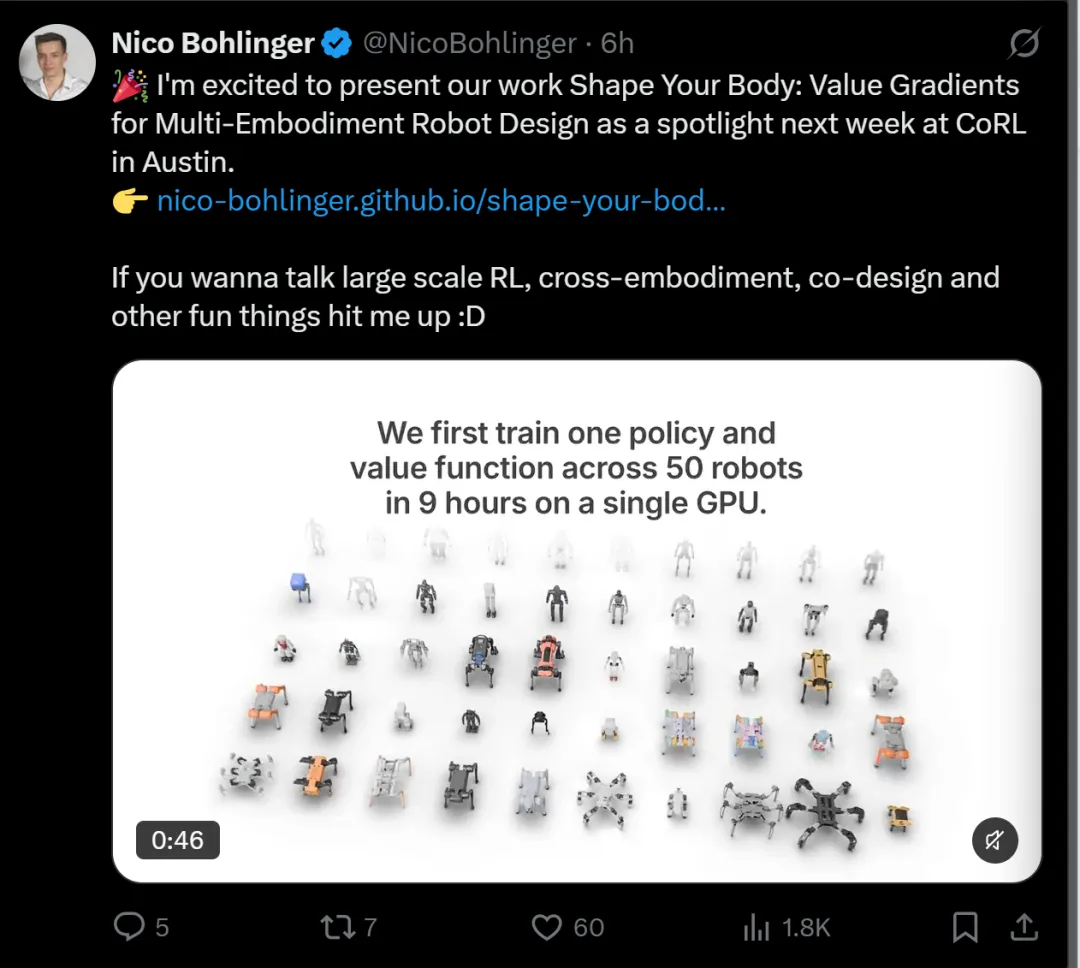
The simulation will allow us to combine these candidate body shapes with basic robot models and allow them to evolve, by variation and mutation, to find the body that is best suited to both the task and the model at the same time. This concept relies on a robust, versatile robot foundation model, although earlier versions already exist: Skild AI's full-scale Skild Brain, designed to control any robot without prior knowledge of the robot body, see Skild AI@NicoBohlinger's γ0 uses several million body shapes derived from 200 robot models, training a unified movement strategy, covering foot, wheel and flight robots, and has been deployed on dozens of real robots, see γ0.
As a result, the ultimate activity on the planet is machines, whose appearance may be completely different from that of today's Humanoids and mobile operating robots. I expect evolution will not produce an exclusive body for each task, but will narrow it down to a family of physical forms: a shared basic form at the core, providing modular variables for different tasks. Thus, the evolved design can still be mass-produced and benefit from the same economies of scale, which are making today's Humanoids cheaper.
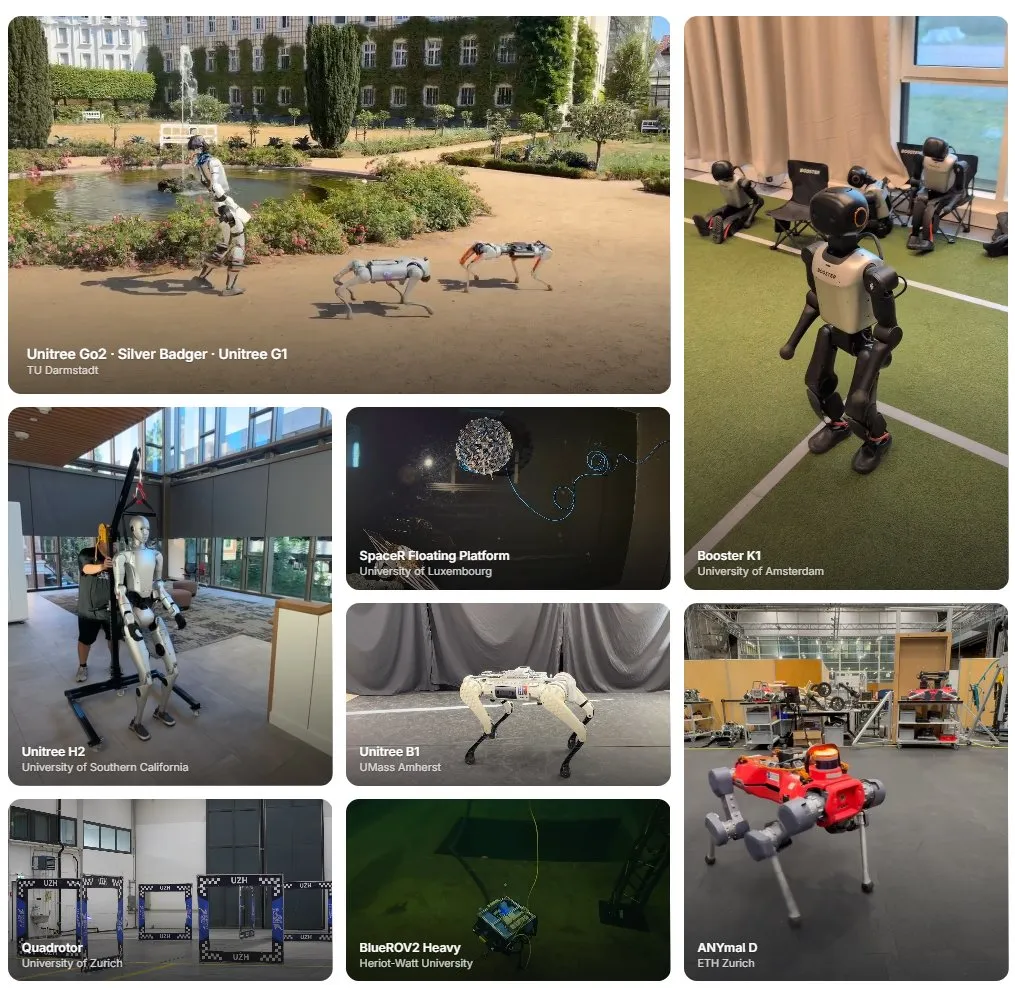
The γ0 model deploys real machines in different shapes. Source:
As mentioned above, real-world data and human first-person data dominate today, and therefore the least amount of information loss from human learning is advantageous. As simulation narrows the sim-to-real gap and becomes the main data source, this advantage will be weakened as robots trained primarily in simulation no longer need to be similar to humans in demonstration tasks.
Part 3: Economic and industrial structure
When investments are made, existing machines and interfaces are replaced.
Assuming we have a strong enough physical AI model and a universal hardware body shape, we will eventually be able to replace human labor in tasks that have never been automated by the classic robotic method. Until automation reaches a certain reliability, enterprises will not replace human workers; enterprises will weigh reliability against workers' hourly wages, and the actual operating costs of robots, which include the robot's body, computation and model costs.
Under the current paradigm, no one can guarantee near-perfect reliability, so robots will make mistakes, and investing fully in such a solution initially is a risk that most companies are unwilling to take. This is the reason for the rise of robots-as-a-service (RaaS) model: companies such as @Robco_Robotics and InLoop Robotics deploy these models in multiple tasks, and enterprise owners pay a sustained fee. This can be a fixed monthly subscription fee, packages containing hardware, AI updates and remote assistance, and can be charged for tasks that need to be completed.
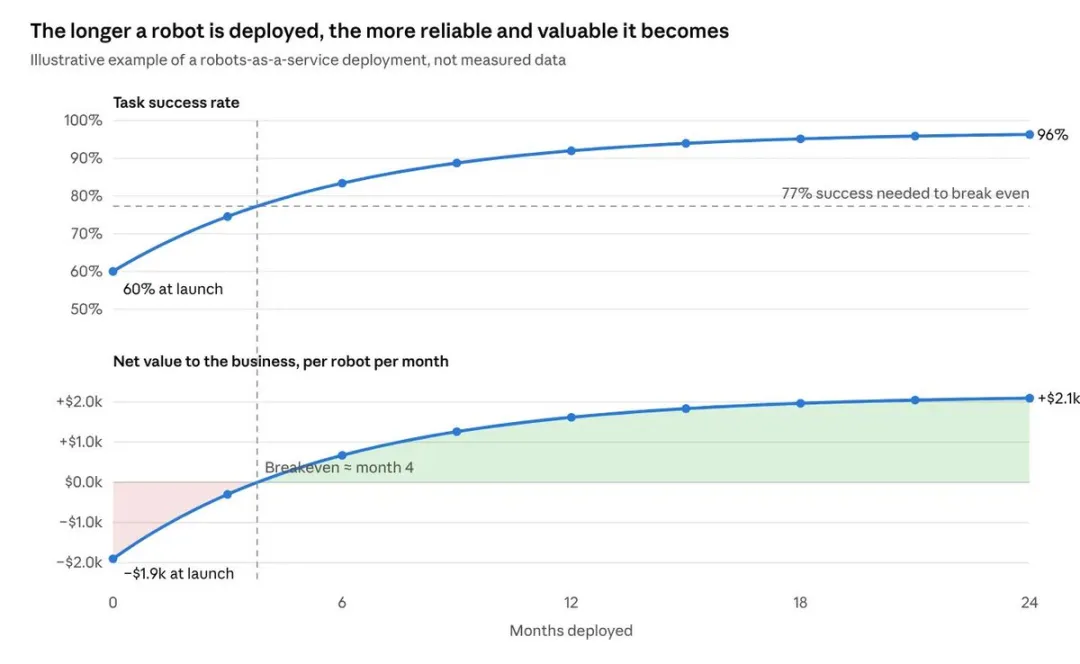
Examples of the relationship between mission success rates and their economic value.
Therefore, the replacement of the labor force will be gradual. Robots will make mistakes, and original workers are more likely to become remote operators, correct the trajectory of failure, and teach robots how to perform tasks correctly. In line with the Jevons paradox, cheaper automation is likely to expand the overall scale of work, creating new monitoring and remote operating positions. For tasks that fail at high costs, this process is more difficult, but simulation can help by establishing models of these environments before the deployment of robots. Therefore, large quantities of physical labor positions can be optimally shaped to be obtained by mobile robots, humanoids, or future developments.
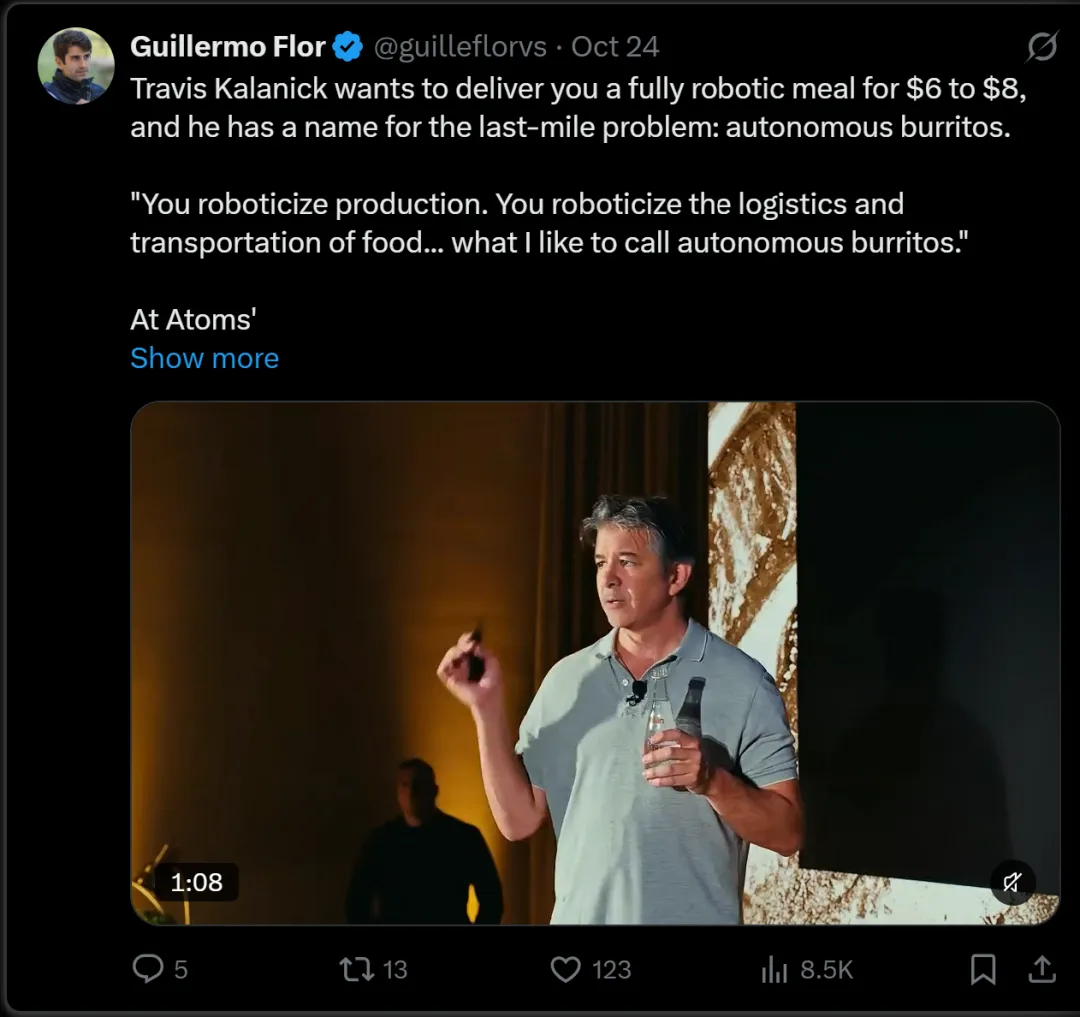
However, this does not mean that existing automation will disappear. Many factories and manufacturing processes have been highly automated through integrated dedicated systems. Because these systems are designed around a single process from end to end, they are far more cost-effective and productive than general robots. These systems will further increase the degree of automation that is not covered by general-purpose automation systems until the entire production cycle is automated and not replaced. Atoms by Travis Kalanick for high-throughput work in the fields of food, mining and transportation build specialized robots, diversify, and leave low-volume tasks to Humanoid, see Atoms.
A handful of super-large cloud companies will dominate and build standards around their understanding of the world
As simulation becomes the main source of basic robot model training data, the companies with the most computing power will climb to the top of physical AI. Supermassive cloud computing companies will release their own robot models, including models with intelligent body capabilities, compete with companies such as Physical Intelligence, Generalist AI and Rhoda AI, and win the competition. Scaling Laws for LLM seem to apply to robots as well.
Scaling data diversity in VLA pre-training.
More pre-training data and computing will improve downstream performance in predictable ways. As the number of different environments in the training data increases, generalization capabilities steadily improve; as the pre-training scale expands, new capabilities emerge, such as learning from human video, see GEN-0, and the human-to-robot transfer of Physical Intelligence.
Not surprisingly, Quan Vuong explains, Physical Intelligence is positioning itself as the future provider of computing. This is also the reason why it opens up its model through APIs: to upload data to partners, to minimize and reason on the infrastructure of Physical Intelligence, and to see the API beta of Physical Intelligence. In a world like this, robotics labs don't need to outspend large-scale cloud computing companies.
The API workflow architecture proposed by Physical Intelligence. Recently, Generalist AI and DreamLabs have released a similar API workflow.
This oligarchic format of supermassive cloud computing companies will also determine where standardization occurs in infrastructure, tools, protocols, and platforms. Anthropic introduced the Model Context Protocol (MCP) as an open standard for connecting AI intelligent agents with tools and data; OpenAI's API format is widely used so that competitors also provide interoperable endpoints.
Geopolitical constraints will give rise to multiple competing underlying models, as has already happened in the field of LLM.
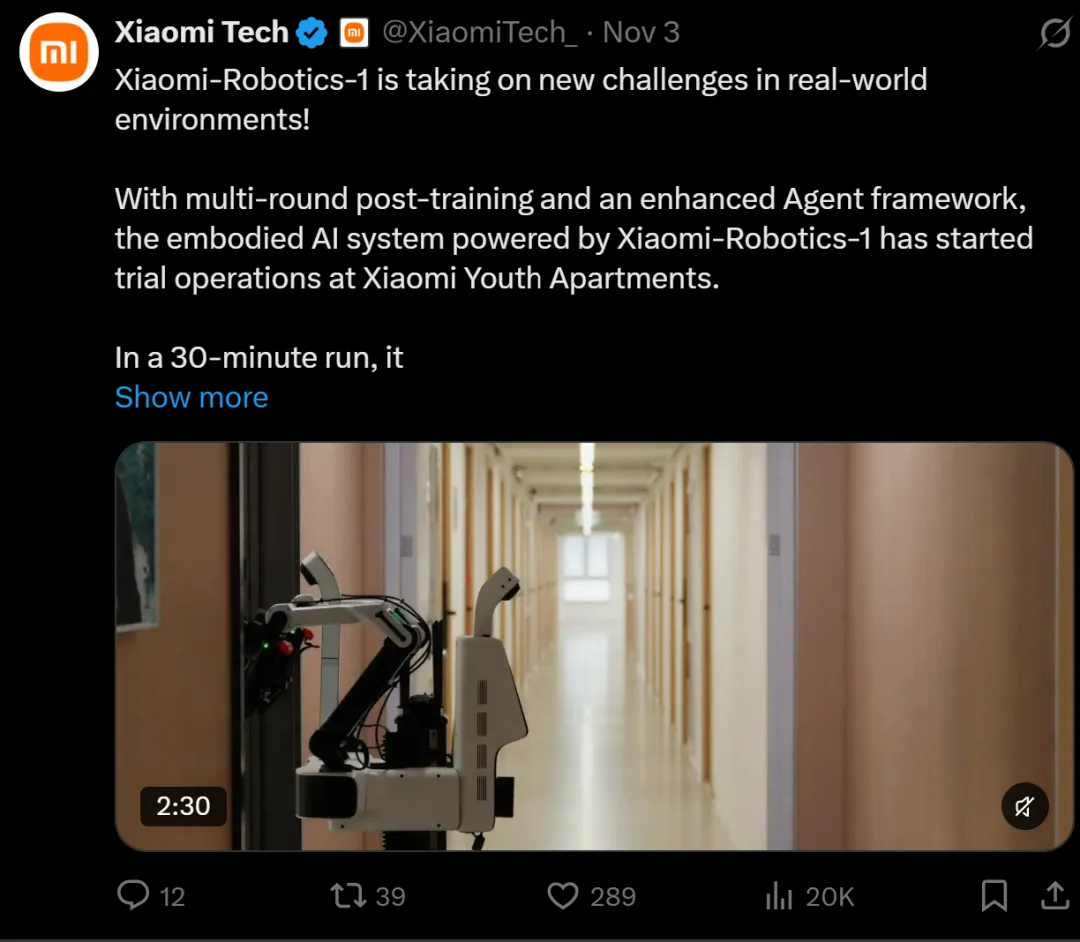
Stanford's AI Index 2026 shows that the gap between the strongest U.S. model and the strongest Chinese model is only 2.7%, although the U.S. investment in AI is much higher. It is designed to ease China's export controls and instead push China's laboratories to shift to efficiency optimization and open power. Interestingly, physical AI is already developing along the same path. Robbyant of the Ant Group has opened up LingBot-VLA, a model that uses real-world data training from nine robotic platforms, see LingBot-VLA; Xiaomi has also released its own open power VLA model, both of which outperform Physical Intelligence π0.5.
The deployment is to protect the city.
When intelligence is concentrated in the hands of a few ultra-large cloud computing companies, when models are commercialized, the value is shifted to what these companies are not very good at. The exponential acceleration of human progress will not come from intelligent AI alone; I think it will come from the synchronization of physical capabilities with intelligent capabilities. To make this happen, we have to do the most challenging, the most proactively driven work: really deploy physical AI.
There's no doubt that promoting physical AI ecological standardization through platforms, infrastructure, or tools has value, but awareness of this value is formed during deployment. @huggingface was originally a virtual companion chatbot, and it was later discovered that the platform infrastructure for sharing open weight models was the real value.
The deployment of physical AI will create both economic value and security. A company may still need to rebuild everything from scratch for each new customer, even if it completes difficult and valuable integration work. Therefore, we must accumulate replicable integration schemes, reduce the cost of one installation deployment, and ensure that each deployment generation improves operations.