GPT-6 Astra:3D, with physical intelligence and other features
Is a language model a must-have for general-purpose intelligence? is it a shortcut, or is it a diversion?
The language model discussed in this article is not limited to text processing models, but also includes the broader paradigm of the current multilingual language model. The main topic discussed below is general-purpose intelligence, i.e. the ability to perform multiple tasks and to generalize across environments.
The question can be divided into two levels: scientifically, how does intelligence come about?intelligenceIn engineering, how do we build systems with these capabilities?artificial)。
At the scientific level, I believe that intelligence arises from a cyclical interaction of perception with the environment: intelligent agents behave through perception and action, adjust behavior based on feedback, accumulate experience. This is already a sufficiently intrinsic expression of intelligence. This process does not depend on language. For example, many animals in nature do not have language ability and are still excellent physically intelligent agents.
However, it should not be overlooked that in current AI practice, it is usually necessary to have a foundation model that has been pre-trained on a large scale to achieve a certain level of universality. Internet data is sufficiently high in intelligence density and volume, while self-monitoring methods such as next-token prediction provide a simple and scalable learning pathway. Therefore, pre-training in Internet data is currently an efficient path to achieving certain universality in engineering.
Pre-training provides knowledge and common sense, and models further develop reasoning and decision-making skills through interaction. Combined, the two form an important paradigm in the current development of AI. GPT-6 Astra's performance also provides an example of an observation of this paradigm.[1] From the current limited public information, reinforced post-training in programming and computer operations may be an important source of its capabilities.[2] The next step in this paradigm is becoming increasingly clear: as more real-world interactive data is incorporated into training, it will move further into the physical world.
However, is this language-based pre-training and post-training paradigm merely an engineering choice? Why do physically intelligent agents in nature not need language pre-training?
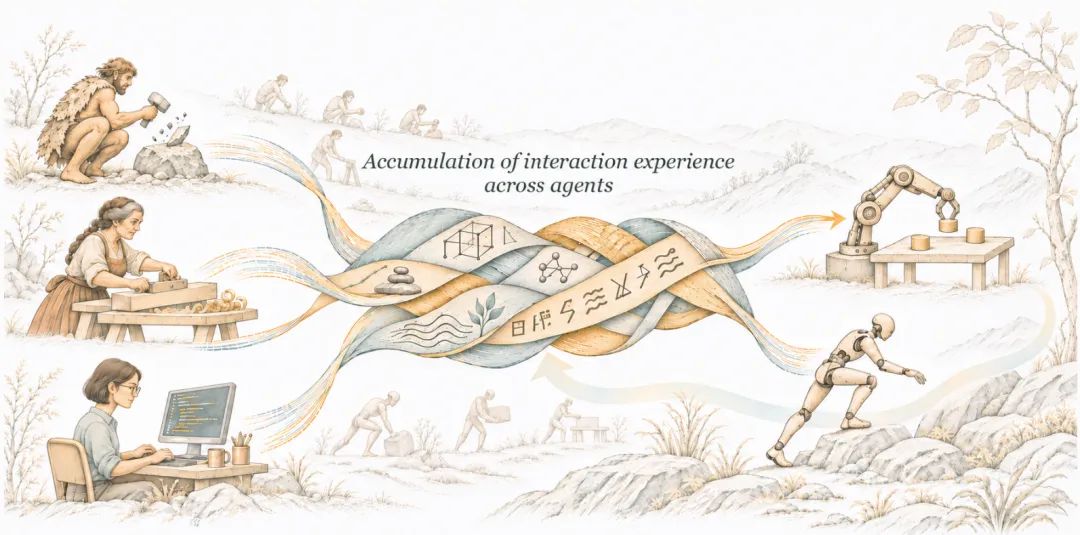
Essentially, each interaction has a cost - time and energy - and the individual experiences of an intelligent body are limited in quantity and variety. If one can only learn from one's own experience, each individual will have to repeat the exploration that other individuals have already done. Therefore, it is especially important to develop sufficient universality in a limited interaction budget to accumulate and replicate across individuals.[3] In this sense, there are at least two important ways:
The evolutionTransgenerational accumulation of characteristics that are conducive to adaptation to the environment allows generations to acquire certain skills without having to learn from scratch or learn certain behaviours more easily.[4]
CultureIt allows individuals to pass on the knowledge and skills they have learned to others through examples, language, writing, and so on, so that they can continue to learn the results they have already achieved [5].
In this sense, the bio-intelligence behind nature is the result of innumerable individuals' interactions with the environment accumulated through evolutionary generations. Humans have also developed language, writing, and the Internet, which has further improved the efficiency of transmitting and preserving experiences.[6]
So, is a language model the only way to be physically intelligent?
Language may not necessarily be a necessary form of computation for physical intelligence, but it enables intelligent agents to exploit experiences far beyond their own ability to experience.In this sense, language pre-training may not be just an engineering option.
When large amounts of resources continue to be invested in this route, it is likely to take the lead, leaving a narrow window of exploration space and time for other routes.Even if the language model is not a theoretical necessity, it can be an unavoidable option in practice.
On the basis of language-trained intelligence, I still believe that real general-purpose intelligence requires online, physical interaction - whether in virtual simulation sandboxes or in the real world. In the process, real-world interaction costs limit the efficiency of individual accumulation experiences and make interpersonal accumulation of intelligence especially important.
On this path, there are more and more questions:
How does touch, sensation, and continuous action access language models and how does decision-making in basic models synchronize with high-frequency underlying controls?
Is it possible to specifically extract from language models the ability to be physically relevant, such as spatial perception and decision-making, to reduce the size of the model and reduce the cost of interaction while maintaining universality as much as possible?
How can we measure the benefits of interaction to a person's intellectual capacity? Can self-interaction be compared to the contributions of interpersonal accumulation to intelligence? What experiences must be acquired personally and which can be inherited from other individuals?
Is the accumulation of interpersonal experiences replicated by human linguistic and cultural mechanisms to develop a language that is derived from AI, or by some evolutionary mechanism?
In the digital world, AI has made discoveries that can be exploited and further developed by humans [7]. Can robots expand our knowledge and capabilities by interacting with the physical world? Human knowledge is the starting point for robots, but not necessarily the boundary of what they can discover.
Language models have already been able to symbolically express feelings, emotions, and other information through language. How will we cope with the possible ethical shocks if we have the ability to ground these expressions into our own physical experiences?
In my opinion, the answers to these questions will be the challenges, opportunities and responsibilities of our generation of researchers.

It's not easy.Last weekend, I was happy to participate in the three-day Mini 3DV workshop in Beijing's Autumn and Lake Lighthouse Studios. One of the hottest topics discussed at the conference was the development of the large language models and the path of physical intelligence, including the Native Chinese language and the Chinese heritage language.
References
OpenAI. (2026). GPT-6 Astra: A new generation of intelligence.
Zhu, W. (2026). GPT-6 Astra: 3D, Embodied AI, and Beyond.
Cook, J., Lu, C., Hughes, E., Leibo, J. Z., & Foerster, J. (2024). Artificial Generational Intelligence: Cultural Accumulation in Reinforcement Learning. Advances in Neural Information Processing Systems, 37.
Zador, A. M. (2019). A critique of pure learning and what artificial neural networks can learn from animal brains. Nature Communications, 10, 3770.
Boyd, R., Richerson, P. J., & Henrich, J. (2011). The cultural niche: Why social learning is essential for human adaptation. PNAS, 108 (Supplement 2), 10918–10925.
Tomasello, M. (1999). The Cultural Origins of Human Cognition. Harvard University Press.
Novikov, A., et al. (2025). AlphaEvolve: A coding agent for scientific and algorithmic discovery. Google DeepMind technical report, arXiv:2506.13131.