


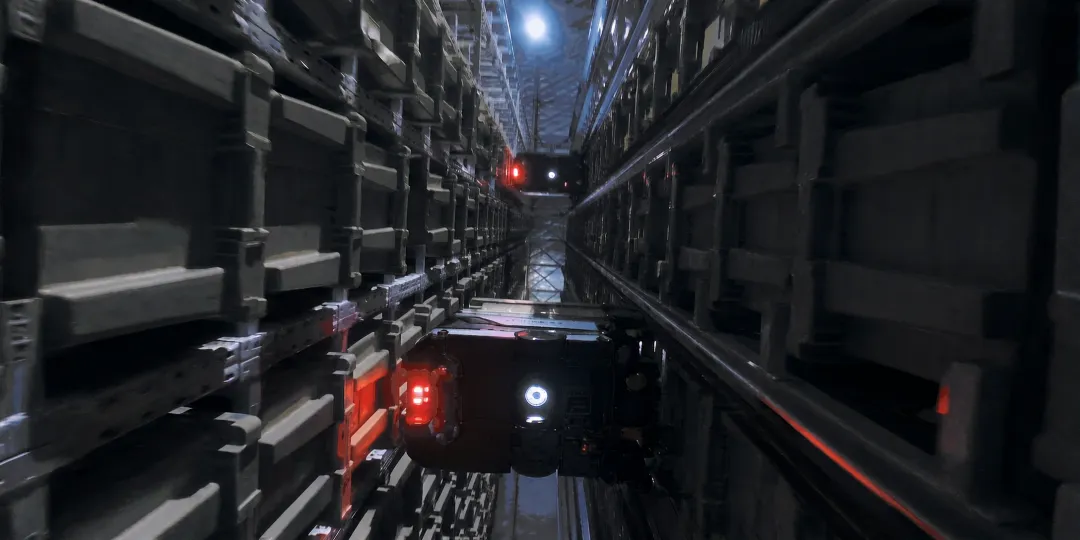
The same move upward, but three different approaches from Geek+, HAI Robotics and Exotec.
Floor space has long been scarce in warehouses, and logistics-robot vendors have competed to improve automated workflows and efficiency. At CeMAT ASIA 2026, one notable shift was that more robots were no longer content to travel along the floor: they were climbing warehouse racks.
Climbing robots are not new. What brought them into focus at this year’s show, in our view, is a change in the center of competition in warehouse automation. Micro-fulfillment is growing, while the cost of warehouse space in city centers is making flat, floor-based storage less economical. E-commerce, retail, cross-border fulfillment and returns all demand more from warehouses. Companies want to store more goods in less space while handling more frequent and complex orders.
The shift was visible at CeMAT ASIA 2026: Geek+, HAI Robotics and Cainiao all brought climbing robots to their booths, making them a highlight of the show. For an overseas comparison, France-based Exotec’s Skypod is an established system in this category and a useful reference point for assessing Chinese suppliers’ innovations.
The four companies appear to be doing similar things, but their systems follow different technical paths. The following comparison looks at key specifications and what they may mean for the technology’s development and applications.
01.
Geek+ RS Hyper: bringing high concurrency to the rack
In conventional climbing systems, when a robot retrieves a tote, four to six neighboring rack columns may become inaccessible to other robots. The denser the racks, the more this hidden lockout can reduce fleet throughput. Climbing robots have therefore faced a familiar criticism: one unit can be fast, but a fleet can get stuck.
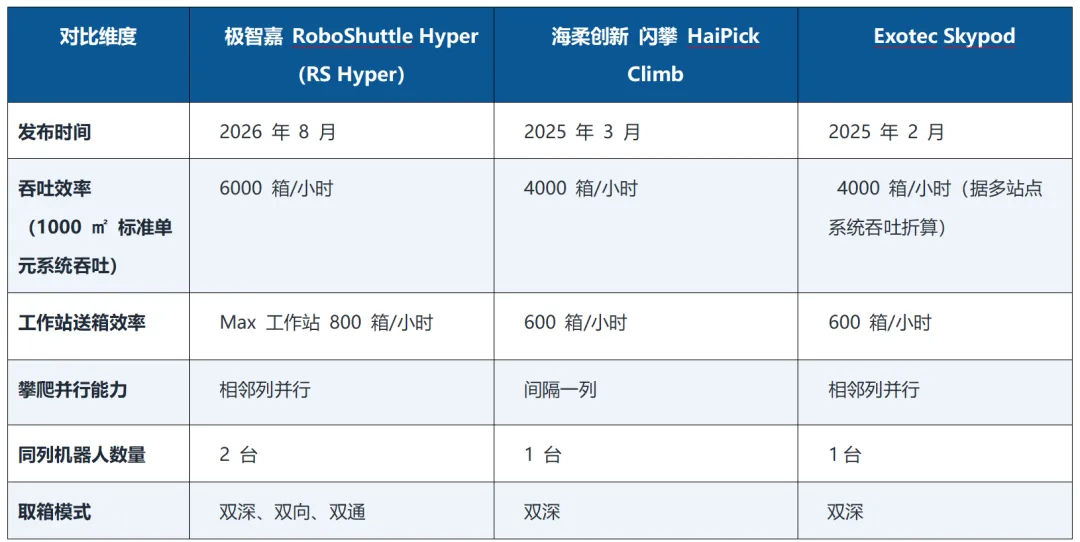
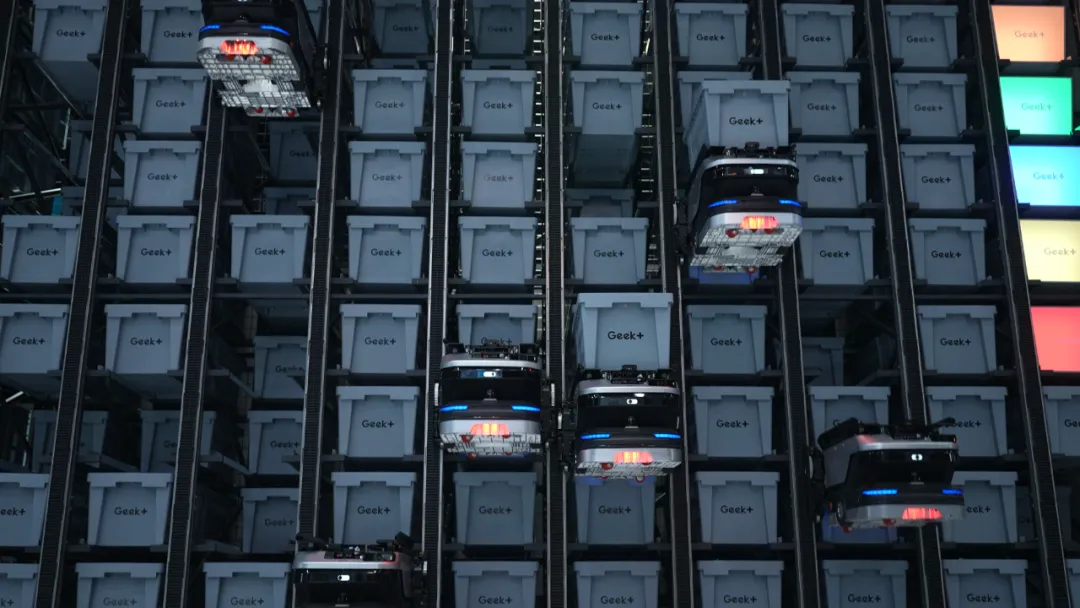
Geek+ presented RoboShuttle Hyper, making its global debut after its launch in August. The system is designed to address a common trade-off between very high throughput and dense storage. It supports parallel operation in adjacent aisles, two robots in one aisle, bidirectional routes, and double-deep, two-way tote retrieval. Combined with high single-robot speeds, the company says the system can handle 6,000 totes per hour per 1,000 square meters, with its Max workstation processing up to 800 totes per hour.
At the booth, six RS Hyper climbing robots moved along the racks and retrieved totes at the same time. Geek+ said it was the only climbing-robot demonstration at the show to feature parallel operation in adjacent aisles, illustrating the system’s approach to high-concurrency handling.
This puts the emphasis on throughput per unit of floor area, rather than rack height or single-robot speed alone. The demonstration rests on an integrated engineering design: climbing speed affects vertical retrieval time, travel speed affects horizontal transport, and parallel operation, multiple robots per aisle and bidirectional routes determine whether equipment can work simultaneously. Raising single-robot speed alone can simply move the bottleneck to aisles, intersections or workstations. Robot motion, rack design, routing and fleet scheduling have to be designed together for single-unit performance to translate into system throughput.
Geek+ says RS Hyper completed a 180-day, 24-hour continuous operational test. The company also said it secured orders for more than 1,000 units within a week of launch. Its performance at larger deployment scale remains to be seen.
02.
HAI Robotics FlashClimb: high density with broad tote compatibility
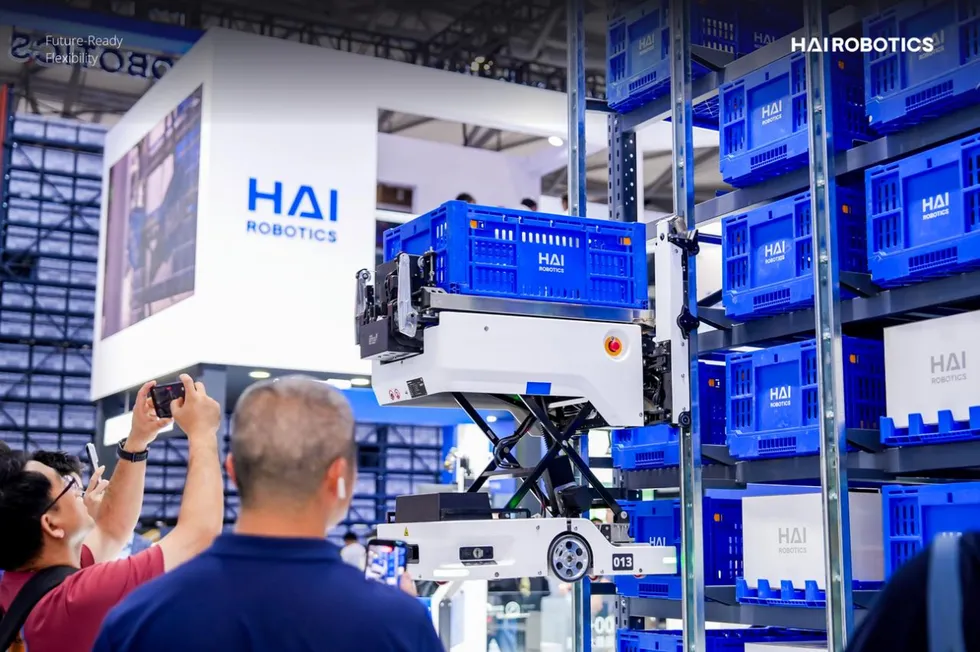
HAI Robotics demonstrated the operating logic of its double-deep FlashClimb system. Launched in March 2025, the system was shown with a model layout that stores about 45,000 totes in a 1,000-square-meter area. The booth paired it with piece-picking and automated tray-loading and unloading workstations to show how one system can handle storage, piece picking and full-tote inbound and outbound operations. The company lists throughput of up to 4,000 totes per hour and workstation rates of 600 picks per hour.
HAI Robotics says FlashClimb can work with multiple storage containers, including foldable bins, rigid bins, angled bins, pallets, cartons and full cases. The company positions the system for the varied loads found in apparel, e-commerce, retail and cross-border warehouses.
HAI Robotics says it has signed contracts for more than 20,000 FlashClimb units worldwide since the system’s March 2025 launch, for use in apparel, e-commerce, retail and overseas cross-border warehouses. That would put the system beyond the prototype-validation stage less than two years after launch.
03.
Exotec Skypod: a repeatable multi-site model instead of a single-warehouse peak
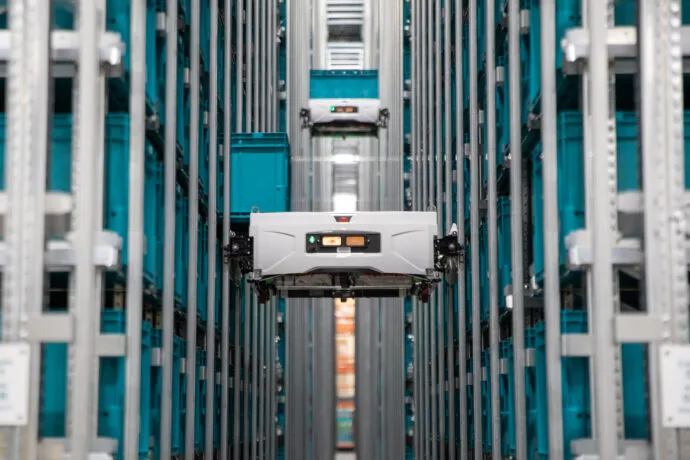
Exotec’s Skypod is designed around practical, repeatable specifications rather than a peak figure from one warehouse. Its robots climb to a maximum height of 14 meters, travel horizontally at up to 4 m/s and lift vertically at up to 1.5 m/s. Each robot carries up to 30 kilograms, and a workstation can process up to 600 totes per hour.
The latest generation increases the capacity of a single workstation by 50% and storage density by up to 30%. Exotec says it achieves this by making the robots smaller and narrowing the rack spacing, rather than simply building higher racks or increasing speed. The system’s repeatability comes from the combination of modular hardware, a shared software codebase and end-to-end integration.
As of February 2026, about 14,000 Skypod robots had been sold, according to the company, serving customers including Gap, Uniqlo and Carrefour.
04.
After climbing, the real contest is three-dimensional throughput
The CeMAT ASIA 2026 booths showed warehouse automation moving from flat-floor travel toward three-dimensional operations, but each vendor has a different approach. Geek+ emphasizes concurrency, using parallel operation in adjacent aisles, two robots in one aisle, double-deep two-way retrieval and bidirectional routing to raise throughput per unit of area. HAI Robotics emphasizes double-deep storage and compatibility with multiple containers, aiming to handle a wider range of goods in dense warehouses.
The systems address the same industry problem: as warehouse space becomes more expensive, simply adding racks and robots does not necessarily improve real-world efficiency. Warehouses need not only higher storage density but also continuous movement of goods through that dense space.
Warehouse automation is therefore shifting from adding equipment to getting more out of space and workflow. Climbing robots are one way to improve vertical access to totes. As robots begin competing for space on the racks, the contest is moving beyond who can move the most goods toward who can keep more goods flowing at once.