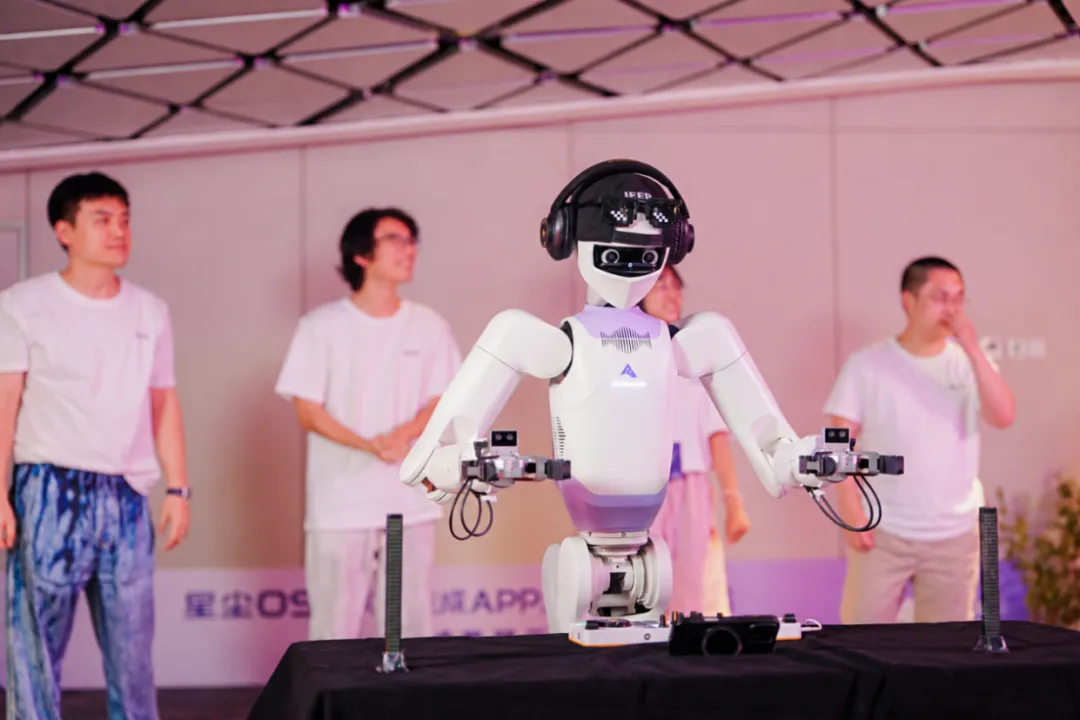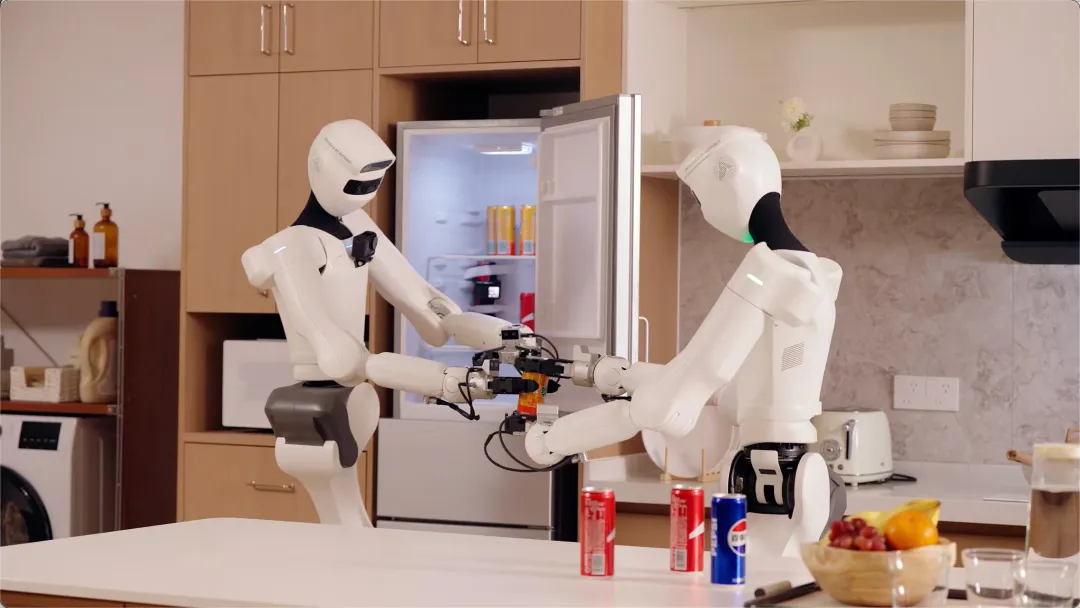
Astribot has introduced CoMind, a framework designed to help robots coordinate by sharing selected task context directly with one another. This approach aims to reduce reliance on a central controller and avoid flooding teammates with irrelevant data. Astribot says the framework improves coordination in tests involving blocked views, object handoffs and cooperative assembly.
CoMind builds on Lumo-2, Astribot’s second-generation foundation model, which the company says supports collaboration among multiple robots and between people and robots. CoMind extends that work by allowing robots to exchange task-relevant context rather than forwarding every observation.
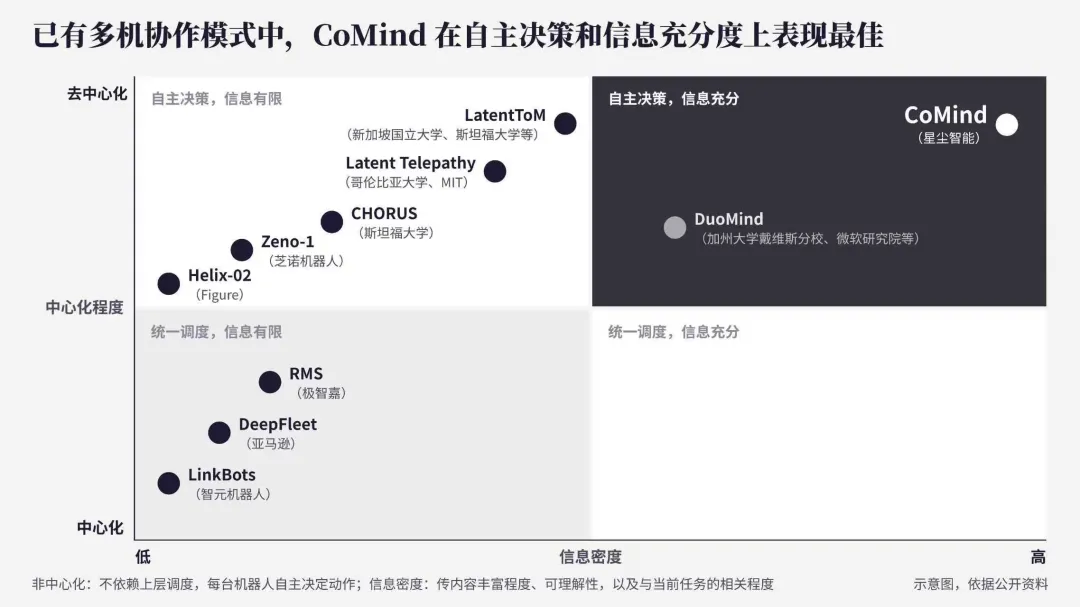
CoMind has two core features: first, "decentralized" active sharing, allowing team members to communicate with each other in real-time task context, saying goodbye to the passive, centralized scheduling of "waiting for leadership to assign tasks"; second, selected information, which filters and compresses the information that team members need and affects decision-making before sharing, rejecting the noise of "one-click forwarding".
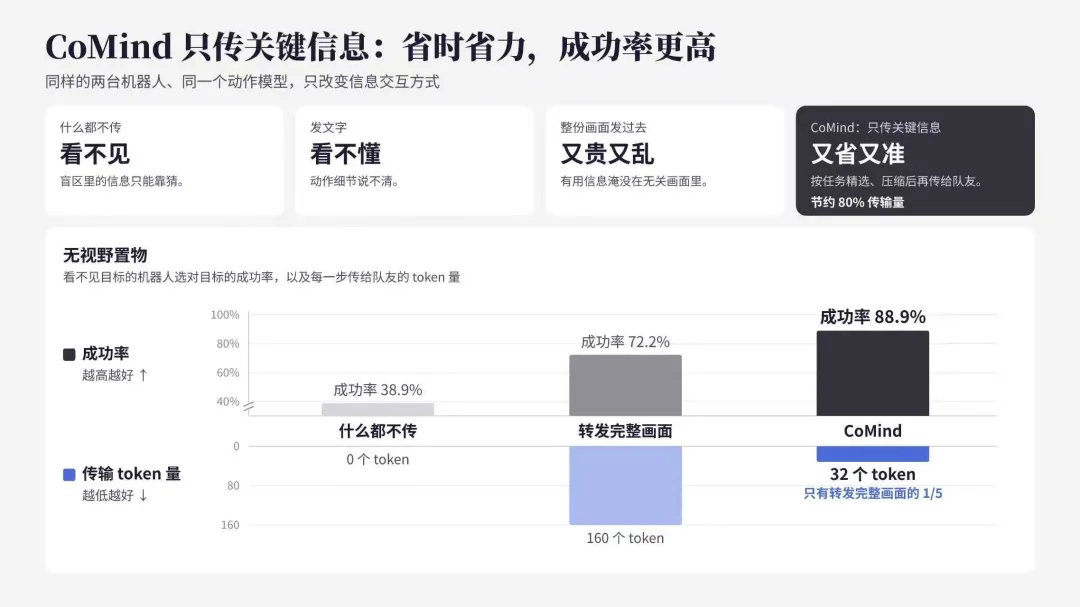
Astribot says this selective exchange of task-relevant information improves coordination in complex household chores such as assembling cartons and dumbbells, folding quilts, and replenishing refrigerators.
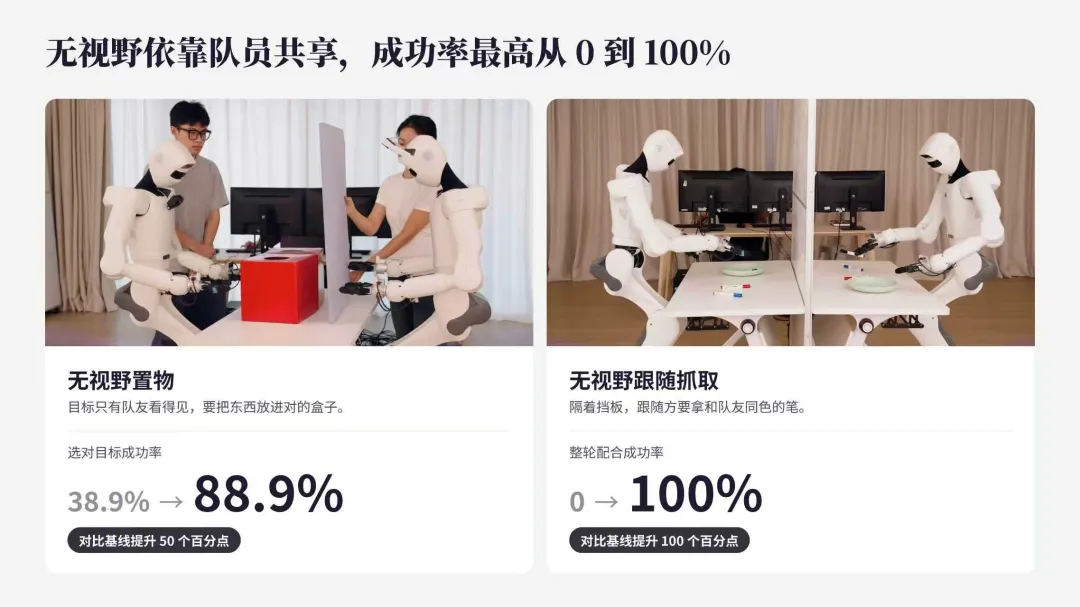
In the extreme test of completely blocking the field of view, CoMind gave the robot the superpower of "shared vision" in science fiction novels. When they follow each other through the wall to get pens, Astribot reports that task success rose from 0% to 100% in this test. After covering the eyes, the reported accuracy for placing an object in a designated box rose from 38.9% to 88.9%, while the amount of information transmission is reduced by 80%.
By extending intelligence from a single machine to multi-robot collaboration, CoMind also plans to extend from "sharing information" to "sharing intentions" in the future, so that robots will no longer cooperate in a reactive manner, but will predict each other's future intentions and actively fill in positions, leading to ultimate tacit understanding and efficiency.
01.
Six real machine tests: different collaboration problems, one set of framework to crack
The most difficult thing about two robots working together is that the information that determines the next move is often only in the hands of the teammate. In order to verify the robot's ability to cross blind spots in the field of vision, Astribot tested how CoMind can improve the robot's collaborative capabilities in complex operating tasks in home and extreme experimental scenarios.
Assembling cartons: motion coupling, full line of sight blocked, assembly still going on
Box assembly involves frequent physical contact between the robots and the object. The larger box frequently blocks the line of sight during flipping, and the movements are highly coupled. Both parties need to push and open the box simultaneously, and coordinate their movements in real time and avoid getting in each other’s way. This is a very difficult continuous and precise operation for the robot. CoMind is designed to let both robots track task progress in real time, and "borrow eyes" during extreme tests where the field of view is completely blocked, allowing assembly and handling to proceed smoothly and continuously until success.

Folded quilt storage: continuous operation of flexible objects in a consistent manner
The quilt is large and soft. When it is lifted, folded and moved, its shape and edges continue to change, which is a dual challenge for robot perception and control. CoMind's selected visual context allows both robots to align their action intentions in real-time amid high-frequency contact and dynamic tension, and independently generate and synchronize each action without requiring a central system to issue every step-by-step instruction. Even under the interference of large deformations, they can seamlessly connect and collaborate without pause in continuous operations.
Refrigerator replenishment: visual complementation, global sharing, efficient relay
When critical information is spread across different views: the robot on the left sees that the refrigerator is out of stock, and on the right it sees drinks on the island. With the help of CoMind, both robots can use the "eye" to complete the whole situation in real time and start seamless delivery and relay without having to move back and forth repeatedly, saving time and effort.

Assembling dumbbells: Complementing the limited viewing angle and still being accurate in motion
When assembling dumbbells, it is difficult for the person inserting the piece to clearly see the dynamic relative positions of the rod and the hole at the same time. CoMind completes the spatial relationship between teammates' perspectives at the millisecond level, allowing the robot to adjust its posture in real time, locking the alignment accuracy in continuous changes, and completing a seamless collaborative assembly.
Blind box placement: extreme occlusion, from blind guessing to precise hits
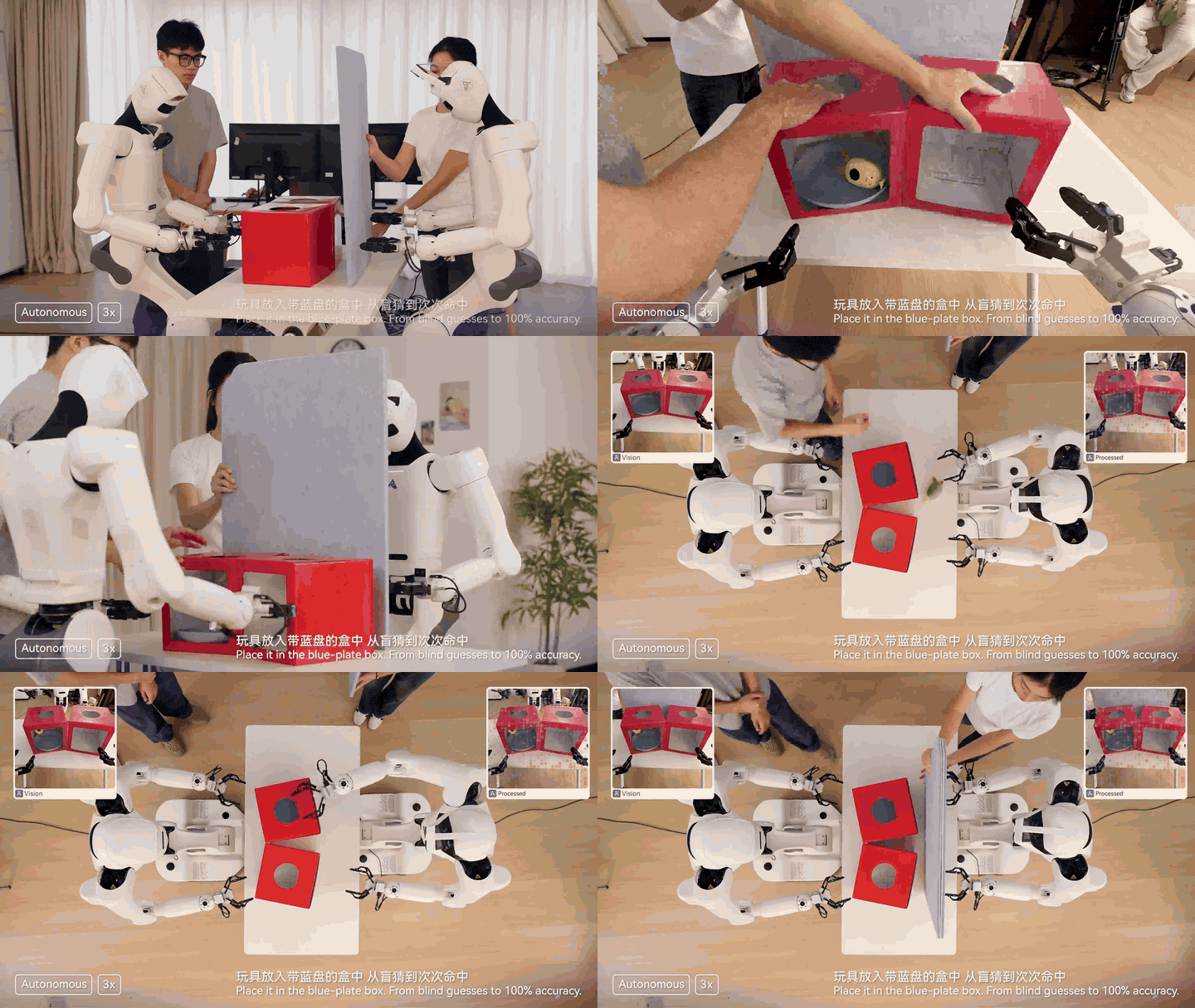
The position of the box containing the blue plate changes randomly. The robot on the left is clearly visible, while the robot on the right is completely obscured and knows nothing about it. With zero visible information, CoMind shares the key visual features from the left robot’s view with the right robot in real time, allowing tasks that could only be completed by blind guessing to be accurately hit and the accuracy greatly improved (38.9% → 88.9%).
"Looking" at each other through a wall, but 100% accurate
Even if they are invisible to each other, they can share the target color and action timing in real time through CoMind. The two robots alternately take the initiative and follow the pen, and the task success rate jumps from 0% to 100%.

02.
Robot collaboration requires knowing the key points: how CoMind works
Current multi-robot collaboration solutions generally face the dilemma of "slow scheduling" or "shallow communication". Traditional centralized dispatch is like an experienced on-site commander, good at planning the macro tasks of "who moves boxes and who puts quilts", with clear logic and convenient management. However, when executing millisecond-level coordination such as "two people lifting a table or folding a quilt", the commander becomes a bottleneck - every fine-tuning requires reporting, decision-making, and then issuing, and the smooth collaboration is fragmented into a rigid "waiting for instructions."
However, existing decentralized solutions fall into the dilemma of "shallow communication". The robots work independently and appear to be flexible, but in fact they lack information density. Some robots only rely on cameras to "visually" see teammates. Once they are blocked or their backs are turned, collaboration is immediately interrupted. Even if data can be exchanged, most of what is transmitted is general text such as "I am moving" that is disconnected from the task, lacking deep information that directly supports the action. A robot produces a massive amount of images every second. If all images are forwarded, not only will the bandwidth be congested, but teammates will also be drowned in useless data.
CoMind’s design centers on two stages of information exchange.
CoMind selects mission-critical information in the first stage and actively shares it in both directions in the second stage, guiding the respective VLA models to output coherent actions.
The first stage is "active context construction": moving from passive perception to "predictive sharing".
Different from the traditional scheme's crude forwarding of the original video stream, CoMind introduces dual learning objectives. The first is to not only focus on the present, but also on "future prediction of tasks", guiding the model to prioritize visual information that is of critical value to future actions and weight it according to task relevance. The second is to combine "task progress corresponding learning" to allow robots to understand each other's execution stage - whether it is "just started" or "about to be completed".
For example, when assembling a box, the robot delivers a progress update such as “I’m in position and ready to insert the box panel.” In the blind box competition, the core feature of the "blue disk" is accurately locked, and real-time progress status sharing is included. Key information synchronization is achieved with extremely low bandwidth, ensuring that teammates can predict actions instead of just reacting to them, saving time and effort in collaboration.
The second stage is the "two-way feedback synergy mechanism": shifting from one-way transmission to "joint optimization".
CoMind has designed a symmetrical context encoding and action strategy interface, allowing everyone to serve as each other's "eyes" and "brain". Each robot is equipped with the same "translator" (context encoder) and "decision officer" (action strategy interface), which can independently extract the key information it sees and send it to teammates, and can also receive information from teammates. When making decisions, not only look at the ‘live broadcast’ of teammates, but also look at one’s own ‘road conditions’. The receiving end integrates the context shared by the partner, local visual observations, task instructions and ontology status, and then inputs the pre-trained Vision-Language-Action (VLA) strategy to generate continuous actions.
More importantly, the "action-level backpropagation" mechanism is introduced, using the results of robot A's actions (supervision signal) to reversely train what robot B should transmit in the future (encoder optimization). This "begin with the end in mind" training method forces information extraction not only for "seeing clearly" but also for "doing well", ensuring that every bit of data directly serves the final collaborative decision-making. For example, in a blind box guessing game, if robot A, which cannot see the target, reaches the wrong position, the deviation between its action and the correct action will be transmitted back to robot B's encoder along the network, which is equivalent to telling B that the key features of the target are not prominent enough in the information just passed. After rounds of such training, B learned to give priority to the part of the information that can best help A make the right action.
03.
Stardust AI model: Let robots act correctly in the real world
Behind CoMind, from the explicit reasoning in Lumo-1 to Lumo-2’s prediction of how the world changes after an action, Astribot says its models are designed to help robots act in the physical world. The company is continuing to develop a full stack spanning AI models, a robot operating system and cable-driven robot hardware, with the stated aim of supporting broader deployment of physical AI.
Go back to those “two hands are not enough” moments at the beginning. We hope that in the future, what will appear in commercial, industrial and household scenarios will not only be a capable robot, but also a team of robots that know how to predict each other's intentions and take the initiative to fill in the gaps.