How does fine-grained marking help a robot actually perform a task?
RoboAtom allows millions of tracks to be monitored at the same time.
In robotic learning, an unlocked cabinet door picks up the pudding and puts it down the trajectory of the pudding, containing several successive movements. In addition to knowing what the task is, the model also needs more detailed supervision: what each step is doing, where to start and where to end.
As data expands to millions of tracks, the cost of refining these markings gradually becomes a key issue.
The cost of gradual man-made refurbishment is approximately$100 for an hour of videoThe cost of GPT-5.6-sol is estimated to be around Rs.$3,510Whereas the PhysExtend proposed by RoboAtom, under the terms of reference labels, requires only:$0.000028The cost of spreading the calculations and achieving higher marking accuracy.
From artificial refinement to physical signal-driven dissemination, the above single-price ranges are roughly the same.Three and a half million timesFocusing refinements on a small number of reference tracks and then expanding them to the same task data at a low cost is key to achieving scalable labeling at RoboAtom.
It was developed by the Shanghai Artificial Intelligence Laboratory in conjunction with Zhejiang University, Pudong University, Tsinghua University and Shanghai Transportation University.RoboAtomIn order to improve the quality of the food and beverage products, it is necessary to ensure that the food and beverage products that are already labelled are corrected, seed labelled, disseminated and tested.1,446,974 tracksIt is a unified, time-aligned, atomic movement marker that contains all of the following elements:It's been 6,876,282 clips, 16,882.1 hours.It covers16 data sources and 32 robot entities。
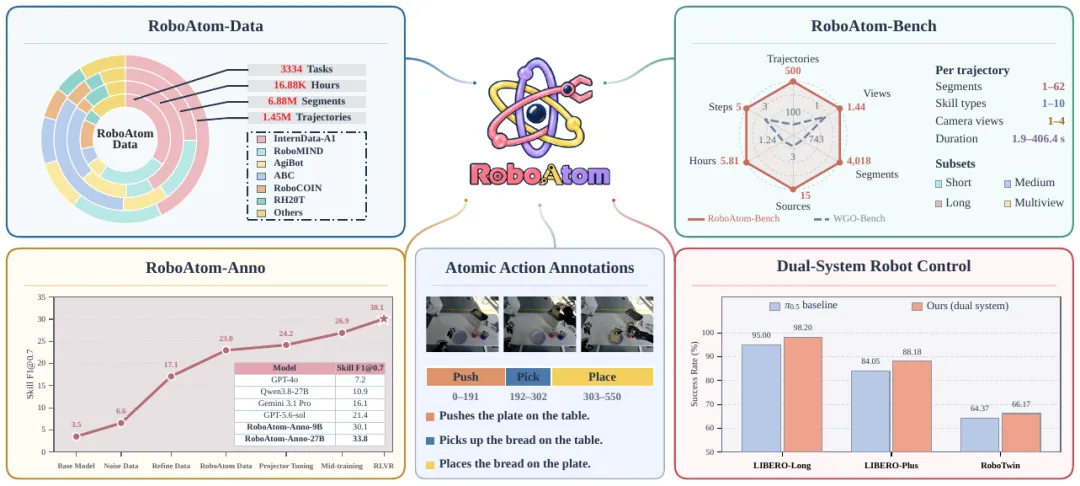
Figure 1 provides an overview of RoboAtom. The above shows data and benchmarks, the middle shows time-aligned submission labels, and the following shows the labels' model performance and robot control success rates respectively.
We have opened this account and we want to not only pass on the knowledge message of the leading authority to those who are interested in the use of artificial intelligence, but also to witness it as a bubble or another heatwave.Welcome to the attentionDeep blue-skinned smart mouse👇
Background of research
From mission instructions to atomic control
Tom takes the pudding out of the cabinet and describes the task goal, but does not specify which steps the robot performs at each moment. For long-time sequence operations, opening, crawling and placing the respective different stages of action, accurately distinguishing between these stages, helps to construct more subtle learning goals and execution instructions.
RoboAtom marks each atom's movement as a fragment, containingSkills category, description of action, and stop-and-goThe skills category unifies the syntax of the movements in different data sources, describing the movements to retain the operational objects and specific details, and aligning the information with the trajectory.
The difficulty of constructing this type of supervision lies in the quality and expansion costs of labeling. Man-made modifications can be made, but it is difficult to directly cover millions of tracks; general video models can assist in labeling and are still inadequate in the positioning and particle cleavage of short physical events.
The trajectory of repeating the same task often shares a skill sequence. This provides an extended path:
Is it possible to fine-tune a small amount of reference trajectory and reliably distribute the labels to a large amount of same-task data?

PhysExtend methods and dissemination experiments
Finding boundaries of motion from physical signals
PhysExtend makes direct use of a robot's state-of-the-art motion signal to signal transmission without the need to call large models or process video images during transmission.
These signals include motion intensity, stoppage, directional change, clavicle opening, grip state and bottom speed, etc. For example, clavicle and grip state changes can provide a boundary clue to grab and place movements; starting the bottom helps to locate moving segments.
For consistent task trajectories with skill sequences, PhysExtend first gains skill sequences from a small number of reference trajectories, and then combines clues such as relative progress, time frames, and claw events, byDynamic planning with orderly constraintsJointly determine the movement boundaries of the target trajectory.
This joint solution takes into account the constraints of the entire trajectory while reducing the spread of errors caused by the step-by-step decision. In contrast, the Cortex aligns the characteristic distribution of the reference trajectory, which may deviate from the actual skill switching position when the execution speed changes or stops and retests occur.
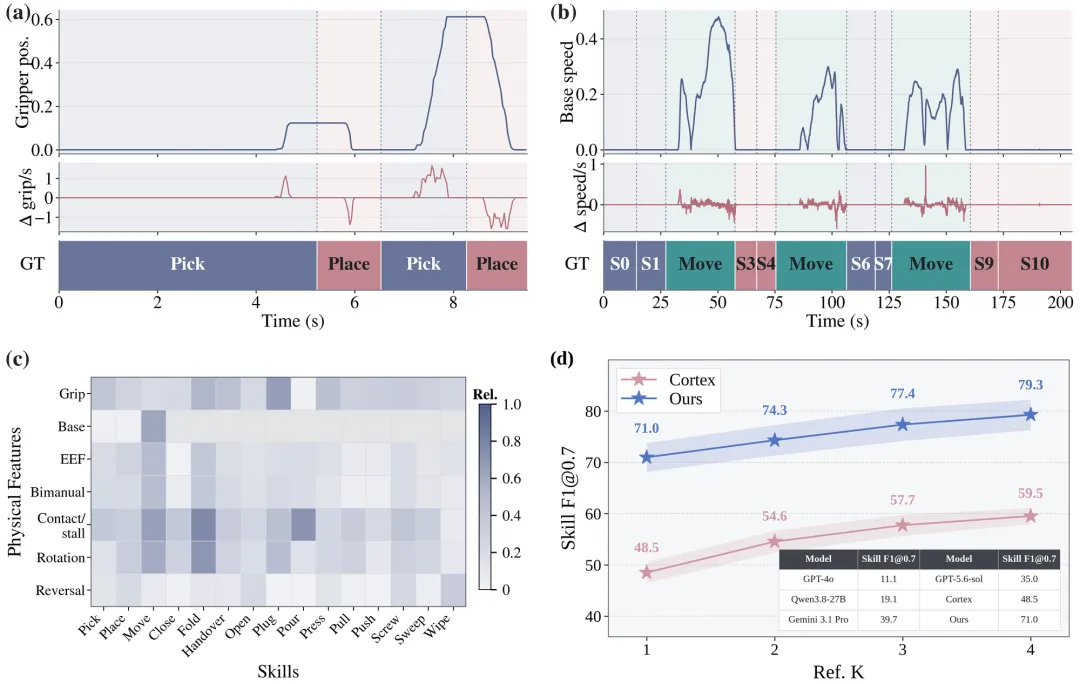
Figure 2 shows the physical cues and transmission effects of PhysExtend. (a) the claw signal is aligned with the Pick/Place boundary; (b) the bottom disc movement is aligned with the Move boundary; (c) the relationship between skills and physical characteristics; (d) the performance comparison of PhysExtend with Cortex under different reference quantities.
How accurate is low-cost transmission
The team is here.100 missionsEach task consists of 5 man-made marking tracks, in a consistent skill sequence within the task. In a single reference setting, 1 trail provides a reference marking, and the remaining 4 are used to evaluate the outcome of the spread.
Skill F1@0.7 (mailto:F1@0.7) simultaneously checks for skill categories and time boundaries: skill labels are consistent, and time passes are at least 0.7 to make an effective match. The entire trajectory's full-parity rate is verified by artificial replication, requiring that all sub-tasks in a trajectory are semantically and cross-sectionally correct; this indicator is evaluated on a total of 100 trajectories per 1 task.
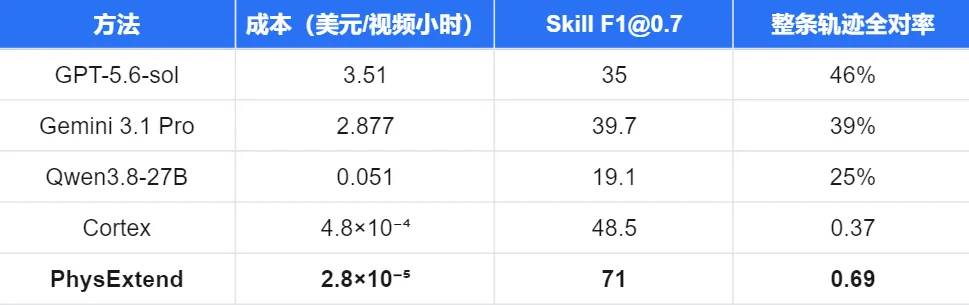
In this setting, PhysExtend's Skill F1@0.7 can be used as a71.0It is about twice the size of the GPT-5.6-sol; the total parity of the entire trajectory is 69%.23 pointsIts mIoU is 76.8, which is higher than Cortex's 66.5 and GPT-5.6-sol's 58.9.
The cost advantages come from the direct use of the signal for the state-of-the-art motion.
With a single CPU, single reference setup, the throughput of PhysExtend reaches15,952 trajectory/CPU hoursIt's the first time I've seen this.17.1 timesThe cost of broadcasting is calculated for every hour of video.$2.8 x $10 to $5.。
Increasing the reference trajectory also improves the dissemination effect. The method is based on the results of each reference independently solved boundary, and then integrates the corresponding location. When the reference number is increased from Article 1 to Article 4, Skill F1@0.7 is changed from71.0 up to 79.3。

RoboAtom builds data
From a little refinement to a million tracks
Low-cost dissemination provides scalability, while unified label definitions, reference quality and follow-up quality checks determine whether the final data can be used for training.
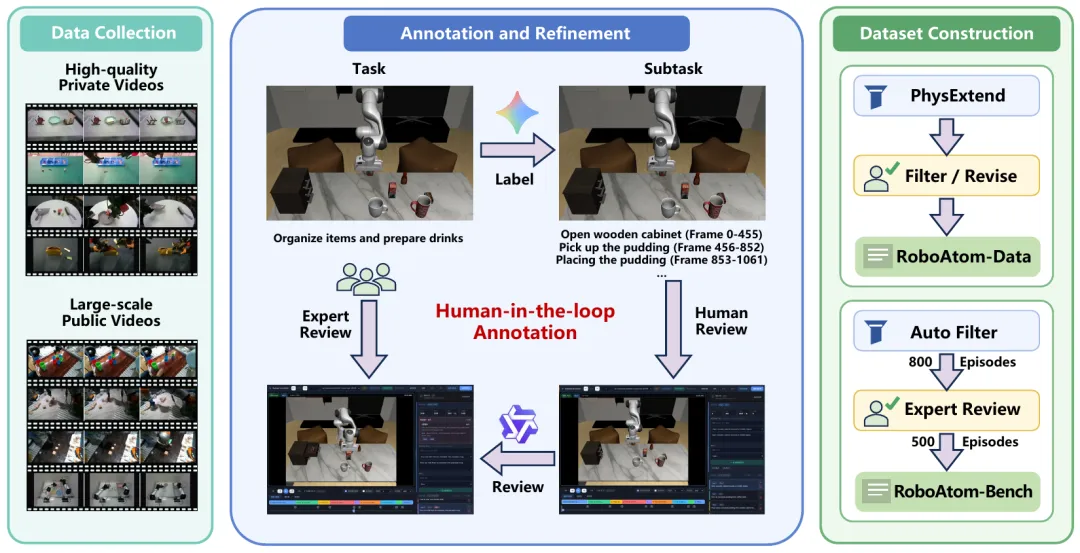
Figure 3: RoboAtom builds a process. Model-assisted labeling and seed labeling to produce artificial replication form RoboAtom-Data through PhysExtend dissemination and qualitative testing. Experts build RoboAtom-Bench by replication.
The team first assembled real robots with simulated trajectories, unified data formats, skill categories, and marking granularity, and replicated corrected marking.
For tasks requiring complementary labeling, the visual language model generates candidate action snippets and initial boundaries, and the labeler then controls the original video, revises skill categories, action descriptions, and stops. These results become seed labeling after model-assisted checks and artificial replication.
PhysExtend will then distribute the reference tags toA consistent skill sequence along the same mission trajectoryThe dissemination results were followed by quality checks and revisions to form RoboAtom-Data. Artificial sampling results showed that the subtasking accuracy of each data set was more than 85% and the simulation data set was more than 95%.
At the end of the day, RoboAtom-Data includes:1,446,974 tracks, 6,876,282 clips of action, 16,882.1 hoursIt's from...16 data sources, 3,334 missions, and 32 types of robots.。
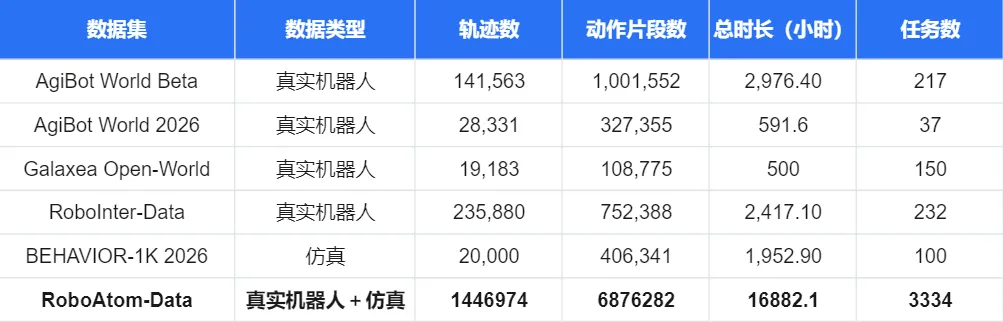
Compared to data sets marked with sub-tasks in the table, the number of orbits of RoboAtom-Data expanded to millions of scales, and the number of tasks expanded to thousands.6.1 times and 14.4 timesThe number of action clips and total duration is approximately the same as AgiBot World Beta.6.9 times, 5.7 times。
Among them, RoboAtom-Data contains both real and simulated trajectories, combining data types to understand scale differences when compared.

RoboAtom Assessment and Automated Marking
RoboAtom Bench tests actions to identify and locate borders
Scalable marking also requires a unified assessment method. The existing WGO-Bench contains 100 tracks, 75 of which are robot tracks; its open vocabulary marking is also difficult to assess for identification accuracy directly under the Unified Skills category.
In order to more systematically evaluate skill recognition, sequence of actions and time boundary positioning, the team has builtRoboAtom-Bench。
The benchmark covers 15 data sources and contains expert reviews.500 tracks, 4,018 clips of actionThe number of tracks is 5 times that of the WGO-Bench. The average number of tracks is 5 and the single track contains a maximum of 62 steps.
In the evaluation, the model input isVideo and mission instructions without reference trajectoryThis setup differs from the previously mentioned PhysExtend task markup dissemination, considering the ability of the model to directly generate motion markup.
The results showed that the general model recognized the sequence of movements better than the positioning of the time boundary. GPT-5.6-sol's skill sequence editing scores Edit for63.4The time is F1@0.7 for28.0Edit, regardless of time boundaries, the two categories of indicators together reflect the gap between what the pump does and when the pump is positioned.
The length of the motion sequence also affects the shear grain: four reference models tend to over-shear on the Short subset, predicting the number of segments to be true.1.48 times 1.70On the Long subset tends to combine actions, predicting the number of segments to be only true.0.51 times 0.65。
RoboAtom Anno uses a large-scale monitoring and training labeling model
To improve automated marking capabilities, the team used RoboAtom-Data to train.RoboAtom-AnnoThe 9B version is based on Qwen 3.5-9B, followed by training, monitoring, and GRPO optimization in the robotics field; the 27B version is based on Qwen 3.8-27B and uses the same training process.
On the RoboAtom-Bench, the 9B version of the Skill F1@0.7 has reached its peak.30.1The cost of reasoning is about 21.4 times higher than GPT-5.6-sol.1/700The 27B version further reaches:33.8。
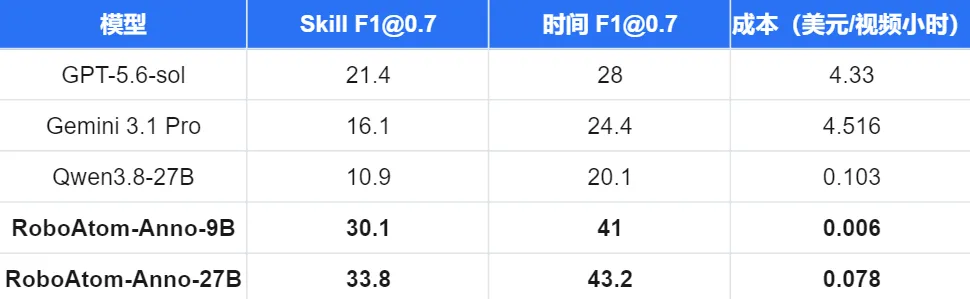
9B and 27B versions of Skill F1@0.7 are higher than GPT-5.6-sol, respectively.It's 8.7 and 12.4.The cost of reasoning for the 27B version is about the same.1/56The cost in the table corresponds to the video automatic marking inference, statistics separated from the above reference-driven dissemination calculations.
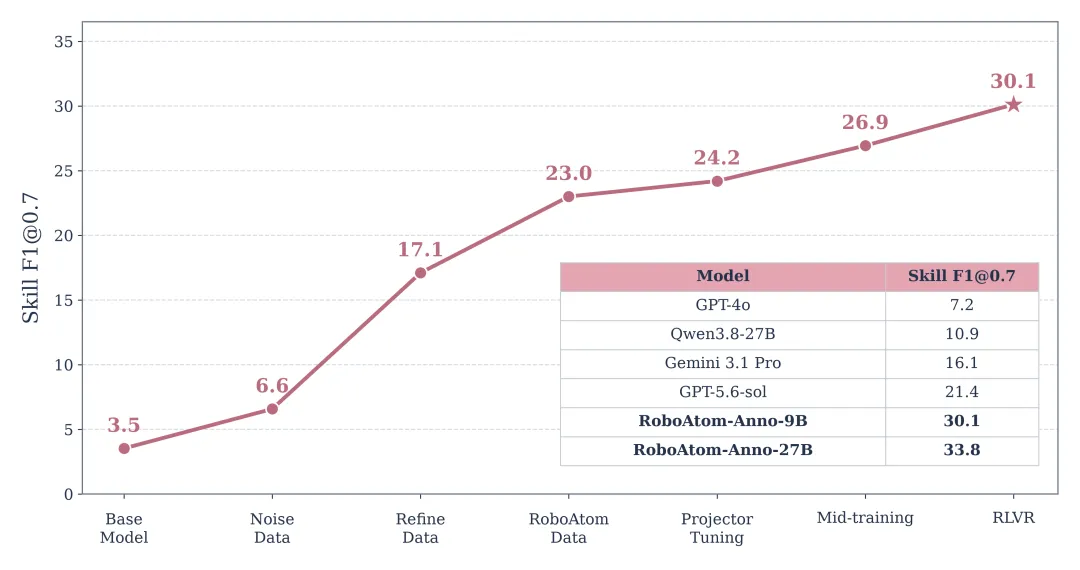
Figure 4 shows the training configuration of RoboAtom-Anno as compared to the reference model. Under different configurations, Skill F1@0.7 shows the effects of labeling, monitoring sources and subsequent training on model performance.
Training controls further illustrate the role of quality oversight. When using open-source data original labels for monitoring mitigation, Skill F1@0.7 is used to measure quality oversight.6.6After filtering the syntax and discrimination samples, it was upgraded to17.1• Replacing the RoboAtom-Data tag with the LoRA language-only training side, the score was further upgraded to23.0。
Combined with visual module updates, training in the field of robotics and GRPO, the final score was achieved.30.1The GRPO reward also takes into account sequential time matching, continuous time overlap, skill sequence editing similarity and output format.35.5 up to 41.0For example, the prediction of the number of segments compared to the actual value can be calculated from1.20 down to 0.99。
The model also demonstrates the potential for human-operated video migration. Despite the fact that RoboAtom-Data does not include human video, the F1@0.7 time on the WGO-Bench Ego Human First View video is still reached in the 27B version.28.3This is roughly twice the size of the most powerful reference model.

Robot controlled verification
Micro-particle monitoring of how robots get to execute
Using a dual-system architecture, the team compared two settings under the same training budget, observation space and action space: a pi0.5 baseline that trains task-level instructions and executes them end-to-end, and a RoboAtom program that uses atomic motion monitoring and combines layered execution.
In comparison to the baseline, RoboAtom is at the top.LIBERO-Long、LIBERO-Plusand RoboTwinThe success rate has improved, respectively.3.20, 4.13 and 1.80 points.。
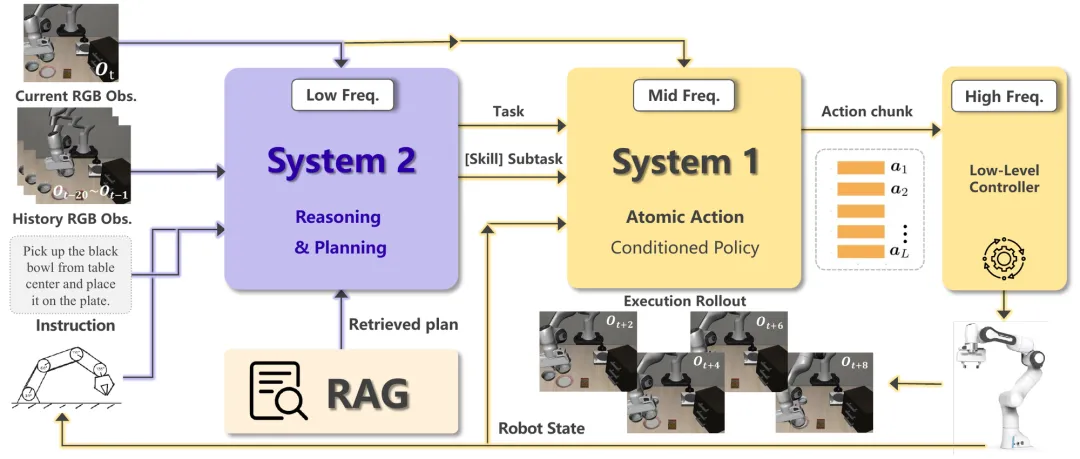
According to the task plan, the current image and the execution of the progress selection submission instruction, System 1 uses this instruction to conditionally drive π0.5 to generate robot movements, new observations and feedback to System 2.
During training, the team provided a skill label and description of each observed crawling motion for the completed segment, together with the task instruction, to minimize π0.5 to System 1.
When deployed, System 2 uses Qwen 3.8-27B, depending on the task plan, the current picture and the execution of the progress selector submission instructions. After System 1 is executed, the new observations are returned to System 2, which decides whether to continue the current submission or switch to the next step.
Figure 6 provides π0.5 baseline and RoboAtom program success rates on three benchmarks. LIBERO-Plus is the overall outcome of all 10,030 missions, with RoboTwin as the average for both Clean and Random settings.
In LIBERO-Plus's Object, Goal and Long subset, success rates increased, respectively.6.63, 6.41 and 3.73 pointsThe results show that the results of the study showed that there was a significant increase in the number of deaths in the United States.Oversight of atomic movements combined with layered executionIt helps to improve the ability of objects in the measured task to adapt to changes in objectives, as well as the performance of long-range execution.
Summary
RoboAtom focuses artificial refinement on a small number of reference trajectories and then uses physical signals for low-cost dissemination. Combined with labeled correction and multi-stage qualitative testing, this process is about the same.1.45 million robot tracksIt is the result of a unified, timely monitoring of atomic movement.
These labels further support automated labeling model training and robotic execution: RoboAtom-Anno is better than participating in comparative reference models in reported evaluations, and atomic movement supervision combined with layered execution also increases success rates on the three robotic benchmarks. RoboAtom-Bench provides a unified assessment benchmark for test skills identification, sequence of movements and time positioning capabilities.
Low-cost dissemination provides scalable built-in pathways for fine-grain monitoring and provides a data and experimental basis for studying how finer robotic data labeling can help models learn and execute fine-grain.
Editor's note:
I'm not sure what I'm doing.
Title of the paper:RoboAtom: Large-scale Atomic-Action Supervision for Robot Learning
Author of the paper:Xueyuan Wei, Xuanxu Wang, Xudong Li, Yuping He, Wanshui Gan, Jiaqi Peng, Wenqi Guo, Jianjun Zhou, Junting Dong, Chunhua Shen, Haoyu Guo, Mulin Yu†, Tao Lu†
Unit of studyShanghai Artificial Intelligence Laboratory, Zhejiang University, the University of Pudong, the University of China, and the Shanghai Transportation University
Link to the paper:https://arxiv.org/abs/2610.40207
Project homepage:https://internrobotics.github.io/RoboAtom/
The code:https://github.com/InternRobotics/RoboAtom
The data:
Models:https://huggingface.co/InternRobotics/RoboAtom