OpenAI's highly-anticipated round of financing has finally fallen into a phased phase.
Recently, Bloomberg quoted sources as saying that OpenAI has completed its first round of funding of about $11 billion, valuing the corresponding company at $125 trillion.
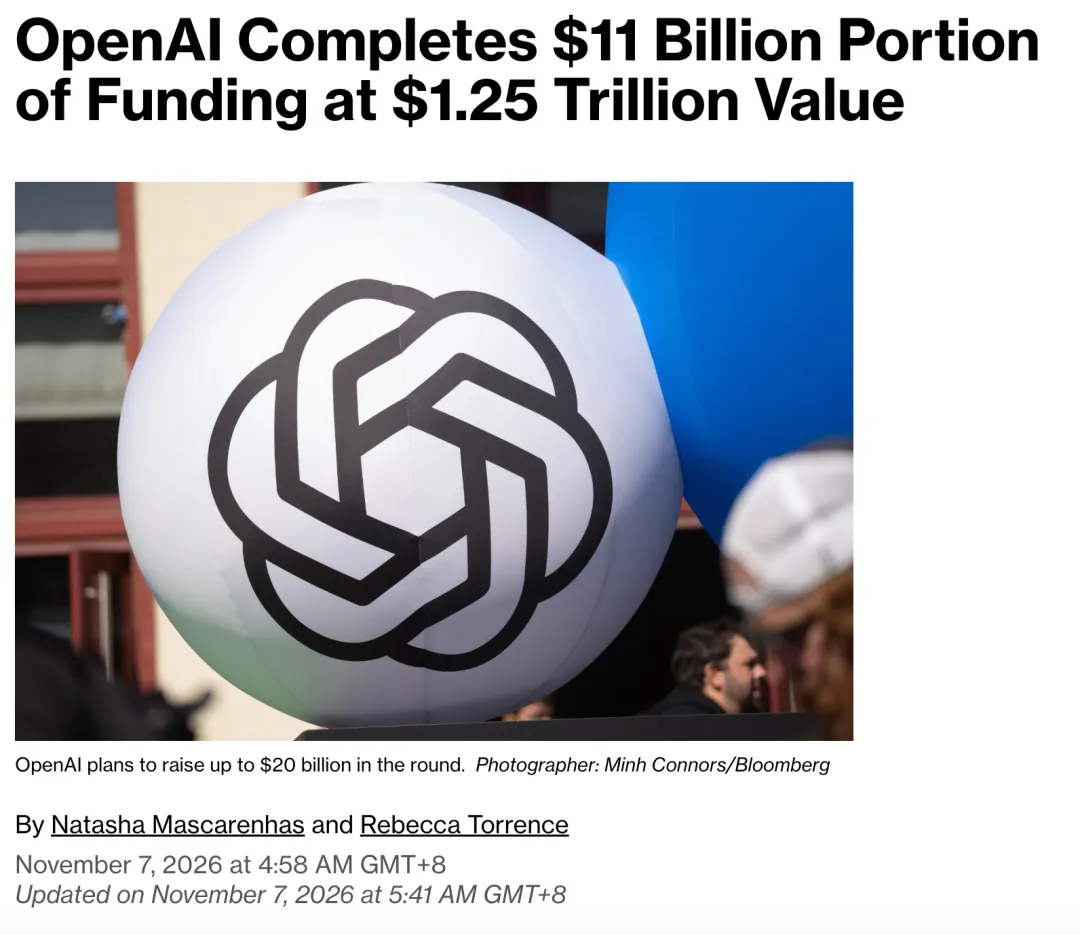
Bloomberg disclosed that the funds had been transferred to the company on Friday, with the remainder expected to be completed in the coming weeks, when the total round of financing could reach $20 billion. OpenAI declined to comment on this.
At the end of September, foreign media reported that OpenAI hoped to raise at least $30 billion, seeking a pre-investment valuation of about $144 trillion. This money was seen as a transition financing round after the IPO was postponed to continue providing funding support to the company before it went public.
By the end of October, the Financial Times reported that OpenAI had cut its funding target by about $10 billion to about $20 billion, and its target valuation had dropped from $14 trillion to $125 trillion. According to Reuters, some investors have reduced their planned investment amount, and initial divestments are not expected to reach the adjusted $20 billion target at once.
The $11 billion landing is of course a huge sum, but it is far from the scale that OpenAI originally envisioned. At the same time, the financing is ongoing and cannot be taken directly as the final outcome of the first round of financing.
Participants are also steadily rising to the surface. Recent Bloomberg reports mention that Coatue and Pfizer Group participated in the first round of divestments; other investors in the round include SoftBank, Redwood Capital, Founders Fund and Andreessen Horowitz, a consortium of other UAE investors. OpenAI is also working with investment banks to raise funds from high-net-worth individuals and retail investors.
As this round of funding targets declines, the focus of the market also naturally falls on a more practical question: where does the money to support these numbers come from?
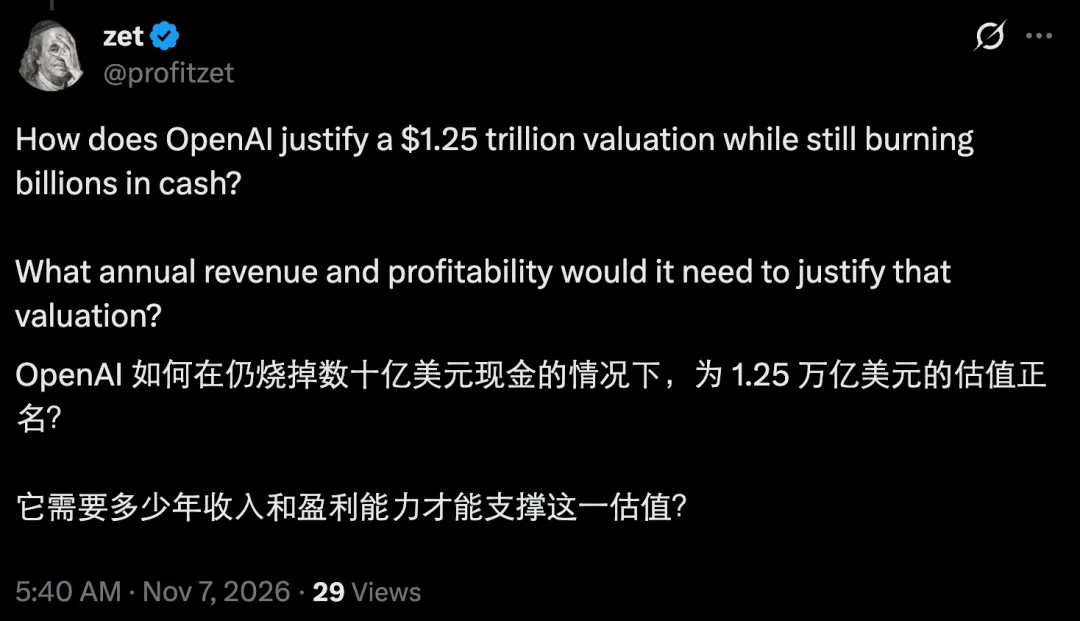
The response from the management of OpenAI is that the demand is still there and the investment must continue.
On November 6, Sarah Friar, Chief Financial Officer of OpenAI, was interviewed at the TMT Leadership Summit in Flagstaff, California. She spoke about the pressures on data centers following the midterm elections in the United States. She said that the company would still need to continue investing to meet customer needs; relying on previous partnerships with large cloud service providers would also mean continuing to finance in the future.
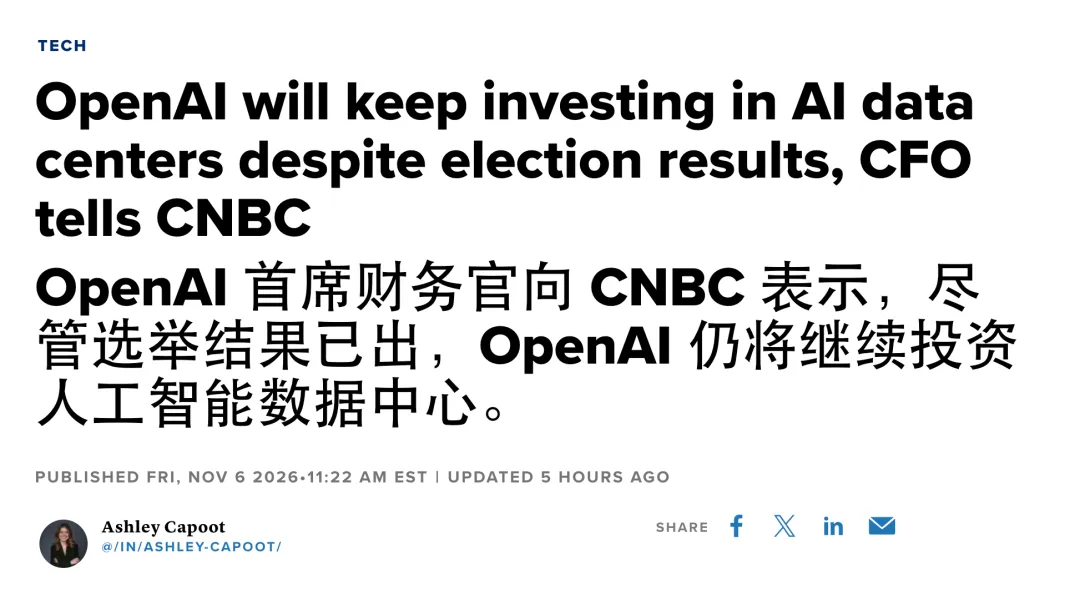
She also said a CFO-style catchphrase: "A good CFO will always finance when he can". She made it clear that this round of financing is ongoing and stressed that the need for AI is real.
Data center construction has become a controversial topic in U.S. local politics.
According to CNBC's Ballotpedia analysis and its accompanying statistics, 40 of the 41 local voting measures involved in the midterm elections in 10 states tended to limit data center construction or vote against supporting development.
For OpenAI, these disputes are directly related to the fact that computing cannot land on schedule. Financing can support expansion, but data centers will eventually be built in specific communities with access to local power grids.
On November 5, OpenAI announced a series of commitments for future data centers owned and operated by the company: to assume the full cost of power supply; to seek community feedback; to open up construction plans; and to stop signing confidentiality agreements with public officials when discussing future locations.
Friar said in an interview that OpenAI will continue to enter the community and build trust if the election means that the outside world will be more concerned about the relationship between the data center and the community. She does not believe that the election results will fundamentally change the company's business.
At the same time, she revealed that OpenAI is still studying the possibility of going public in 2027. The company reportedly submitted its IPO filings to the U.S. Securities and Exchange Commission in June this year.
This makes it even more remarkable to see how much more leverage the new capital can give OpenAI while the time for launch has not yet been finalized and infrastructure investments are still to continue, and it remains to be seen whether subsequent funding will arrive as expected.
The next round of funding that is most traceable is whether it will eventually reach about $20 billion, and how the company will transform its ongoing investments into revenues and profitability that can support trillions of dollars in valuations.
The link is as follows: