Henry from the Monastery of Phineas
QbitAI is public.
Within three-and-a-half months, the company was valued at between $4 billion and nearly $10 billion.What are you doing?It's all over again.
On 4 November, at the World Internet Congress in the town of Wu, he foundedMagic core technologyA new generation of generic 4D world models has been introduced.
MoWorld 2.0。
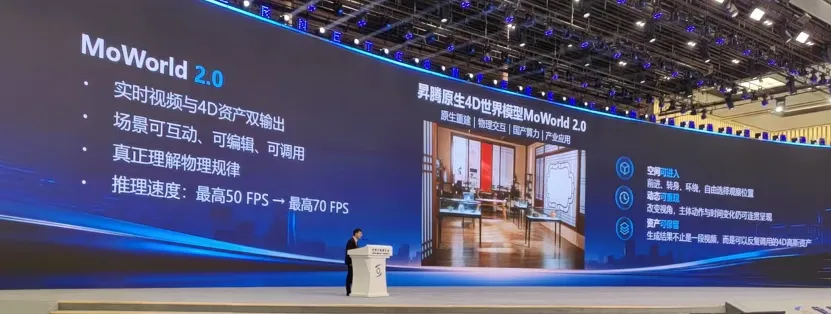
MoWorld 2.0 further enhances the modeling capability of physical laws based on the previous generation of space generation and real-time interaction capabilities.
It integrates more than a dozen physical elements, such as gravity, elasticity, buoyancy, light, elasticity, fluidity, rigidity, shape, and heat, into the same model.
According to the team, by studying these physical elements and their interactions, world models can more accurately simulate the movement of objects, collisions and environmental changes, and support downstream tasks such as physical simulation.
For example, in the example below, MoWorld 2.0 can not only generate images of bookmarks falling off, but also simulate how the bookmarks come into contact with other objects, are affected, and ultimately fall and pop.

When faced with fluids such as water, it can also more precisely restore their motion under the influence of foreign forces.

It can be said that MoWorld 2.0 is a much more sophisticated world model that predicts what will happen next based primarily on images and text instructions.
Let the material of the object, its external forces and their interactions with each other determine how the world will change next.
At the same time, in order to allow world models to interact in real-time in real-world scenarios, the team has further upgraded the model in order to enable real-time interaction in real-world scenarios.Huawei promotes the NPUUpper operating efficiency, pushing real-time video reasoning speeds from the previous generation to a maximum of 50 FPS70 FPS。
It seems that this seems to be taking into account the accuracy of the simulation and the cost, how is this done?
Putting multiple physical elements into the same model.
I'm going to get this book first.
Where the wind is blowing, how strong it is, affects where the pages are lifted and how they roll.
The flexibility of the paper itself determines how it bends and shapes under pressure.
That's it.SomeThe fact that the factors are superimposed together, forms the process of flipping the pages that we finally see.

If we want a world model to recreate this process, it needs to deal with different physical elements and the interactions between objects and the environment at the same time.
This comprehensive understanding, the idea of simulating multiple physical variables, is at the heart of MoWorld 2.0.
According to the team, during the training, the model learns the role of each of the physical elements, such as gravity, elasticity, elasticity, and fluid, as well as how they affect the movement and shape of objects after they are superimposed.
In order to achieve this, the team mainly worked on two tasks.
One is to buildPhysical Gaussian filterssupporting the interaction and rendering of different physical elements;
The second is adoption.Many experts predictFor example, in the field of physics, pixel and Gaussian three-dimensional information prediction.
These designs allow models to more accurately project changes to objects under different conditions and support downstream tasks such as physical simulation.
In addition to physical performance, MoWorld 2.0 also has a notable capability:
The scenes generated can be output as 3D/4D Goose assets, saved, and continued to be edited, rendered, and repeatedly called.
Cos's asset sounds somewhat abstract, but in simple terms, it can be understood as a spatial data of preserving scenes.
Among them, a large number of three-dimensional clusters with location, shape, and appearance information represent objects and environments together.
Software can render scenes from different angles based on these data; 4D assets can further record information about changes in spatial content over time.
In this way, the spatial content generated by the model is no longer just a one-time video, but can be edited, rendered and summoned as assets, further into game engines, video production systems, and robot simulation training platforms.
For example, in the official presentation, MoWorld 2.0 based on an ancient painting, generates an ancient street market that can be accessed.
Shops, street corners, pedestrians and motorboats in the painting become editable and interactive scenery content. Users can explore along the street corners and adjust their perspective to observe the movement of people and objects.
For video and game teams, the same scene can change location, change weather, adjust objects, and be used for filming previews and content production.
For robots and intelligent driving teams, it is possible to change obstacles, roads and weather conditions in the same environment, repeatedly testing how intelligent agents respond.

In reality, the difficult to reproduce rain, snow, crater slopes and sudden obstacles are also part of the virtual training environment.
However, if you want these application scenarios to support real-time interaction and repetitive training, you also need to focus on how the model works.Speed and cost.
Core modularity behind 70 FPS
The aforementioned 70 FPS refers to the speed at which the model generates new images in real time.
It directly affects the user's mobile lens, whether the scene can be updated in a timely manner, similar to how we play games.
Prior to the release of MoWorld 2.0, Mochore had spent nearly a year training and reasoning optimization with the Huawei team around the domestic NPU, achieving real-time video reasoning of up to about 50 FPS on MoWorld 1.0.
After this upgrade, the speed was increased to about 70 FPS, up from the previous generation.It's up about 40 percent.
In the interview, the team told the qubit that the key to this acceleration was to dismantle different computing tasks and then transfer them to multiple NPUs for parallel processing.
Specifically, the MORCHOR uses the underlying arithmetic and parallel scheduling tool chains that are open to the ascendant to perform tasks like scene decoding, mainstream generation, and more on multiple NPUs; while optimizing synchronized scheduling between multiple cards, reducing duplication of stored data and inefficient computation.
In addition, the team also optimized the scarcity attention mechanism, and adopted methods such as mixed accuracy quantification, generating algorithmic convergence, to further improve training and reasoning efficiency.
In addition to speed, costs are also in this round of optimization.
According to the team,The lowest reasoning cost is 30% for GPUs of the same size.
For teams that need to continually generate training environments, this means that the same budget can cover more scenario changes and training attempts.
In specific applications, MoWorld 2.0 has entered mobile devices such as mobile phones.
In October this year, it was unveiled at the launch of Huawei's new smartphone.Touch the little mouse.It is a terminal application of MoWorld 2.0.
Users can upload several photos of pets to generate 4D digital separations of pets, observe them from different angles, and interact with them.
It is reported that the experience was completed by a collaboration between the cloud and mobile phones: high-quality 4D assets were generated in the cloud; end-side models of about 600 million parameters were trained on the raising platform, and then deployed to mobile phones with silicon chips for reasoning; mobile phones were responsible for rendering and interaction.
Moreover, in the interviews, we learned more about what happened.3D/4D Gaussian assets have a rendering rate of up to 500 FPS, while mobile phone-related rendering tests are about 100 FPS.
Overall, from the model training on the lifting platform, to the end-side reasoning on the welding platform, and to the rendering and interaction of mobile phones, domestic computing has begun to go through the entire product chain of MoWorld 2.0, and the welding process has also fallen into specific applications.
Looking at the industry as a whole, the world model, which has been a frequently discussed buzzword since the beginning of the year, is gradually moving towards a new type of baseline model that parallels the large language models.
Following this trend, MagicCore has gradually established its own technology line of succession:At the same time, physical modeling capabilities and model deployment efficiency are improved.
From a 3D printer to a foundation model of the physical world
Finally, let's talk about the magic core technology behind MoWorld.
The company was founded in 2021. When it was founded, Chen Tian was still a student at Zhejiang University, the team's first product was a 3D printer.
The transition from a printer to a world model will occur at the end of 2024.
Publicly reported at the time, the team found that the network they were testing could not only generate objects but also generate space; the accuracy and consistency of space reconstruction continued to improve as the amount of data increased.
Chen Chen moved the modeling framework to the World Model Project, and the company's focus shifted to space intelligence.
After the transformation, the team retained the 3D printer business while validating the modeling capabilities and cash flow through video, travel and travel projects.
This experience in consumer electronics has also made him accustomed to considering R&D, cost, quality and delivery progress together.
Along this line, in December 2025, the KOKONI-World prototype was launched; in July this year, MoWorld 1.0 was released; in November, the model was upgraded to 2.0.
At the same time, according to reports in September this year, in the first half of this year or so, the magic core has expanded from 56 to more than two hundred people.
When introducing industry partners, the team focused on computing beyond finance, terminal products, sales channels, and customer scenarios.
In terms of financing, the company has completed five rounds of financing in a row this year, totaling 2 billion yuan, valued at nearly 10 billion.
In an interview, Chen Chen talked about target customers such as Chinese automotive companies, and summarized the advantages of the Magic Core in three areas: domestic computational adaptation, edge deployment, and engineering experience in the field of consumer electronics.
His vision was to make the Magic Core a foundation model for the physical world and really get into the actual business processes of manufacturers such as automotive companies.
MoWorld 2.0 is a national test base for artificial intelligence applications in three directions: physical intelligence, cultural tourism, space and geographic information.
According to the announced plan, follow-up collaborations will focus on interactive simulation and robotics training, cultural digital assets and immersive experiences, as well as 3D data production and big-scene reconstruction respectively.
Finally, with this release of MoWorld 2.0, we might ask a rather philosophical question:
If an AI has seen enough of an object landing, it can predict how a bookmark that has never been seen before will move the next second.
So what it learns from the data is whether it's just statistical relevance, or whether it can migrate to new scenarios, to the physical laws that drive the results?
Or a more extreme question is: Is the world we live in just a set of mathematical equations that are determined jointly by the interaction of countless variables?