VISTA team posted
QbitAI is public.
Putting a box of cheese on the shelf, the goal is clear, and the robot needs to locate, grab, move and release the adhesive.
How to judge when an object has been seized, when to start moving, and how to proceed after the first attempt fails, all need to be implemented in a specific way.SkillsandDecision-making logic。
So can we give this part of the job to the robot itself, let it do the experiments, change the code, build up the experience, complete the task?
FromChinese UniversityandNational University of SingaporeThe research team proposed and open-sourceVISTAIt handed over experimentation and development work to the Meta-agent, allowing it to acquire new evidence and improve Harness through active exploration.
The entire process does not need to update the weight. If the underlying model parameters remain fixed, VISTA will change the overall task success rate of LIBERO-Pro from17.5%It's upgraded.95.0%。
Harness as an object of evolution
Using learning strategies, movement planning, feedback control, and perception tools, Harness is responsible for organizing these capabilities: what instructions to provide to the model, what skills to open, how to call tools, and how to handle feedback execution. Skill codes, call logic, and long-term memory are all things that can be developed.
In VISTA, the executive agent uses Harness to complete tasks; as a developer, the meta-agent checks the code and runs records, writes or modifies skills, and then validates the candidate version. For example, it can combine positioning, learning strategies to complete crawling, and controller-executed movements into a new skill for executing Agent calls.
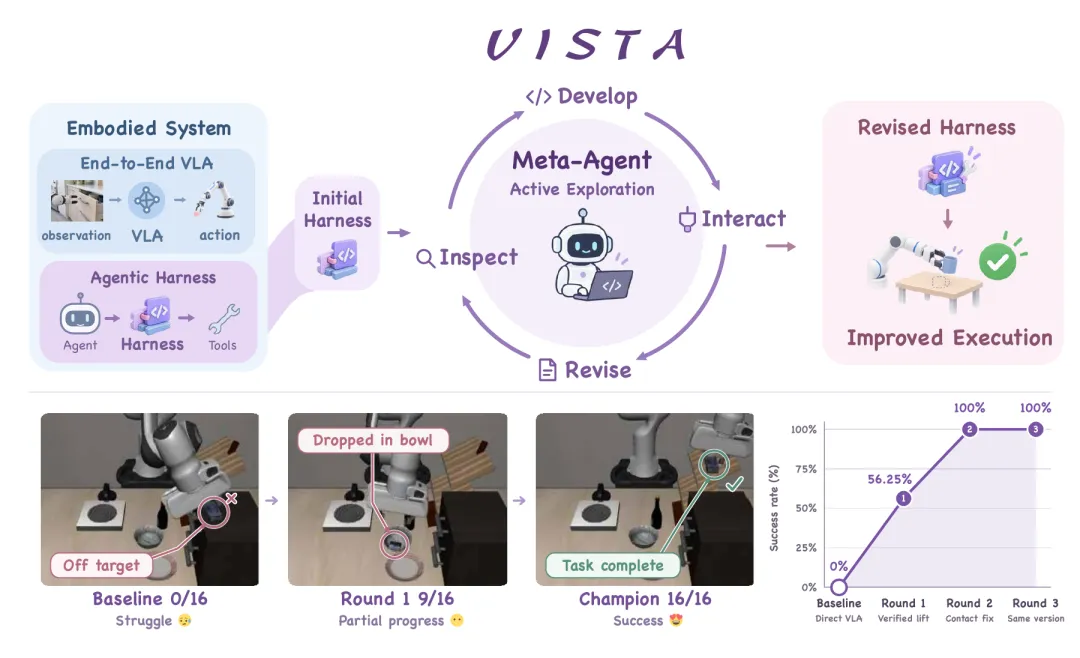 △VISTA overview: Meta-agent improves Harness through environmental interaction and code development.
How to develop Harness by Meta-agent
Each round of development starts with an existing version of Harness and its execution records. The meta-agent checks the code, contrasts observations, actions and task results, identifies behaviors that need improvement, and suggests specific modification ideas.
Around these issues, it modifies skills, instruction or decision-making logic. If there is insufficient evidence to judge, it enters the simulation environment for observations and operations, obtaining additional evidence. It can also run autonomous tests during development and continue to adjust the candidate version according to the execution results.
Upon submission, the candidate Harness is frozen and receives a new autonomous execution evaluation under pre-set mission conditions. Meta-agent is not involved in the execution of the evaluation; only results that are better than the current version are replaced by the candidate.
The version of the code, the inheritance relationship and the corresponding evidence are preserved together in the Harness graph. The next round can continue to improve the effective version, or it can go back to the earlier nodes to try other directions and replicate the previously developed mechanisms. Once modified, the skills and experience acquired can become the basis for subsequent development.
How a Harness improves step by step
In one instance, the task requires the robot to put a box of cream cheese on the shelf. Initial Harness failed in all 16 development evaluations of the task.
In the first round of development, the Meta-agent constructed a clear transportation and release process for this task: first confirming that the object has been lifted, then carrying out the transportation; retrieving unsuccessfully, repositioning the object, and retesting it within a limited number of times. These modifications were written into Harness and the success rate of submissions increased to9/16。
The second round retains the process already in place and continues to analyze the remaining failures. The execution record exposes a specific problem: the starting point of the lifting position shift is not consistent with the actual crawling contact phase, which affects the judgement of the crawling state.16/16The same version was subsequently re-evaluated.16/16。
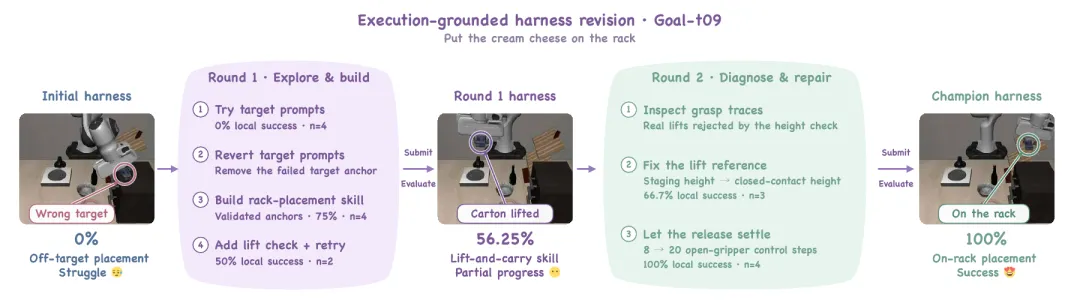 △The process of developing skills.
This process leaves behind skills that can be further developed: transportation, release and limited retesting are retained, and subsequent versions improve their state judgement. Each round of development has specific code and execution results as the starting point for the next round.
The experimental effects of Harness evolution
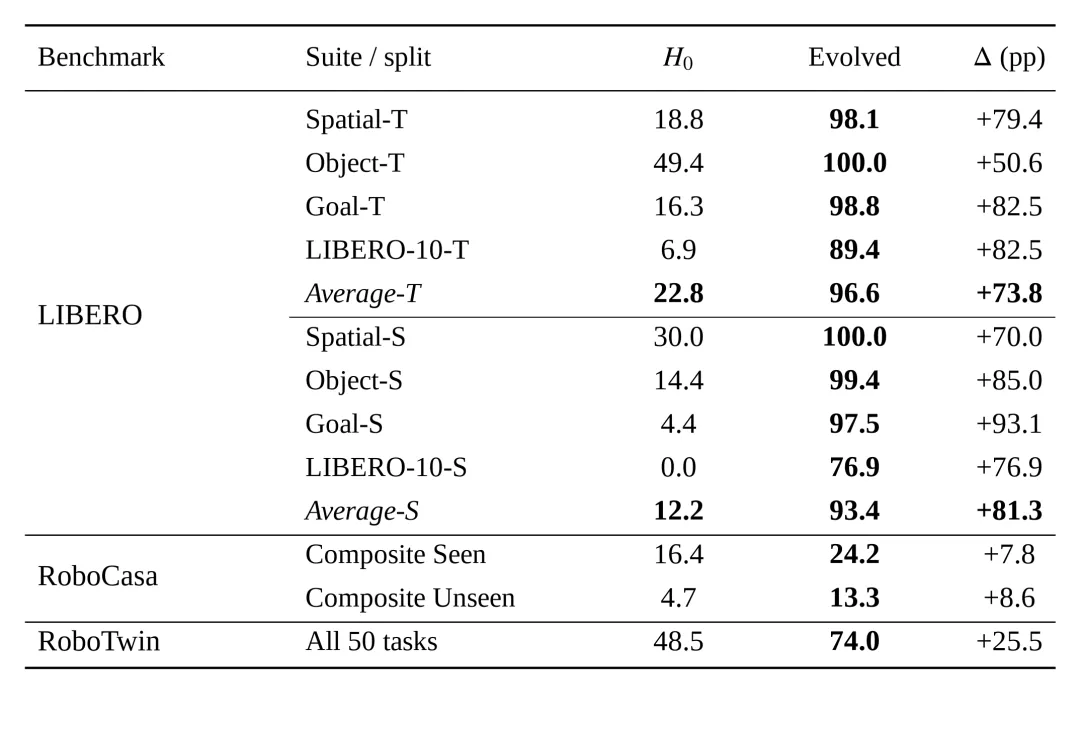
The experiment covers LIBERO, RoboCasa and RoboTwin. The following table compares the initial Harness success rate with the evolutionary version selected for each task.
The average success rate for LIBERO-T and LIBERO-S increased from 22.8% and 12.2% to 96.6% and 93.4% respectively; the average success rate for RoboTwin's 50 missions increased from 48.5% to 74.0%. In multi-phase missions at RoboCasa, the success rate for Seen and Unseen increased from 16.4% and 4.7% to 24.2% and 13.3% respectively.
Round-by-round results extend the overall improvement to specific missions. Eight of the ten goals-T missions were evaluated at 16/16 in the first three rounds of development. The pace of development of different missions remains markedly different, and the performance of subsequent candidates may fluctuate, requiring an evaluation to decide which version to keep.
△LIBERO Goal-T results in rounds.The evolution of the physical and intelligent body
The model training is complete, and the robot's capabilities do not need to be typed for this. VISTA enables the coding agent to continue developing Harness, transforming the experience gained in execution into inheritable skills. Current simulation experiments show that this development can lead to real improvements without changing the model parameters. Furthermore, we hope that robots will gradually take on this part of the job in the real world: developing, verifying and improving their skills based on mission experience, so that capacity growth continues after deployment.
The main page of the project:https://agenticei.github.io/VISTA-page/
Link to the paper:https://arxiv.org/abs/2610.35051
The code repository:https://github.com/AgenticEI/VISTA