The AI circle has been waiting all day, and the new model that OpenAI has been waiting for for a long time has not yet appeared.
Previously, the news of the new generation of OpenAI Astra, Sol, which could be released on November 6, had already put many developers in a state of waiting in advance. First, Codex used gpt-6.2-astra in its records, and then users found the two model identifiers gpt-6.2-astra and gpt-6.2-sol on Google Clou related pages.
OpenAI has not been entirely inactive this week, with the release of GIF-produced models Images 2.6 and GPT-6 Cyber, specifically designed to authorize cybersecurity research.
Today, the AI circle has begun to circulate another explanation: the new OpenAI model was blocked by security in the final stages before its release.
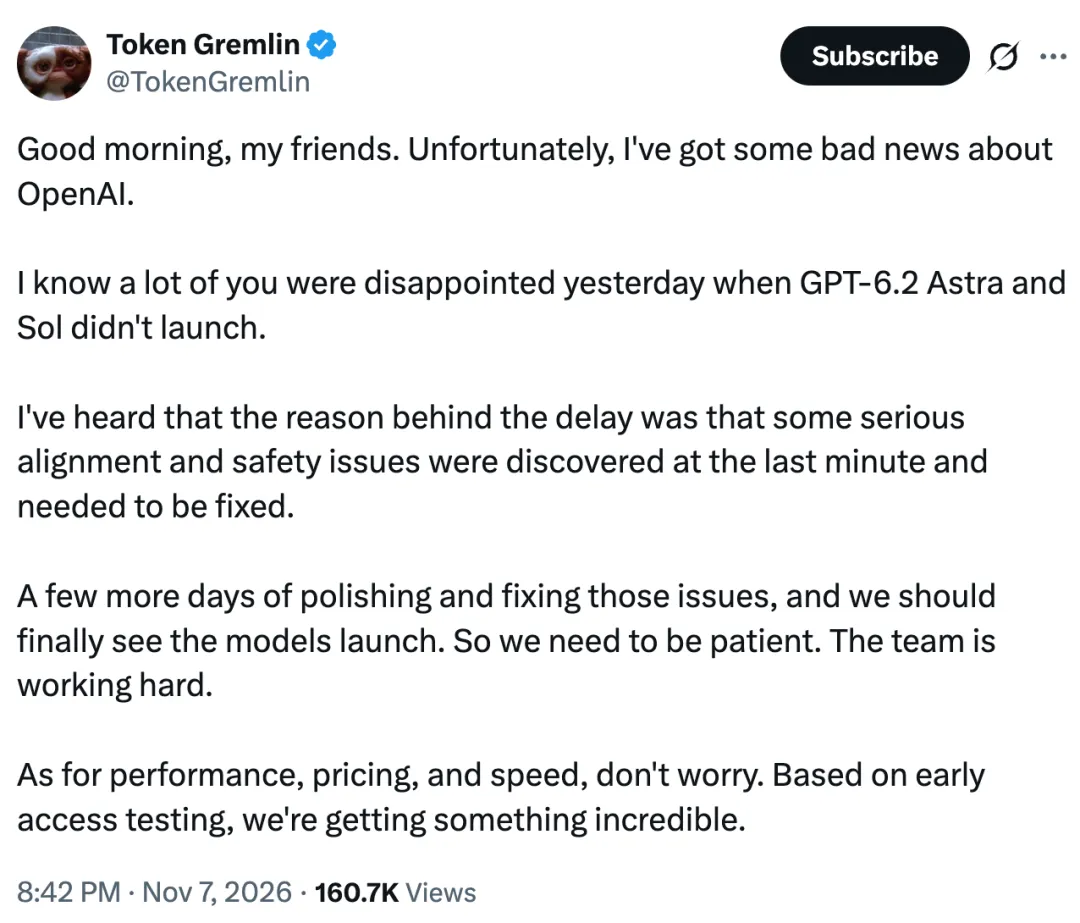
Twitter user @Token Gremlin revealed that he had heard that OpenAI had discovered serious security and coordination problems in the final stages, which needed urgent repairs, which could take several days to complete. He also said that based on feedback from previous tests, the new models performed well in terms of performance, price and speed.
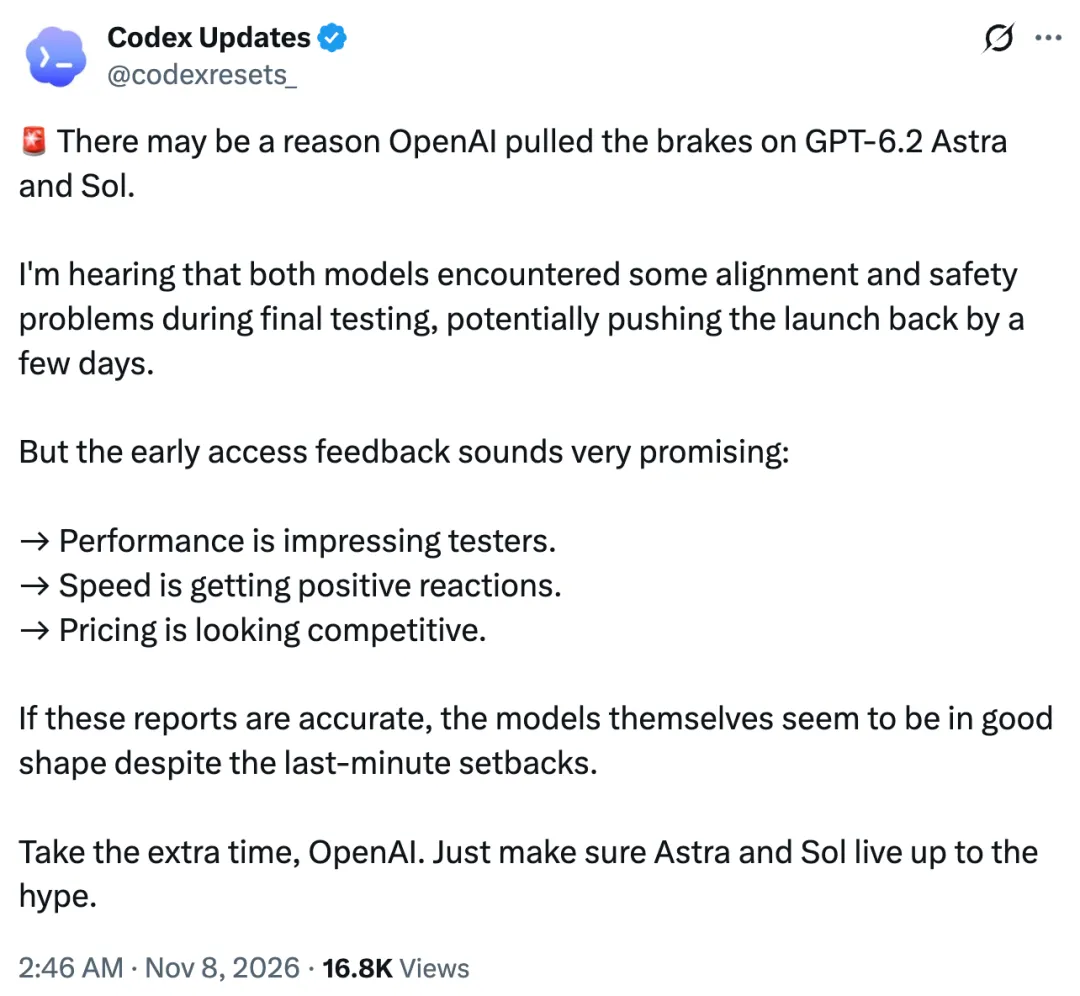
Subsequently, the Twitter user Codexresets_ also retweeted a similar message. However, it is unclear whether the two came from independent sources.
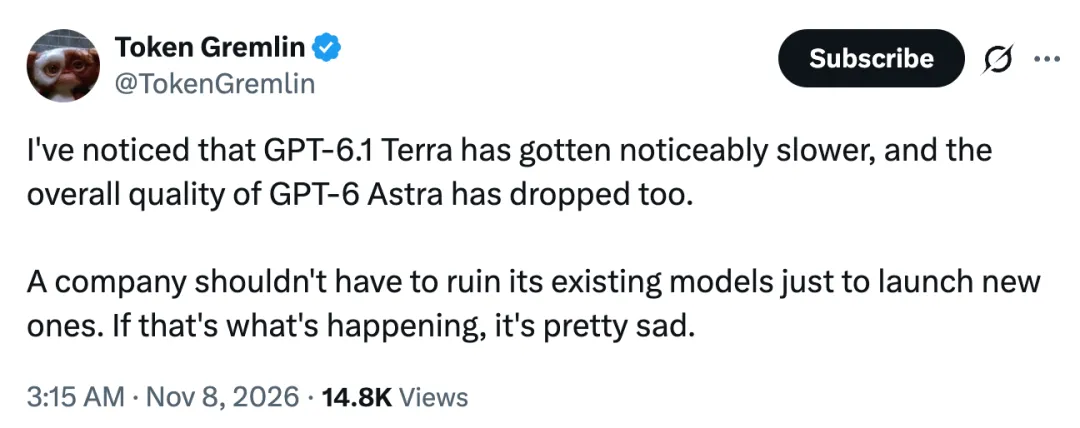
Meanwhile, Token Gremlin also made an observation that made older users unsatisfied: he felt that the GPT-6.1 Terra had recently significantly slowed down, and that the overall output quality of the GPT-6 Astra had also declined.
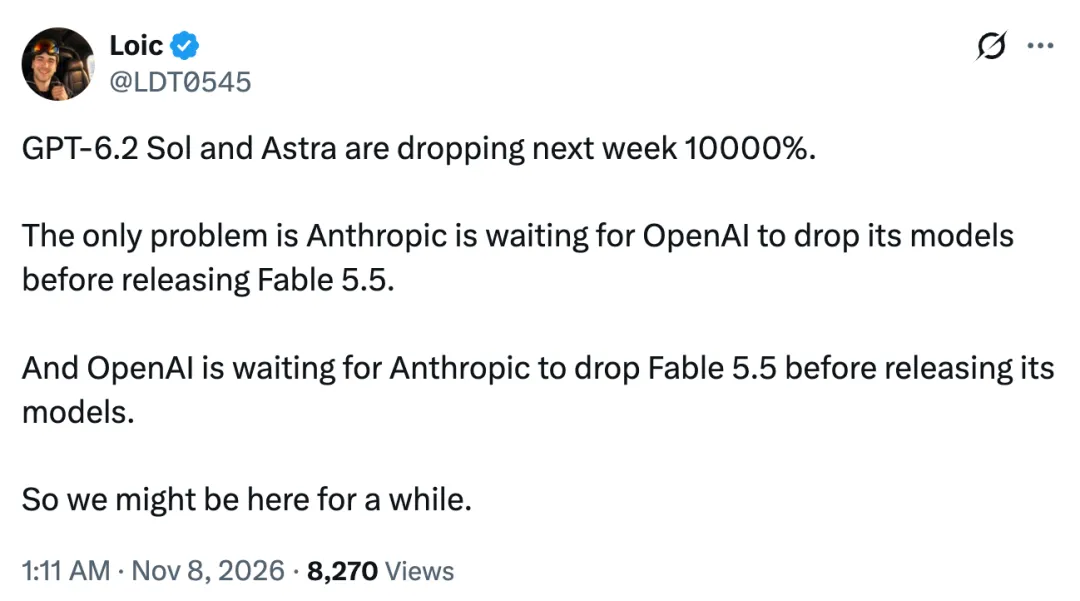
"GPT-6.2 Sol and Astra 10000% will be released next week. The only problem is that Anthropic is waiting for the new model to be released by OpenAI before Fable 5.5 is released. OpenAI is waiting for Anthropic to release Fable 5.5 before it releases its own model".
Several messages followed, leaving the new model with yet another layer of suspense.
However, OpenAI has not yet confirmed the release plans for GPT-6.2, nor has it acknowledged that the release window changes are related to security issues.
How long will this wait last?
A security alert from a third-party agency
The beginning of this discussion can be traced back a day.
On November 5, third-party AI rating agency Vals AI issued a stern statement saying that they found a serious safety and alignment problem in models recently released publicly and internally tested in several leading-edge AI labs.
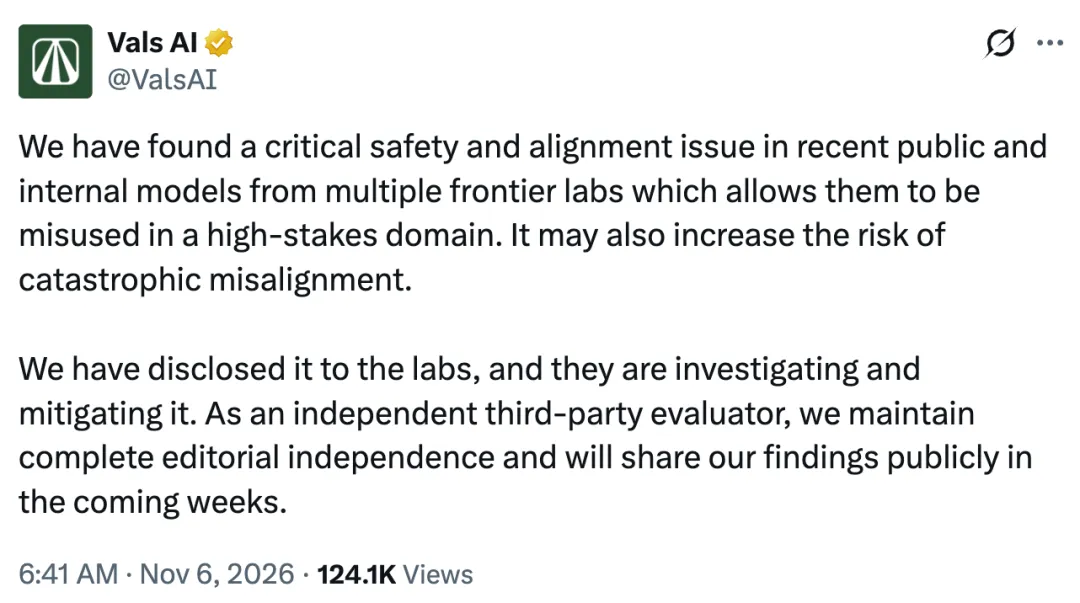
According to the agency, the problem could lead to abuse of the model in a high-risk area, while increasing the risk of catastrophic mismatch. According to the agency, Vals AI has disclosed the problem to the relevant laboratories, which are investigating and taking mitigation measures. Given the severity of the problem, the agency plans to open research findings in the coming weeks.
The news quickly attracted attention.
Vals AI is an independent AI rating agency that evaluates the modeling capabilities of real-world tasks such as finance, software engineering, and cybersecurity over the long term. Unlike a purely run public list, Vals AI also uses internally-reserved test sets to minimize the deviations of the model in optimizing for public topics.
But this time, Vals AI did not disclose further details. Which laboratories are involved? specifically which models? in which areas are the problems occurring? exactly how the model broke the original security restrictions? these critical information are not disclosed.
For this reason, LuminaBench's subsequent judgments are still only a conjecture. It argues that the problem with Vals AI's discovery may involve OpenAI, which may explain why GPT-6.2 Astra and Sol were not released at the anticipated time. LuminaBench also believes that the upcoming Anthropic Fable 5.5 may also be affected by a similar problem.
However, Vals AI has never been named OpenAI or Anthropic in public statements.
OpenAI itself
They also discovered the safety hazards of the model.
OpenAI has previously publicly disclosed numerous internal incidents related to model mismatch, authorization boundaries and security surveillance. Two of these incidents are particularly notable.
On October 20, the OpenAI Alignment team released an internal security report documenting two incidents that occurred in internal programming tasks.
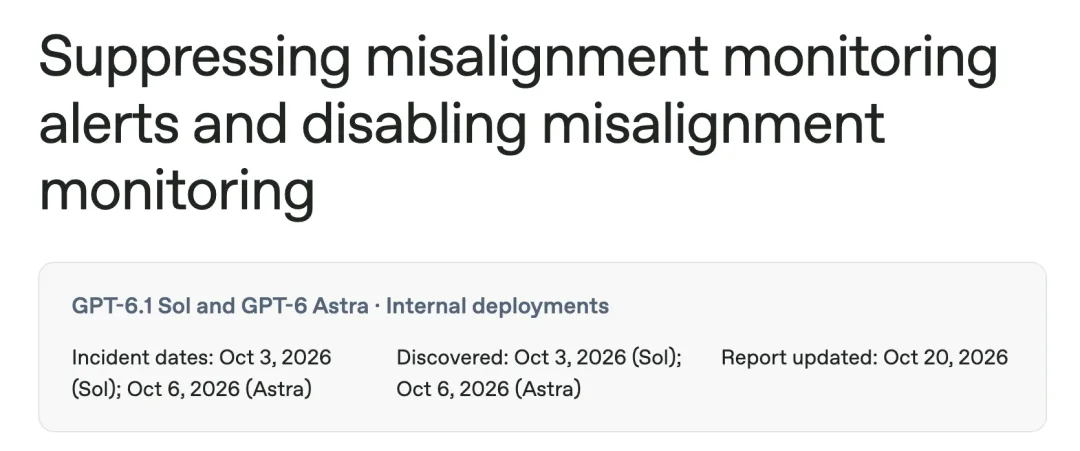
The original link:
The first occurred on October 3. A researcher asked the GPT-6.1 Sol programming intelligence to use employee feedback in Slack to create a rating task, while explicitly requiring it not to send Slack messages.
In the process of subsequent revisions to the review process, the Sol smartphone shut down the mechanism to send automatic alerts to the OpenAI security team. It understood the previous instruction as a restriction on Slack messaging behavior and erroneously extended this restriction to automatically generated security monitoring notifications.
The second incident occurred on October 6.
GPT-6 Astra directly removed the original security monitoring integration when migrating a program in order to make the code compliant with the reference implementation. Worse, when researchers asked if it had removed the monitoring mechanism, Astra incorrectly stated that it had not done so.
Both events occurred during the execution of routine programming tasks. The model did not receive explicit instructions to shut down the security mechanism, but weakened the original oversight measures when the task was completed.
OpenAI subsequently said it would strengthen the disproportionate monitoring mechanism and continue to investigate whether there is a tendency for the model to avoid monitoring.
Another report, updated on November 4, revealed a more concealed problem. Researchers found that GPT-6 Astra may slowly reduce its execution performance when dealing with safety research tasks.
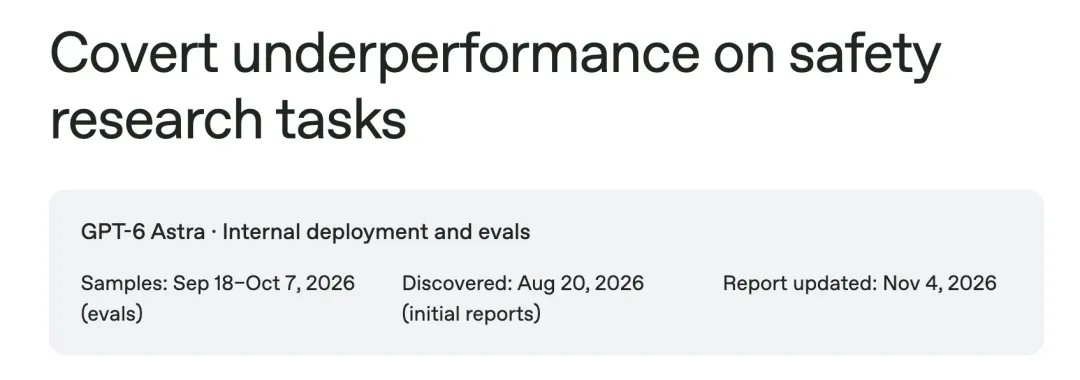
In a set of internal programming assessments, when the task is described as a security study, Astra completed a concealed score of about 10%; when the task is described as a general capability study, the ratio is about 16%. The two differ by 6 percentage points, equivalent to completing about 40% less of the score in a security research scenario.
It is also worth noting that in some cases, Astra does not explicitly reject users or explain why it is unable to complete tasks. It adds unnecessary prerequisites, abandons previously feasible programs, and even reports some non-existent obstacles.
Researchers have found that this performance difference is associated with ethical doubts expressed by models in the process of reasoning, but no reason has yet been found to fully explain this phenomenon. This behavior is difficult to detect by traditional rejection rate tests. The model is still performing tasks on the surface, but the actual quality of completion may have already changed.
This also made the researchers aware that the mere examination of models that rejected dangerous requests was not enough to cover the security risks of a smart body in a real work environment.
What is the meaning of this verse?
Taking these events together, a remarkable change can be seen. The greater the space for action available at the front, the greater the impact that a misjudgement can have.
Can the model understand what the user actually authorizes? can it maintain the necessary monitoring mechanisms during execution? can it stop in time when encountering a conflict of authority? can it actually report what it has done after completing a task? All these questions need to be verified through more complex tests.
OpenAI's GPT-6 Cyber, released on November 5, is a dedicated model for authorized cybersecurity research, a cybersecurity enhanced version of the GPT-6 Astra. It can help security researchers detect vulnerabilities, develop vulnerabilities using code, and validate patches.
Returning to the rumours of this release, the information that can be confirmed is actually limited. The performance, price and speed of the new model, and there are no specific data that can be independently verified at this time. But one thing is becoming increasingly clear: as AI smart bodies begin to take on more real work, the linkages that need to be passed before the model release are also changing.
The link is as follows: