Taken from the Temple of Fujian
QbitAI is public.
GPT-6 Astra was released two months ago, and GPT-6.2 Astra is coming in tears.
However, the body-smart industry has not slowed down God from the previous round of strikes.
It's all so overwhelming.
Remember that when the GPT-6 Astra first came out, a group of fitness practitioners were beaten.
Recently, there have been reports in the industry that some of the smartest companies in the industry have started cutting back on their algorithms.
In the past, GPT-6 Astra has demonstrated a slightly diminished capacity for data, computing and algorithm engineers without the need for additional post-training for specific tasks.
What's wrong with that?

An engineer at a robotics company working on model development told the qubit:
There is no new paradigm breakthrough in the field of embodied intelligence, with Astra representing a large general model that is hitting the embodied industry vertically in a coding way.
The pressure brought by the shock was not entirely from Silicon Valley.
Compared to the technological advances of overseas large model companies such as OpenAI, domestic corporations are more sensitive to the next steps taken by local large model players.
Kimi, DeepSeek, Wise Spectrum... these names are becoming the variables that the fitness industry has to look out for.
In recent hot RoboDojo assessments, more and more teams have begun attempting to introduce their own robotic systems to generic models such as the GPT-6 Astra, which are powerful and capable of striking generalization.
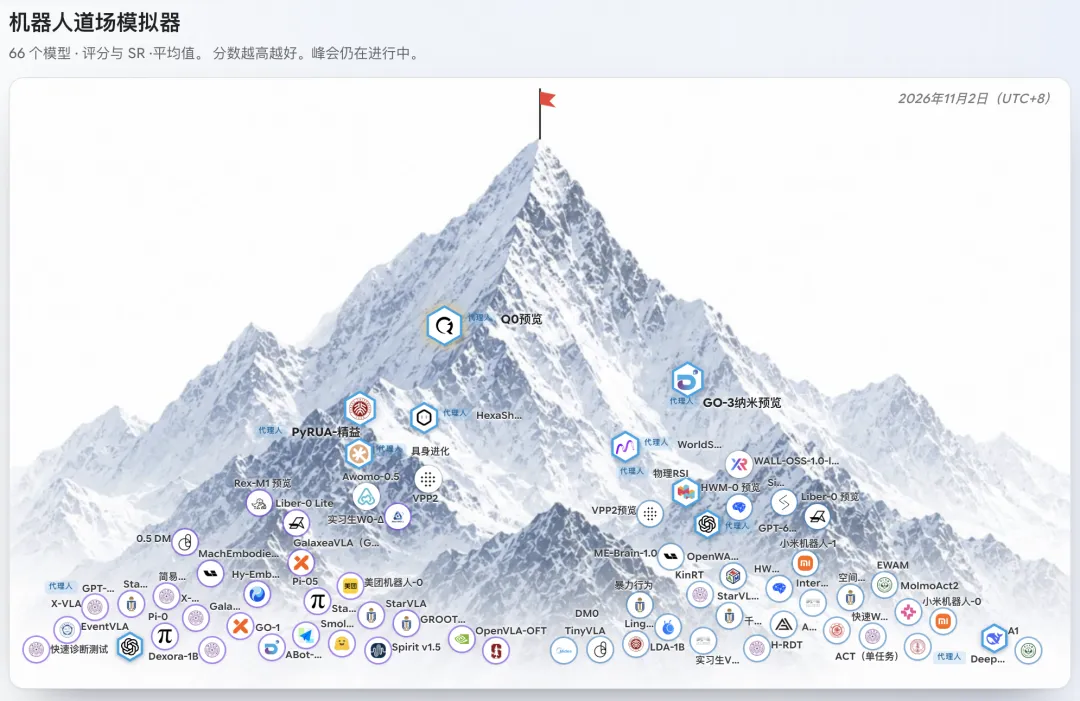
According to the first author of the RoboTwin/RoboDojo assessment of the benchmark, Chen Tianqing, a team that had been training the basic models of the native body has now begun to submit plans to combine technologies such as Robot-Use-Agent (RUA) to complete robotic tasks using the General Large Model.
The results were fairly straightforward. Originally only 20 or 30 points were scored, and the score was raised to 50 or 60 points when combined with Astra-related schemes.
The number of points on the list went up, and there was only one voice in the minds of corporations:
Is there a need for a self-developed model?

As a Ph.D. student at MMLab at the University of Hong Kong, Chen Tan participated in the writing of RoboDojo's assessment and evaluation report on GPT-6 Astra.
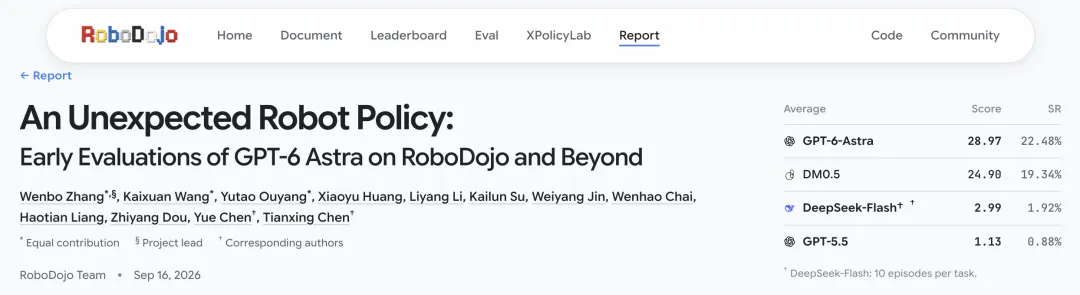 △RoboDojo team reports on early assessment of GPT-6 Astra
Recalling a day in mid-September, Chen told the qubits that while the partners were continuing to get the test results, he waited for a few seconds:
You can see that the impact it has had on 3D reconstruction, on mathematics, etc., is unprecedented.
It's scary. It's scary.
They've all been hit by GPT-6.
The GPT-6 Astra has jumped from 80 to 90 points in a single round.
This is an illustrative metaphor given during this review.
Furthermore, in some tests, Astra did not even do additional post-training for specific tasks, nor did it use a task demonstration.
Unsurprisingly, Astra quickly demonstrated the ability to focus on three body models in the past.
The first is ICL ((In-Context Learning, upcoming literary studies).
Simply put, it's about letting a robot learn a new task quickly through a small amount of context information.
For example, when a human takes a video of his own operation and writes it down, the robot can understand what he is doing and try to restore the machine arm.
In July, the ICL was still a hot topic of research. A common paradigm was to demonstrate human operations, allowing robots to simulate so-called single-situation learning in order to learn new skills.
However, communities have found that providing images or text samples to Astra can be more successful than not providing samples.
What's even more surprising is its online adaptability. Researchers intentionally altered the camera's image and action coordinate system, and Astra was able to adjust the strategy to successfully complete the task based on actual execution results after several rounds of attempts.
In other words, it can not only understand the context but also make edge corrections.
In Chen's view, because the general model itself has a strong understanding of the context, it can remember the history of previous conversations, give it a video, and understand the relationship between video content and text.
To transfer these capabilities to robotic operation, an ICL problem that would have required specialized research is suddenly solved.
The second is OOD (Out-of-Distribution, Out-of-Distribution) and Correction (Correction).
In the real world, robots are easily exposed to situations outside of training data.
For example, a mechanical arm was about to grab a cup, and suddenly the cup was hit and its position changed.
A model that relies heavily on training data may also be executed along its original trajectory, eventually catching a gap.
Astra is able to rearrange its movements based on visual information after the change, and attempts to capture objects.
It sounds like a very small move, but behind it is the problem of whether robots can adapt to the real world.
After all, in the real world, no one is responsible for putting every cup back into practice.
The third is Open-Vocabulary Manipulation.
This ability involves the coordination between language and movement.
For example, when users make different requests for operations, robots can still understand and execute.
In the past, there was often a gap between language understanding and action execution, and body models needed post-training for specific tasks in order to achieve better alignment.
However, Astra has demonstrated stronger capabilities in this regard. In some tests, even without additional training and demonstration for specific tasks, it can perform a lot of robot operations using only language instructions.
In Chen Chen's view, the above three have been highly fragmented technical proposals in the physical sphere, and in the past they have all belonged to companies that can tell entrepreneurial stories separately.
Now that Astra has solved all three of these problems once, it is a near-explosive blow to the original model's development path.
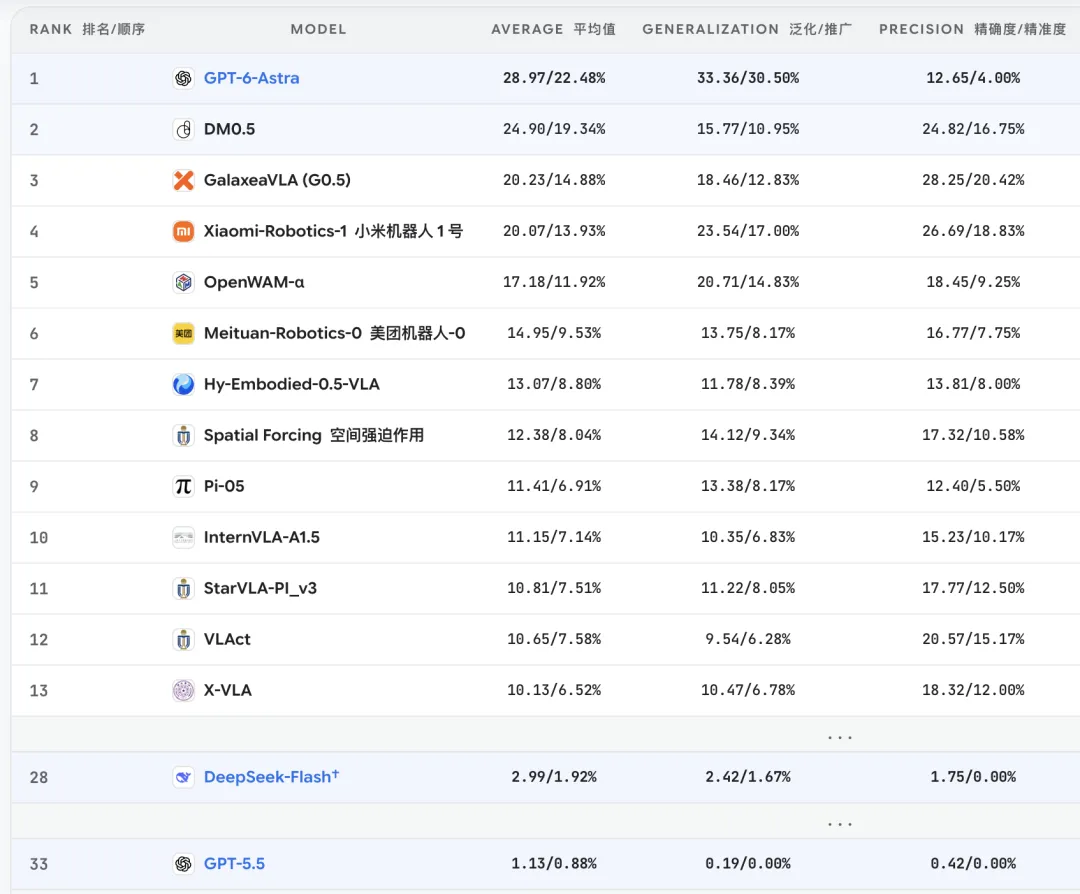 △Zero-sample test results in the RoboDojo-Sim benchmark test do not mean that Astra has been able to perform these tasks steadily on real robots.
In the report, the RoboDojo team pointed out that Astra's machine testing had been suspended due to safety concerns.
High scores on the simulation list are not directly equivalent to real-world productivity.
But it's enough to allow the company to rethink past R&D investments.
Why isn't a generic model that was originally built for robotics and could quickly approach the ability of corporations to build up over the years?
It's a bit unhelpful to say.
While the general model is not about learning robots from scratch, it is about entering the field of robotics with a range of capabilities, including language, vision, reasoning, and coding, in large-scale pre-training.
These capabilities could have been used in a variety of ways, without even thinking about putting them on a robot that could have been directly deployed.
Many teams have trained the robot brain from scratch, and the data in their hands is mainly from the robot itself.

Models need to understand the environment, understand the instructions, learn how to move, and many skills need to be honed from the limited data.
One is to be a robot with a general purpose, and the other is to separate data, computing and human resources for each capability.
This battle is not the same as the runway itself.
Do we still need self-development models?
The GPT-6 Astra was indeed powerful, but it was not strong enough to allow the company to surrender directly.
At least in the real world of physics, there are a lot of hard bones waiting for you.
The founder of the breakthrough robot, Xu Zheng, broke down the ability to be physically intelligent into three levels of semantic, spatial and physical generalization.
He believes that Astra excels in the first two, but still faces challenges in terms of complex physical contact, force changes, object shapeshifting and high-precision operations.
For example, letting a robot know where a cup should be held and letting it hold a cup is two things.
Is the cup soft or hard? How much force should be used when grabbing it? What happens when the object is squeezed?
These problems are not enough to understand the picture, to understand the instructions.
 △The report's snapshot
The RoboDojo team also found in the evaluation that Astra did not excel on all missions.
Geometrical alignment, language instruction understanding are its strengths, but in terms of continuous contact and multi-step physical operations, VLA still has many opportunities.
Wang, the founder of the company, believes that if a general model is to become operational, it will still have to deal with infrastructure issues such as robotic data, real-world assessments, hardware, simulation and deployment.
These difficulties will not disappear automatically because of having a stronger language model.
The question is, what Astra does not do well today, will it suddenly do tomorrow?
Currently, the industry speaks a lot more Astra, and reasoning is too slow.

Chen Chen also noted that the GPT-6 Astra cloud API reasoning has a higher delay, which is a real obstacle to robot real-time closed-loop control.
You think, if a robot had to wait half a day for a big model to make a move, it would be hard to meet the demands of a real scene.
However, Chen Tian believes that this problem is not a fundamental barrier, and that there are already many existing LLM end-to-end deployment schemes, including model quantification, distillation, end-to-end reasoning engines and other technologies. As long as large model companies view robots as an important business scenario, they can use existing technologies to complete delay optimization.
There is a very confusing concept behind this problem: "modeling frequency" and "robot control frequency" are not the same thing.
An unnamed body model engineer told the qubit:
Slow reasoning can still be controlled quickly, sacrificing only the speed of reaction. It is irrelevant for a flow line task compared to the beat-taking type.
For example, crawling sorting requires robots to continuously, steadily, grab and throw. Higher-level models are responsible for understanding tasks, planning movements, and lower-level control systems execute control instructions at a higher frequency.
As long as tasks allow for early planning, or as long as there is some tolerance for delayed responses, large models do not need to participate in each underlying control cycle.
Of course, in the face of high-speed dynamic change, complex contact and other tasks, the speed of response is still important.
But at the very least, slow reasoning doesn't necessarily mean that robots are slow to control.

The types of short boards exposed by today's large-scale models cannot be seen directly as a fortress on which companies can rely in the future.
It's hard to believe that this is true for a company.
But the truth is out there. This year, OpenAI has begun recruiting large numbers of robot-related jobs.
If future generic models absorb more robot-operated data, the limits to the capability of a dedicated body model could continue to be squeezed.
Is there an opportunity for corporate ownership? Is there a need for a self-development model?
Chen Tian's judgment is that the opportunity to have a corporation does not depend on who is smarter than the model, but on who can create better "economic benefits".
This bill is easy to count.
On a highly standardized industrial flow line, robots repeat the same actions every day, with customers most concerned about success rates, pace, stability and cost.
If it costs a few bucks to call a model to complete the task, why not spend a few bucks to call the GPT-6 Astra?
Even if it requires some intelligence and generalization, a small specially optimized model may be more economical than calling Astra directly.

Of course, the situation would be different if a home-service robot were replaced.
Today, I'm packing the table, tomorrow I'm looking for items, and the next day I'm doing a new task that I've never seen before.
In such an open environment, the more tasks change, the higher the demands on understanding, planning and generalizing skills.
In a personal blog post on November 6, Chen Chen explained the difference with two lines.
The left side is "scene demand" and the right side is "modeling ability". The higher the biased universality, the lower the biased efficiency.
△Chinese bloggers"Open tasks can be done more with a general model, stable tasks can be done with rules or light strategies, and the mid-scenes leave room for a scenario-optimized model", Chen said.
In my opinion, two lines of axis are put together and there is one sentence:
Things that can be solved using rules/lightweight strategies don't need to be done with a large model; tasks that can be done with a small model don't need to be done with Astra every time.
Conversely, if the task changes too much, the dedicated model will need to constantly collect data, retrain, and call the general model directly.
In the end, a complete financial account is needed to decide which scheme to adopt.
What is the success rate of a mission? How long does it take? How much artificial intervention is needed after failure? How much does data collection, model training, and long-term deployment cost?
These are real numbers that determine whether a robot system has commercial value.
So it's not self-development that's not important, it's the "self-development direction" of the company that needs to be rearranged.
General models already excel in language understanding, task planning, and other capabilities that can be considered for direct use; problems involving physical interaction, specific intrinsic control, real-world scenario adaptation, and deployment efficiency still require a large amount of specialized research and development.
As to whether it is necessary to continue training a larger body-based model from scratch, it remains to be seen whether it can provide a sufficiently apparent, sufficiently lasting advantage in the actual task.
There are friends in the industry and quantum spacers, and many teams with a stronger academic mindset are always looking to create a general intelligent model and are reluctant to put all the tasks into their own models.
But now things have changed. GPT-6.2 Astra is coming soon.
If the direction of corporate research and the target industries are detached, the model training will be beautiful and the commercial closure will not be established.
One more thing
In the last 60 days, many physical practitioners have been chatting privately and are still confused.
However, when it comes to public occasions, everyone should defend their interests and positions, or stick to it.
What is certain is that the GPT-6 Astra did disrupt the original pace of the fitness industry...
The impact of Mata, the re-evaluation of the post-marketing industry, the RSI becoming a breath of fresh air... are superimposed together, ultimately forming a recent industry sentiment bubble.
"Investors are starting to stop investing".
There may be exaggerated ingredients, but smart robot startups say goodbye to demos, burn investments, but it's unmatched.
The elimination round of the Super Bowl has already begun.