


“ It's a muscle-bone robot, a different way of doing it.
People go one step at a time, with muscle contraction, myopic transmission, straps to stabilize the joints, soft tissue to absorb the shock, so many soft tissue to work together.
Over the past few decades, Kenta, Kotaro, Kenshiro, Kengoro, Musashi, and the number of muscles and walking lines at the University of Tokyo have become more like humans, but they have one thing in common:Most muscles are replaced by steel wire, which has no volume; the joints are also mostly ordinary axis of rotation, which has no ribbon.
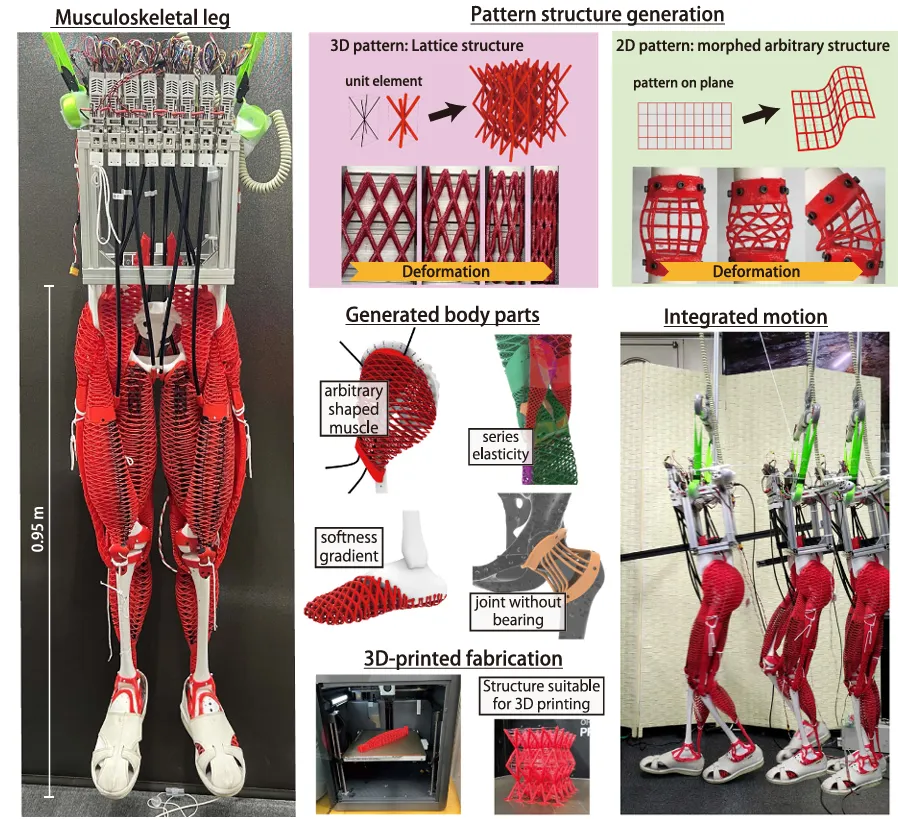
A few days ago, researchers at the University of Tokyo published a new paper on the Advanced Intelligent Systems platform that changed their minds: using only one material TPU95A, an FDM printer, they printed out all the muscles, tendons, ligaments, and underfoot buffers, and then folded them into a 0.95-meter-high, human-sized robot leg.
It was later extended to two legs, with the help of an external suspension to make a left-hand turn.
01.
A set of crystalline crystals can change several parameters to form different structures.
The core of the whole process is calledFlexible Pattern Structure (also called Flexible Pattern Structure)It's two different things.
The first is a 3D lattice. The basic unit is a long square, which connects the center and each vertex with a forked substrate, and then rearranges it in three directions, which can be equidistant or gradual.No reinforcements inside the grid。
The second type is a 2D pattern. First draw a well-forked web on the plane, and then project it onto a curved surface, which is what the back ribbon does.
And the really interesting thing is,If you change a few digits, the soft hardness of the structure can send several numerical levels.
The team used four parameters to describe the three-dimensional unit dimensions of the grid: x, y, z, plus the pole diameter p.pFrom 1.5mm to 3mm, the Zenith modulus is roughly 28 times larger.When x and y take 5 mm, the modulus is 0.08 mm 0.27 MPa, and when magnified to about 15 mm it decreases to 0.005 mm 0.01 MPa, the compression deformation is more than half. Z increases from 25 mm to 40 mm, allowing the hardness to be gently reduced to 1/2 to 1/5 of the original.
So the same grid,The weakest part is the soft muscles and the encrypted part is the hard muscles.。
In myopathy, the team shortened the x from 8mm to 5mm, and the stretch modulus increased from 1.07MPa to 2.61MPa, basically linear. In a single-printed silicon-muscle-muscle complex tube, the muscle end has a compressive stiffness of about 1.3N/mm, and the tendon end has a stretch stiffness of about 15N/mm. In the literature, the human tendon has a stiffness of 10 tons 100N/mm, and the researchers also explain that these values are only a design reference and do not represent exactly the same as real tissue.
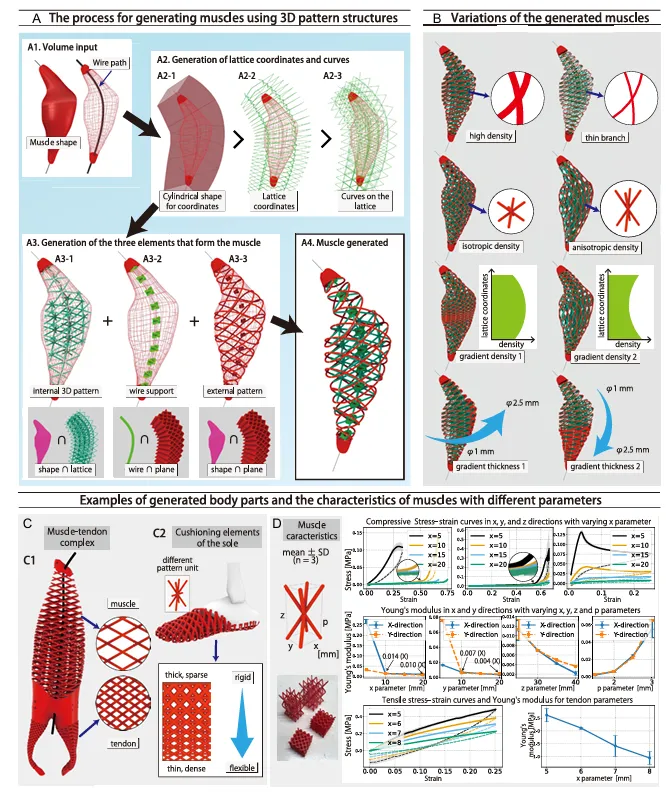
This logic is also applied to the bottom of the foot buffer. By adjusting the direction and thickness of the fork, its stiffness is maintained at about 5 N/mm at the first 5 mm of pressing and then rises to about 30 N/mm.It's soft when you step lightly and hard when you step deep.。
This is not the case with true water-containing muscles, where TPU grids collapse mainly to the inside, rather than to either side of the drum when pressed. The researchers believe that TPU has the advantage of reducing squeezing interference between parts of the robot's body.
02.
Rubber bands are fastened to the surface of the joints without bearing in the joints.
It's more clever to do the joints.
If the cylindrical surface of the joint is stretched into a plane, drawing a pattern in the desired direction, and projecting backwards, the band outside the joint is wrapped. The pattern is oriented to form a single-freedom chain; multiple-freedom joints can be made with a grid of the same sex. Multi-layered projection surfaces can be overlaid to form complex bonds similar to knee-crossed bands.
The team did it this way.The neck, knee, knee, three joints.The knee joint can bend 90°, extend 30°, extend 60° outward, receive 30° inward, the knee joint can bend 150°, the knee joint can bend 30°, bend 15°.
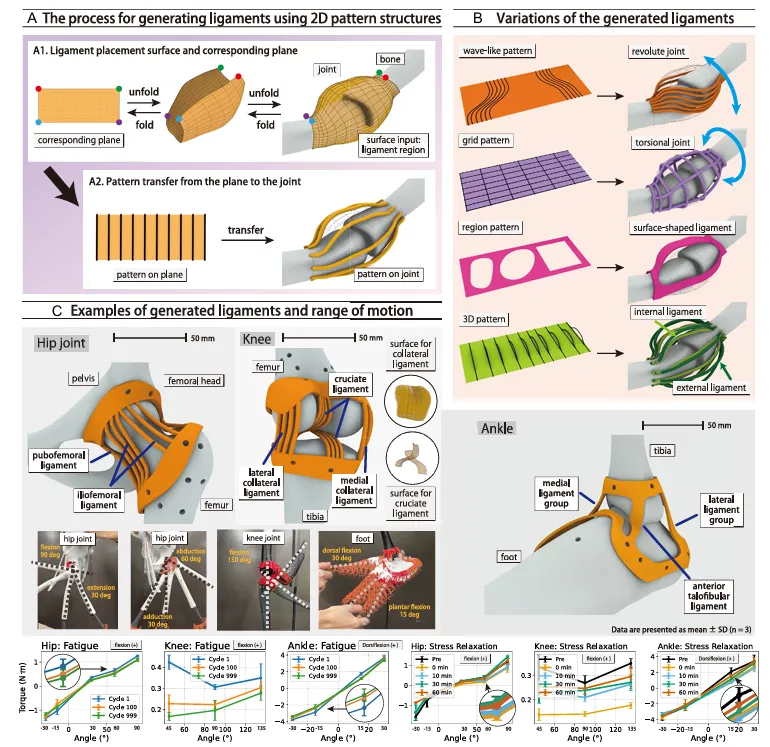
The endurance was also tested. After 999 repetitive exercises,The torque of the knee joint is maintained at about 87° when it bends 90°, the knee bends at about 79° when it bends 135°, and the knee bends at about 94° when it bends 30°.There are no restrictions in place.
If the joints are loosened for 3 hours, the torque will initially decrease slightly due to stress loosening and then slowly recover over time.
At the material level, the research team also measured fluctuations, cycle fatigue and response at different speeds.The apparent changes in mechanical performance were concentrated in the first 100 cycles, then gradually stabilised, with no sample breaking throughout the test.Therefore, the researchers suggested that pre-training the parts be done for a period of time before they are put into operation.
03.
A 0.95-metre real-sized leg takes the first step
It's time to put all the pieces together.
This leg hasThe pelvis, the femur, the femur, the quadriceps.The bones are printed with PLA; the three joints are all bound by a ribbon pattern; the muscles are shortened to six pieces, including two joints that cross the two joints at the same time, and a pair of opposing muscles.Try not to add weight to your legs and feet.。
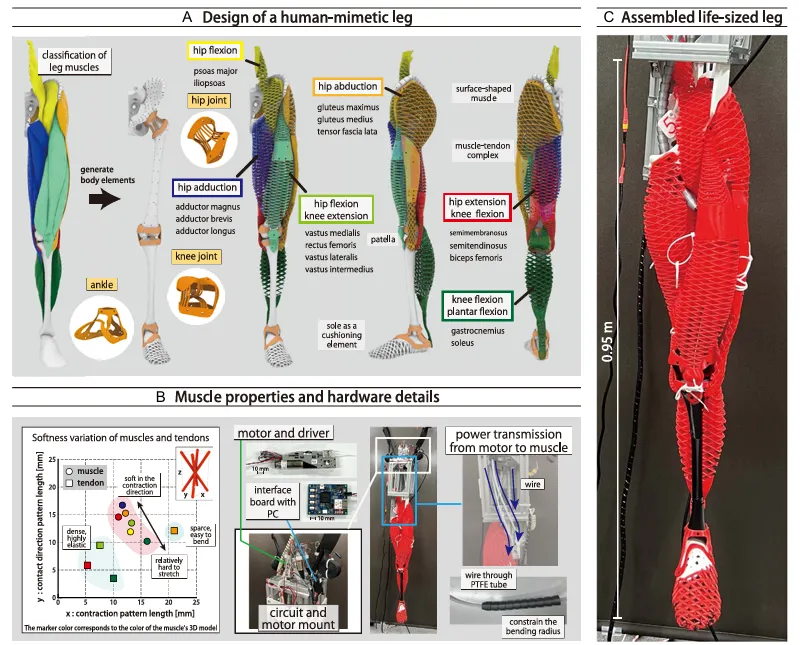
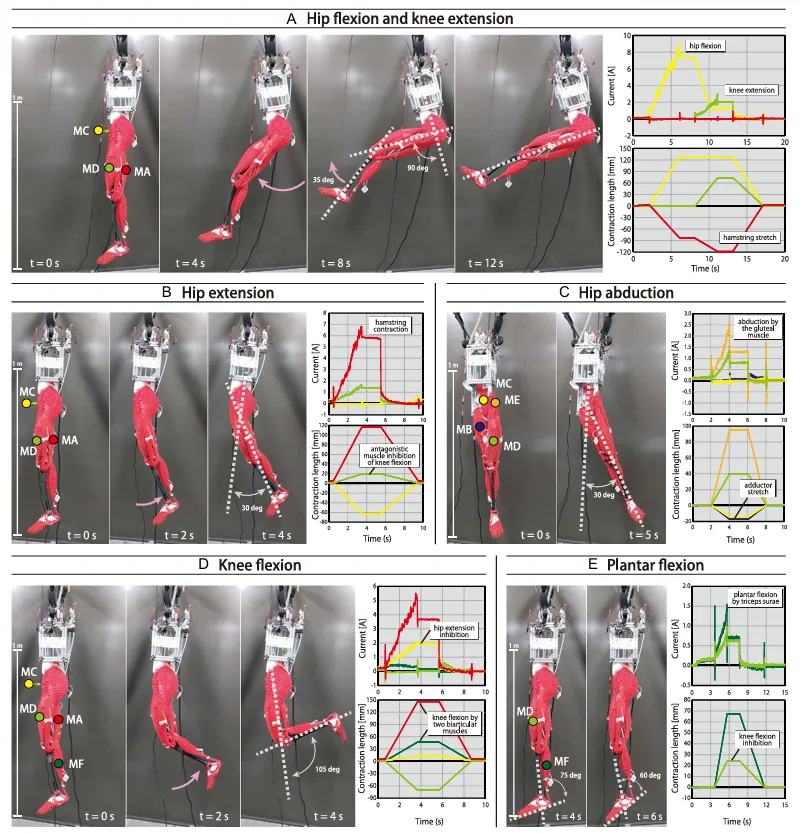
In the experiment, by controlling the length of closure of each steel wire, the leg performed five representative movements: bending about 90° and then stretching the knee, stretching about 30°, extending about 30°, bending about 105°, bending about 15°.
These movements are coordinated between the muscles. For example, when kneeling, the other muscle presses against the knee joint to prevent it from moving.
The team then extended the single leg into two legs, using an external rope to restrain the rope, providing some weight support, and limiting the rope's rolling, tilting, and deflection within ±20°. After driving the set steel wire length sequence, the two legs made successive alternate strokes under both conditions of 0.4 m gait, 1.6 m gait, and 0.8 m gait, 2.4 m gait.
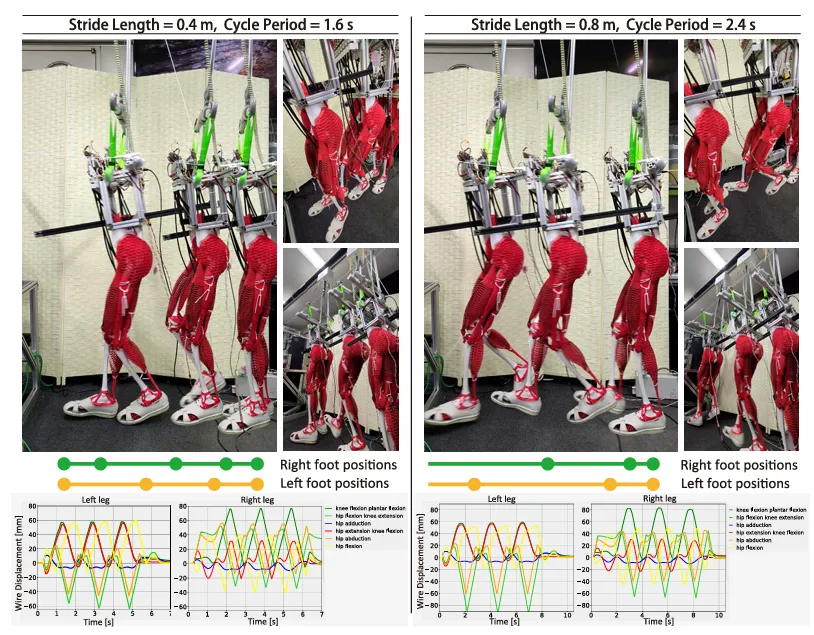
CurrentlyIt's not walking on its own.。The researchers explained that the suspension was intended to disconnect the balance controls first, and to independently test the binding of the joints and whether it is possible to drive the pump itself.
Soft-structure deformation is large, force-arm and steel wire friction can vary dynamically, modeling and controlling is difficult; the current parametric design relies mainly on experimental mapping, and there is no general analysis model yet; printing a real-sized piece of muscle takes 20 tons 40 hours, and machine time is long.
However, from another point of view, this practice does not require molding and also saves a lot of manual labor. The parts can be directly re-printed with the old one, and the customization of different body types only needs to change the parameters.Human-like robots, prosthetic limbs, supporting outer bones, and artificial bodies with built-in sensors.
Before the creation of a muscle-bone robot, each muscle, each joint, was often designed separately; this study unified them into a single set of parametric processes.