
 The successful demonstration of Personal Agent also failed to solve the problem of enterprise-level AI.
Written by Cynthia
Editor's note:
Legend has it that Bader, the god of light, dreamed that he was going to die, so Bader's mother, Frigia, walked around the world and made a vow that everything would never hurt him. All the gods took it easy and even invented a new pastime: turn to throw weapons and stones at Bader, watching him unharmed, to make sure they had conquered the prophecy.
This is the story of Bader's death in Norse mythology. The danger has long been foreseen, and people have taken action, but they still deceive themselves, and once seemingly successful demonstrations are seen as proof that the problem has been solved.。
In the first half of 2026, the enterprise-level Agent market had a similar setback.
At each conference, AI's single-task capability of programming, formatting, coding, and generating posters is updated in turn.Everyone seems to think that enterprise-grade AI has matured.
But in the middle of the year, efficiency rebounded, and everyone was embarrassed to find:Individuals can use Agent three to ten times more efficiently, for the whole team, for the entire company, and overall efficiency improvements are often less than doubled.One person writes the report ten times faster and cannot have the other three departments confirm in advance. The designers made ten plans faster, the operation may still be waiting for merchants to confirm the price, and the warehouse has not updated the inventory.
On November 9th, the official release of Ask Office 2.0 directly hit these pain points.
As the industry's first team-oriented collaboration, Team Agent 2.0 integrates collaboration, document co-creation, and automated tasks into the same Agent product: the team can associate original workgroups and data around the same Agent, continuously discuss, distribute, and execute.
And with the introduction of HQ 2.0 in the context of the production stage,The era of Agent 2.0 has just begun.
01
From singles to collaborations,
The age of Agent 2.0 is here.
How to bridge the huge gap between individual efficiency improvement and organizational efficiency improvement has been the biggest opportunity in the enterprise-level Agent market over the past year.
To achieve this goal, mainstream exploration is broadly divided into two categories: increasing the collaboration capability of the Agent, and increasing the capability of the Agent to existing office software.
The first choice for most Agent players is the first, to give the Agent a group chat. Bringing colleagues into the same Agent's project group to discuss, AI naturally has a context in the team.
This logic seems to work, but supporting multi-talk is just the beginning of corporate collaboration.
Why is there a need for topics, read, online documents, even expressions in a workgroup? Because employees are here every day to confirm things, express attitudes, make a distinction. A workgroup that has been used for many years, and also connects customers, suppliers and partners, accumulates documents, meetings and business records.
It's easy to invite a few colleagues into a new product, but for Agent to get a complete overview, the company needs to migrate the entire workflow.Even customer communication, departmental discussions, document modifications are best done in this new product.
You can drag a colleague into your agent, but it's hard to ask a customer to install a new AI product before they can send him a coupon.
For businesses, both IM and chat tools are far more than just tools. Personnel relationships, authorizations, approvals and business habits have all been formed.
That's why another path is chosen, in turn, to give existing IM tools plus Agent. It's a more pragmatic option, and it does go more than halfway.。
Employees can ask questions, summarize meeting timetables, and learn about the background of the project in their daily chat group without needing to move elsewhere.
The problem is that IM is ultimately a communication space, not a production space. The Agent in the group can help you organize chat logs, refine meeting points, write code, design, modify documents, analyze complex data, or jump to specialized production tools, so the context is broken.
Discussion in the group, output elsewhere, as long as employees download files, switch software, reintroduce the background, co-creation books do not disappear.
Since both roads are only half way, why not make them one?
Ask Office 2.0 was the first to combine the two explorations.
On the one hand, it associates original clusters and project information to allow the Agent to know what's going on in the business; on the other hand, it provides complete task execution and content production capabilities that allow teams to continue to document, process spreadsheets, and modify programs around the same Agent.
In the enterprise version of the collaboration group, different positions can complement the information they have in their possession, and Agent Minor Q will organize progress, consensus and problems accordingly, and then create work to be done according to the division confirmed by the team.
Sales can serve as a working basis for project colleagues; changes in the program can also be reflected in the delivery arrangements in a timely manner. The team does not have to wait for someone to collect all the information and then arrive at the instructions unified to AI.
Team Agent is also distinguished from Personal Agent.
02
Testing: How AI is deeply involved in the real workflow
For the first time since the release of Q2 Office 2.0, we have conducted tests.
The first scene selects a scenario that is complex enough in the context that requires a lot of transportation work to be done.
Usually, when billing is done, employees send electronic invoices to finance, which is then organized, checked, classified, and finally forms billing material. Behind the clear process, there are many trivial issues that actually arise: the same electronic invoice may be unintentionally downloaded twice, sent twice. The invoices need to be sorted into categories, but the costs of different projects and subsidiaries are often confused in the same context.
At the end of each month, hundreds and thousands of bills are collectively submitted at the same time to complete the process of auditing, confirming and organizing, and professional finance takes at least 1-2 days.
Therefore, I personally encouraged the financial recommendation of the thousand questions office 2.0. In the thousand questions office, directly associated with invoice billing related nail groups, the preliminary construction was completed.
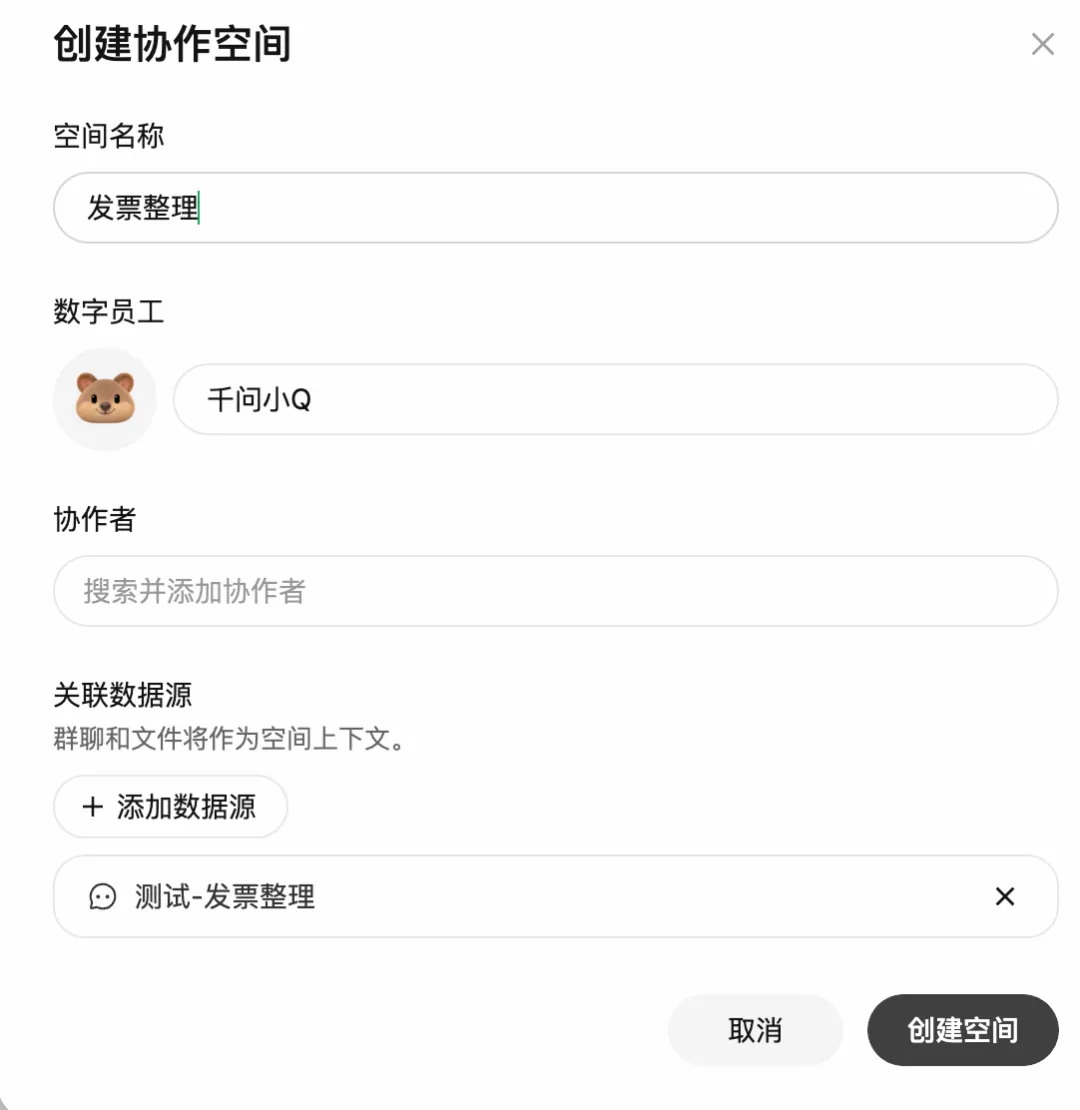
Then, with just one sentence describing the needs and adding a colleague as a co-author, the QB can automatically solve all the remaining problems.
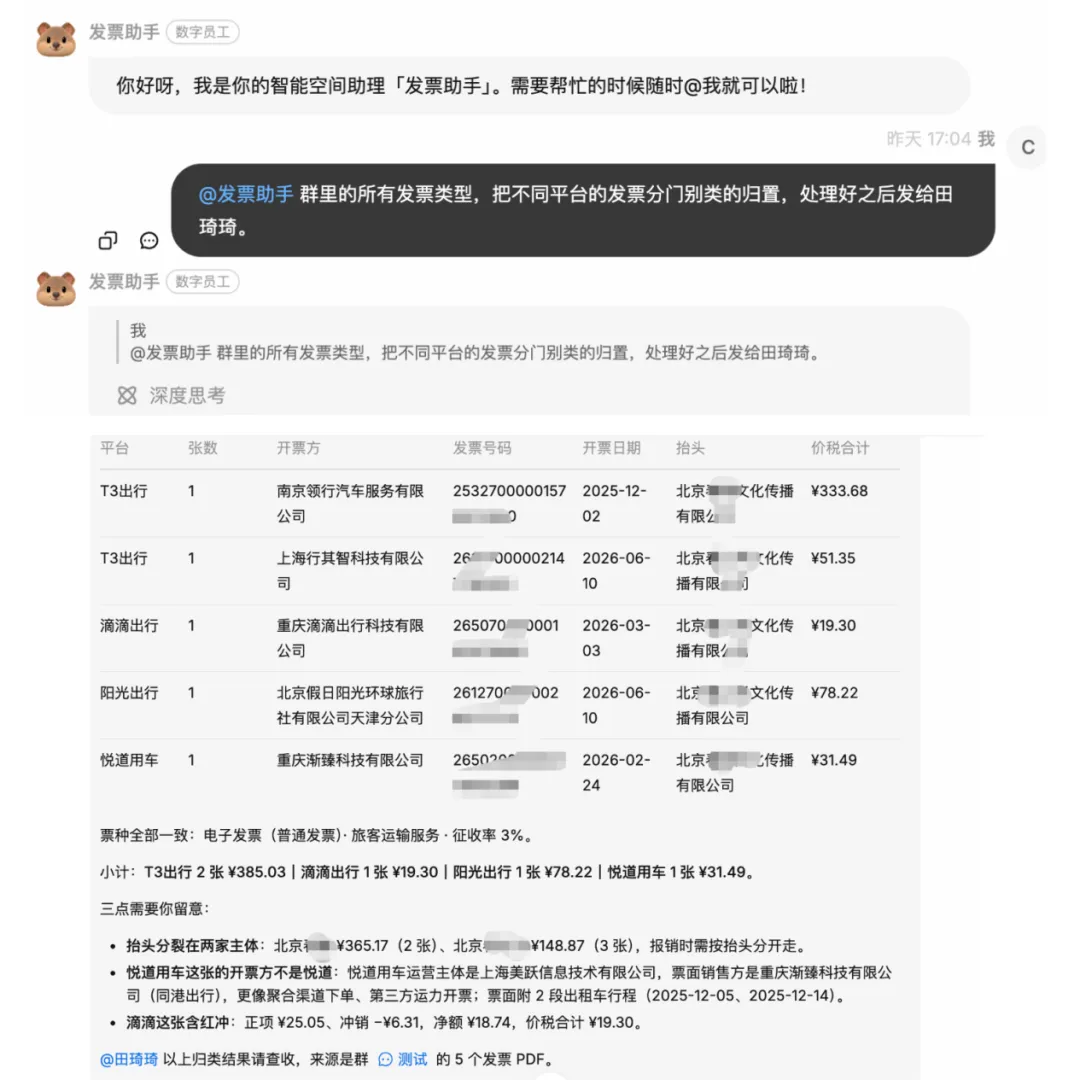
In the past, it took a day or two to arrange the files in the chat logs into folders and upload them to the AI process, and now the Agent can find the content directly from the group chat itself and then do a summary analysis.
There is a lot of similar work in enterprises. Usually, these tasks are not complex in themselves, but the materials are often scattered among different people, projects, and context integration requires a lot of time and effort.
In comparison, there is another situation that has not been approved.The business department may send 20 contracts a day to the legal department, although the legal department only needs to respond to approval or rejection, but the cost of judging can be as much as half a day.
The same goes for brainstorming. Our team has a habit of regularly tracking industry papers, with colleagues in different roles focusing on different areas, and the quality papers we see are put together in groups and compiled by specialists.
But as the number of students and the number of papers increases, it becomes a heavy burden for the students who are responsible for integrating, to read and refine the points.
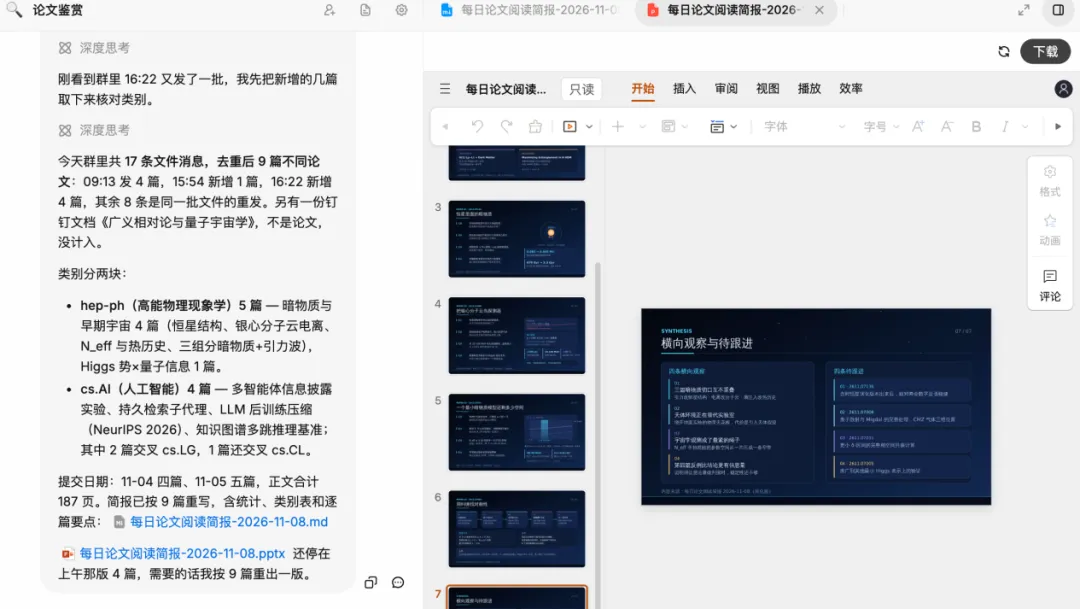
In the end, we chose to associate the collaborative space of the FAQs Office with the daily group discussion papers. What papers are added every day, what are the core conclusions of each paper, what are the innovations worth focusing on, and Agent can all be automatically sorted out. Of course, summarizing the group discussion content, producing PPT, and then allocating tasks is not important.
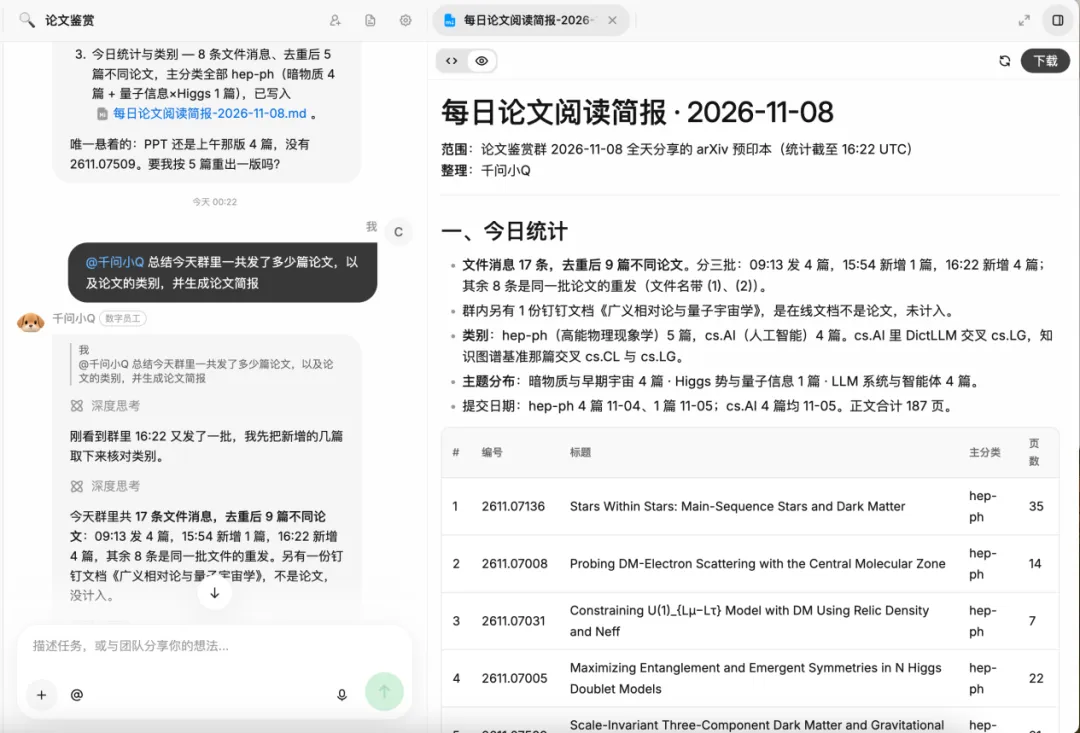
After reading, there is discussion and revision. Some colleagues will use PPT to summarize this week's recommendation paper. If I find a problem, or generate new ideas, I can also edit the document directly with AI in the QA office. In the past, AI re-writing required precise location description, and then replicating the results back to the document.
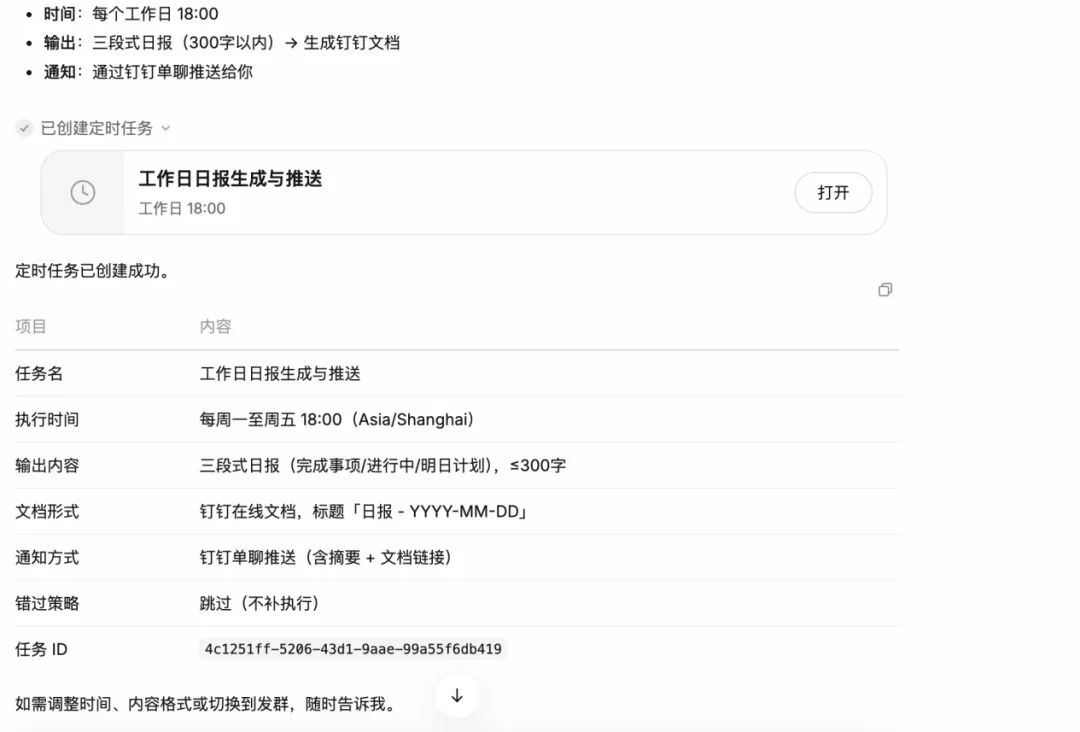
In addition, considering the regularity of the paper, I also set it up as an automatic task, executed on Mondays and Wednesdays of the week.
For our small team, Ask Office 2.0 has solved a lot of the time in the context of collaboration. For those organizations that are larger, the effects of deep collaboration in the context of more enterprises will become even more evident.
In Thailand, the direct-to-air ticket business covers 62 brand stores nationwide, connects more than 200 stores, merchants and operators, annual GMV exceeds 200 million yuan. A group of purchases of tickets from notification to final listing, through archival confirmation, information verification, content production, auditing and release of multiple links, only the information that needs to be verified is the name, price, validity period, availability of stores, materials, etc.
In the past, the work was carried out in dozens of store groups, and no one group could see the complete progress. Operators had to scroll through the chat logs group by group, manually summarize the information to the spreadsheet, and then notify the head of the next link to follow. During the rush, a group of tickets went online, and the entire team had to turn the axis for several days, spending most of their energy looking for "information" and "synchronized progress".
Things started to change after Office 2.0.
The team built a collaboration space in the Millennium Office to connect more than 60 stores' nail groups and ticket AI tables. There was no change in how the stores communicated, no change in what was said or said in the group, but all progress changes were captured by the Agent simultaneously and automatically updated to the central table.
The person in charge wants to know about the preparation of a batch of cards, without having to ask questions group by group, directly in the collaboration space, to get the latest overall progress.
In addition, the team also set up a timely inspection task, in which the Agent will check the status of each card at a fixed time, list the list of conditions that have already been met, then arrange the incomplete information, pending approval, and forward it to the responsible person.
In the past it was necessary for people to follow the information run, now information and tasks will actively find people, the model of production collaboration, starting to change gradually with the arrival of Agent at the enterprise level.
03
What's the reason for the question office?
One fact that has to be acknowledged is that the QB is able to integrate team collaboration and professional agent capabilities, which is the reason why the QB is able to do so.It's in Ali's business genes.。
It connects China's largest corporate customers, serving more than 20 million corporate organizations and nearly 800 million users. Thousands of Q&A companies have spent decades immersed themselves in the context, messages, documents, approvals, and knowledge base of the vast amount of data that is scattered throughout the business process, finally being delivered to Agent in a complete and orderly manner.
It's not just a nail in the coffin, Ali Cloud, the e-commerce platform is a 2B service.
For many industries, production creation is the subject of work, and transportation in the context is just an additional cost, which can be overlooked; but in e-commerce and retail, operations, marketing, customer service, inventory management jobs, the final output may be just a report, an activity plan, a customer response, and more than 90 percent of the working time is spent collecting information, coordinating information, and synchronizing information.
The friction in the context above is the core pain point faced by this type of job every day. Ali itself is one of the largest e-commerce economies in the world, from Taobao Tomatoes to Centaurs, with millions of practitioners inside turning to this pain point every day. This feeling of immersion in real business is a team from a pure AI laboratory that is hard to have naturally.
Finally, one of the most easily overlooked points is that more industry know how comes with the Ali rolling snowball effect.
Thousands of people have been online for the first month, exceeding 30 million, more than half of whom are enterprise users, which means that it has been pushed forward by massive real enterprise users since the very beginning.
The "Corporate Context" capability, which was unveiled in September at the Yunnan Conference, is in essence a 2.0 version of the technology pre-set that is based on structured processing of corporate data, allowing the Corporate Context Agent to truly understand the organization's business logic. From the corporate context to the Team Agent, this path is not imaginary.
Of course, Team Agent is just the beginning.According to the project, future automation tasks will also have access to more internal OA and third-party SaaS applications, and collaboration capabilities will cover more IM platforms, including Microsoft, allowing companies to choose Agent without having to re-select an IM set.
04
The end.
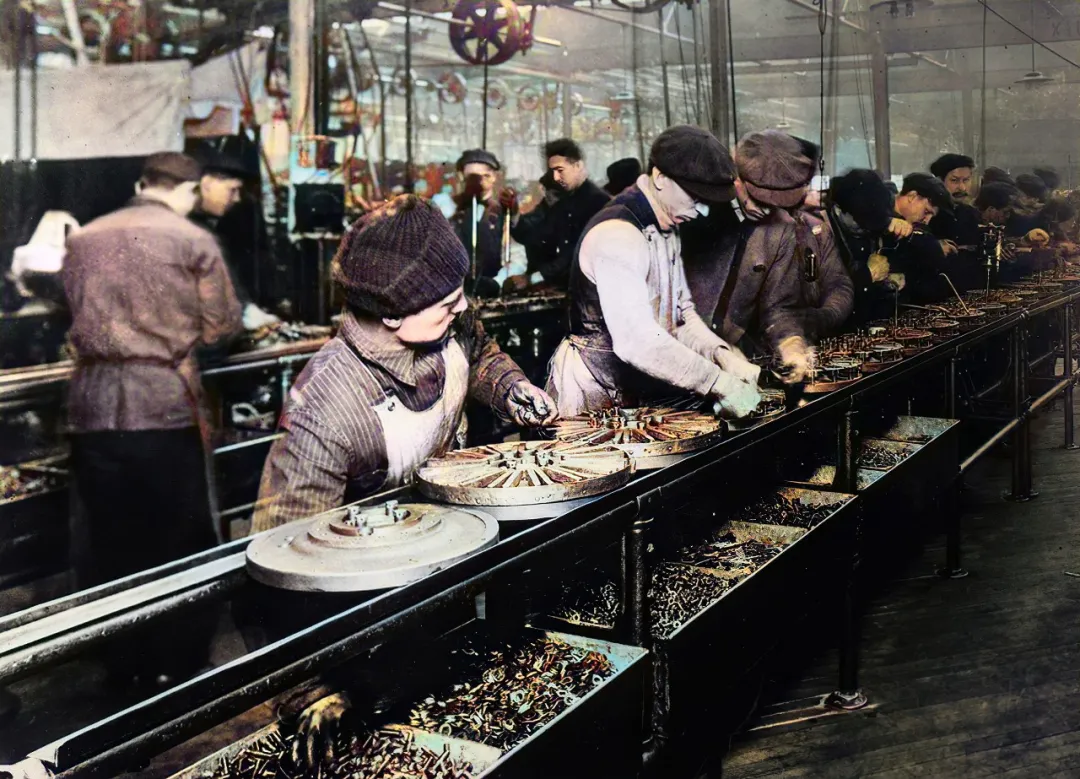
In the autumn of 1913, at the Detroit Highland Park factory in the United States, Henry Ford created the world's first automobile production flow waterline, whereby automobile manufacturing took parts from workers around fixed assembly locations, completed the process with a craftsman-like dynamometer, and upgraded to flow waterline production according to production order. Since then, the assembly of the magnetic motor has been reduced from 20 minutes to 5 minutes, and the entire downline has been compressed from 12 and a half hours to 90 minutes.
In the absence of eight times the speed of the workers, work was reorganized, reducing unnecessary movements, resulting in eight times the productivity jump.
This is also the transformation that Agent at the enterprise level is completing today. From AI accelerating the production process of individuals to AI reconstructing the collaborative model of organizations, the growth of individual capabilities, there is finally an opportunity to transform into a leap in organizational productivity.
This time, the moment of Agent's flow of water really came.
* Source: Visual China
In 1913, at the Detroit Highland Park plant in the United States, Henry Ford created the world's first automobile production pipeline.
A question from the PolesIs Team Agent going to launch a synchronisation of enterprise AI?