


Scaling law + Zero Shot Zero sample generalization: using language to command robots with target images to complete long-range operations
——Open-HumanWAM
Human video pre-training is not a lack of proof of concept, it is a lack of reproducible evidence of scale and comparable routes.Open-HumanWAM, proposed by a team from Beijing University's DAGroup and others, does not continue to argue about the use of filters in human videos, but instead takes the question one step further: how to use, how much to use, and how to share data with robots.

The first step was to build a data base: to organize large-scale human first-person view videos into data that can be learned by robots. The difficulty was not to create a video box, but to extract the laws of operation that could be migrated from human video and converted into the robot's own movements through structural differences across human hands and mechanical arms.
To this end, the study breaks down migration into two interconnected routes:
HumanWAM-Vanilla is pre-trained with human video only, testing robots only to see how humans do and how much they can learn from robots.
HumanWAM-Goal further introduces a combination of robotic data pre-training and visual target conditions, allowing the robot to decide how to operate based on a target image.
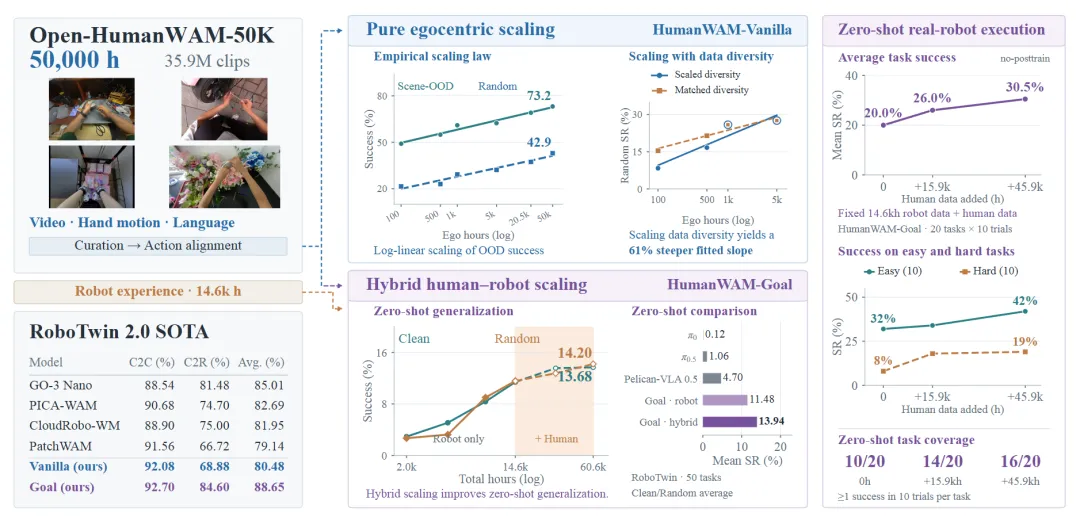
▲The overall research path of Open-HumanWAM: first, using large-scale human first-person video to learn general operating experiences and then adapting to specific bodies through robotic data; further, HumanWAM-Goal combines human and robotic experiences and joins visual goals to enable strategies to adjust actions according to desired outcomes.

50,000 hours of human video should be organized into what robots can learn.
The team first constructed the Open-Human WAM-50K dataset, integrating five categories of open human first-person data sources. After being screened, the data size reached about 50,000 hours, containing about 35.9 million continuous video clips, and accompanied by human hand movement information and language descriptions. The data covered different operational scenarios such as home, business services and industry.
The most important job here is not simply to put the videos together, but to clean and align.
First, the video must show the hand that is working. If the hand is not in the picture at all, it is difficult for the model to connect the changes in the objects seen to the specific movements of the hand.
Second, the motion trajectory of the hand and camera should be stable enough. The original data estimates that gestures may suddenly jump, and the team checks for position, acceleration, torque, and camera movement to remove unreliable footage.
Finally, it is also necessary to remove images that have not been operational for a long time, so that the model does not waste a large amount of training resources on static scenarios.
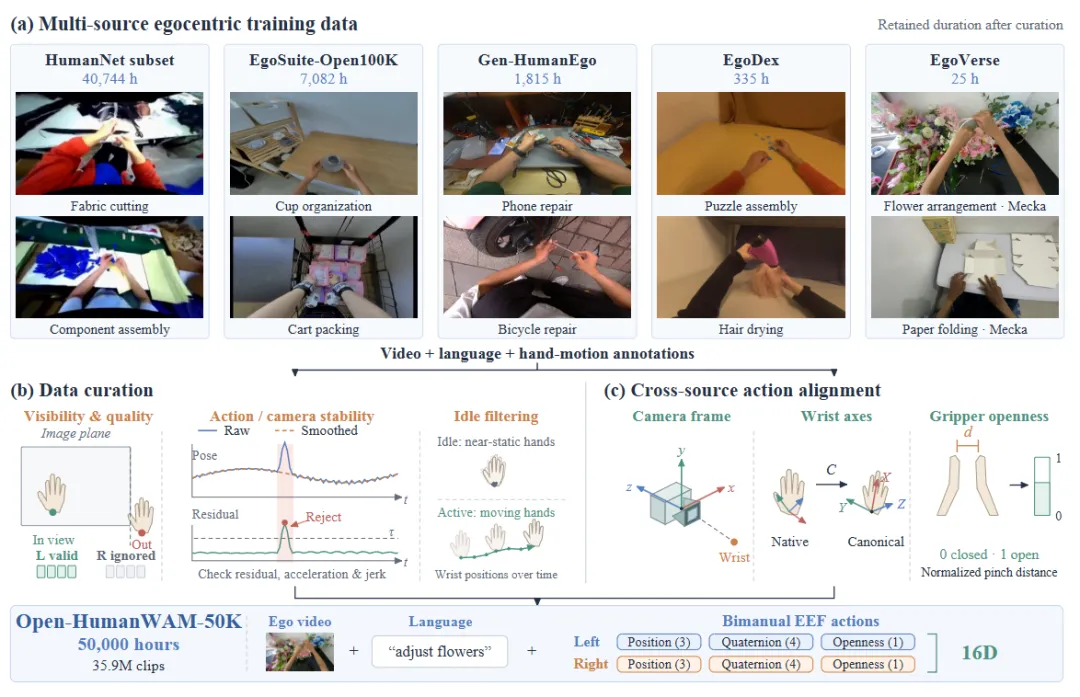
In the future, Open-Hunnan WAM-50K videos from different sources will be organized into a unified set of training data: first, a selection of hand-shaped images of the hand that can be seen, a reliable trajectory of action and movement, then a unified representation of hand-shaped movement and a language description. Thus, the process of action in the video is not just a visual image, but a model that can learn and coordinate the experience of operation.
More importantly, different data sets differ in how the batsman moves. Some records the position of the wrist, others records the critical points of the arm, and others use different coordinate systems.
Research has unified them into a hand-held end executor representation: each hand describes the position, direction and degree of opening.
This does not require human hands and robots to have the same joint structure, but allows both hands to move where, in what direction, open or close the jaw to express the operation.
This step can be understood as establishing a common language of movement for different bodies.
Human wrists and robotic claws do not have to be the same size, but they can both express a slight forward motion and a slight bending to a certain angle. With this interface, human demonstrations have the opportunity to participate in training together with robot demonstrations.

How much can robots learn just by looking at what humans do?
With the data, the team first looked at a relatively straightforward problem:
If the pre-training phase uses human first-person video entirely and then adapts to robot demonstrations, can robots learn better?
This route corresponds to HumanWAM-Vanilla.
The model is based on video and motion co-modeling, which studies the relationship between hand movements and scene changes in human video. Researchers then use robot demonstrations for post-training to adapt the model to the body and control patterns of specific robots.
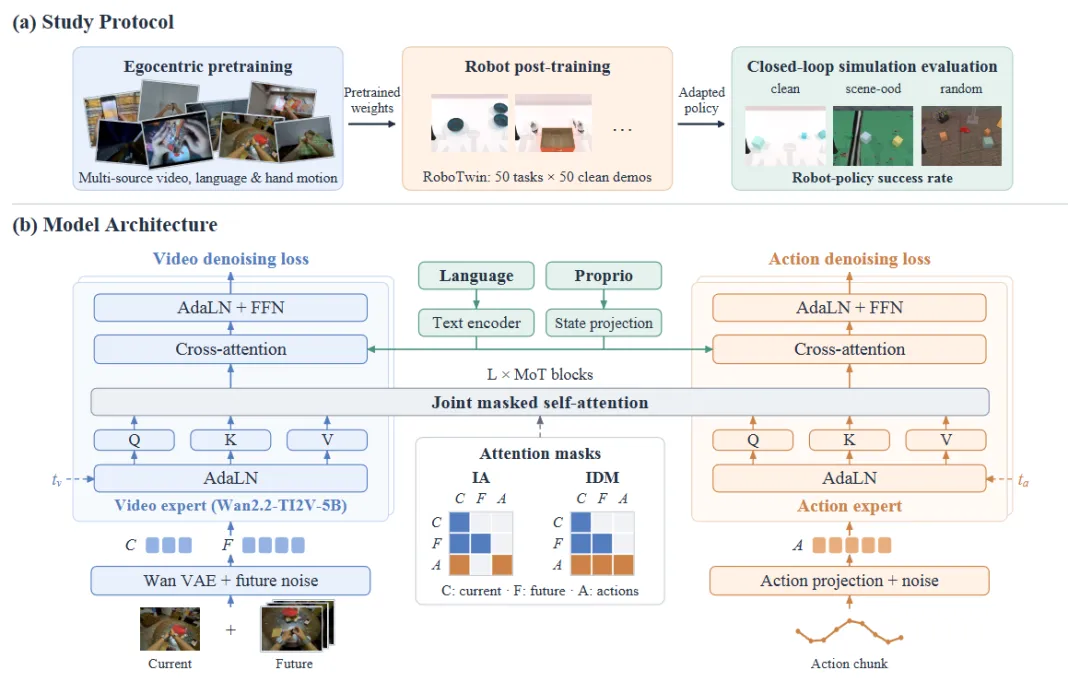
Image: HumanWAM-Vanilla uses a training process to see human operations first, and then to adapt to robot maneuvers: the model learns the maneuvers from human video, language, and hand movements, then uses robot demonstrations to adapt to tasks, and finally to perform a closed-loop evaluation under different scenarios.
Why not directly present human video as a robot?
Because human hand movements and robot movements are not exactly the same. Human videos are better suited to provide broad operational insights, such as how objects are typically grasped, from which direction the hand approaches, and which stages an operation typically undergoes; robot demonstrations are responsible for telling the model how the current robot should perform these movements.
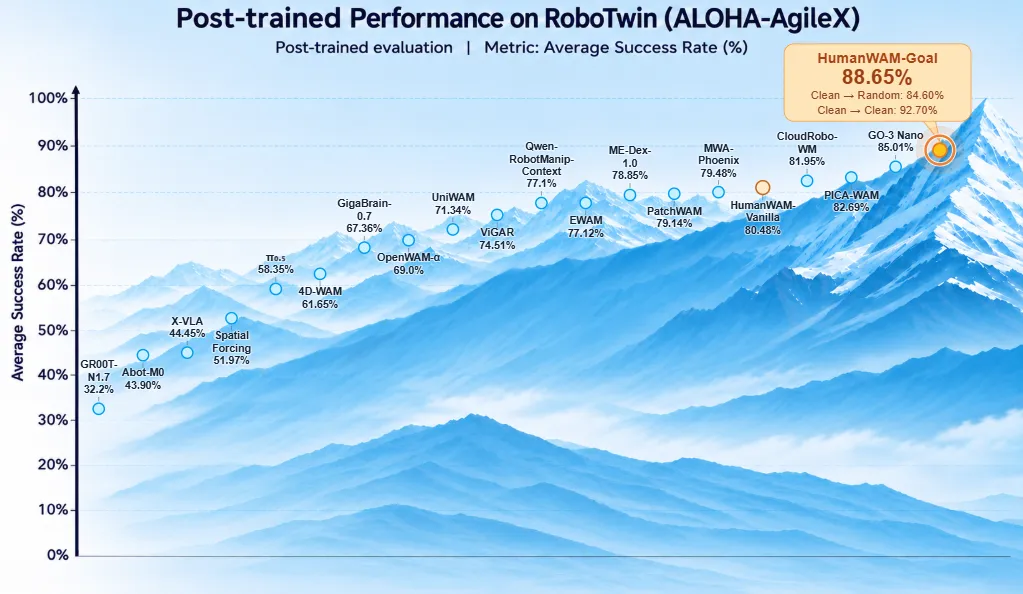
In the final model results, HumanWAM-Vanilla achieved 92.08% in the Clean2Clean setting of RoboTwin 2.0 after robot training and 68.88% in the Clean2Random setting.
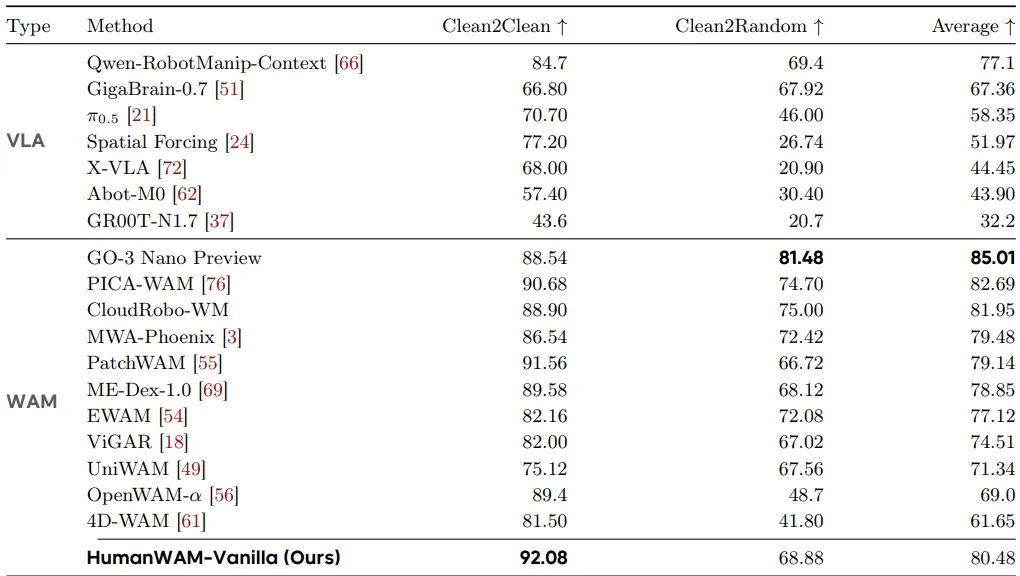
What's that?The results of the evaluation on RoboTwin 2.0.It's a great way to get started.
The study also compared human video pre-training of different sizes in RoboTwin 2.0.
The results showed that with the expansion of human data from a smaller scale to 50,000 hours, models performed significantly better outside the training environment, especially when the background, desktop texture, object placement and lighting changes, models with large-scale human video pre-training are better able to adapt to the new environment. On the contrary, in scenarios very close to training data, the improvement is less obvious.
This illustrates the value of human video, which not only makes robots more skilled at what they've already seen, but also helps them access more objects, scenes and modes of operation, making them less vulnerable to environmental change.
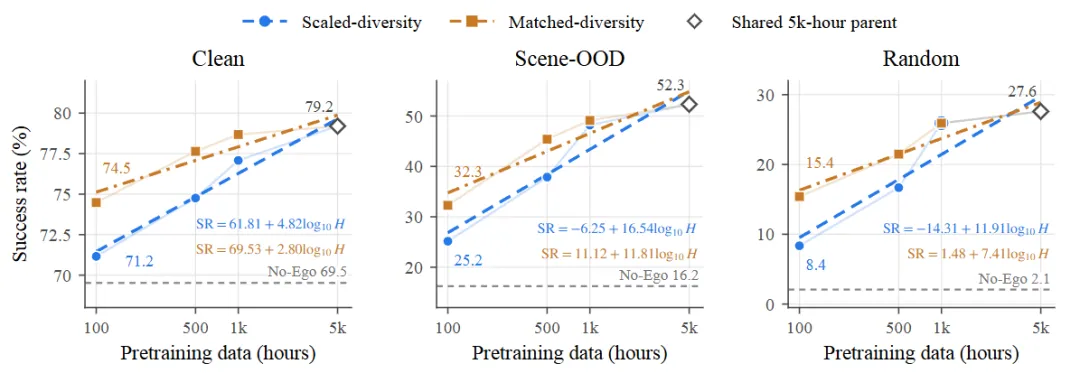
With the increase in human first-person pre-training data, models have gradually improved their performance outside the training scene. Especially when the desktop, background, lighting and object layout change, more human operations experience will help robots better adapt to the unfamiliar environment.
Research has also focused on comparing data diversity.
The researchers constructed different ways of expanding the data: one mainly to increase the length of the video, but the task and scene coverage is relatively fixed; the other, while increasing the length of the task and the scenery, does not stop expanding the scope of the task and scene. The results show that the benefits of generalization are more apparent.
In other words, allowing robots to see more repetitive content rather than allowing them to see more different people, objects and operating scenarios.

▲It's a zero-shot.Eggs and balls, each in a bowl

What else does a robot need, from looking at people doing things to looking at charts and completing targets?
HumanWAM-Vanilla demonstrates that human video can help robots learn, but it still requires post-robot training.
The team then proposed the HumanWAM-Goal, hoping to combine human and robotic experiences to make the model more flexible in the face of new goals.
The most intuitive change is the addition of a target image.
In the past, robots often needed to know what to do through language instructions, such as a mouse placing a laptop in a slot on the right.
However, language can sometimes be difficult to accurately describe the positioning relationships between objects. The target image can directly show the state you want to see when the task is completed: where the notebook should be, in which direction the bottle should be, and what the relative position between objects should be.
The model simultaneously receives current observations, language instructions, robot status, and target images, and then predicts future visual changes and movements. The target image tells it what a mouse should eventually turn into, the current image tells it what a mouse is now, and the model needs to generate an operating process between the two.
This is also the difference between HumanWAM-Goal and purely simulated video: it does not simply replicate a human-made action, but attempts to adjust behavior according to the target state.
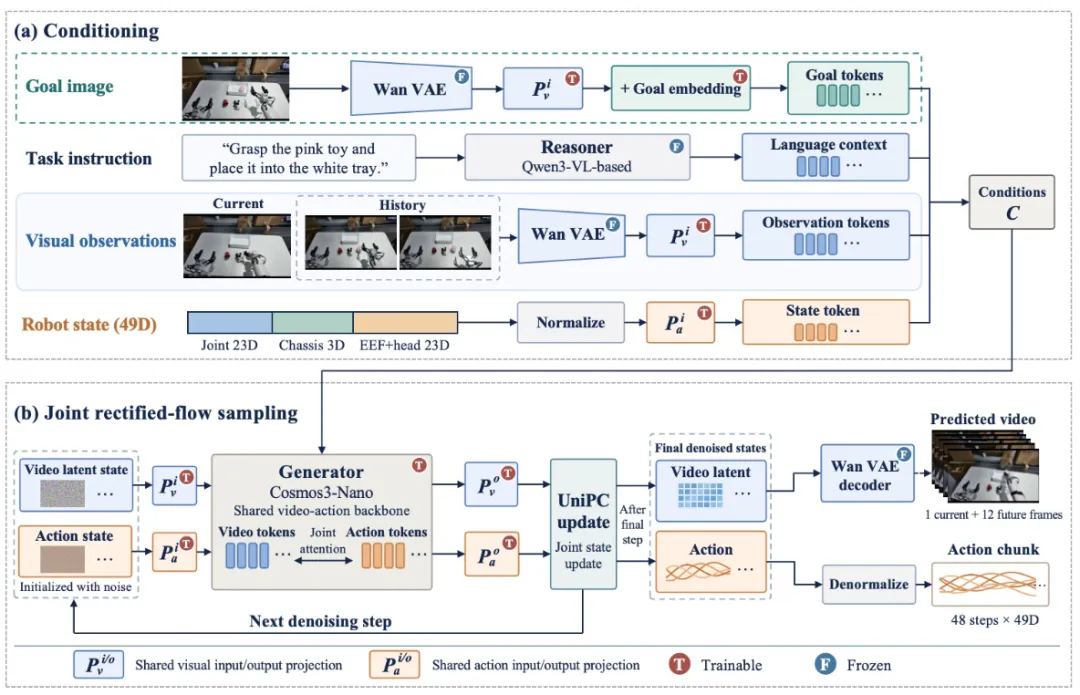
Image: HumanWAM-Goal combines language instructions, current observation, robot status, and target images as conditions to generate future video changes with robot actions. The target image is responsible for describing what the mouse will eventually become, and the motion prediction is responsible for giving the execution process from the current state to the target state.
In order to achieve this, human and robotic data must be further integrated.
Research has established a unified motion interface for different robots, incorporating information such as the movement of the two-handed end of the executor, claws opening and the robot bottom. Human video provides hands-operating experience, while robot data complements real mechanical structure, control modes and physical states.
Together, the models have the opportunity to learn how to make a robot addicted to addiction and how to make a robot addicted.

▲The first thing that robots do is put a lid on the cup, and then, based on a human-targeted map, they send the cup to the side of the display or the side of the file shelf.

Can robots really use human experience?
HumanWAM-Goal has a zero-sample average success rate of 13.94% on RoboTwin 2.0. Here 13.94% is the native result of the model not being adapted to the RoboTwin task, and most open source baselines at the same time do not support this rigorous zero-sample assessment.
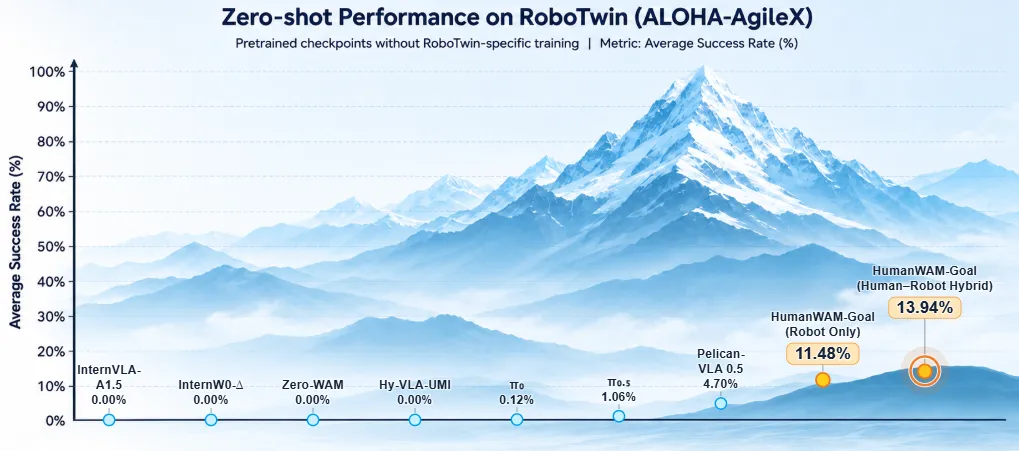
▲Image: Open source model zero-sample comparison.
After post-mission training, the average success rate was 88.65%, with Clean and Random being 92.70% and 84.60% respectively.
In real-world robotics experiments, the research team fixed the size of the robot data and gradually increased human video data to observe the model's zero-sample performance in a set of real-world operations tasks.
After 14,618 hours of robot data, the average mission success rate increased from 20.0% to 30.5% as human data increased from 0 to about 45,938 hours.
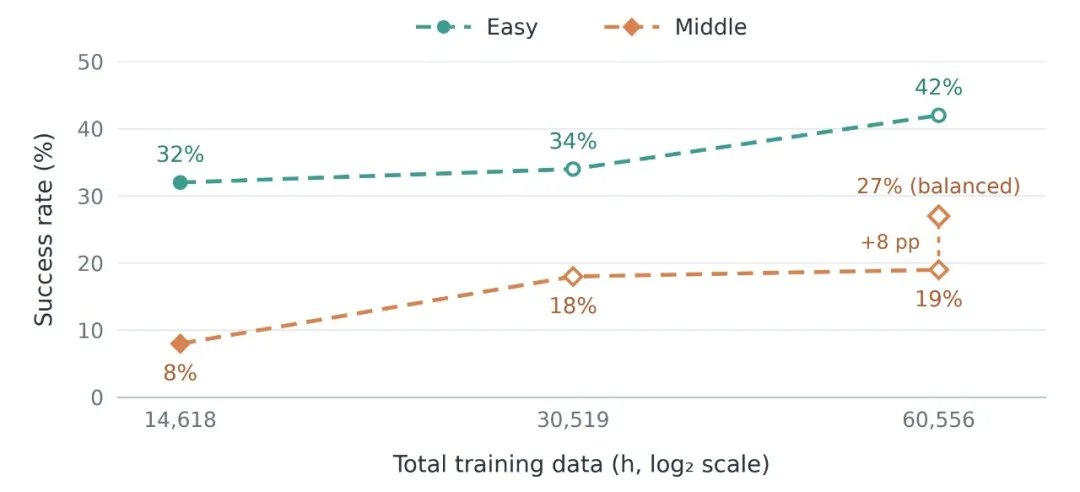
▲It's a real robot with zero-sample performance by task difficulty.
In order to rigorously verify this ability to migrate, the team built a set of real-world sample assessments containing 20 missions, all of which did not appear in the training center.
This shows that the experience provided by human video can not only improve the results of simulation, but can also help with real robots. Here is a comparison of zero-sample evaluation that has not been trained for these targeted tasks.
▲Figure 6 Under the conditions of fixed robot pre-training, the real robot zero-sample operation success rate increased from 20.0% to 30.5% with the gradual addition of more human first-person videos. This shows that the operating experience provided by human video can not only improve simulation performance, but also bring measurable help to real robots.
Another more intuitive experiment is visual target guidance.
Researchers keep the same pre-training tactics unchanged, only replacing the target image, and robots try to place objects in different positions. This ability can be understood as an up-and-down literature learning in a physical scenario: the model does not need to re-train the parameters for each new target, but to adjust movements based on the current given target image.
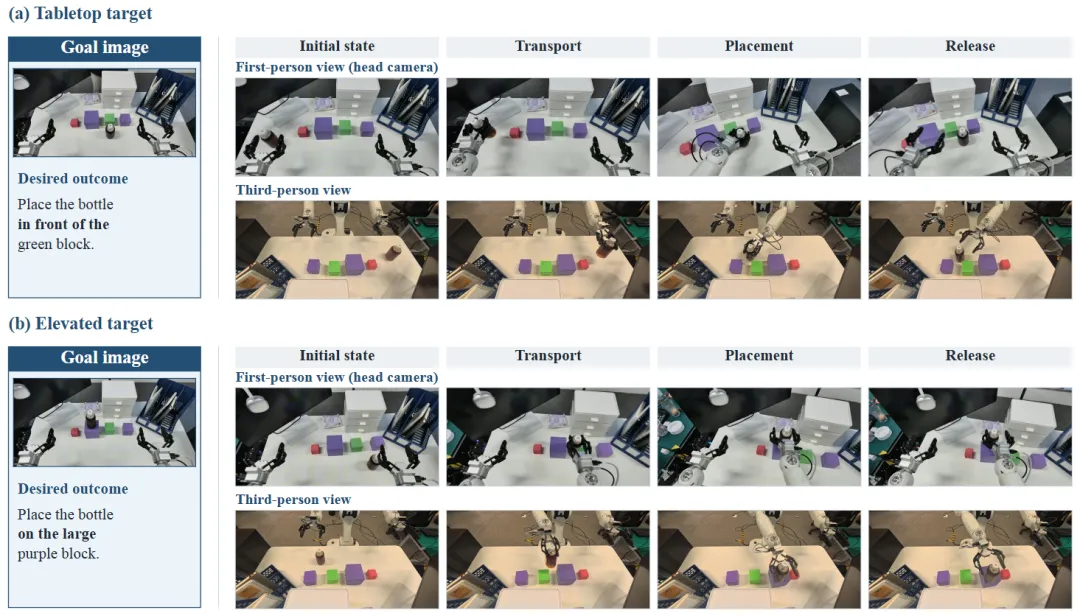
The same pre-training strategy puts the bottles in different places in front of two different target images: one group requires the bottles to be placed in front of green blocks and the other group requires the bottles to be placed on higher purple blocks.
Of course, this does not mean that robots already understand all images as human beings do, nor does it mean that just watching video can completely replace robot data.
The results of the study are closer to an important breakdown: human data extends the scope of operational experience, robot data brings these experiences to a specific body, and target images tell the model what to do at the moment.
Written at the end
What Open-HumanWAM wants to answer is a very real problem in robot learning: it would be very expensive to train a truly universal operating model if all the operating experience had to be collected by the robot itself.
Human beings are taking, organizing, assembling, and transporting objects on a daily basis, experiences that have long been abundant in first-person videos. Instead of allowing robots to practice limited movements over and over again, they must first build their understanding of objects and processes from human experience.
But the key to this work is not simply to scale up human video, but to organize video, language and hand movements into expressions that can be trained together and then physically adapted using robot data.
HumanWAM-Vanilla explains that human experience can be a pre-training source for robotic learning; HumanWAM-Goal further demonstrates the possibility that models can flexibly adjust movements based on visual objectives when combined with human and robotic data.
A robot doesn't have to learn everything from its own hands. It can first observe how humans interact with the world and then turn these experiences into real executable actions through its own body.
Editor's note:
I'm not sure what I'm doing.
Ref
Open Human Scale: An Open Recipe for Scaling Human and Robot Experience for Embodied Foundation Models
Address of the paper:https://arxiv.org/abs/2611.06817
Open-HumanWAM:
Open-HumanScale:
The data collection:https://huggingface.co/datasets/DAGroup-PKU/Open-HumanWAM-50K
Code and model:https://github.com/DAGroup-PKU/HumanNet/tree/Open-HumanWAM