

GPT-6 Astra's scenographic modeling capabilities are impressive. But realistic restoration of geometry and appearance does not mean accurate grasp of physical laws. Avoidance of object wear and tear, using semantic precision to estimate physical properties, and precise projection of object motion. The latter also require further identification of masses, friction lines, and resistance counts in order to only observe certain properties and parameters.
The Asking the World (ATW) framework, proposed by a team at Tsinghua University, allows AI to independently construct a functional physical simulation world based on video, and to obtain evidence through attribute queries, motion simulation, and conditional intervention, answering questions such as physical properties, motion prediction, and counterfactual reasoning. With Gemini-3-Flash as its base model, ATW achieved an overall accuracy of 80.82% and 70.56% on the two physical reasoning benchmarks, CLEVRER and ContPhy, respectively, compared to direct video responses, improving by 46.50 and 28.10 percentage points respectively.
As a sequel to the team's PhysMind, ATW inherited the idea of retrieving the physical world from video, then experimenting with reasoning, further allowing the intelligent body to decide how to model, which experiments to conduct, and extending the method to more material and physical scenarios.
This method requires no additional training or fine tuning, and offers more economical model options: calls are much less expensive compared to Astra, Gemini-3-Flash, or other visual language models. ATW uses visual language models to understand problems, select operations, and then calculate motion by physical tools.
01/01 Recoverable from the physical world via video
ATW's methodology is based on the team's previous work in PhysMind. It restores geometry, motion, and physical parameters from video to build a simulated and conditionally modifiable world cup.
For example, if a sphere is removed from the video, which collisions will still occur? The original video does not give an answer. PhysMind will remove the sphere in the reconstruction scene, re-run the simulation, and respond based on trajectory and collision events.
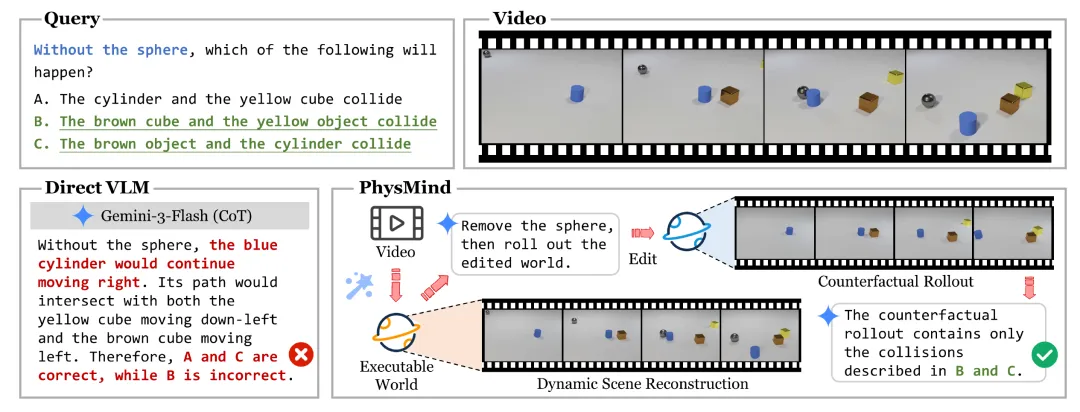
Figure 1: PhysMind provides a basis for judging which collisions will still occur after the ball is removed by modifying the reconstruction scene and running a simulation.
To construct such a world, PhysMind first identifies objects, restores their shape and trajectory, and then combines ground and support correction results. The deceleration of objects while sliding, changes in speed before and after collisions, provide clues for estimating friction and mass relationships.
The system uses a continuous time analysis method to estimate physical parameters such as friction, mass ratio, and collision recovery coefficients to make the simulation as consistent as possible with the observations. This process is called system-recognition simulation.
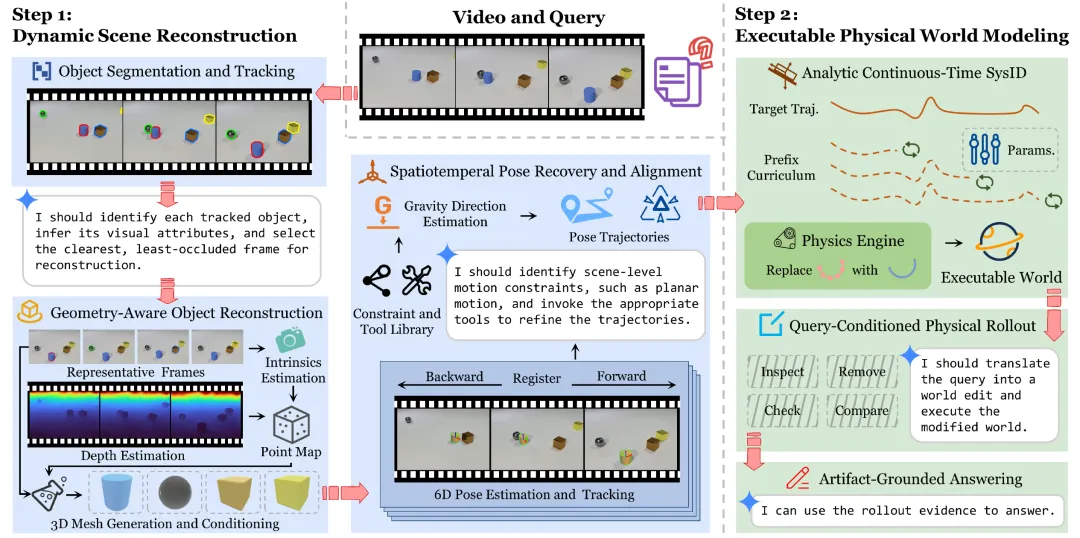
Figure 2: PhysMind's overall process, including geometry and motion recovery, estimation of physical parameters, and the acquisition of reasoning by querying, simulation, and intervention.
With this in mind, ATW has expanded further: how do we allow AI to independently choose the right modeling method for different scenarios and tasks, and decide which experiments to use to get answers?
From modeling to experimentation, autonomous decision-making by intelligent agents
Physical property judgments may be based on reading parameters, while predictions may be based on extended simulation. Missions are different, objects need to be addressed, tools need to be called, and evidence obtained are different. ATW introduces the need for problems into the world of constructing and divides the process into two phases.
During the world modeling phase, the intelligent body selects relevant objects and physical models, invokes appropriate visual tools to restore geometry and motion, and reconfigures physical parameters. It examines the intermediate results, adjusting perceptions, model selection, or parameter estimates based on feedback.
The case in the paper illustrates this process: after finding that the yellow ball is not split, the intelligent body completes the detection and continues the follow-up steps.
After completing the modeling, the intelligent organism enters the phase of detecting the Earth's magnetic field. Judging physical properties, it can query suitable parameters; predicting the future, it can continue to simulate; answering counterfactual questions, it replicates scenarios; intervene. If there is insufficient evidence, it will further query trajectories or conduct new experiments.

Figure 3: ATW selects operations based on mission and feedback, including correction of object leaks, removal of brown balls, and investigation of collision events.
Different experiments are based on the same calibrated world, respectively preserving the results for comparison. On this basis, the intelligent organism launches movements under different conditions and responds according to trajectories and events.
03 Expand to a wide range of materials and physical scenarios
Another advancement in ATW is the expansion from rigid collisions to more materials. Fabrics can bend, fluid can flow, and may interact with other objects, requiring corresponding physical models.
To this end, the team developed PolyWorld Engine, a physical simulation engine for use by intelligent agents.
It is built on Warp and covers rigidities, software, fabrics, ropes, fluids, and their interactions. Smart entities can build scenarios, read states, promote simulation, and intervene through a unified interface.
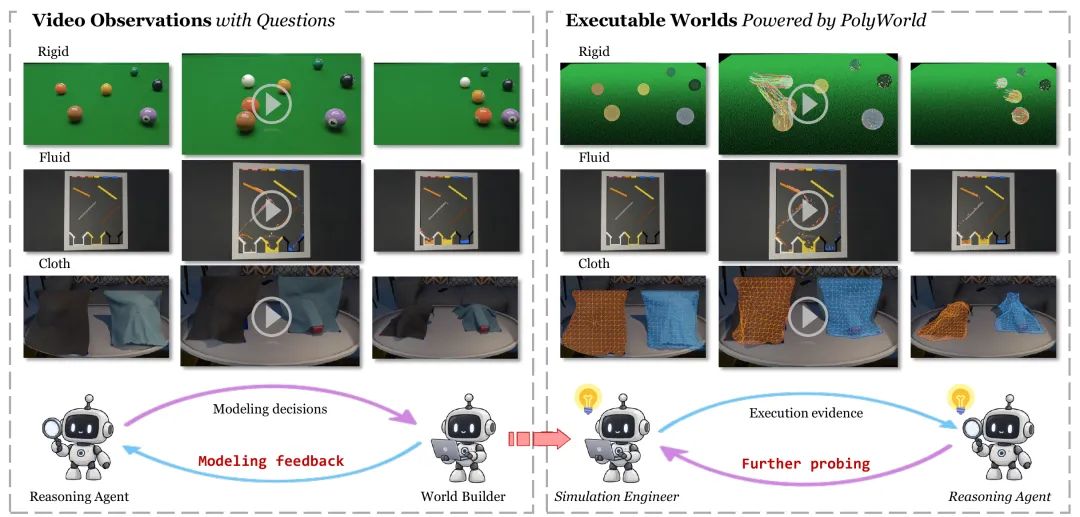
Figure 4: ATW will apply unified modeling and experimental reasoning to situations such as rigidity, fluidity and textiles.
Constructed scenarios still need to be aligned with video observations. ATW compares simulations to observational differences, calibration movements and shape changes by searching parameters. For variable objects, the shape, surface or centerline changes over time. If the deviation is due to object-relationships or physical model selections, intelligent objects can be modified and reconfigured during the modeling phase.
How to test the effectiveness of rebuilding the world using physical reasoning tasks
The motion in the video reproduction was not enough to show that rebuilding the world was physically credible. The team therefore used a physical reasoning task to verify ATW: allowing it to predict events after the end of the video, judge the results after changing conditions, and test whether the dynamics recovered could help AI answer the problem.
On CLEVRER, based on the Gemini-3-Flash model, ATW's overall per-question accuracy was 80.82%, an increase of 46.50 percentage points over the same direct answer model and an increase of 8.27 percentage points over PhysMind.
On ContPhy, which contains multiple materials and continuous medium phenomena, the overall accuracy of ATW is 70.56%, up 28.10 percentage points from the direct response of the same model.
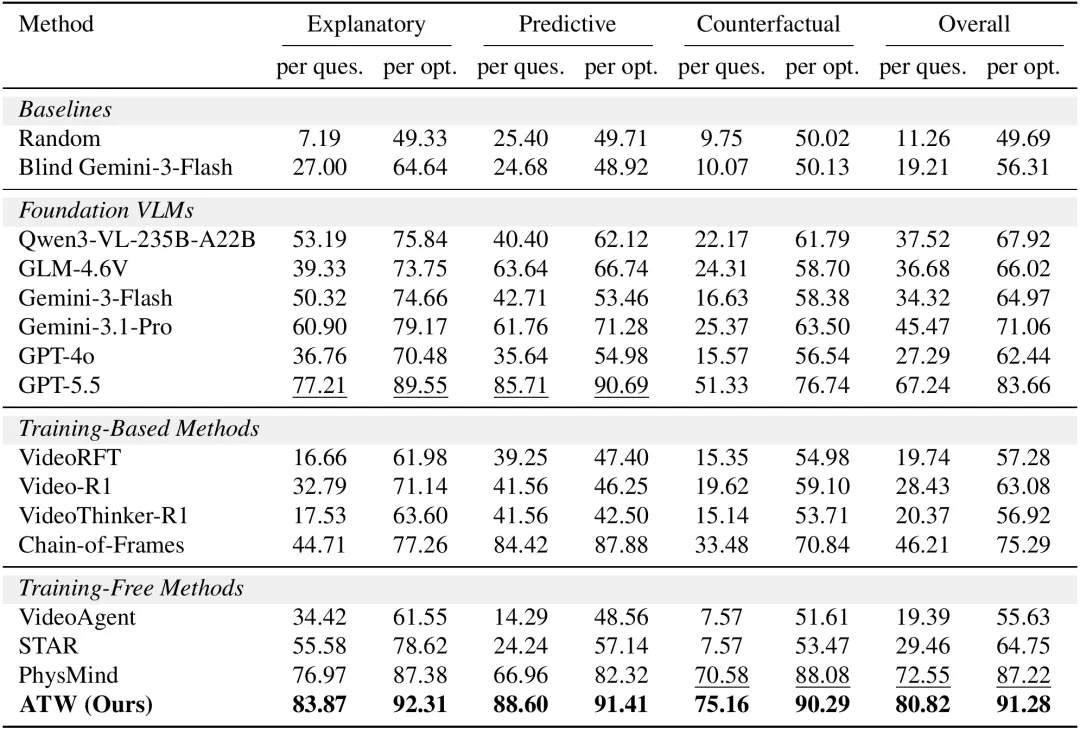
Table 1: CLEVRER experiment results, with a more direct answer, PhysMind and ATW performance

Table 2: ContPhy experimental results, covering attribute judgments, predictions, counterfacts and goal-driven issues.
In 60 video clips and 60 questions of real-world stage ball, jump ball, and toy car scenes, ATW's accuracy was 71.67%, and the accuracy of direct responses to the same model was only 33.33%. This demonstrates the potential for this approach to expand further into wider real-world scenarios.
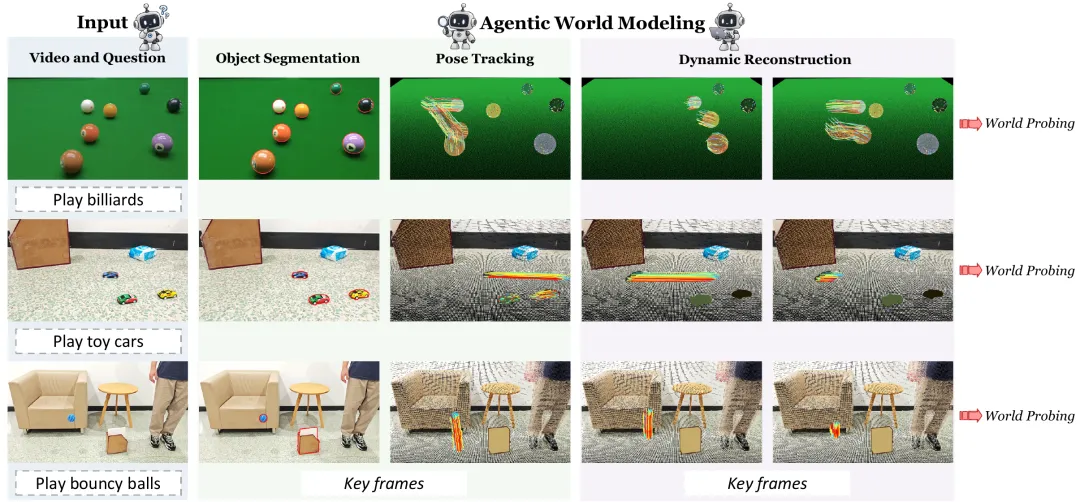
Figure 5: ATW splits objects into real scenes, movements are tracked and dynamically reconstructed.
Starting with PhysMind's executable world, ATW will organize modeling, experimentation, and feedback as a more autonomous reasoning process. Visual language models are responsible for selecting operations, physical tools are responsible for calculating movements; rebuilding the value of the world to test whether it supports correct prediction and intervention reasoning.
The main pages, codes and papers of the relevant work are open to the public and welcome to exchange information.
Asking the World(ATW):
Shenxiang Zeng, Chen Yang, Peiyao Chen, Guohui Zhang, Jiansheng Fan, Chen Wang, and Chen Wang are the main characters of the series.
What are you doing here?
The code is:https://github.com/zengsx23/Asking-the-World
The paper:
PhysMind:
Chen Yang (晨), Shenxiang Zeng (曾申翔), Haoyang Zhao, Zhouyuan Xu, Youquan He, Haoyu Li, Mingyi Deng, Jiansheng Fan (健生), Chen Wang (王)
What are you doing here?
The code is:https://github.com/ccyydd/PhysMind
The paper: