

We are making it easier for robots to learn real-world skills, covering everything from everyday skills to factory production lines.
Today, we're launching Gemini Robotics 2.5, which is the most powerful VLA we've ever had. Gemini Robotics 2.5 not only expands the range of skills that robots can learn, but also improves the speed at which robots learn these skills. It improves the agility, reliability, and security of robots, helping them get out of the lab and into a more unstructured real-world environment, helping people complete more types of tasks.
Earlier this year, we brought full-body intelligence to multiple robots, including Humanoid. Today, thanks in large part to the Gemini 4 Argon's ability to accelerate robotics research, we are further advancing the forefront of physical intelligence. We tested Gemini Robotics 2.5's capabilities in terms of mission breadth, performance and complexity through more than 200 different missions, and this approach can be extended to more missions.
Gemini 4 Argon for Robotics
Gemini Robotics 2: The next generation of VLA systems from Humanoid
Gemini Robotics 2.5 has made cross-cutting progress in three key areas:
It's a good idea.Our robots are capable of performing many tasks with higher performance and sophistication, from using everyday tools to handling delicate, flexible objects.
Reliability:In a real-world proof-of-concept on the Mercedes-Benz production line, our model helped Apptronik's Apollo 2 Humanoid with a 96% success rate of picking up and assembling car parts. This is expected to allow robots to take on uniform work, enabling technicians to focus on complex assembly tasks.
Security:As robots enter everyday environments, we have improved physical security controls and introduced a new benchmark test to test resistant jailbreaking attacks against robots.
Gemini Robotics 2.5 is gradually opening up to our robotic partners.
Expand the scope, reliability and flexibility of tasks
Because the real world environment is unstructured and difficult to predict, robots must be able to handle everyday objects with precision and high reliability.
With Gemini Robotics 2.5, we expanded the model's capabilities in terms of mission breadth, performance, and complexity. We evaluated the model through 200 different tasks, such as stuffing food with a spoon, putting butterflies in a gift box, and moving fluids with a liquid remover. These tasks combined a variety of skills, including the use of advanced tools, the sophisticated handling of movable objects, and the precise handling of deteriorating objects, representing a step towards a level of human dexterity.
Our evaluation shows significant improvements in mission accuracy, robustness and speed. Compared to previous baselines, Gemini Robotics 2.5 has a 30% to 100% success rate and a 20% to 30% success rate, depending on the type of mission.
Like our previous Gemini Robotics model, it was able to work with a wide variety of different types of robots, including Apptronik's Apollo 2 Humanoid (with five fingers, 22 degrees of freedom from SharpaWave) and the Franka Duo platform with parallel claws.
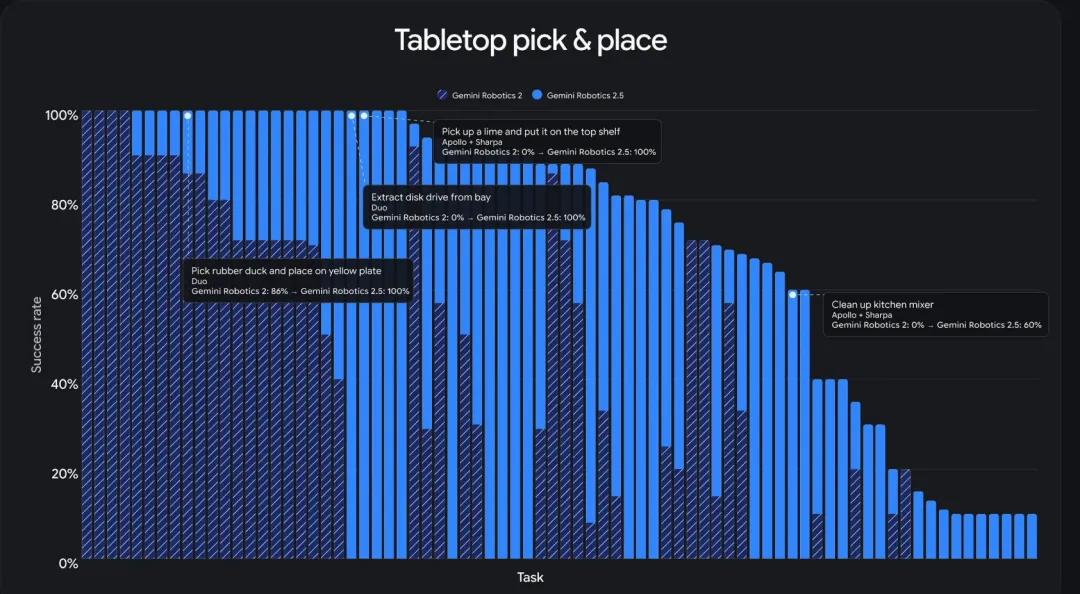
The column diagram compares the success rates of Gemini Robotics 2 and Gemini Robotics 2.5 in various desktop pick-up and placement missions. Gemini Robotics 2.5 has always outperformed its predecessors: on many missions, it has a 100% success rate, while Gemini Robotics 2 has a significantly lower success rate, even zero.
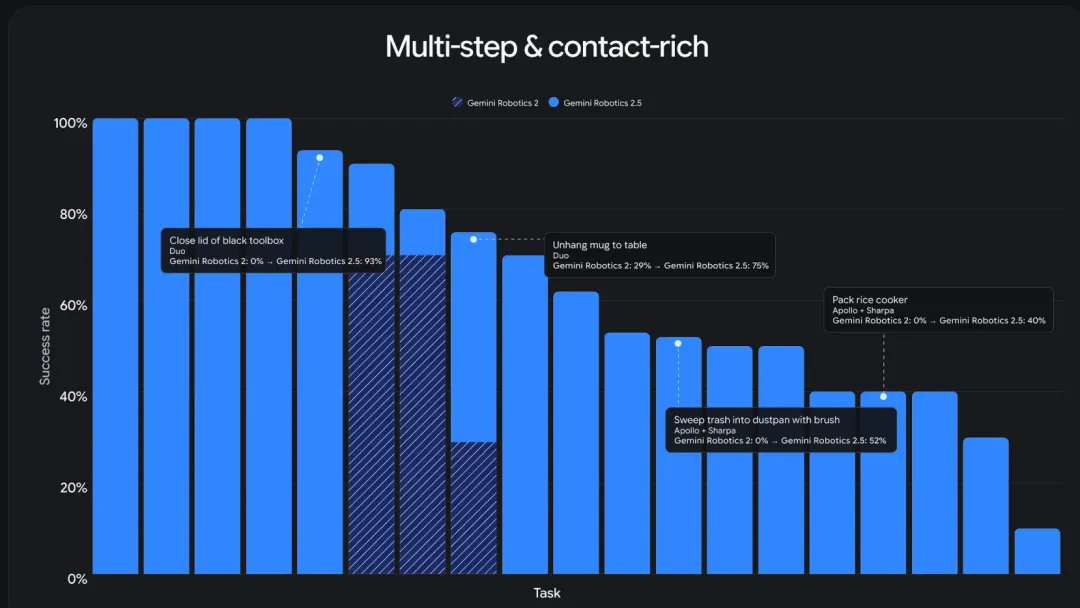
The column diagram compares the success rates of Gemini Robotics 2 and Gemini Robotics 2.5 in a variety of multi-step, high-contact missions, showing significant performance improvements in version 2.5.
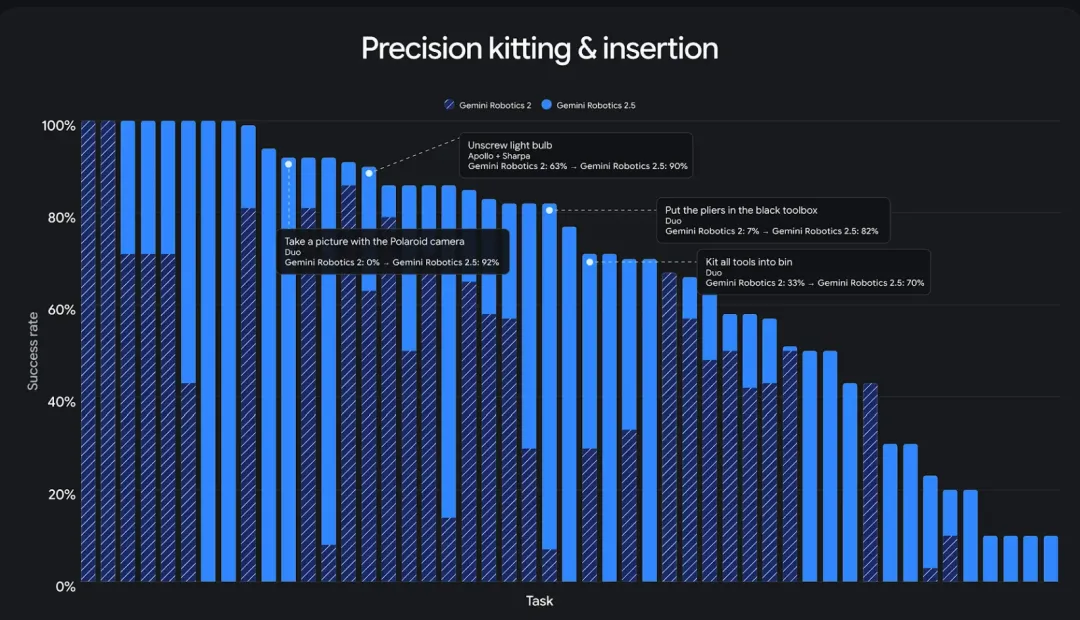
The column-shaped diagram, titled Precision Rubber Support and Insert Rubber, compares the success rates of Gemini Robotics 2 and Gemini Robotics 2.5 in various missions, highlighting the significant performance improvements of Gemini Robotics 2.5.
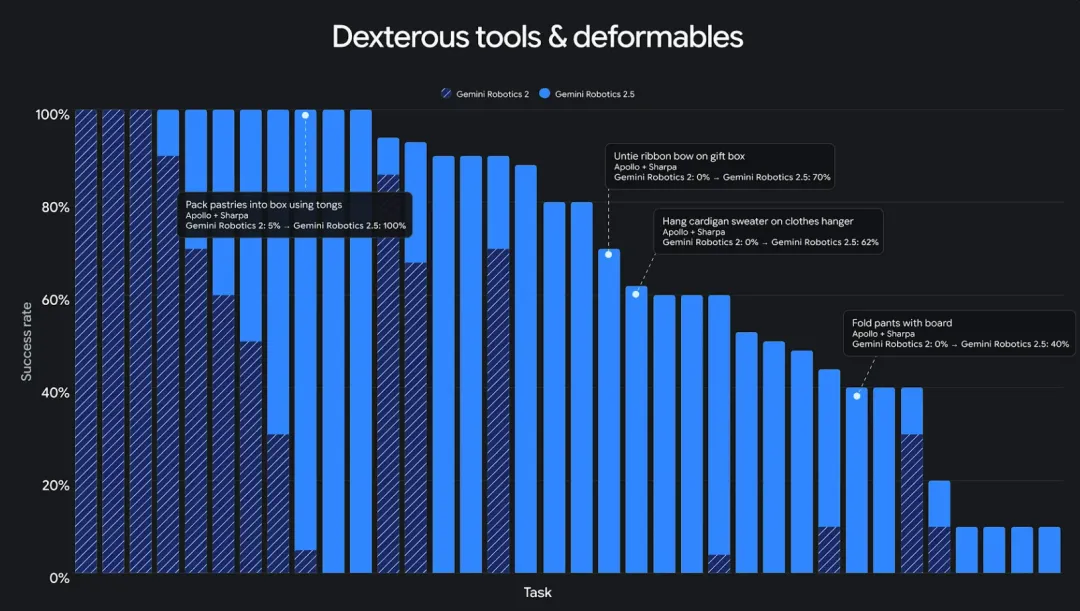
The column graph compares the success rate of Gemini Robotics 2 and Gemini Robotics 2.5 in a variety of tricky operations. The graph shows a significant increase in the success rate of Gemini Robotics 2.5, with specific tasks including: unlocking the ribbon butterfly knot from 0% to 70%, hanging the shirt from 0% to 62%, and folding the ribbon from 0% to 40%.
Apptronik's Apollo and Mercedes-Benz are testing the reliability of the real world.
The ultimate criterion for measuring a robot model is whether it can perform tasks reliably in actual workplaces. In order to test Gemini Robotics 2.5, we worked with Apptronik and Mercedes-Benz to use the Apollo 2 Humanoid on an automobile production line in Kecskemét, Hungary, and Sindelfingen, Germany.
It is difficult for robots to adapt to new, unpredictable environments, and our Gemini Robotics model gives Apollo the ability to think, make multi-step reasoning, and take action to adapt to change. In this proof-of-concept, Apollo 2 independently performs auto parts support tasks: placing individual parts in the bulk container in an orderly tray according to the exact order needed by each vehicle on the production line. This is a complicated and costly task.
The robot uses our body-reasoning model (Gemini Robotics ER) to track workflows and use the Gemini Robotics 2.5 motion model to control arms and arms, extend into the supply box to grab the metal car rack and place it in the sorting container, while correcting any gaps in it. The pilot had a 96% success rate, demonstrating remarkable progress towards a wide range of real industrial applications.
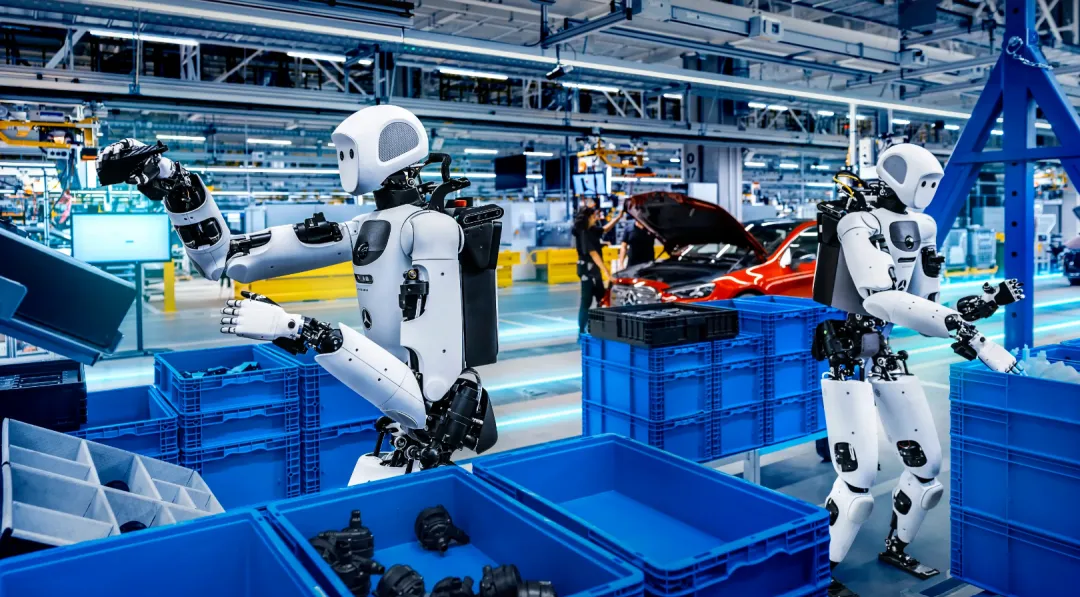
The two Humanoids classified the parts in the blue containers on the assembly line at the automotive plant.
This is what we originally wanted for Apollo: to do useful work alongside humans in real industrial environments. After combining Apollo 2 with Gemini Robotics, we saw that the model was significantly improved after only a few weeks of training, with very little performance decline when moving to the production environment of Mercedes-Benz. This laid the foundation for the large-scale introduction of Humanoid into industrial and commercial environments.
Jeff Cardenas
Co-founder and CEO of Apptronik
Apollo 2 uses Gemini Robotics 2.5 to autonomously perform support missions for car parts at the Mercedes-Benz plant.
Promoting the controllability and security of robots
Physical safety is crucial as robots operate in a chaotic everyday space. For this reason, we have significantly improved the security features of Gemini Robotics 2.5.
Gemini Robotics 2.5 uses reasoning guidance to guide robots to avoid physical hazards in real time. Just as security classifiers add a layer of protection to Gemini's response, this guidance enables robots to operate safely in complex environments.
We are also improving the security of long-range intelligent robot missions. In our assessment of intelligent robots, Gemini 4 Argon currently leads the way in rejecting unsafe missions, resolving uncertainties, and working near staff. To test its ability to withstand escape attacks, we released a new open-source benchmark test, ASIMOV-Jailbreak, which contains hundreds of hints used to disguise unsafe requests in dozens of scenarios.
The controllability of GR-2.5 enables the robot to take actions that take into account the safety of the person.
Using the Gemini 4 Argon to accelerate robotics research
In order to teach new robotic skills, researchers need massive amounts of physical data and efficient modeling algorithms. The robotic research capabilities of Gemini 4 Argon, by serving as a simulation engine, helped solve these bottlenecks and greatly accelerated our development of Gemini Robotics 2.5.
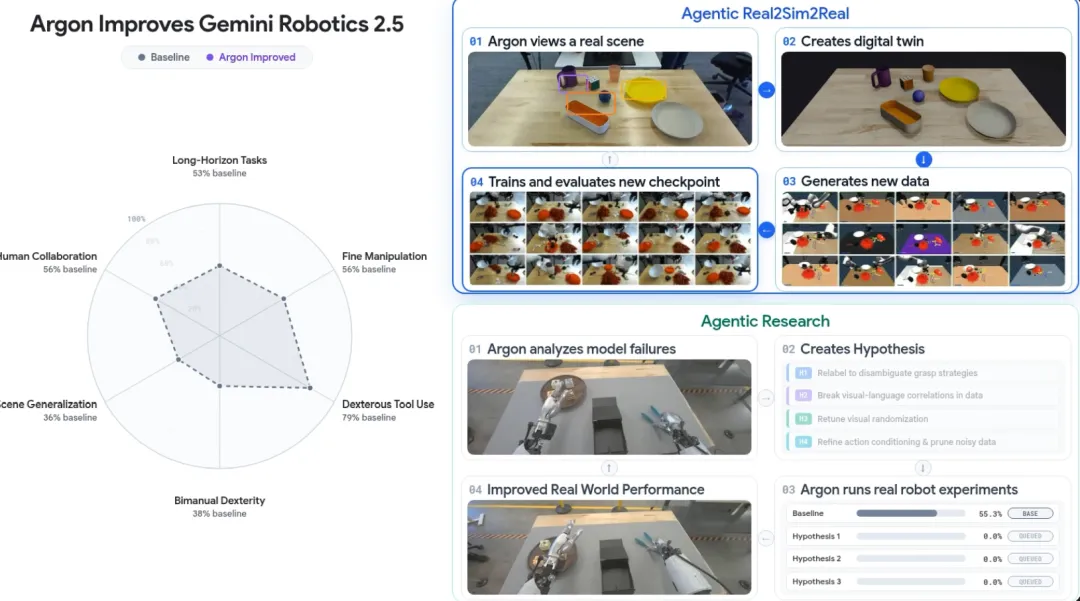
Gemini 4 Argon's robotic research capabilities accelerate the development of Gemini Robotics 2.5.
In order to teach new robotic skills, researchers need massive amounts of physical data and efficient modeling algorithms. The robotic research capabilities of Gemini 4 Argon, by serving as a simulation engine, helped solve these bottlenecks and greatly accelerated our development of Gemini Robotics 2.5.
Argon can generate thousands of diverse simulation exercises based on real-world camera scenes, and build real-world digital simulations. Combined with real-world training demonstrations, it allows robots to broaden faster to new scenarios and new objects. Argon can also help researchers estimate the reasons for failures based on video images, and directly test the best improvement on simulation environments and real robots.
With the acceleration of cutting-edge smart models such as the Gemini 4 Argon, Gemini Robotics 2.5 marks an important step on our path to achieving physical AGI. By improving agility, real-world reliability and strict security, we are building the necessary physical intelligence to enable robots to work side by side with humans and solve real-world challenges.
Thank you.
The work was developed by the Gemini Robotics team, thanks to the leadership and support of the following people: Huizhong Chen, Radu Soricut, Jean-Baptiste Alayrac, Melvin Johnson, Edward Grefenstette, Claire Cui, Jon Shlens, David Thacker, Zoubin Ghahramani, Clement Farabet, Koray Kavukcuoglu and Demis Hassabis.
We also want to thank the many teams within Google and Google DeepMind who have contributed to this work, including the Research, Legal, Marketing, Communications, Responsibility and Safety Council, Responsible Development and Innovation, Policy, Strategy and Operations, and our Business and Corporate Development team.