

Post by PTDG team
QbitAI is public.
The focus on industry-recommended optimization has shifted from a single interactive indicator to overall eCPM.(Exposure gains per thousand)。
Once exposed, users can click, download, pay, watch... all of these targets are distributed over a single page.Turning a pipe into a pipeThe higher, the lower, the scarcer, but often the more valuable.
The industry's standard practice is multi-tasking(MTL)Let these goals be shared: express, train together.
The paper focuses on one specific issue: Personalized Task Dependency Graphs for Mitigating Signal Erosion in Multi-Task Recommendation.
When the signal is transmitted in stages along a fixed loop, the signal decreases in one layer, and the deep scarcity task that needs the most help receives the weakest signal.
The paper calls this phenomenon "signal erosion" and suggests that the effects of this phenomenon are more likely to be negative than negative.PTDGThis is the first time I've ever seen a personalized task dependency graph to mitigate this.
Problem: The same loophole, different dependency intensities on different objects
Commonly used architectures such as MMoE and AITM largely default to one premise: dependency intensity between funnel tasks is the same for all traffic.
The paper gives an example:
- Gravity games often go through a strong chain of causes: click → download → pay;
- Users of lightweight tools often skip the intermediate steps and pay directly after clicking, making the relying on this loop much weaker.
Physical order of precedence(Please click first)It is compulsory, butStrength of correlation between adjacent tasksAll samples are stuck into the same fixed topology, which on the one hand limits the model's ability to express itself; on the other hand, information must be passed down from one level to another, and the signal received by the deep task has been diluted by the intermediate link.
Work has also focused on task relationships, but each has its limitations: PMTRec personalization is to optimize weight, without charting structural differences between tasks; MIT's task relationships are universally shared; CSRL learns the causal structure, but the cost of iterative search reaches O(T2) or even higher, making it difficult to meet industrial latency requirements.
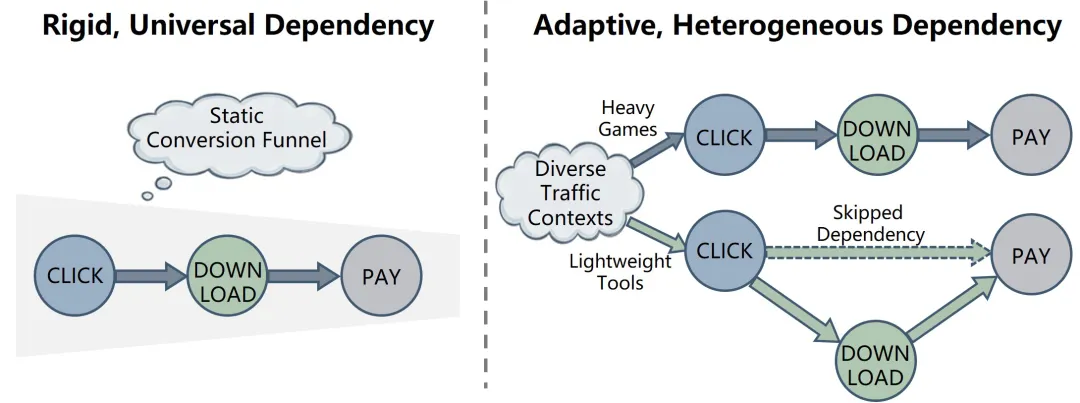 △The left is a unified, fixed dependency; the right is a personalized dependency graph depending on the intensity as the case changes.
Method: The three components of PTDG
The core idea of PTDG is to see mission dependency as one.A dynamic, learning topologyThe paper concludes with three innovations:Learning in dynamic topologyFor example, the use of the term "dependent strength" is used to describe the strength of the structure.Controlled transmissionGCN with a hard-causal mask is used to create adaptive shortcuts;Optimization of self-adaptationStructured masks are used to mitigate gradient conflicts from a parametric level while reducing computational complexity.
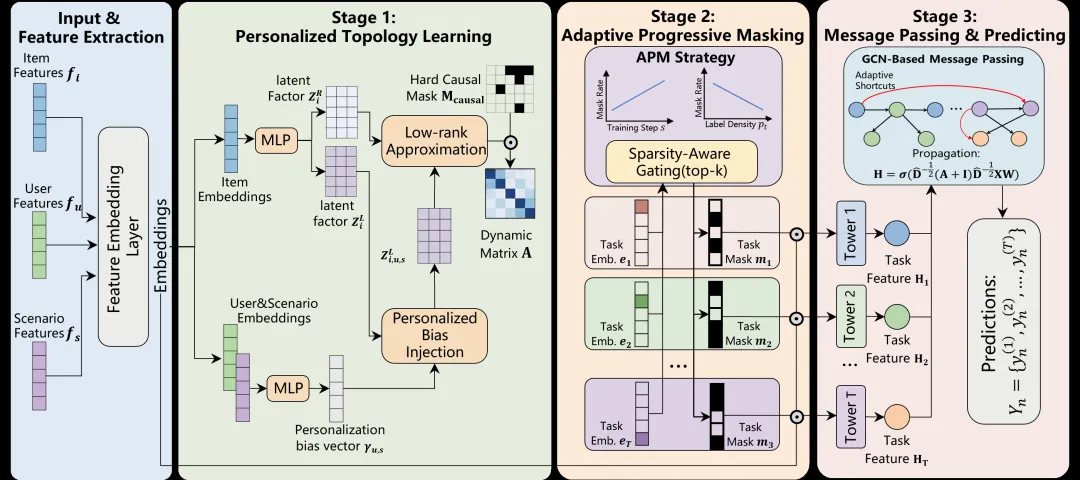 △PTDG is divided into three phases: personalized topological learning, adaptive gradual masking, messaging and prediction.
Personalized topology learning: A low-level dependency chart for each item
PTDG does not directly learn a complete T×T neighbor matrix(T is the number of tasks)It's about embedding things into things.(Extracted from the DeepFM or MLP spine model)Produced two sets of low-order factors, multiplied by the dependence matrix of the class of objects. Low-order decomposition here begins the function of structural norms: industrial interaction data noise is high, and direct learning of the low-order matrix is easily adapted to false correlations. Low-order form also allows the expense of depending on graph computation and GCN transmission.Linear growth by number of tasks T。
On this basis, the model then uses user and scene characteristics to generate a highly personalized bias vector array to modulate the lower order factor of the object class. Thus, the same object can vary in intensity depending on different users and scenarios.
Hard Cause Disguise + GCN Message Transmission: Allowing crawlers to copy near roadblocks, but not allowing crawlers to roll upside down
After the dynamic dependence matrix, the PTDG is first multiplied by one.Hard cause masksTo ensure that information can only be transmitted in the order of behavior, prevention of pay-as-you-go (→ click through); then GCN dissemination at the mission node.
Compared to fixed chains, the key difference is that dependency charts can be built between highly relevant tasks.Adapting shortcutsFor example, the information that lets the mouse click on the mouse directly reaches the mouse, without having to go through redundant intermediate nodes. The paper argues that this is where the signal erosion is mitigated.
Self-adjusted incremental masking (APM): how many parameters are decided by task scarcity
Transmission of information between tasks can also exacerbate gradient conflicts. The practice of PTDG is not to project or overload at the gradient level, but to give each task a two-value masquerade, allowing it to see only part of the shared parameters:
- The disguise rate is determined by the positive sampling rate of the task: the rigid task corresponds to r_min = 0.2, the sparse task corresponds to r_max = 0.7 ((the paper is optimized after experiments in the range of 0 to 0.9));
- In the early stages of training, linear warm-up gradually improves the coverage rate and stabilizes training.
- The camouflage is fixed after the training, and there are no reasonable expenses.
Unlike PCGrad, which requires O (T2) gradient projection, the training costs of APM can be overlooked. In addition, the loss weight of each task is weighted by the loss of the clock task/its index sliding average clock to one, pulling the different tasks to the same quantity level.
Experiment: First look at the rare deep missions
The data:Open data set KuaiRand1K: 8.4 million samples, 6 tasks, with a positive sample rate of 0.02% to 37.9%) and an industrial data set: 13.2 million samples, 7 tasks. Each set has 20 random seeds to replicate and report average values. Comparison methods include MMoE, PLE, STEM, MoCoGrad, PMTRec, MIT.
The average AUC of the two datasets is as follows:
 △The average AUC of the two datasets.
In both sets of data, the average AUC of PTDG is the highest.The paper also reported that PTDG's average performance was 1.59% higher than MoCoGrad's.Rare deep missionsThe above is particularly clear:
- Task 3:PTDG 0.8872, which is 1.45% higher than PMTRec (0.8745) in the industry data set;
- Follow-up mission of KuaiRand1K: PTDG 0.9193, 1.77% higher than the linear baseline MMoE ((0.9033);
- Key deep conversion tasks in industrial datasets Task 6: PTDG 0.8993, 1.05% higher than MIT ((0.8899).
(The above percentages are the original expressions of the paper, each corresponding to a specific task and a specific method of comparison.)
In clicking on such dense, shallow-level tasks, the PTDG stays at a fair level with the baselines.While mitigating deep node signal erosion, it does not impair the performance of head missions。
Melting experiments were carried out on industrial datasets, indicating average AUC:
△Industrial data sets, average AUC)Each component has an explicit contribution.Removing personalized dependency charts, the average AUC decreased by 1.21%.GCN was replaced by a simple spelling decrease of 0.93%, indicating that the message on the graph is more conservative; removing the APM decrease of 0.59%.
Low-level dimension:q is best adjusted from 1 to 7, when q = 2, indicating that a lower-order approximation uses fewer parameters than its neighboring matrix, effectively controlling over-adaptation. The experimental value given in the paper is q≈T/3.
A/B online
PTDG was deployed as a ranking model for a mainstream application distribution platform that had a daily life of over 100 million. Online A/B lasted two weeks: baseline barrels and experimental barrels each accounted for 10% of the traffic, with the remaining 80% still running on the original model; baseline was MMoE on the line at the time.(That's the same MMoE in offline comparison)The paper made a double-sample t-test of the daily indicator for each barrel.(p<0.05)According to the report, the key business indicators improved statistically significantly:
- CVR +1.2%
- eCPM +1.9%
Project value
In the meantime, we're going to have to make a decision.The computation increases with the numerical linearity of tasks, with MMoE baseline only increasing by 8 ms compared to end-to-end delays, within the service SLA; APM masking is fixed after training, without increasing reasoning costs.
The result is the most difficult goal:Improve the depth of conversion tasks focused on scarce, high-value tasks while maintaining the accuracy of tight tasks.
The online verification:The statistically significant improvement in CVR and eCPM across more than 100 million platforms in China reflects the industrial viability of PTDG as a multi-tasking learning framework that brings steady gains in real recommendation systems.
Applicable scenarios and future directions
The most appropriate scenario:Deep conversion scarcity, marked differences in the conversion paths of different items, is where PTDG's profits are most concentrated.
This is the first time I've ever been in a relationship with a woman.The personalization of graphs is always done within the limits allowed by the hard factor masking, avoiding structural semantic upheavals.
More extensive and cross-domain:The paper states that the next step will extend to larger task sets, as well as cross-domain scenarios.
Personalised task dependency graphs for mitigating signal erosion in multi-task recommendation
In the meantime, we're going to have to make a decision.
It's the first time I've seen this.
DOI:10.1145/3799682.3839876