


It's really going to put a human mathematician out of the way...
The Fermat theorem, a 30-hour 1000-hour Claude Fable 5.2 team, completed the complete formalized proof.
Just today, someone + Claude has formalized the proof of the "Triple Godbach conjecture" that was confirmed 13 years ago.
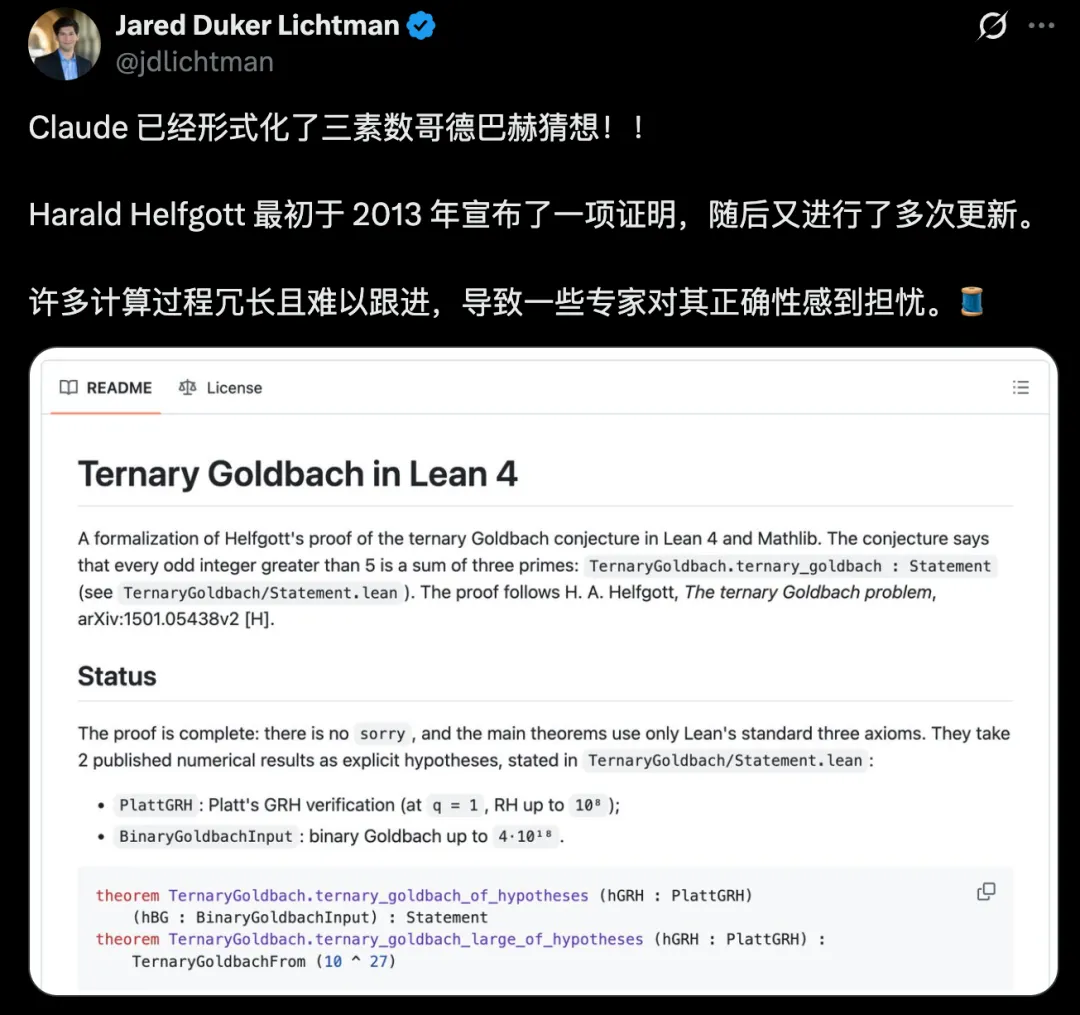
The wave was operated by independent developer Charlie Reams, who racked up 194,000 lines of Lean 4 code and dropped "Zero Sorry" across the library.
What's more, Claude himself discovered that the original 2013 proof contained many errors!
It is clear that these mathematical flaws have been solved by hand.
 One + one Claude, 194,000 lines of source code
There is a blackboard that has to be struck, and the so-called "1+1" is a strong-willed conjecture that has yet to be fully proven.
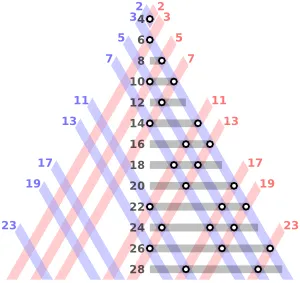
The "triple Godbach conjecture", also known as the "weak Godbach conjecture", refers to the hypothesis.
Any odd number greater than 5 can be represented as the sum of three primes.
In 2013, the Peruvian mathematician Harald Helfgott announced that he had thoroughly proved the problem that has plagued humanity for 271 years.
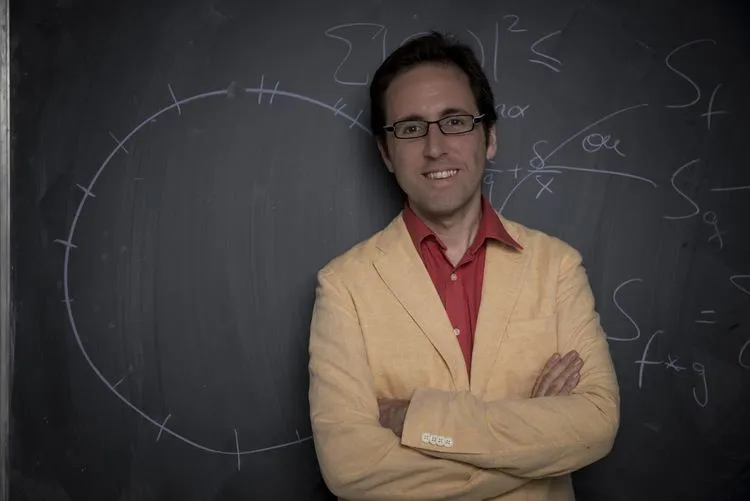
At the time, it was a global mathematical achievement.
But the problem was that Helfgott's proof was too long, too cumbersome! The original manuscript was 300 pages long and filled with a series of unequal scales and constant computations.
In the decades that followed, Helfgott himself kept updating several versions to correct details.
Even so, because the computing process is lengthy and daunting, few mathematicians around the world have the strength to verify every constant from start to finish.
Independent developer Charlie Reams decided to hand it over to Claude Code.
Open the GitHub warehousecalr3/ternary-goldbach(cde-moebiusThis is an amazing digital project:
A total of 194,000 lines of Lean code, supporting scripts and technical documentation.

During the campaign, Charlie Reams was responsible for setting top-level targets, dismantling mission instructions.
The vast majority of Lean's formalized code, automated scripts, and even documentation were hand-picked by Claude Code.
The end result shocked everyone: 194,000 lines of source code, 0 sorry!
In the Lean language,sorryZero-sorry means that every line of reasoning has been subjected to extremely rigorous machine verification, with no gaps left.
 11 questions to be answered"Changing the assignment" for top mathematicians
Helfgott's proofs are difficult to verify, and it is difficult to prove that "all is number".
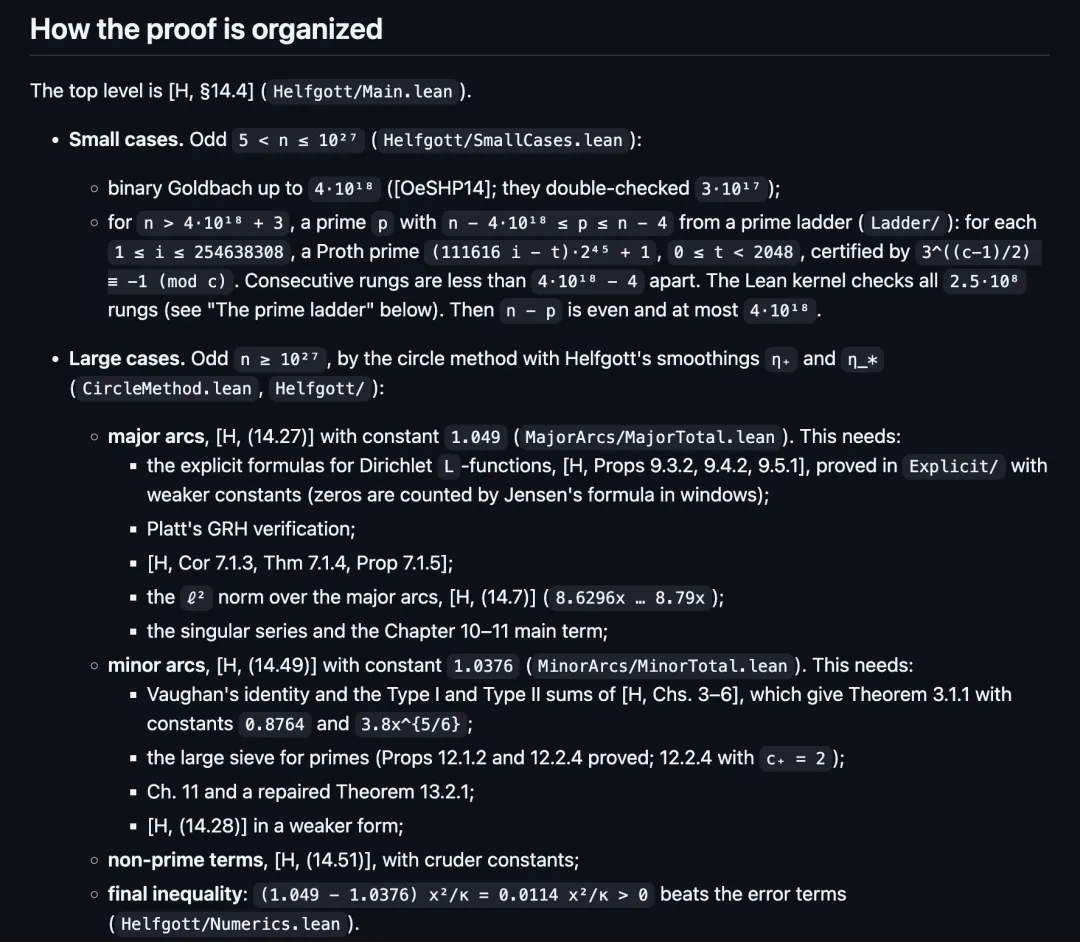
It uses the circular method: dividing the problem into two parts, the main arc and the inferior arc, the main arc is "income" and the inferior arc is "expenditure", and the theorem is established as long as the income is steadily greater than the expense.
It's the kind of thing that happens in the human eye when you look at the 50th page and it starts popping, but Lean doesn't.
The README warehouse lists 11 places that are different from the original book, and here are three of the most impressive details.
First, the arithmetic is sliding. In the book (6.77) a critical constant is written as 0.5 and the correct value should be 0.8102; after the correction of the band, the project ends up using 0.8764.
Secondly, there is an inequality that does not exist.
In the book (5.32) v=2 is wrong: a score actually counts out to be 0.53344, more than the upper limit given in the book is 0.37273; log 4 (about 0.5167).
And third, finding the wrong and finding the wrong of others.
The original proof cited a step in Ramaré's 1995 paper, claiming that a factor of not more than 8 is actually about 8.0845.[7] Claude did not copy the hard copy, but instead took a break from the past and got 7.04, still within the required 7.284.
In addition, there is a "hard wound" in the proof. The proof of the 13.2.1 theorem states that the main arcs of the two scales are mixed together, which is equivalent to being reconstructed again.
After Claude's completion, the main arc "income" decreased from the original 1.058259 to 1.049, and the lower arc "expenditures" decreased from 1.00948 tons to 1.0376.
The difference between the two, the proven safety margin, shrank from 0.04877 x2/κ to 0.0114 x2/κ, shrinking three-quarters more.
The original author was present.It's about two "unprecedented" things.After the ferment, everyone was curious.
How would the author Harald Helfgott react when he saw his reputation being erased and repaired by AI?
As a result, Helfgott quickly appeared on X and was extremely candid, and on October 4 of this year Charlie Reams contacted him privately to inform him that the formal work had been completed.
This month, one by one, AI has done another big thing.
If we take the external additional assumption that the entire proof depends on (the rationale), we're going to cut out only two of the first five!
In this warehouse, all parsimonial inference logic is 100% formalized and zero-sorry, but it still hangs outside the Lean.The results of two existing numerical validationsAs a prerequisite:
Platt's generalized Liman conjecture (GRH) for numerical verification and the even-numbered Godbach conjecture for local verification is 4x10^18.
Putting these two human beings in the "Giant Digital Steppingstone" in Lean's core, the whole three-dimensional Godbach conjecture closes tightly.
Super-intelligence is defining what is "proven".A few hundred pages of proof is not a "proof of completion", and a few experts have to wait years to finish it, and they don't have to pack a ticket.
Now, the standard is being changed to another phrase: have not passed the core.
Perhaps not for long, the hardest-core peer review in mathematics has just one sentence:
"Please don't send me the PDF, but give me your proof and tell Claude to run away and say sorry".