
As soon as I woke up, Google released another Gemini 4 model.
On November 12, Google officially released Gemini 4 Hydrogen, along with the launch of the multi-model smart timing system Orchestrator.
It is a large model of the Flash-class (and the successor to the Gemini 3.8 Flash), originally multi-mode, input, think and output sharing 1 million token windows, but according to the new Gemini name, Google chose the all-new Hydrogen () as its class name.

In the Gemini 4 product matrix, Carbon and Argon focus on deep reasoning and complex tasks, while Hydrogen plays the role of a "quick execution engine".
Using instant 3D coding from Hydrogen, Geminisland allows anyone to create custom structures in real time on a shared pixel island with simple instructions. Players can walk and explore freely from a first-person perspective.
In several benchmark tests, Hydrogen is highly competitive in knowledge work, automation and code repair tasks:
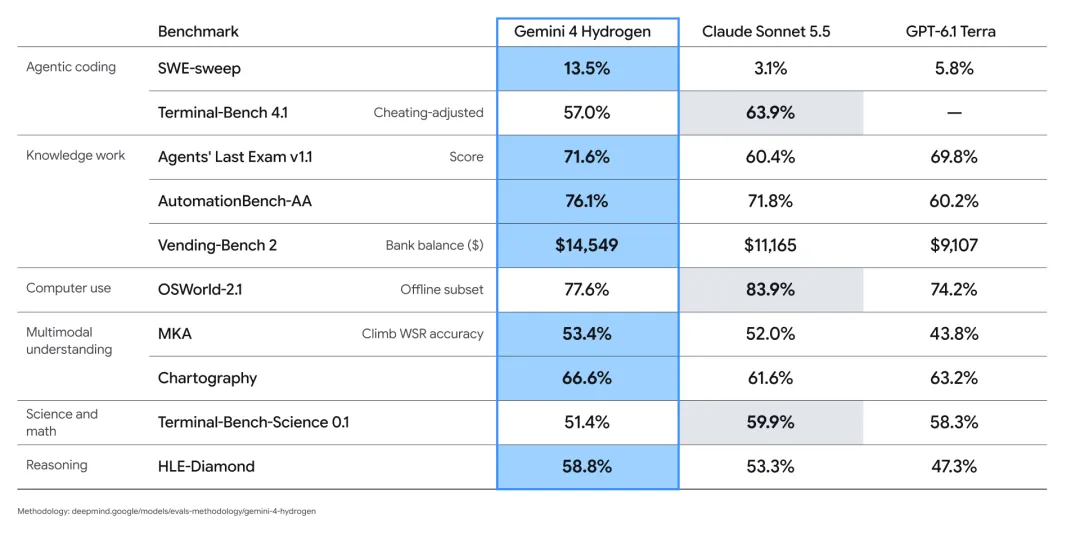
It is characterized by Anthropic's Claude Sonnet 5.5 and OpenAI's GPT-6.1 Terra. In observations involving complex graphing, SQL queries, and high concurrent enterprise-level data workflows, the running speed of Hydrogen has improved 2-2.8 times over its predecessor; while the header delay (TTFT) remains at a lower level when it comes to cross-modal understanding of long video, large code libraries (loaded in millions of levels).
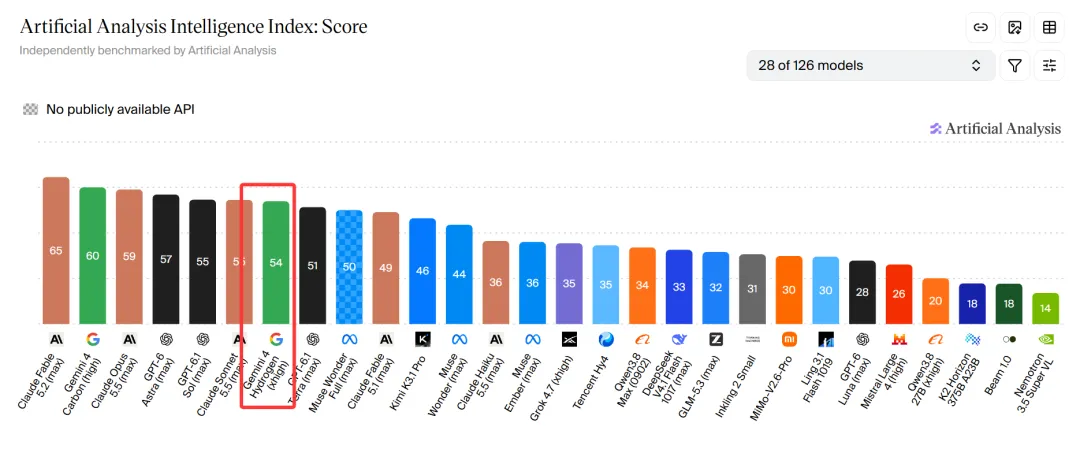
On the Artificial Analysis Intelligence Index, the default high rating for Hydrogen is 51 points, with the highest xhigh rating being 54 points, which is 50 points higher than Google's own larger parameter, Argon.
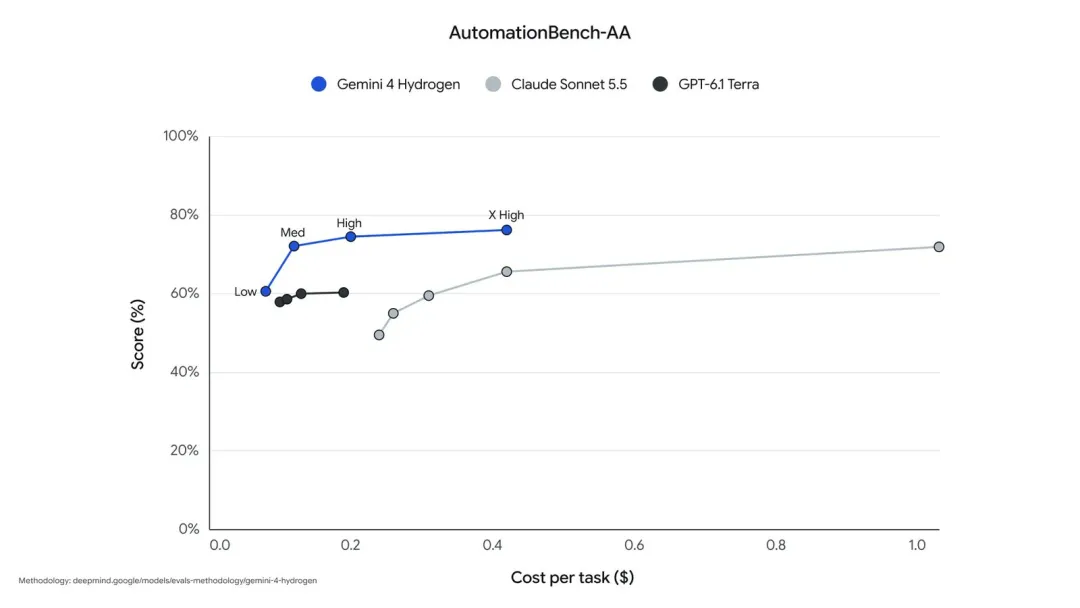
The Hydrogen model adds an xhigh reasoning intensity. Google recommends using xhigh only when faced with difficult multi-step problems, as the latter may increase latency, token consumption, and overthink simple tasks.
With the Hydrogen model, Google is promoting the Gemini 4 series to all levels, including Google AI Studio, Gemini API, Gemini for Business, Gemini app, Google Search, and paid subscribers to Google AI Pro and Ultra in Google Antigravity.
In the Gemini application, free users choose to access the response to Hydrogen via the Auto Automatic Model, while Google AI Plus, Pro and Ultra users can choose manually. Developers can use the free layer of AI Studio and Gemini API, but with speed restrictions.
The Gemini 4 Hydrogen API is priced at $1.5 per million of input tokens, $0.075 in caches, and $7.5 for output tokens.
Google says that in the actual software development process, although developers need to make in-depth architectural judgments using the Carbon and Argon-level front-end models to design systems or solve subtle bugs, they still need a fast, standardized execution model to code write, run tests and validate changes. Hydrogen was originally designed to be used both as a standalone model for everyday work and in combination with Carbon and Argon as an efficient execution engine in multi-model workflows.
To help automate this multi-model collaboration, Google introduced the Orchestrator in its own programming tool, Google Antigravity, which can dynamically switch models such as Carbon and Hydrogen in the same session. In the Terminal-Bench 4.0 test, the Orchestrator's mission success rate is close to Carbon, with average consumption quotas reduced by 24%, and completion speed increased by 19%. For parallel Agent workflows, Carbon can serve as a coordinator, while Hydrogen can provide support for work agents and verification agents, thus building and testing changes simultaneously in isolated work areas, helping teams complete complex projects faster without increasing token costs.
The Orchestrator feature was first introduced to Ultra users.
In addition to the multi-model workflow, Hydrogen was also a major independent upgrade to the Gemini 3.8 Flash. It achieved significant improvements in both speed and intelligence: 2.5 times faster task completion in high default settings, more than three times better Terminal-Bench 4.1 scores (57 percent vs. 18.2 percent), more than five times less hallucinations, and a seamless adaptation to tool call failures or search results.
Efficiency improvements are also reflected in the way models use tools. When exploring large code libraries, Hydrogen is able to execute file readings in parallel with search call batches, reducing the wait for individual file views. In the absence of necessary contexts, it also tends to point to information gaps rather than speculation.
Google demonstrates a more intuitive office case: in Antigravity, it gives Hydrogen a YouTube-themed talk video and a design template that generates multi-page presentation texts directly in Google Slides, and then automatically checks and fixes word overlap and other editing problems. From understanding video, organizational content, to calling applications and checking results, multi-mode capabilities run through the entire task.
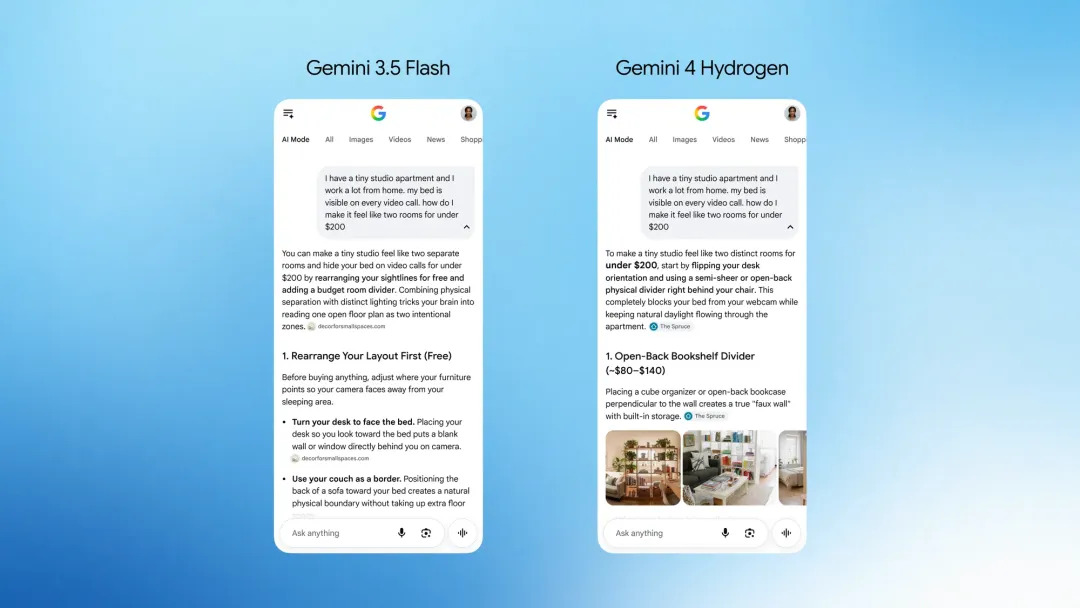
What does it feel like to be faster than 3.8 Flash? It doesn't seem to be very well described. Google has now used Hydrogen as the default model for search engine AI Mode, while using it to support the underlying logic of AI Overviews complex queries in the main search interface, providing more practical, more intuitive search results for all users worldwide.
Using the Hydrogen model, people can ask questions to the search box in a natural way, and even if your query contains multiple parts, difficult spelling errors or very specific requests, the search can intelligently understand what you are looking for. In the search results, you will get highly adaptive, visualised and easy-to-browse feedback generated by AI.
Using the advanced reasoning technology of Hydrogen, Google has also upgraded the query fan in the searches (Query Fan-Out, LLM will unravel the complex problems in parallel, respectively, search generating, and finally merging mechanisms) to provide people with a wider range of useful links to find previously undiscovered websites.
With the addition of Hydrogen, Gemini 4 has covered Google's entire bucket and now more people can enjoy cutting-edge AI.
References are given below: