
With the rise of Recursive Self-Improvement (RSI) research, the long-term capability evolution of intelligent agents has received more attention. Skills can refine interactive experience into reusable operating procedures and task strategies, so that the gains from one task can serve subsequent tasks. Letting an agent learn to create and improve these skills autonomously provides a concrete path for its continued evolution.
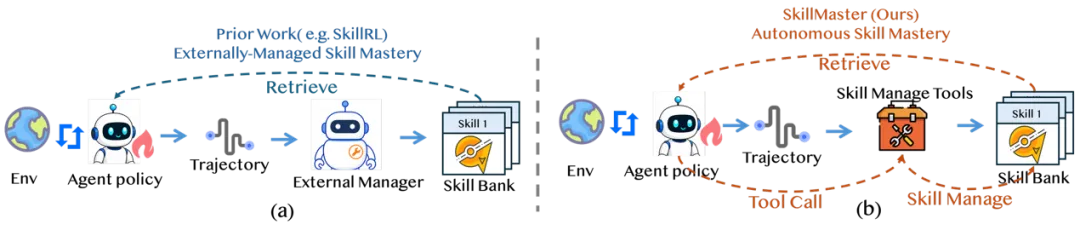
Figure 1 Left: The external module is responsible for managing skills, and the agent retrieves and uses skills. Right: SkillMaster incorporates skill management into the agent's own strategy and learns together with task execution.
However, skill creation and updating in existing methods often rely on external teacher models, preset rules, or auxiliary modules (Figure 1 left). Agents performing tasks learn to use skills, but are rarely directly trained to improve skills. To achieve autonomous improvement along this path, it is also necessary to make “how to evolve skills” an ability that the agent itself can learn (Figure 1, right).
The team of Professor Li Yong of Tsinghua University proposed SkillMaster, and the related paper has been accepted by NeurIPS 2026. The paper’s first author is Min Yang, a doctoral student at Zhongguancun Academy.
The research starts from an intuitive insight: valuable skill improvement should make similar tasks that were originally failed easier to succeed in the future, and allow tasks that were originally successful to be completed in fewer steps. SkillMaster converts these two types of effects into learning signals for skill editing, training the same agent to create, update, and retain skills based on interactive experience, so that skill evolution and task execution enter the reinforcement learning process together.
- Paper title: SKILLMASTER: Toward Autonomous Skill Mastery in LLM Agents
Affiliation: Shandong University, Zhongguancun Academy, Tsinghua University, Southeast University, University of Science and Technology of China
arXiv:
GitHub:
Core Insight: Make failed tasks more likely to succeed
Complete successful tasks more efficiently
To train an agent to improve its skills, it first needs to know what a modification brings to subsequent tasks. Only using the final success of the task as a reward makes it difficult to distinguish between execution ability and skill quality, and it is even more difficult to provide clear feedback for a certain skill edit.
To do this, SkillMaster focuses on the actual impact of skill modifications on subsequent related tasks. If a skill fills the gap in existing knowledge, it should improve the chance of success of the original failed task; if it improves the existing operation strategy, it should reduce unnecessary steps for tasks that can already be solved. These two observable changes provide a basis for measuring the effects of skill modifications.
Method framework:
Joint learning task execution and skill evolution
In order for an agent to learn to create, revise and retain skills independently, three issues need to be solved: on what basis to propose modifications, how to evaluate the value of modifications, and how to jointly optimize task execution and skill management. SkillMaster implements these three links through trajectory-based skill review, downstream utility rewards and DualAdv-GRPO respectively.
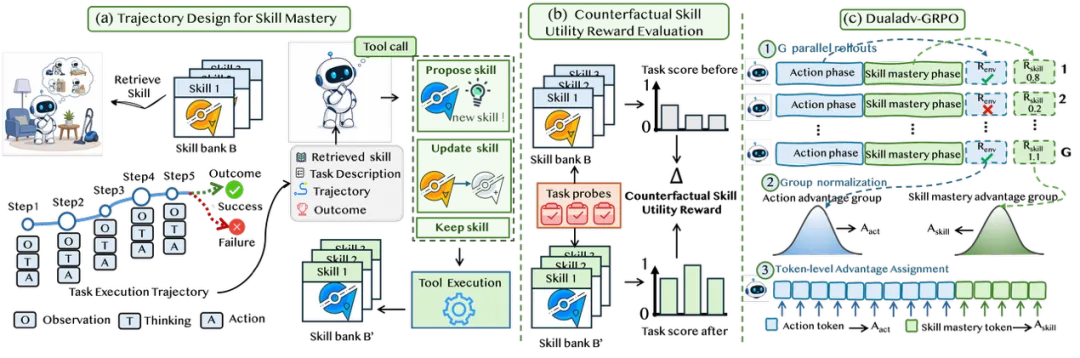
Figure 2 Three components of SkillMaster: trajectory-based skill review, counterfactual skill utility rewards, and DualAdv-GRPO joint optimization.
Learning skills management based on interactive trajectory
The skills review phase provides the model with task goals, retrieved skills, action and observation trajectories, and final feedback. The model is called through three types of tools: propose_skill, update_skill and keep_skill to perform create, update and retain operations respectively. For example, if you find that existing skills do not cover a certain search strategy, you can add new skills; if you observe that actual feedback conflicts with existing operating rules, you can revise the original skills.
Task actions and skill tool calls are generated by the same policy, so skill management is also directly incorporated into model training. SkillMaster first enables the model to have basic task execution and tool calling capabilities through supervised fine-tuning, and then uses skill effectiveness feedback to optimize the decision-making of creating, updating, and retaining skills through reinforcement learning.
Evaluating skill utility through counterfactual comparisons
For candidate skill editing, the system selects a set of related detection tasks, executes them using the original skill library and the temporarily modified skill library, and directly compares the downstream changes caused by the modifications. Whether a previously failed task becomes successful and whether a previously successful task reduces execution steps will be reflected in the utility score, providing direct training feedback for skill editors.
Detection tasks come from the training task pool and are selected based on task category, product category, or question semantic similarity. The system takes into account the average score change of detection tasks, as well as the number of tasks with improved and degraded performance, calculates utility rewards, and optimizes skill editing decisions accordingly. During training, only modifications with positive utility rewards will be written to the persistent skill library.
DualAdv-GRPO jointly optimizes two types of decisions
Task execution mainly relies on environmental result feedback, while skill management uses tool call effectiveness and downstream utility feedback. The two types of rewards have different scales and meanings. To this end, SkillMaster proposes DualAdv-GRPO, which calculates the advantages of task execution and skill management respectively, then allocates them to the corresponding generated content, and jointly updates the same strategy. The model thus simultaneously learns to perform tasks efficiently and improves reusable skills.
Experimental results:
From task performance to skill evolution capabilities
The experiment is based on Qwen2.5-7B-Instruct and covers ALFWorld, WebShop and SearchQA. Among them, ALFWorld includes six types of simulated household tasks, WebShop examines multi-step product search and purchase, and SearchQA covers seven single-hop and multi-hop question and answer data sets.
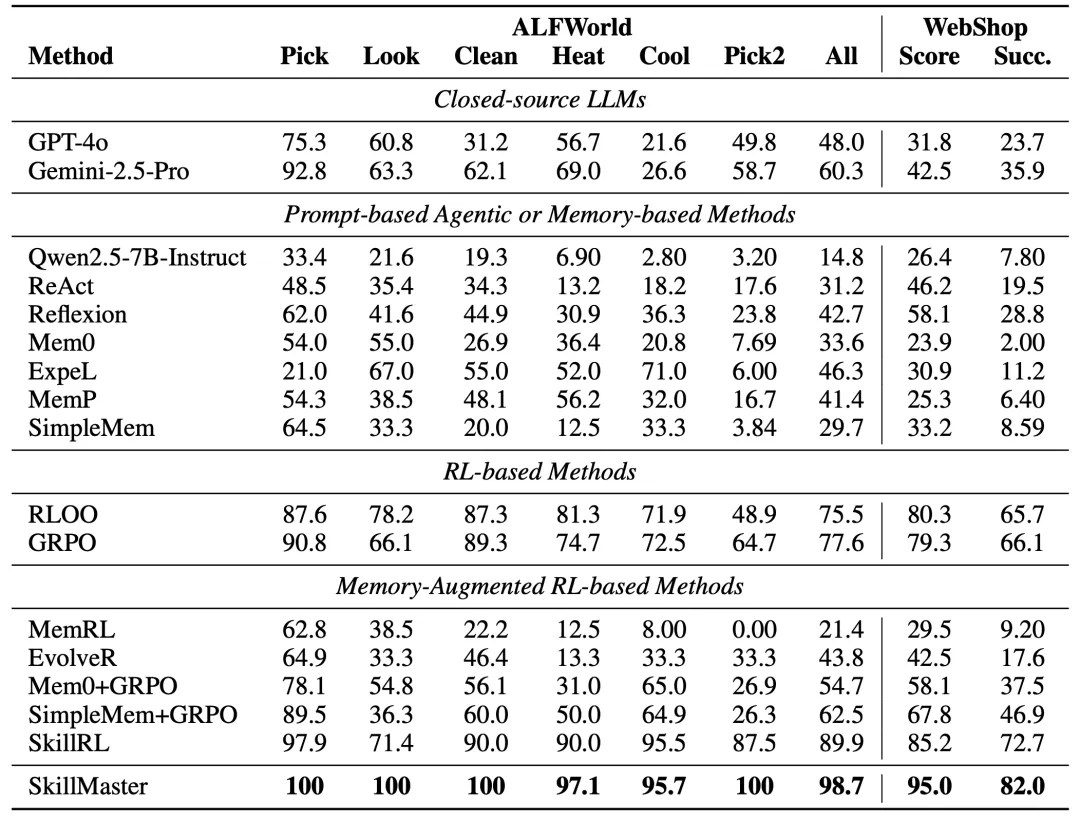
Table 1 Main experimental results of ALFWorld and WebShop.
As shown in Table 1, SkillMaster achieves the best performance among the compared methods on both ALFWorld and WebShop, with task success rates reaching 98.7% and 82.0% respectively, which are 8.8 and 9.3 percentage points higher than SkillRL. Four of ALFWorld's six categories of tasks achieved a 100% success rate, with the remaining two categories exceeding 95%.
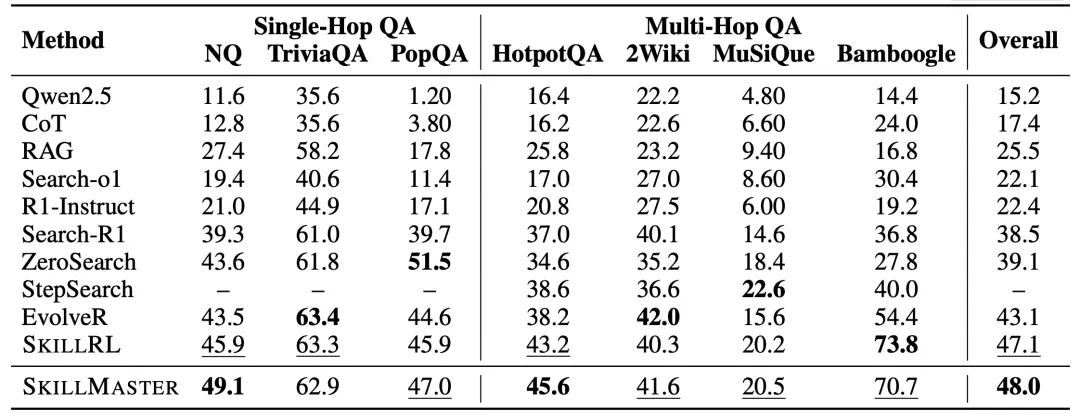
Table 2 Experimental results of seven datasets of SearchQA.
As shown in Table 2, on SearchQA, SkillMaster achieves an overall score of 48.0%, the highest value among the compared methods, which is 0.9 percentage points higher than SkillRL. Outperforming SkillRL in five of the seven datasets demonstrates the effectiveness of the framework in search-augmented question answering tasks.
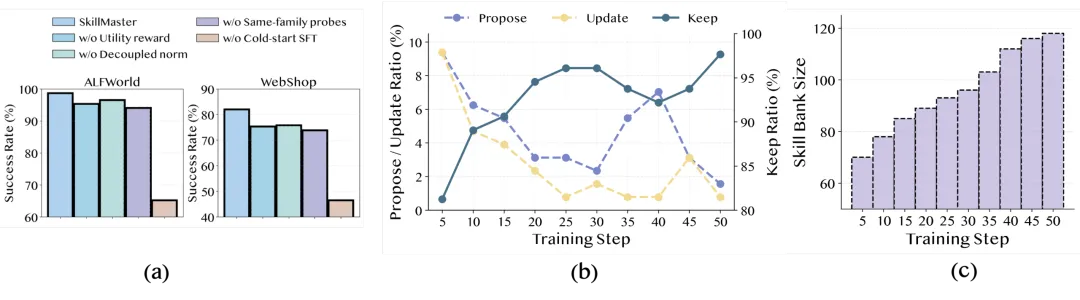
Figure 3 Left: Component ablation results. Center: Changes in the proportion of skill management operations. Right: Changes in skill library size.
As shown on the left side of Figure 3 , removing skill utility rewards, using pooled advantage normalization instead, or randomly selecting detection tasks reduces performance, supporting the role of utility feedback, separate advantage estimates, and relative task selection. The middle and right sides of Figure 3 show the changes in skill management behavior and skill library size respectively.
In ALFWorld training, in the early stage of training, creation and update operations were more active, and in the later stage of training, the proportion of retained skills increased from approximately 81.25% to 97.66%. This process embodies the model's gradual shift from supplementing and revising skills to behavioral changes that retain accumulated skills. The authors also fixed the trained model parameters and examined its ability to build skills in test interactions. At this time, counterfactual detection and utility feedback are not used, and legal skill management operations are executed directly and reused for subsequent tasks. On WebShop, starting from an empty skill library and enabling skill construction and retrieval at the same time, the success rate increased from 65.63% to 71.88%, indicating that the trained strategy can generate and reuse useful skills based on new interactions.
Case analysis:
Create and revise skills based on evidence of execution
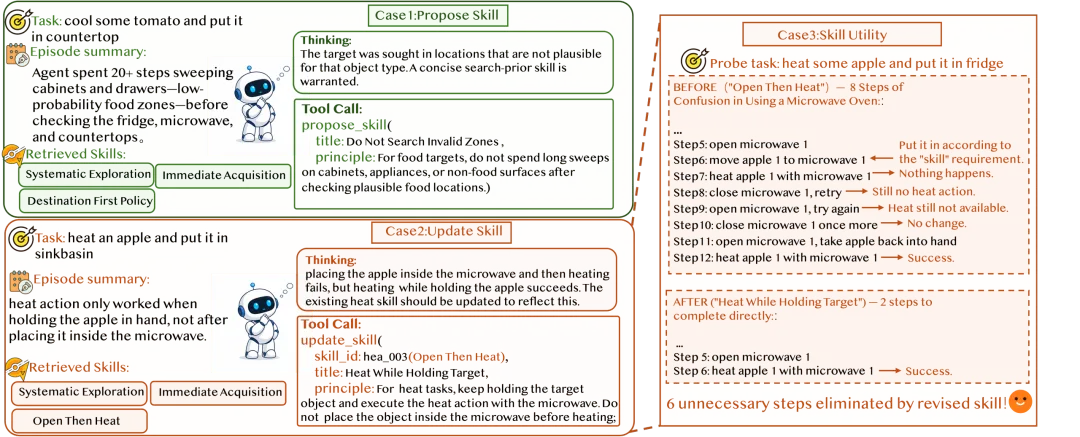
Figure 4 The agent discovers skill gaps from the task trajectory, corrects existing rules, and verifies the modification effect on related tasks.
As shown in Figure 4, in an ALFWorld cooling task, the agent spent a large number of steps on cabinets and drawers with low probability of food, and ultimately failed to complete the task. During review, it identified that existing skills lacked search priority rules, and created new skills to guide subsequent searches to prioritize high-probability locations related to the target object.
Another case shows the revision of an existing skill. According to ALFWorld's interactive interface, heating needs to be performed when the agent is holding the target object, but the old skill requires the object to be placed in the microwave first. The model revised this operating condition based on feedback from the trajectory. The comparison on the right side of Figure 4 shows that in the relevant detection task, the heating step was shortened from 8 steps to 2 steps, reducing six redundant operations, which directly reflects the downstream effectiveness of the skill modification.
Research prospects:
Explore recursive self-improvement through learning skill evolution
SkillMaster starts from skills, a reusable knowledge carrier, and explores a path for recursive self-improvement of intelligent agents. The agent discovers knowledge gaps or inefficient strategies during interaction, changes subsequent behavior through skill editing, and then learns more valuable editing decisions based on actual effects. Task execution and skill improvement are interconnected, allowing the agent to accumulate skills and improve its ability to improve skills through training.
The current approach has been validated in structured interactive environments and search-enhanced question answering. To further face open environments, it is necessary to explore more effective detection task selection and lower-cost utility evaluation, and extend to skill deletion, cross-agent sharing, and continuous learning under distribution changes. These directions are expected to enable skill libraries and agent capabilities to co-evolve with long-term interactions.