

Danqi Chen, an associate professor of computer science at Princeton University, has joined a fledgling AI company.
Early this morning, Danqi Chen revealed on social platforms that she joined Noeri as a part-time employee two months ago. She is looking forward to the research direction of this team, especially the application of AI in scientific discovery, and hopes that every scientist can use AI to solve their most difficult research problems.
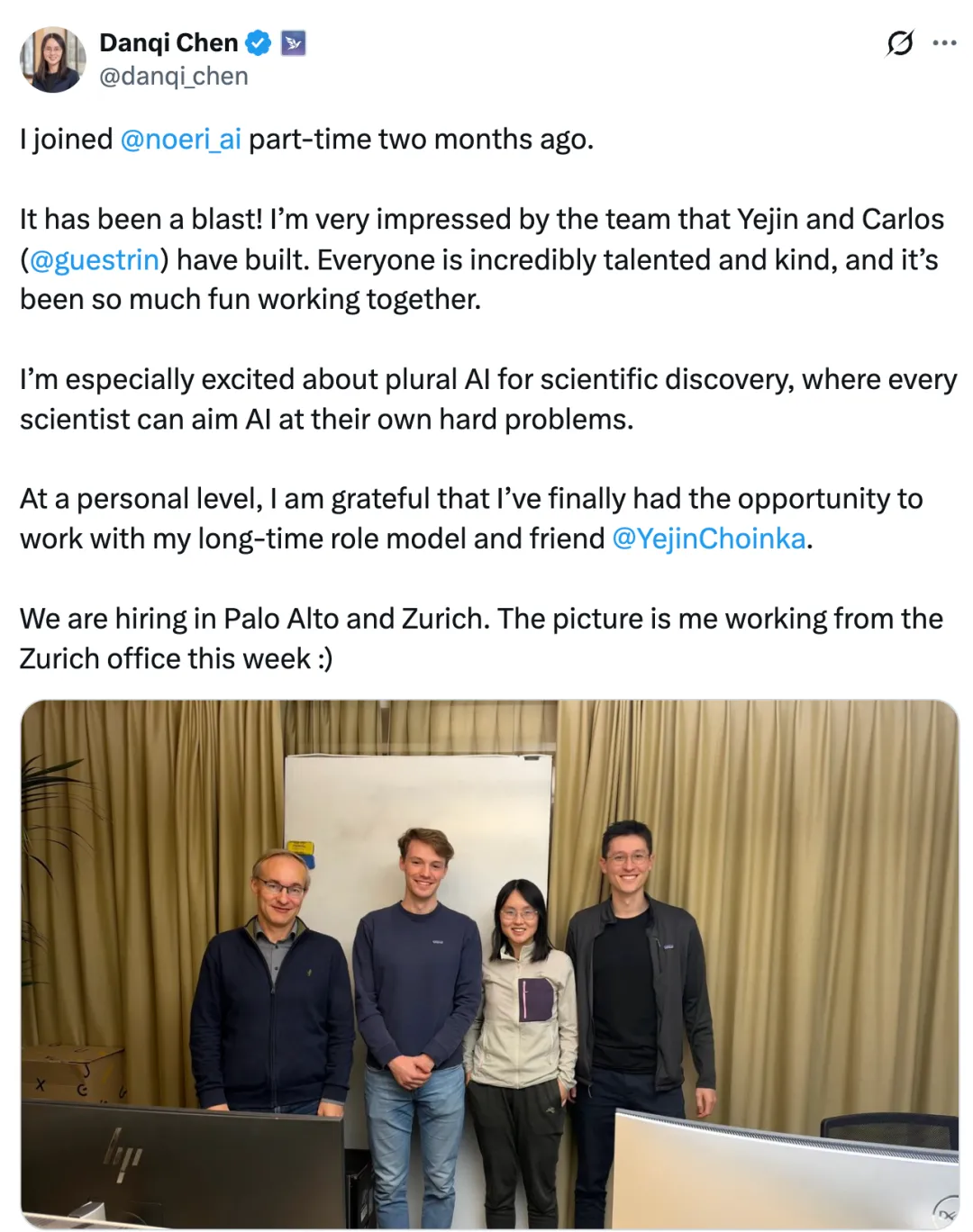
Noeri was co-founded by Stanford University computer science professors Yejin Choi and Carlos Guestrin and focuses on developing AI systems that can continuously learn and improve themselves. The company hopes to help enterprises use their own data and business experience to create their own AI, so that these systems can continuously accumulate experience and optimize capabilities in real work.
Along with its official debut, Noeri also announced it has received $110 million in financing, led by Menlo Ventures, with participation from Madrona Venture Group, Kindred Ventures, Wing Venture Capital and NEA, with NVIDIA, Cisco Investments, Snowflake and others becoming strategic investors.

This team came up with a very recognizable concept: Plural Intelligence. In their view, future AI should be composed of intelligent systems of different sizes and expertise, and each organization and individual can create, master and continuously improve their own AI.
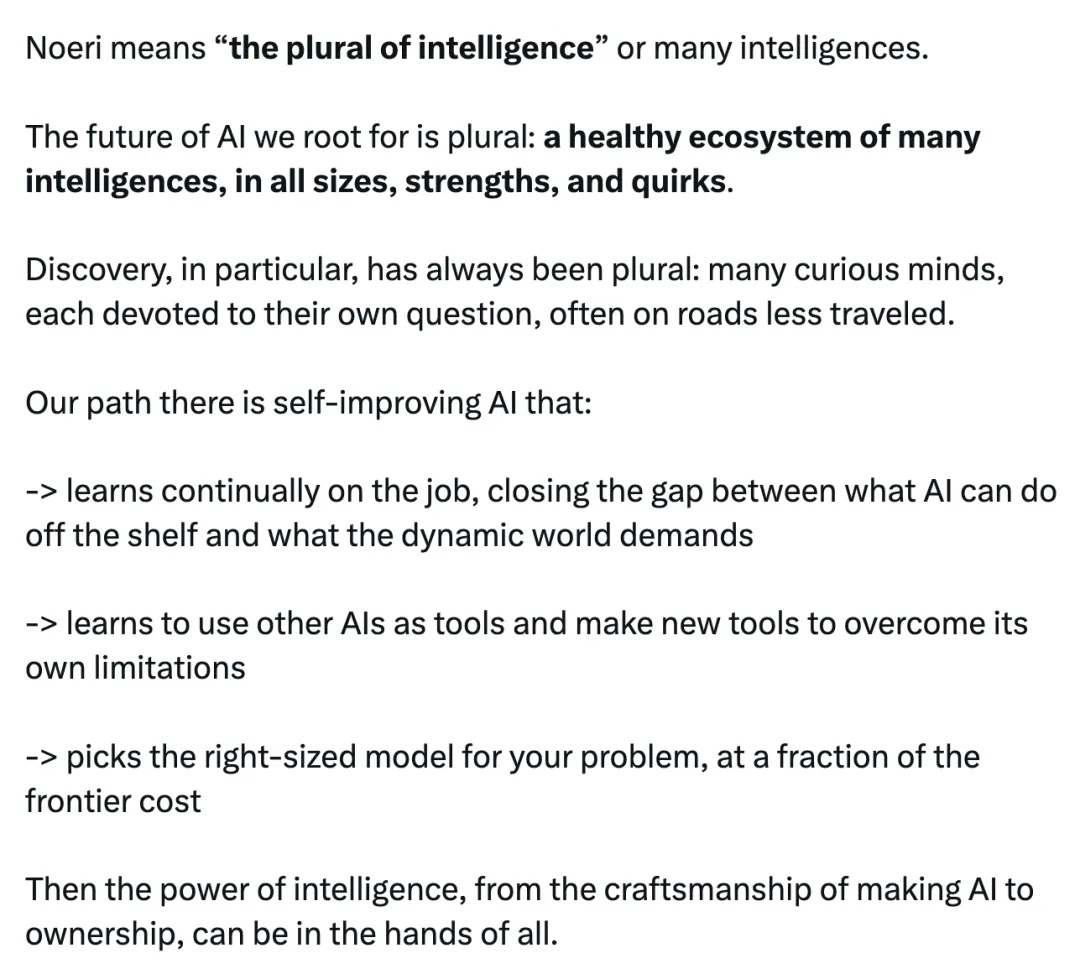
Danqi Chen joined
What’s the lineup behind Noeri?
The two core figures in this venture have considerable experience in the AI research circle.
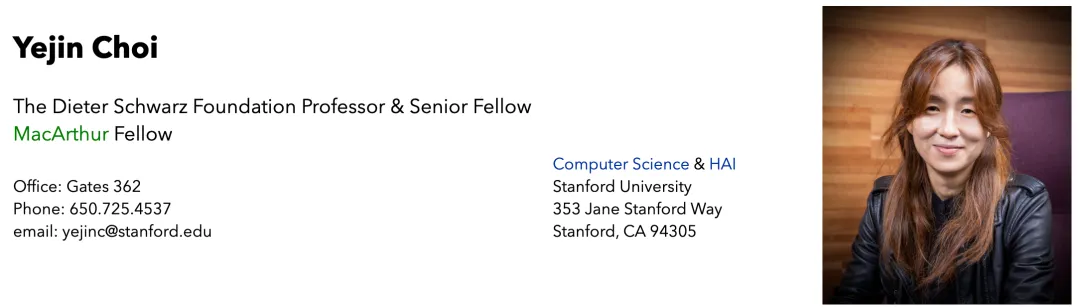
Yejin Choi is a professor of computer science at Stanford University and a senior fellow at Stanford HAI. She has long been researching common sense reasoning, natural language processing, large language models and AI value alignment. She was a professor of computer science at the University of Washington, a senior research manager at the Allen Institute for Artificial Intelligence (Ai2), and a senior research director and distinguished scientist at NVIDIA. In January 2025, she officially joined Stanford University.
Another co-founder, Carlos Guestrin, is a senior scholar and entrepreneur in the field of machine learning.
If you’ve been exposed to machine learning tools, you’ve probably heard of XGBoost, which he co-founded with Tianqi Chen. This is a widely used open source machine learning tool. He also co-founded machine learning company Turi, which was acquired by Apple in 2016. After joining Apple, Guestrin served as senior director of machine learning and AI and participated in promoting Apple's establishment of an AI and machine learning R&D center in Seattle.
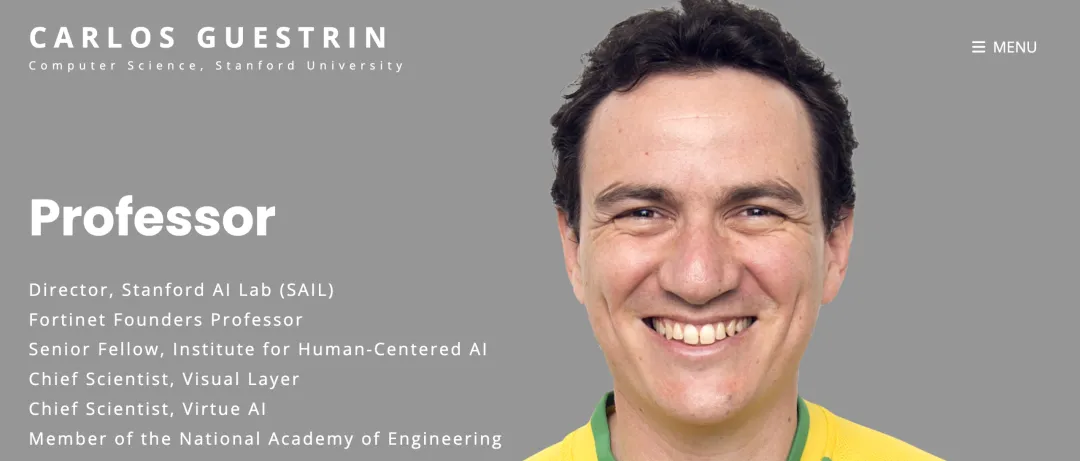
Today, the two serve as co-CEOs of Noeri.
The addition of Danqi Chen has brought another important research line to the team. She is currently an associate professor in the Department of Computer Science at Princeton University, where she co-leads the Princeton NLP research group. She is also associate director of Princeton's Language and Intelligence Research Program, which conducts fundamental research on large-scale AI such as LLM, and is one of the authors of RoBERTa.
In her tweet, Danqi Chen specifically mentioned that she was very happy to be able to work with her long-time role model and friend Yejin Choi.
Judging from the composition of the team, Noeri has brought together researchers in the fields of natural language processing, machine learning, reinforcement learning, agents, and scientific computing. It is obvious that Noeri hopes to put academic research and actual AI product development on the same line.
Let AI learn to improve AI
What is Noeri going to do?
Noeri’s positioning for itself is very clear: to build an AI system that can continuously learn and improve.
Currently, the parameters of most AI models are basically fixed after completing training. When a model is deployed within an enterprise, faced with new business data and workflows, it is often necessary to manually adjust prompt words, tool calling methods, or even retrain the model.
This means that if companies want to truly adapt AI to their business, they usually need to invest in a professional AI engineering team.
Noeri wants to hand over this part of the work to AI.
According to the product introduction announced by the company, Noeri will study the company's own data and workflow and optimize the entire AI system around specific tasks. Its adjustable range includes:
- Instructions and Skills: Improve the instructions, skills, and execution strategies used by AI systems based on actual task performance.
- Tools and orchestration: Adjust tool configuration and calling methods to optimize collaboration between different models and tools.
- Model selection: Based on the difficulty and cost of different tasks, select a more appropriate model to be responsible for the corresponding links.
- Model optimization: When necessary, further optimize the model itself and even adjust the underlying parameters to make the model more suitable for the specific tasks of the enterprise.
Each change is accompanied by an explanation and submitted to human review for confirmation. Noeri likens the process to a code review.
It supports the use of closed-source models and open-weight models, and can also be adapted as new models emerge. Customers retain ownership of their own data, as well as workflows and models developed through the system, but are still subject to relevant license agreements for third-party models.
Noeri hopes to continue to gain experience with AI in real work. The system learns from the enterprise's data, workflows, and interactions during task execution and improves its capabilities accordingly.
The experience and corrections in each task have the opportunity to become the basis for the next round of optimization.
From the perspective of product form, Noeri is more like an AI engineer who can continue to work. It is responsible for studying existing workflows, looking for room for improvement in the system, and proposing optimization plans; every change needs to be reviewed by humans.
plural intelligence
Why is it Noeri’s central claim?
The name Noeri itself hides the founding team’s judgment on the future of AI.
The company explains it as "The Plural of Intelligence." In the vision article published by Yejin Choi and Carlos Guestrin, the two mapped out two different paths for AI development.
One is a superintelligence developed and mastered by one company, and other companies and individuals can only rely on it. The other is an ecosystem composed of a large number of AIs of different sizes and capabilities. Each intelligent system is specialized and tuned around a specific geography, population, or problem, and is shaped by people and organizations that truly understand those issues. They prefer the latter.
There is a very real business issue behind this.
A company may need AI to handle different tasks such as financial analysis, customer service, R&D design, etc. Every job has different model requirements. If all tasks are given to the most expensive cutting-edge model, the cost will be difficult to control; if a lower-cost model with relatively limited capabilities is chosen, the task effect may be sacrificed.
Noeri hopes to find a more suitable combination through model specialization and agent collaboration. For example, let a smaller model be responsible for scheduling, and call other models and professional tools according to task needs; as experience in specific tasks continues to accumulate, the corresponding models and workflows will continue to be optimized. Different AIs perform their own duties and continue to evolve in actual work.
This line of thinking also extends to scientific research.
Danqi Chen mentioned in a tweet that she is particularly looking forward to the application of complex intelligence in scientific discovery. For a scientist, research problems are often highly specialized, and ready-made general models may not capture enough domain knowledge.
If AI can continuously learn around a specific research problem, remember what solutions have been tried in the past and what results have been achieved, and can also allow multiple specialized agents to work together to jointly propose hypotheses, test solutions and improve research directions, then scientists will have the opportunity to focus more on asking questions and verifying findings.
This is something Noeri hopes to explore.