

This time it’s really a king meeting a king!
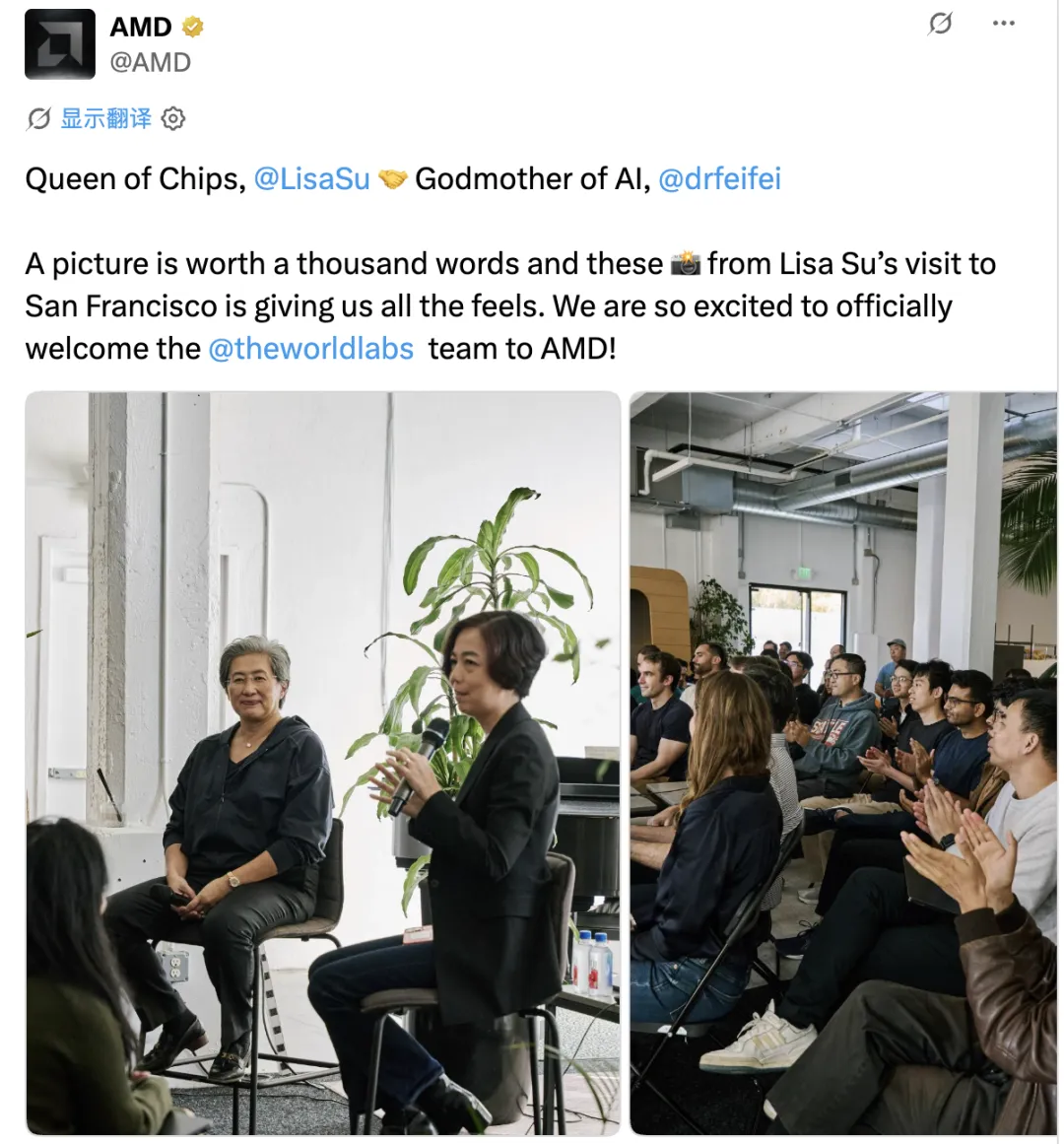
In the San Francisco office, "Semiconductor Queen" Lisa Su and "AI Godmother" Fei-Fei Li sat side by side on high stools, in front of a room full of World Labs employees who were applauding.
On November 16, local time, AMD officially announced the completion of its acquisition of World Labs. This spatial intelligence company co-founded by Fei-Fei Li has since been completely merged into AMD.
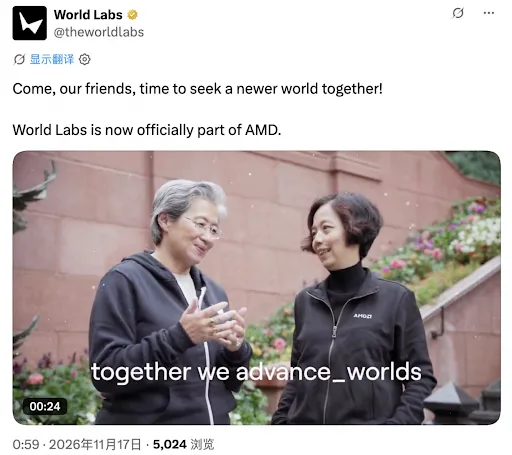
In the official announcement video, Lisa Su was wearing a black hooded sweatshirt while gesticulating and laughing. Fei-Fei Li, standing next to her, had already put on a black jacket with the AMD logo printed on the left chest.
At the bottom of this celebration video, the white subtitles change AMD's slogan that has been used for many years to "together we advance_worlds".
In order to win over this team, which was founded only two years ago, AMD offered an all-stock transaction consideration of approximately US$8.2 billion.
After the completion of the transaction, Fei-Fei Li officially became AMD's executive vice president and chief scientist, reporting directly to Lisa Su.
From the signing of the acquisition agreement on September 28 to the completion of all delivery on November 13, this transaction only took 46 days.
14.98 million shares were sold, the second largest acquisition in AMD history
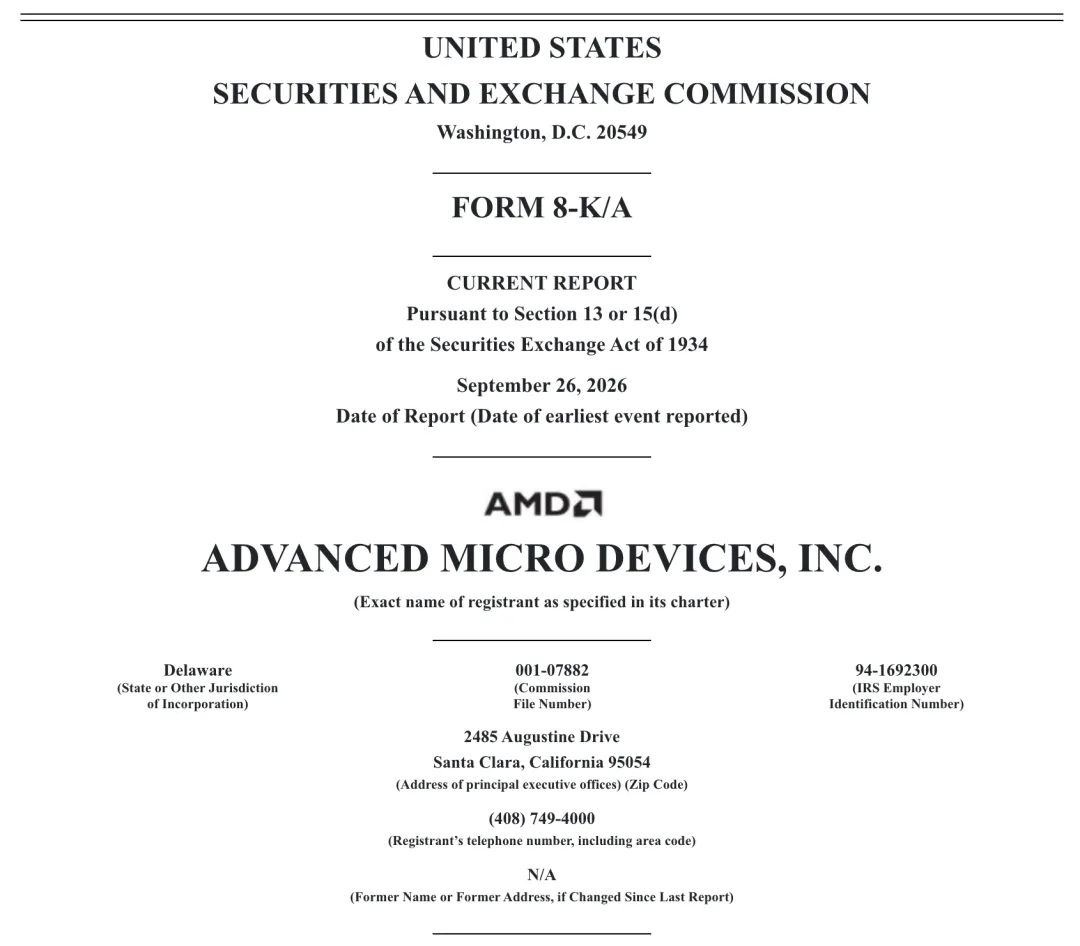
According to AMD’s Form 8-K/A supplementary document submitted to the U.S. Securities and Exchange Commission on November 16, the acquisition was completed on November 13.
This speed is much faster than the two parties originally expected to implement it before the end of the year.
This transaction adopted an all-stock non-public offering. AMD issued 14.978 million ordinary shares to the original shareholders of World Labs, with a total valuation of approximately US$8.2 billion (approximately RMB 54.6 billion).
In the history of AMD's mergers and acquisitions, the size of this transaction is second only to the Xilinx acquisition that will be completed in February 2022.
In 2022, Lisa Su led AMD to swallow up FPGA leader Xilinx in an all-stock manner, with a total value of approximately US$49 billion at the time of delivery.
This acquisition set a record for mergers and acquisitions in the chip industry, and directly supported AMD's subsequent embedded and adaptive computing landscape.
Four years later, Lisa Su once again spent $8.2 billion in stock to buy an AI team specializing in three-dimensional world models.
After the transaction was finalized, Feifei Li, co-founder and CEO of World Labs, officially entered AMD's core management as executive vice president and chief scientist, reporting directly to Zifeng Su.
The other two co-founders of World Labs, Justin Johnson and Ben Mildenhall, will also stay on.
They will continue to advance basic model development as an independent cutting-edge research organization within AMD, while working collaboratively with AMD's hardware, software and systems engineers.
In the computer vision circle, these two are also familiar faces with full resumes.
Justin Johnson is a doctoral student brought by Fei-Fei Li at Stanford. He has participated in the creation of the CS231n course that almost all AI beginners have seen. He is also the core promoter of real-time style transfer and the PyTorch3D library;
Ben Mildenhall from Google Research is the co-inventor of the NeRF paper that set off the entire three-dimensional visual reconstruction wave in 2020.
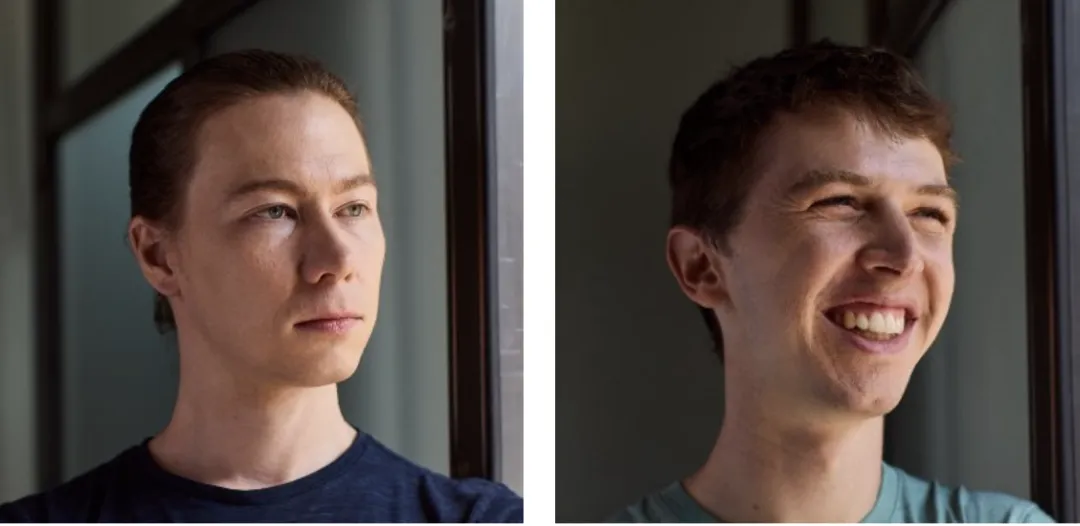 △Left: Justin Johnson, right: Ben Mildenhall
In the celebration posts released simultaneously by the two companies, World Labs also borrowed the phrase "Friends, let us go together to find a newer world" from Tennyson's "Ulysses", echoing the title of Fei-Fei Li's previous open letter.
In sharp contrast to the enthusiasm between the two parties, the reaction of the capital market that day was somewhat calm.
After the market opened on Monday, November 16, AMD's stock price did not rise, but fell by about 5% due to the pullback of the entire semiconductor sector and AI infrastructure concept stocks.
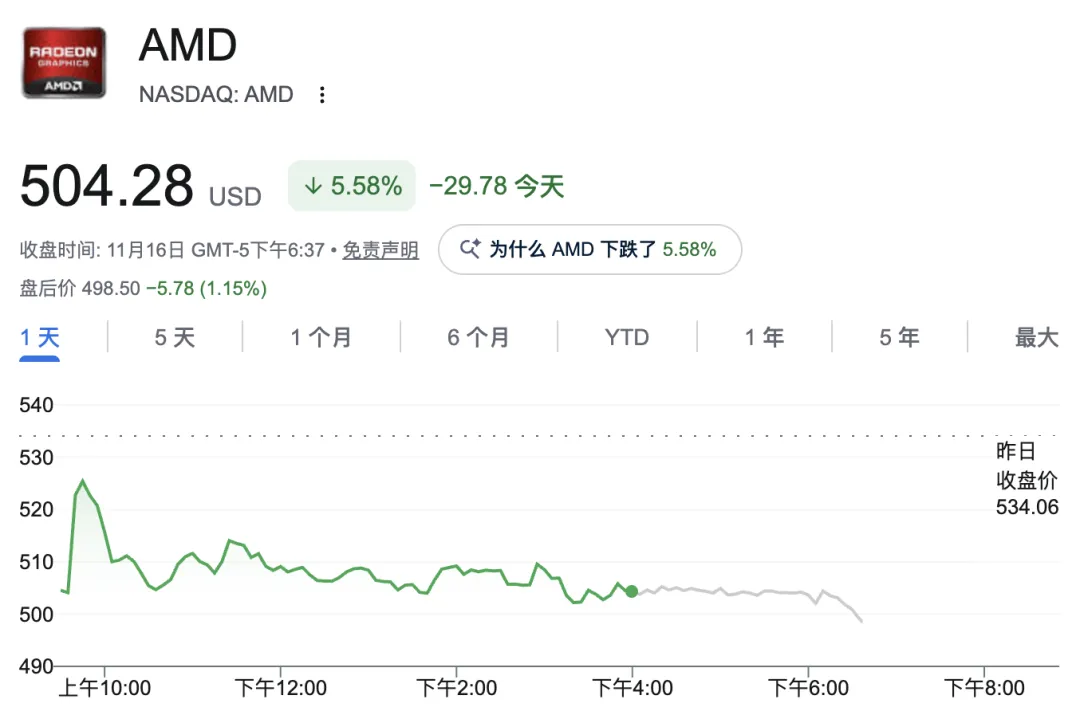
Wall Street is obviously still waiting for this newly formed team to hand over the first answer sheet of soft and hard collaboration.
From 230 million to 8.2 billion, what did they create?
In 2024, Fei-Fei Li co-founded World Labs. The main focus avoided the large language models that were crowded with people at the time and directly focused on spatial intelligence that can understand and simulate the three-dimensional physical world.
When the company came out of stealth mode, it raised US$230 million in financing and was valued at US$1 billion.
In November last year, World Labs handed over Marble, its first multi-modal world model.
Users only need to input text, pictures or rough 3D layouts to generate 3D scenes that can be freely explored, edited and exported.
In February this year, World Labs completed another new financing of up to US$1 billion. The list of investors included Autodesk (investing US$200 million), NVIDIA, and AMD was also among them.
However, what really allowed the industry to see the quality of this company's technology was the new generation of all-around world model Atlas released on September 1 this year.

Fei-Fei Li specifically disassembled the technical base of Atlas at the CoRL 2026 conference a few days ago.
Today, when large language models generally believe in "Next Token Prediction", the core idea of Atlas is "Viewpoint Is All You Need", which predicts the next perspective through precise camera pose condition control.
Atlas simultaneously takes in text, images, videos, depth signals and 3D structure signals during the training phase, and can switch between dense reconstruction, sparse reconstruction and pure text generation modes under the same set of autoregressive diffusion Transformer architecture.
In a blind test initiated by RapidData, a third-party organization, the test party collected approximately 500,000 human reviews to compare the camera control generation capabilities of major videos and world models.
In the end, Atlas ranked first, able to generate more than 60 seconds of coherent perspective video at 1440p resolution.
What's more important is the direction of the robot.
World Labs also acquired Scenix this year, a robotics company that specializes in real-life to simulation and simulation-to-reality pipelines.
Fei-Fei Li demonstrated at the scene that the robot was completely trained in the virtual simulation environment built by Atlas, and then directly deployed to the real physical world in a zero-sample manner.
Just one day before the acquisition was completed, on November 12, World Labs announced that Atlas would be fully open to all public and developers.
Against NVIDIA, AMD decides to raise its own models
Just a few days before the delivery was announced, Lisa Su and Fei-Fei Li talked on the same stage for the first time at the CoRL 2026 conference.
At the beginning of the conversation, Lisa Su judged that physical AI, especially the robotics track, will be a trillion-dollar opportunity in the next few years.
She also revealed that AMD actually already has a large-scale robotics research team within AMD, but the overall layout is still in the early stages.
Fei-Fei Li made the judgment that "AI is computing, and computing is AI" on the stage.
This is exactly in line with Lisa Su’s emphasis in the delivery announcement that “the computing platform and AI model must be jointly optimized.”
When asked before why World Labs didn’t build Atlas right away, Fei-Fei Li said half-jokingly, “Because Justin’s team needs a massive amount of chips.”
To truly make the world model bigger and stronger, it is inseparable from the huge GPU computing power.
In the past, AMD and World Labs were just partners, and the two parties have been jointly debugging model training and inference on AMD GPUs since 2025.
However, external cooperation is always separated by a layer of business boundaries, and it is difficult to spread out and modify the underlying pain points before the chip is finalized.
Now that the two families have become one family, Fei-Fei Li's team can directly take Atlas and subsequent cutting-edge models to participate in the architectural design of AMD's future Instinct series chips and ROCm software stack. Before the hardware drawings are finalized, they can use real space smart loads for stress testing.
AMD's recent moves to fill its territory have also been particularly intensive. In addition to spending $8.2 billion to acquire World Labs and announcing the acquisition of inference chip company Taalas, it recently also planned to invest in quantum computing company PsiQuantum and signed a data center computing power lease agreement with Core Scientific.
Faced with the high wall of software and hardware built by NVIDIA, AMD repeatedly talked about "open AI ecosystem" from the signing of the contract in September this year to the delivery in November.
AMD wants to use open hardware, open software and self-developed cutting-edge models to provide developers with another set of options.
In the competition between chip giants, it is no longer easy to determine the winner based on the parameter table of a single graphics card.