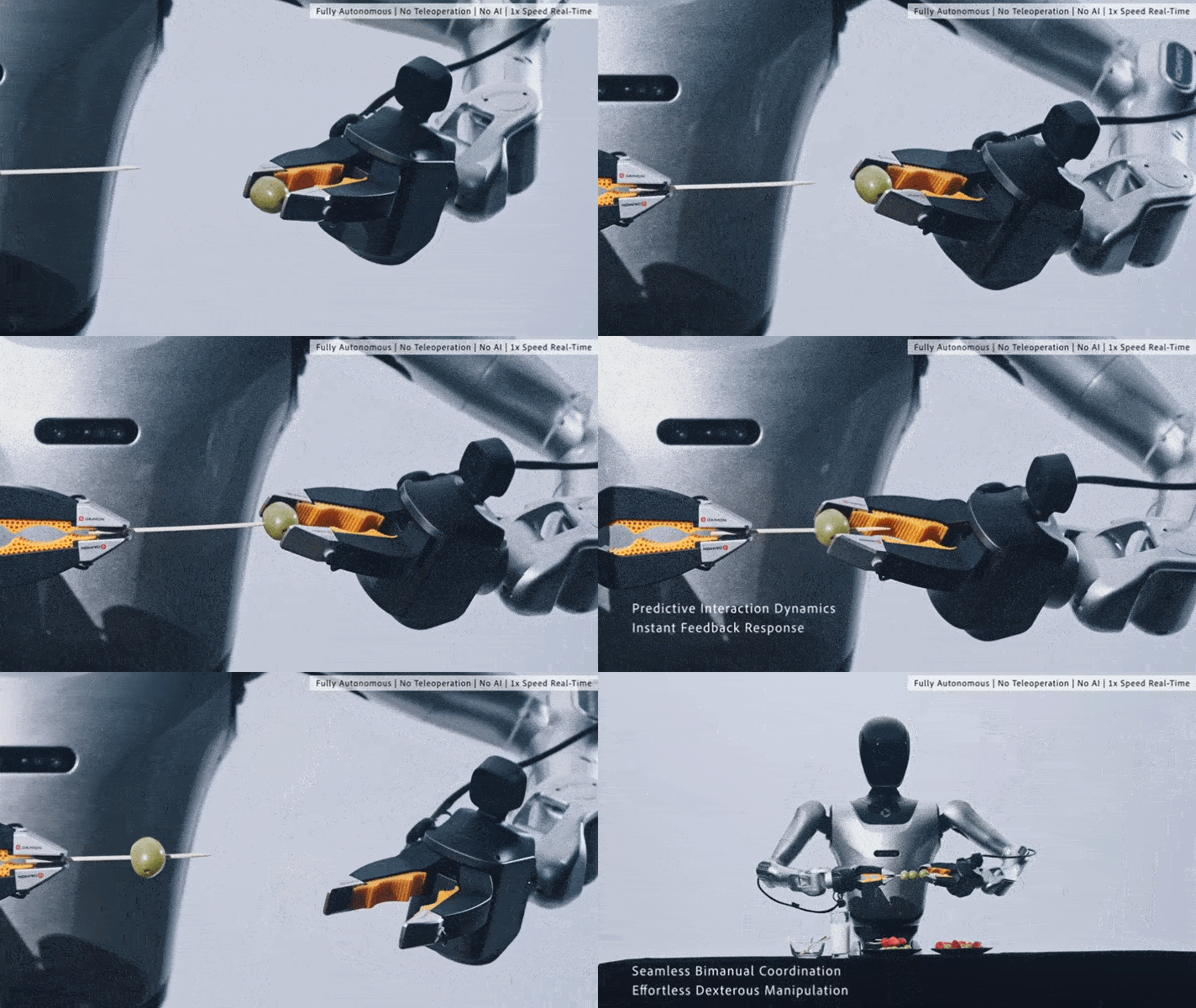
Tactile data isn't only effective when it's collected: AI is starting to learn from the collection tools to modify the molding model.
I'd like to know more about how to turn touch into a robot's ability.
In 2026, touch is one of the focuses of the body industry. The emergence of touch-containing datasets and model connections, allowing robots to install sensors and access touch information, is becoming an increasing choice for teams.Is the model going to work, and is it going to work?
For example, when a claw is inserted into a plug, the image appears to be aligned, but the plug is stuck on the edge. Once the object is not useful, the robot needs to know where it is blocked and in which direction it should be adjusted.
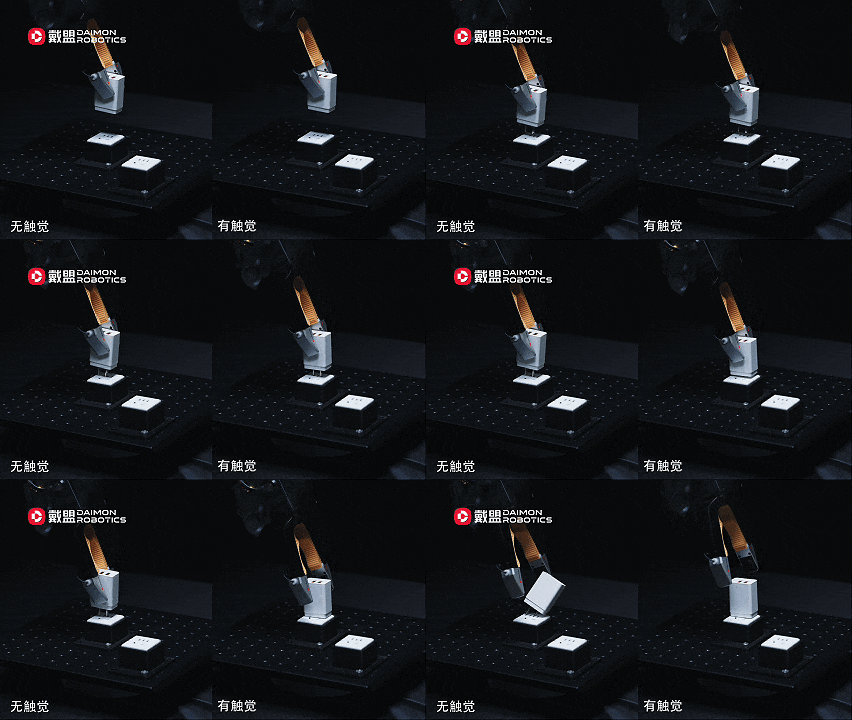
The touch can provide these clues, so the touch is becoming a symbol of the body from high-end selection. However, the model does not necessarily know how to use touch.
In experiments such as T-Rex, adding a touch directly reduces the success rate and improves the results after changing the method of access. This does not prove that touch is useless, but indicates that more than one type of input voltage does not automatically lead to more than one capacity voltage.
The sensation of excitement therefore requires a more specific examination:Are robots doing something bad in the past because of these experiences of contact?
TacClaw-Infinity, recently released by AI, provides direct evidence for this problem: touch data can improve the operational capabilities of robots, improving amplitude by up to 44.7%.
It is worth noting that this work has shown thatHow to make a good touchSystems thinking: from collecting valuable contact information, to organizing it into a learning experience, to letting models learn how to use touch to reason, make decisions, and act.The CovenantIt's not.It's all over the place.“The perception-The data-Models”ofFull Solutions is becoming one of the most tactile teams in the industry。

The value of touch,To see what robots do right.
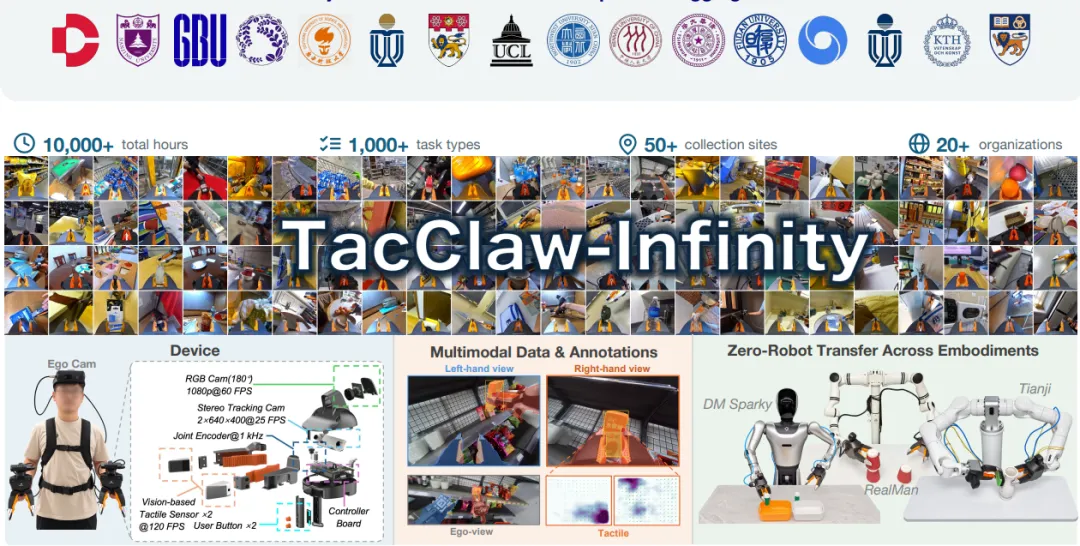
In April this year,Published by DAIDaimon-Infinity is the world's largest tactile full-mode physical world body data setThe data was collected by dozens of research institutions in China and abroad, including Google DeepMind, the National University of Singapore, and Qinghai University (including 10,000 hours of industry-oriented data that has been downloaded more than 10 million times on the Hugging Face and Dragonfly communities).TacClaw-Infinity focuses on the part of the TacClaw collection that uses visual touch in the Daimon-Infinity system.
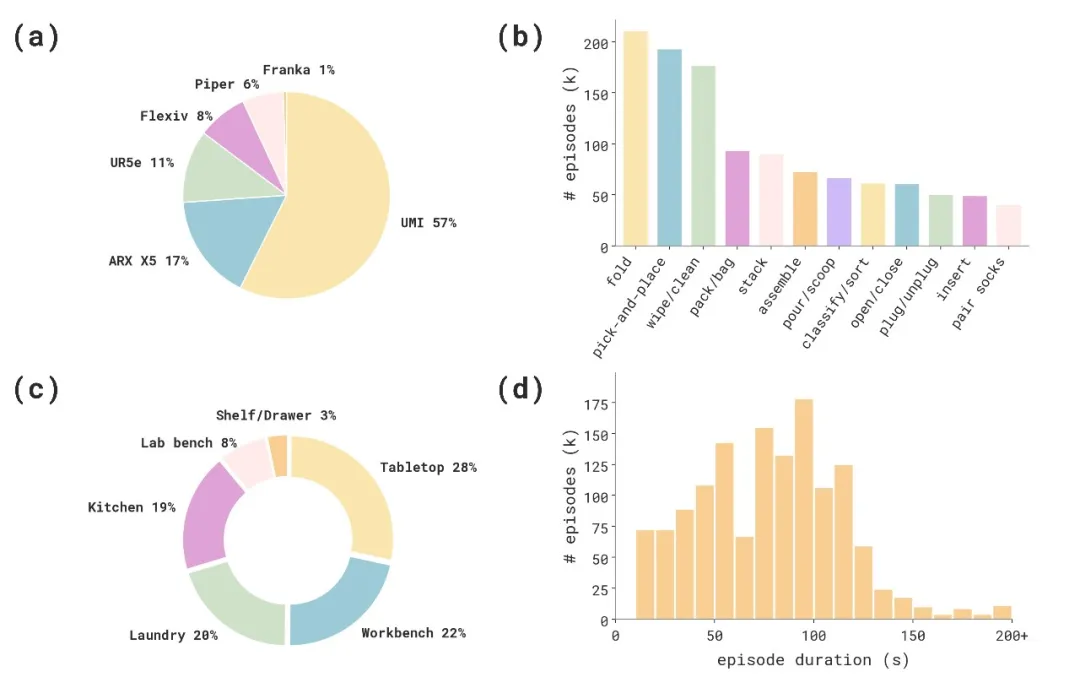
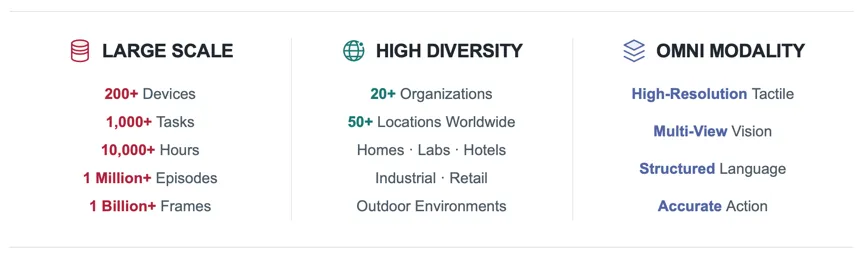
This is aLarge-scale, high-diversity, multi-modal physical contact data setsIt contains more than 10,000 hours, 1 million operation tracks, 1 billion tons of data, covering more than 1,000 types of tasks.
What's more worthy of attention than the scaleConfirmation of the results of improved robotics capabilities。
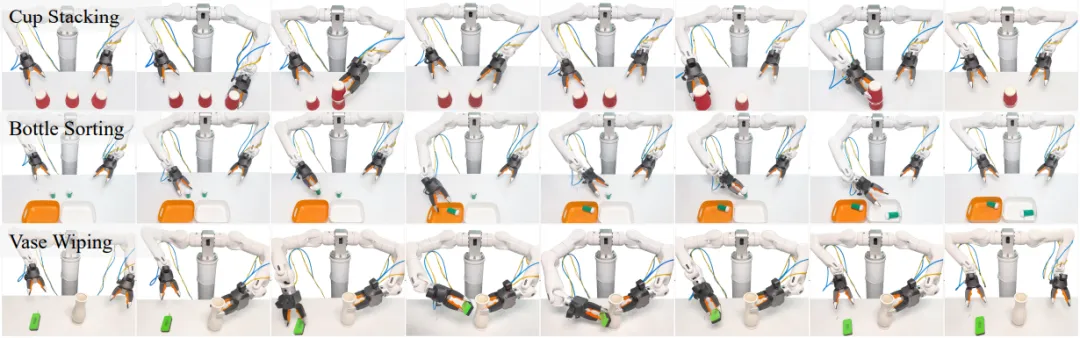
Research on three robotic platforms at Tianji, RealMan and DM-Sparky tested two types of models,π0.5 and StarVLA, with three tasks: cup stacking, pick and place, bottle classification, contact information to judge the state of the object, and bottle scrubbing, which required the robot to adjust the dynamics of the bottle's curve to always maintain the correct intensity of contact, while also ensuring that the bottle is not driven while being scrubbed.
After touch data training, the model's operational success rate has improved significantly.The average success rate of π0.5 increased from 50.0% to 74.0%, and the StarVLA increased from 46.0% to 72.7%. Profits were particularly prominent in more contact-dependent tasks: in the bottle classification, the success rates of the two types of models increased by 44.7% and 43.3% respectively; in bottle wiping, by 22.0% and 38.7%, respectively.
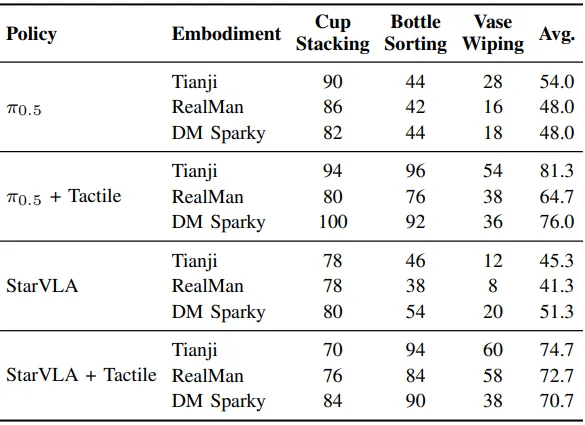
And also,The experiments did not introduce a specific tactile architecture or controller, only input the tactile observation into an existing model as an image.This is enough to significantly improve the operational capabilities of the model.
This shows that the data contains fully effective contact information that can be used by existing strategies and converted into actual operating benefits, rather than just adding an input model to the model.
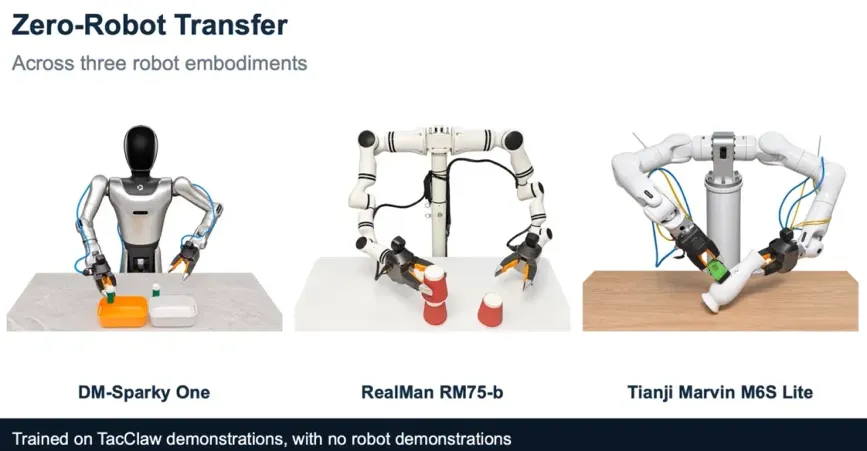
In addition, TacClaw-Infinity can be implemented.Zero-core migrationTypically, models that use non-core data training will also need to use target robot's real-time data to complete further fine-tuning adaptations; however, TacClaw-Infinity does not require additional collection of real-time data to achieve significantly improved capabilities for direct model training, which will provide a cost-effective way of using real-time data.
The three robots used in the experiment differed significantly in mechanical structure, range of motion, and hardware configuration, and the model architecture of π0.5 and StarVLA was not the same, suggesting that TacClaw data also contained a large amount of data.Cross-body migration and cross-model generalization。
In other words, TacClaw-Infinity demonstrates that physical interaction experiences can be unbundled with a robot's body to become a shared, replicable experience asset, and that the value of the data thus falls from how much data is recorded to how much data can help anyone learn.

High-quality data, starting with understanding each touch
The improvement in operational success rates is a direct reflection of the value of access to data, and more industry-relevant is how to continue producing such data. TacClaw-Infinity unveils a complete data system, from collection tools, collection patterns to data processing, that is always designed around a question:How can we record and organize the experience of contact to make the model really feel good?
The first step, with a good touch, took place before the training:Record real contact and make models reliable and accessible。
When a person picks up a paper cup, the strength is adjusted as soon as they touch the wall of the cup. These slight changes may not seem noticeable, but may determine whether the cup is picked up steadily or pinched. If the collection tool is unable to accurately transmit these contact sensations, the model may not learn enough precise operating experience.
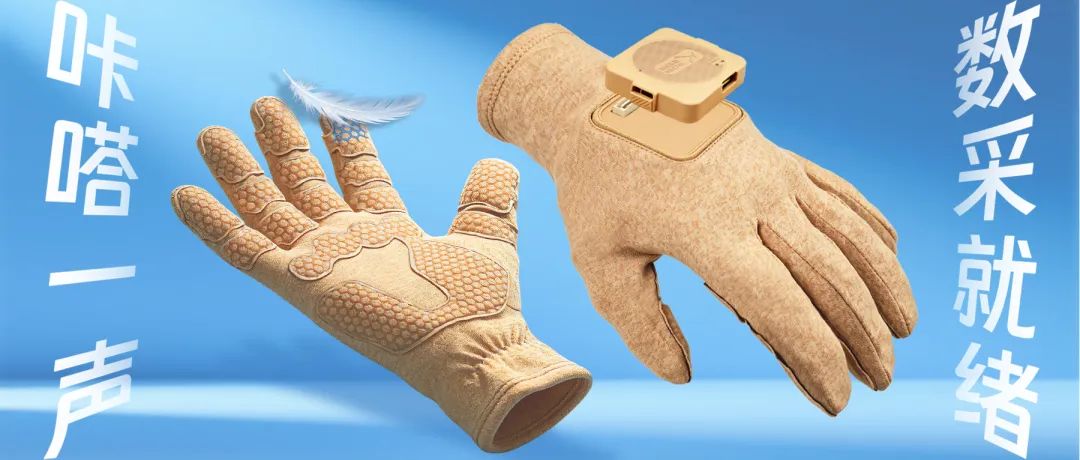
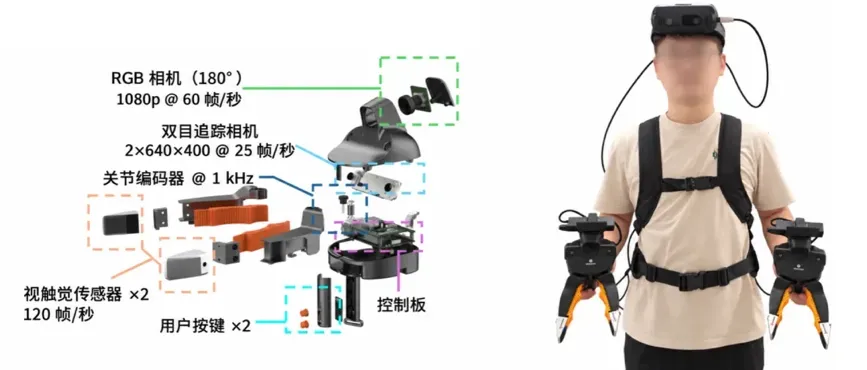
TacClaw is equipped with a self-developed visual touch sensor that records the multi-dimensional information generated by contact into high-resolution images and simultaneously collects vision, clavicle movement and open state. Thus, the model is able to match the movements with feedback, learn what clavicles do and what changes occur with clavicle contact.
The team also optimized the mechanical transmission.Make contact with feedback more direct to the hands of the operatorControl tests show that operators can detect lighter contact using the TacClaw to provide the basis for a natural, detailed demonstration of the operation.
Second, make contact experience rich enough that models have the opportunity to learn to cope with change.
The same cup, grab the mouth of the cup, hold the body of the cup, or pick it up from different directions, generate different tactile feedback. Only repeatedly record a thought, and even with a large amount of data accumulated, it is difficult for a church robot to respond to other situations.
This means that large-scale collection needs to answer two questions at the same time:How to get more samples, how to make new samples bring different experiences.
TacClaw's portability with the involvement of untargeted robots enables data production to move out of a fixed location.
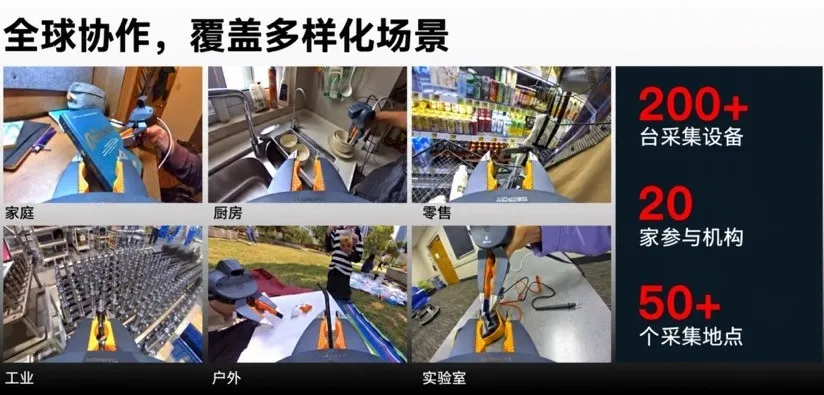
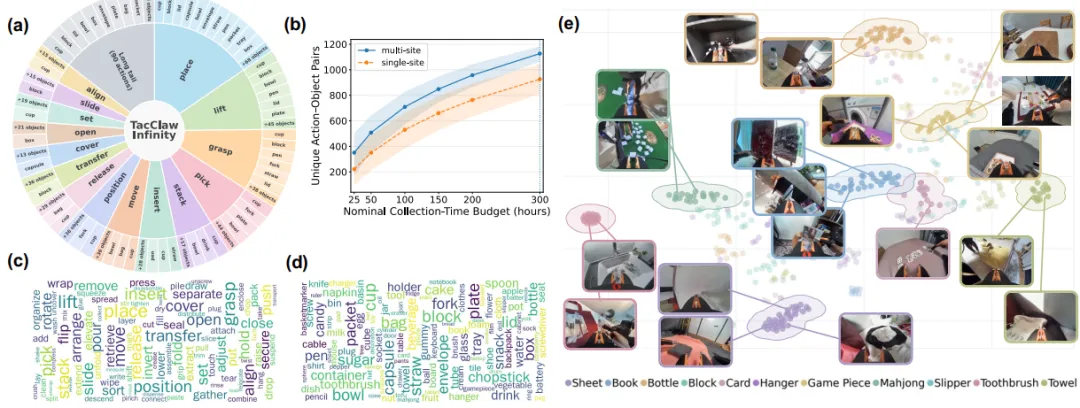
AI has pioneered an outsourced data collection model, with in-country and in-country 2More than 200 devices have been deployed in collaboration with more than 0 institutionsWorldwideMore than 50 locations, covering homes, laboratories, industrial sites, shops and outdoors.
Under the same 300-hour budget, this multi-site collection averaged more than single-site collection covering about 201 pump action-object pump portfolios.
 This increases not only the amount of data, but also the diversity of scenarios with operators, tasks and movements, objects, and touch interaction states. For the model, these changes provide a broader learning material to help it learn how to approach, judge, and adjust under different conditions, rather than just repeating movements in fixed scenarios.
In the end,It's not.ContactsDeconstructing the operational trajectory at a point of focusHow to make models of human experience easy to learn。
The recorded operations will not automatically turn into high-quality training materials.
Common data markers would view the trajectory of holding up the cup as a whole; but from a robotic learning perspective, this involves several completely different stages: reaching for the cup, touching the cup with the fingers, tightening and moving the cup, and loosening the cup.
At each stage, the model depends on different models:
Prior to contact, the robot primarily judges its position visually.
After contact occurs, touch becomes an important basis for determining whether to grip, slide, and adjust movements.
Therefore, TacClaw-Infinity divides the time, language, and space of the trajectory into contact events as a common basis.
It's like this.Continuous recording has a clearer structure: when the object is touched, what the segment is doing, and what movements are taking place around it.Touch is no longer just an external input of information, but the model is used to understand the data based on what the mouse model learns, not only how the mouse ultimately completes the task, but also how the task is completed step by step and how the information is organized.
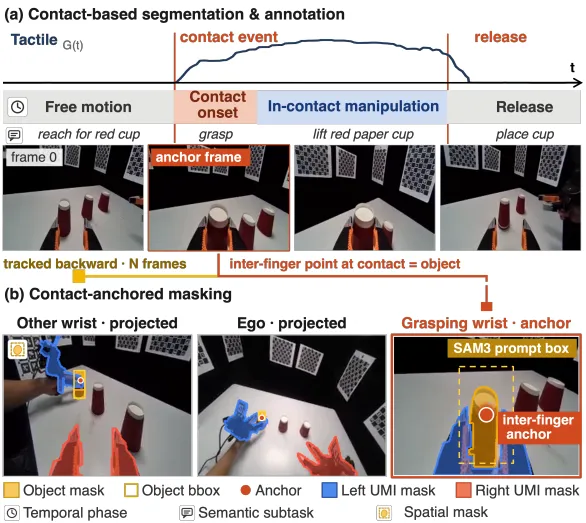
This set of data systems reflects AI's understanding of touch-sensitive cues: designing data around what a model needs from the start, recording critical contacts, covering different interactions, and bringing experiences into the learning process in a clear, reliable form.

How can the model make better use of it after touch?
High-quality contact data provides an added benefit to model capabilities, while, in turn, it helps to improve the performance of models.How the model architecture is designed determines whether the value of this contact information can be maximized.。
Touch contains useful information, and does not mean that the model naturally knows when and how this information should work.
Visual and tactile clues are not the same: the robot must first see the position before reaching for the cup; after holding it, it must determine whether it is firm or slippery; minor changes in contact, sometimes requiring a rapid adjustment by the robot, cannot wait for a complete task to be re-planned.
This is why it is necessary to ask the question more specifically:
What are the times when you need to get feedback? What judgments can't be based solely on appearance? Should you change the overall plan after getting feedback, or just minimize the action?
These problems are not a unified answer to all tasks, nor can they be solved by increasing input.
The CovenantThe world's first tactile grounded world model, Daimon-TWM (Tactile-grounded World Model), was released this year.I'm exploring.How to use a mouse model to communicate with a mouse.
The model incorporates physical cognition, decision-making and instantaneous manipulation into the same model framework, each with touch as a base, giving the model the ability to interact physically so that the value of touch falls into the model's specific decision-making.
In the physical cognitive field
Daimon-TWM makes touch the basis of a model's knowledge of objects and its judgement of their state.。
For example, if an object looks hard but is soft to touch, the model needs to make judgments based on actual contact to modify its appearance. Through tactile reasoning, the model identifies physical properties such as hardness and roughness from feedback such as force, shape changes, and provides the basis for subsequent operations.
The value of touch is thus shifted from the sense of touch to the sense of understanding of the meaning of change.
In launching the decision-making panel
Daimon-TWM further utilizes touch to predict the physical consequences of actionFor example, continuing forward after the plug is blocked may increase card resistance, while adjusting direction may improve contact. The model will link the current contact state to subsequent actions, predicting how the contact will change, and providing a basis for action selection.
Touch, therefore, is not only used to confirm what has happened, but also to participate in judging what should be done next.
Instant control of the board
Daimon-TWM is usingHigh frequencyTactile feedback, timely correction of biases in execution• Touch is a high-frequency pattern that is often not yet observed by the visual, and has been perceived by the touch; these visually difficult to detect subtle changes in gravity, local slippage or contact instability, often directly affect manipulation. • The model responds in real-time by tapping, quickly identifying movement biases, and providing timely small movement corrections.
Tactile perception is thus transformed into the ability to continuously correct biases, which helps robots to maintain stable operations in the face of changes and external disturbances.
This resonates with AI's data and model research: which contact experiences should be retained in data systems studies, and how these experiences work; the lack of exposure to models can be a guide for the next round of collection and labeling.
The data and the model can therefore interact with each other, gradually answering the next round of questions about what to do and how to train a mouse.This allows for a two-way synchronization of data and models.。
To truly understand touch is to turn touch into ability.Putting these work together, the characteristics of AI become clearer. It studies both what sensors can see and what data should be left behind, and how models judge and act accordingly.
This is what it means to connect touch hardware, data, and models:
Understanding the physical significance of contact, knowing which experiences are worth preserving, and using real-world operations to demonstrate the benefits of the model, ultimately transforming real-world interaction experiences into robot-learable, understandable, and usable operating capabilities.
When this all-encompassing capability is turned on, it is possible to become a truly tactile, tactile, tactile enterprise, and from this point of view, AI is arguably one of the most tactile teams in the fitness industry.
RefTacClaw-Infinity