It's the first time I've ever been to a temple in China.
QbitAI is public.
Over the past six months, if you look closely at Silicon Valley's top-notch AI lab, you'll see a circle around Silicon Valley.Life sciencesThe lightning-filled encirclement has been quietly completed:
In April, OpenAI took the lead in launching GPT-Rosalind, a vertical reasoning model created specifically for life sciences, which was rapidly transformed into GPT-Rosalind-5.5 as the basis for GPT-5.5, and simultaneously offered a rigorous live signal rating benchmark.
In May this year, Google followed up with the launch of Gemini for Science.
In June this year, Anthropic officially launched its AI workplace for researchers, Claude Science.
From bottom-up vertical models, assessing standards to scientific workshops, the world's leading AI companies have launched a full-scale deployment of life sciences as one of the world's leading battlefields to verify AGI and RSI levels of gold in just six months.
However, when this front-line wave came into reality,National life sciences community and developersIn the real world, however, there are two real barriers that cannot be overcome:
On the one hand, the GPT-Rosalind representative overseas biosynthesis model is highly closed source. More importantly, these models may not be able to directly meet the needs of domestic thematic groups and pharmaceutical companies for localized deployment, data security and business adaptation;
On the other hand, bioinformatics itself has a higher professional threshold. Faced with millions of sequencing data, missing labels, and analytical pipelines involving multi-step statistical checks and complex tool calls, large general models often require expertise, a combination of tool chains and execution environments, in order to successfully complete real scientific research tasks.
The general model is a biography, as in reciting the medical biography:The surface terms for the answer are flowing, and a real sandbox is falling apart.
To live up to the RSI model, we throw the model directly into the command line with millions of lines of raw noise:I wrote scripts, modified databases, and cross-checked them.
Today, the Infinite Frontier is officially an open source bio-information model.Fx-Bio-1031。
The model is geared towards the research and development of professional bioinformatics missions, targeting the direction explored by professional models such as OpenAI GPT-Rosalind, andOpen the full model weightFx-Bio-1031 is currently running biomedical drought experiments.
In the BioMysteryBench benchmark test published by Anthropic, the Fx-Bio-1031 was achieved on the Difficult subset.70.59%Pass@5 opened up a lot under the same frameworkGPT-6-Astra(47.06%) andClaude Opus-5In comparison, Fx-Bio-1031 was up 23.53 and 17.65 percentage points respectively.
Additionally, on the BiomniBench, which examines the entire process of complex scientific analysis, Fx-Bio-1031's Pass@3 reached even higher.89.50%。
In the face of the headache-stricken task of human experts, it is no longer just a question-and-answer machine that memorizes the names of genes.Writing code, installing software, modifying databases, and doing cross-validationEven after reaching a remarkable conclusion, he proactively added 14 more questions to himself.
Check out the scoreboard: Deep water area of human expert Kavanagh, drawing the gap
Why is bioinformatics a cruel test of the colour of an AI agent?
In Anthropic's BioMysteryBench, the model can't rely on recovering raw data sets, but instead is thrown directly into real biological data and Linux tooling environments, completing a series of complex analytical tasks. These tasks cover whole genome sequencing (WGS), single-cell transcription (scRNA-seq), chromosomal openness (ATAC-seq), macro-genome and protein geometry.
It has to be like a real computational biologist: reviewing the original document himself, going to NCBI and Ensembl to extract notes, writing a multi-step statistical script, and going back and forth.
In the team's unified smart body assessment framework, Fx-Bio-1031 responded as follows:
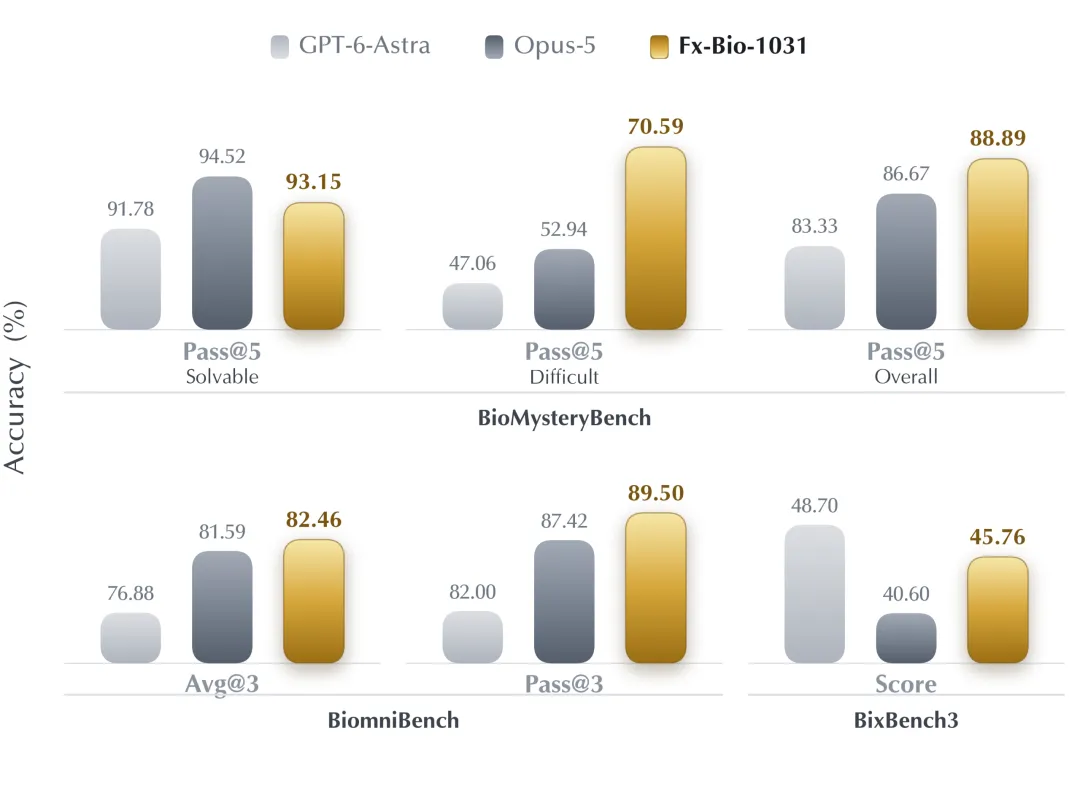 △Fx-Bio-1031 compares with GPT-6-Astra-Opus-5 on benchmarks such as the Anthropic BioMysteryBench, BiomniBench, etc.
If you look closely at this chart, the most striking numbers appear.Difficult (difficult subset)。
When it comes to human experts' solvable subgenre (Solvable), the top models are at more than 90% of the fairy tale battles; but once entering the Difficult Deepwater Zone, which requires dozens of steps of long-range reasoning, multi-source evidence puzzles, and even human experts bend, the GPT-6-Astra and Opus-5's pass rate instantly drops or cracks by about 50%.
Fx-Bio-1031 jumped directly to 70.59%, leading by 17.65 to 23.53 percentage points.
The real model variance is never in the assignment task, but in those conditions where there is a shortage and noise is extremely low, human beings have to struggle with a few days of limitation tasks.
The five landing scenarios: What pain points can be addressed by the Open Source Citizenship Model?
Running on a high difficulty scale is just the first step.
For hospital clinical teams, university subject groups, biotech pharmaceutical companies, and CRO institutions that continue to generate massive amounts of data every day, what is truly valuable is whether AI can get into the actual scientific process, process different types of genomic data, complete complex tasks ranging from data quality control, statistical analysis to verification of results, and integrate these capabilities into existing scientific workflows.
Based on its expertise in bio-messaging analysis, tool calling capabilities, and local sandbox operating environments, Fx-Bio-1031 focuses on:5th classApplication scenes:
1. Drug research and development and clinical tumor sequencing (target point and biomarker verification)
Supporting pharmaceutical companies in locally privatized environments to perform genetic co-mutation/repudiation analysis, drug-resistant mechanism screening, patient subgroup classification and survival correlation reviews of a large number of patients in clinical sequencing rows.
After a new batch of clinical samples was grouped, one key re-run the entire pipeline and automated more than a dozen sensitivity analyses, compressing the week-long focus-point research required by the GM team to the hourly level.
2. Multidisciplinary joint analysis and the dismantling of molecular mechanisms (universities and research institutes)
It covers the entire genome (WGS), the conventional transcript group (Bulk RNA-seq), the single-celled transcript group (scRNA-seq), the epigenetics (DNA methylation, ATAC-seq, ChIP-seq) and the proteome data.
From pump start sub-region methylation variation screening pump to pump gene expression correlation analysis and functional pathway enrichment pump, the model can run end-to-end from original matrix cleaning, statistical testing to the complete chain of evidence generated by published-level charts and reports.
3. Pathogenic microbial traceability, macro-genome mining and quality control barriers, disease control, clinical testing and sequencing service providers
In the face of anonymous clinical isolation strains, intestinal infection samples or bulk environmental macro genomic data, the model can automatically perform underlying FASTQ/MAF filth data quality assay and repair, accurate identification of virus/bacterial species and serum types (such as viral subtypes, flagellum antigens) and lock resistant genes or novel defense system signals in complex background noise.
4. Experimental abnormalities examination, blindness restoration and review supplementation experiments (wet experiments and dry experiments collaboration)
When wet experiments involve sample label confusion, batch effect interference, or when journal reviewers are asked to change a statistical calibre/add a negative control conclusion to a rigorous questionnaire, researchers can directly throw the problem to a model with data, connect NCBI, Ensembl, COSMIC, and cross-verify public databases to quickly complete blind tracing and complementary experiments.
5. LiveSign Automation Agent base with customized pipeline development (AI+Bio developer ecology)
With 512K context-supported and enhanced tool-call capabilities, developers can directly access the Fx-Bio-1031 from research and intelligence workstations such as Dynamic Technology BioMaster or enterprise-wide LIMS systems, building automated biometric flow lines that can automatically write code, install software, diagnose reports, and deliver auditable reports.
Why does this platform really go to the forefront of industry, even across disciplines?
The first is:Extreme pricing, born exclusively for privatised local deployments (data out of scope)。
Fx-Bio-1031 uses an efficient MoE architecture with a total parameter of 125B, each token activating only 6B parameters.
Thanks to its lower activation parameter scale, the computation needed for reasoning in Fx-Bio-1031 is relatively controllable, helping to reduce the cost of reasoning. For hospital classrooms, university subject groups and pharmaceutical companies, it is possible to deploy computing power clusters privately in local rooms without the need for overhead.
This means that it can both reduce the cost of reasoning and keep the core clinical and genomic data from physical sources, never leave the safety red line of the domain, and run on specific professional missions that exceed the real-time accuracy of the general giant model.
Secondly, RSI-OS is more than just life support, reliance on RSI-OS is more than just life support.Fast migration to tens of thousands of scenes。
Bioinformatics is just the first cornerstone of this self-evolutionary system. The model that is really learned in training is a general problem-solving paradigm for unraveling vague needs, calling tools, cross-validation, self-correcting errors.
Thanks to RSI-OS's rapidly evolving capabilities, the methodology not only explores life sciences, but also low-cost, efficient horizontal migration to chemicals, drug-molecular design, industrial research and development, as well as other stringent rules such as finance and software engineering.
Three hard-core scenarios: even if you don't know biology, you can understand the power of terror.
Why did Fx-Bio-1031 rise to the top of these five hardcore scenarios?
The team directly dismantles its three running scenes in evaluation and real blindness testing to show you how hard it is to understand the problem and see how it breaks down.
Breakdown one: Calculating that the significant result is just the beginning, it handles itself 14 pump pressure test pumps.
It's a common saying:
When drug companies were developing anti-cancer drugs, the most feared false positive lipid surfaces were calculated to show that two cancer genes can't fight each other, but a different screening criterion was ruined.
In this issue, AI first calculated that the two genes do indeed contradict each other from nearly 2,000 hospital records; but it did not rush to turn around, instead proactively changing the judging criteria to a rigorous 14 types of spell replication calculations.
In data science and biotechnology, one of the most feared phrases is:
So you're changing the statistical caliber, and this remarkable rule is still there?
Oftentimes, the so-called "significant detection" of lead occurs only when it is placed on a specific screening threshold. To verify that the conclusion is not harsh, researchers have to overturn the lead sample, adjust it to the standard, and run the entire test again.
In a BiomniBench da-18-7 breast cancer clinical queue assignment, the task was to investigate whether the ESR1 mutation and the RAS/MAPK pathway variation in endocrine-treated HR+/HER2 − breast cancer patients tended to coexist with acne or were acne mutually exclusive.
Starting with a sample record of 1,918 disorders, Fx-Bio-1031 cleaned the complete duplicate record in the MAF file, accurately locked 762 independent patients, and calculated the core conclusion: pathway variation in ESR1 mutant patients was only 7.1%, well below 19.5% in wild patients.
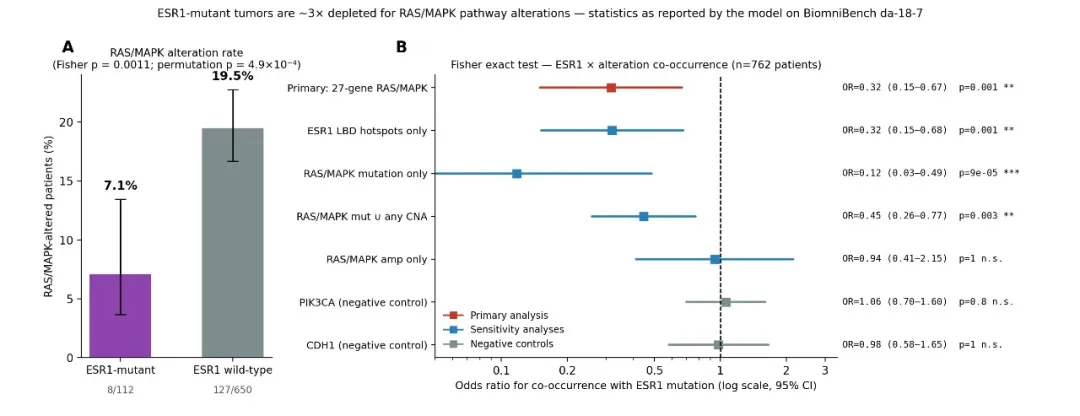 △An association analysis of ESR1 mutations with RAS/MAPK pathway variations. The left side compares the variance rates of the two groups of patients, and the right side shows the main analysis, representative sensitivity analysis and negative controls.
If it were a general model, the p-value would have been rolled over. But Fx-Bio-1031 did something extremely hard:It proactively launched 14 sensitivity analyses of its conclusions and set negative controls.
It attempts to narrow the range of mutations to specific LBD hotspots; attempts to eliminate copy number variations by looking only at point mutations; attempts to look only at gene expansion; and even actively pulls in the two genes PIK3CA and CDH1 as negative controls.
In the end, not only did it draw significant conclusions, but it also drew a clear conclusion to the boundary map fallacy: in the overwhelming majority of rigorous settings, the mutually exclusive effect is stable as in Thailand; but statistical significance disappears once the definition of variation is placed too broadly, or only when statistical genes are expanded.
So it's not only accurate, but it's also very clear where the boundaries of inference lie.
In case 2:9, a sample that has completely ripped off the label, how could you use cross-book reasoning to blindly test the case?
It's a common saying:
In the laboratory, the label of the sample of 9 tubes has disappeared, only 3 tubes are known to be water (control group), and the other 6 tubes have added two drugs, A and B respectively.
2) AI compares the most similarly-looking samples to three pairs using the internal data pair; then runs to the external database to find out which direction the cells will turn after adding A or B, and takes the external iron proof back to the pair, returning the identity of the nine-pipe unlabeled samples to their original location.
This is a very difficult test for anthropic BioMysteryBench (hb047).
The team entered into the model a sample of 9 human sources inducing multicellular (hiPSC) ATAC-seq sequences without any grouping tags, with raw data involving 110,559 chromosome open peaks (peaks).
The title gives only one clue: six of the samples were treated with two class I HDAC inhibitors, and three were untreated blank controls.
Please find out who's who.
The first step to Fx-Bio-1031 is to make sure that you are able to use it.Looking inward for structureAfter filtering down the signal noise, two correlations were calculated between the nine samples at 83,354 points, and the net profit drop-off grouped the nine samples into three groups (three repetitions per group).
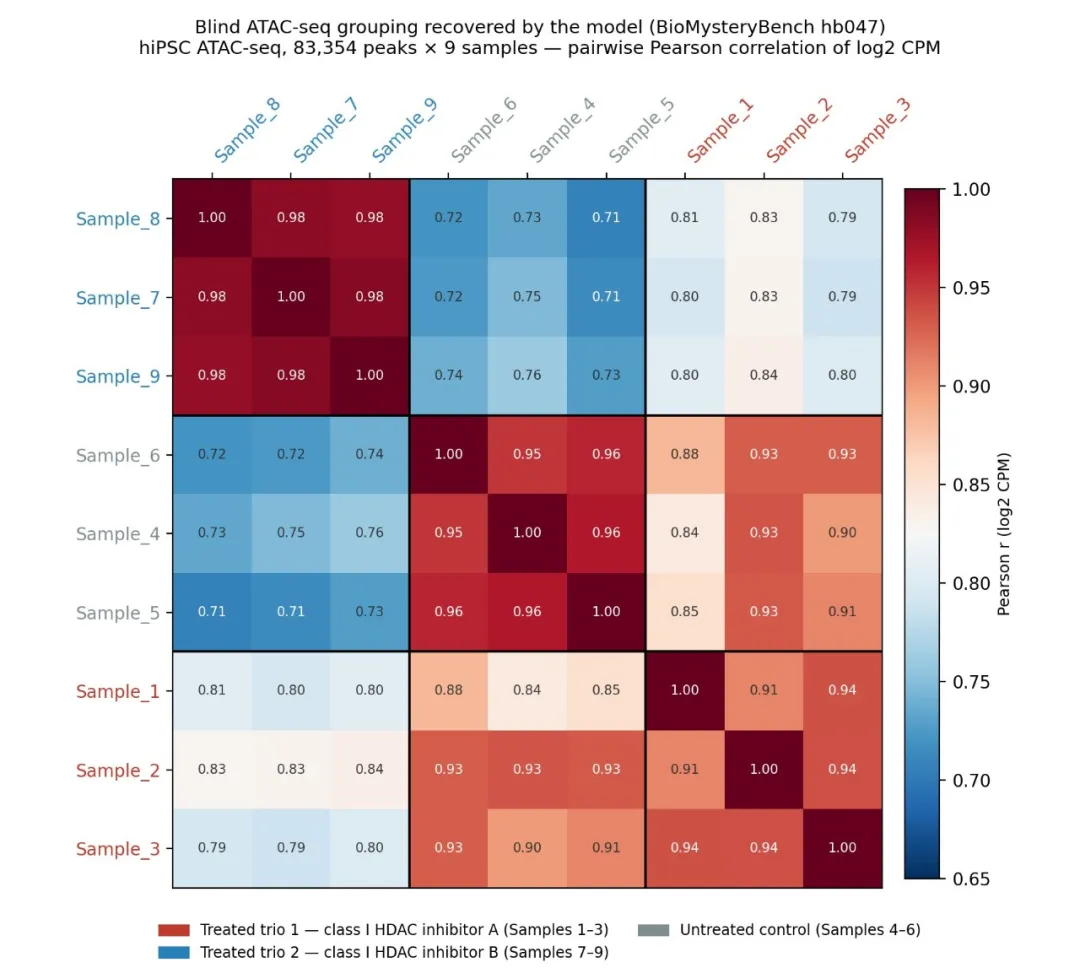 △Relativity heat charts of nine unlabeled ATAC-seq samples. The model combines sample clustering with open drug response data inference experimental grouping.
But the real problem lies in the second step: after the three stacks, which is the control group that is not medicated? Just looking at the similarity inside the data, the gods can't guess.
At this point, Fx-Bio-1031 exhibited an amazing scientific intuition that jumped out of the current documentation and proactively adapted the genome annotation and publicly disclosed HDAC inhibitor known transcriptional response data, linked open peaks to genes, measured the known direction of biological responses on the outside of the gene, and then, by peak-to-peak comparisons, determined whether the responses to the two groups of drug treatments were consistent and ultimately determined, restored the two groups of drug treatments to a set of blank controls.
Breakdown three: 206 000 variations, 76 steps of continuous operation, and even the bug at the bottom of the original file escapes its eyes.
It's a common saying:
1 Sea urethra: Cancer-causing factors (such as ultraviolet radiation, tobacco, gene-repair defects) leave specific pathogenic fingerprints in tumors, and AI has run 76 steps from 206,000 data to pinpoint the prime culprit of breast cancer without reference to the plot entirely.
2) Automated mining: A real user transmits a bacterial sequencing file with underlying defects (data format errors), and the normal software crashes, and the AI accurately extracts and cuts the bad data, even completing the perfect report in 258 steps.
Will the model be stable when the data is pushed to the limit, or when the raw data itself is loaded with craters?
In another high-level problem, the input directly filtered 2,700 tumor samples, 2,060,000 single nucleic acid variants (SNVs) and 96 mutation pathways, neither providing a reference library nor specifying algorithms, requiring the identification of the most significant contribution of COSMIC SBS mutation signatures to breast cancer cohort merger statistics.
Fx-Bio itself analyzes the mutation matrix with the SBS reference signature spectrum in a local test environment, performs non-negative binomial NLS mathematical matching, activates official tool cross-validation, runs 200 bootstrap sampling and cross-version revisions, completes 76 step analysis operations, and accurately locks the answers.
In a bacterial sequence analysis test based on the BioMaster platform, the model needs to infer a strain's flagella H antigen (which is the exact identification of an unknown bacterium) based on the input sequence readings.
In an underlying data quality check prior to launching the analysis, Fx-Bio acutely grabbed a highly hidden engineering bug:In the last record of the R2 sequence file, the length of the base sequence does not match the length of the mass value!
It proactively wrote the script to remove this damage record, then called the professional tool SeqSero2 to complete the forecast; in the middle it encountered a first run error, it instantly self-diagnosed, repaired the pipeline, and completed 258 consecutive steps, lasting 34.5 minutes, and finally issued a fully traceable delivery report.
The underlying engine: from Big Bang to Fx-Bio, infinite-fronted three-layered RSI silicon evolutionary flywheels
How is it that a model can demonstrate the intuition and engineering skills of an experienced researcher in such a fragile, hard-core and extremely low-performance field of expertise?
The answer lies in the core belief that the Infinite Frontier is consistent:RSI (Recursive Self-Improving, referring to self-improvement)。
This year, from the departure of Google legend Jeff Dean, founder of the Discovery Loop, to the founding of the Silicon Valley Chinese scholar Recursive Superintelligence, the world's top AI brains are all betting on the same thing: that the speed at which human experts ask questions and make judgments is completely out of step with the appetite for big model evolution.
The only point of failure is thatLet AI replace AI itself。
The standard answer is there, and the wrong answer is to reset a parameter.
The real-life RSI is like a real high-stakes exam: faced with unprecedented open problems, from data cleaning, calling tools to statistical check rings, with only one type of dead-end hardback, the entire test will fail once it's changed.
In August, Infinite Frontier was released.BigBang-V1Using scientifically cutting-edge data that was 100% autonomously synthesized, verified, and evolved by AI, it ran through the RSI curve of the silicon data layer, giving the 35B model a positive hard-to-trillion-parameter model on multiple high-risk scientific benchmarks.
And this time, on the Fx-Bio-1031, Infinite Front pushes the engine of self-evolution further along the deep end of the hard-to-closure scientific cycle, dismantling and biting three recyclable RSI steering wheels:
This is the first time I've been able to do this, and I've been able to do this.
The team joined the Deep Power Technologies BioMaster team to build an internal independent verification system around typical tasks and complex workflows in bioinformatics analysis, focusing on the performance of models in data processing, tool calling, multi-step analysis and results review.
In a complete system of models, tools and sandboxes, three rounds of self-construction-complex tasks run independently on 114 routes (a total of 342 questions and over 20,000 model requests).
Data Layer: AI creates questions for shortcuts by itself
Following the evolution of the Big Bang data layer, AI is deeply involved in training tasks for generating, solving and reviewing.
Based on internal independent verification sets (non-external public assessment benchmarks) reflecting general capability shortcuts (such as cross-batch statistical qualitative drift, multi-step evidence chain rupture), the system develops autonomous training trajectories on publicly compliant scientific literature and real-life workflows; all external public benchmarks (such as BioMysteryBench, BixBench3, etc.) are strictly as zero-contact final blind tests and do not participate in any training, fine-tuning or data synthesis strategy adjustments.
Environmental level: AI is involved in grinding tools and the environment
This is a highly potential segment in the field of biotechnology. In the course of the model iteration, not only academic knowledge, but also attempts to write and analyze biotechnology scripts, using a continuously evolving intelligent operating framework (Harness), so that the next generation of models will be able to synchronize the arsenal of weapons and execution environments to the task.
Why was bioinformatics chosen as the first stage in the evolution of these three planes?
Because it is the busiest in the literature, the most fragmented in the data, the longest in the chain of reasoning, the results of code execution and statistical checks can also be reviewed and recalculated.
In this natural training ground, once the wheels are turned, the model evolution is no longer limited by the maximum capabilities of human experts.
Infinite Frontier defines this set of underlying engines for the three-layer closed loop of the lithium data lithium environment as:RSI-OS ((back to the evolutionary operating system)。
Relying on RSI-OS's continuous evolutionary pipeline and the underlying computing and training engineering support of Trisol, a high-performance machine learning platform provided by Dynamic Technologies, the Fx-Bio-1031 has been able to rapidly converge and evolve in high-frequency iterations of mass-complex tasks.
Full-power open source: make lifecycle base controllable
Today, Infinite Front officially unveiled the full model weight of the Fx-Bio-1031:
Infrastructure: Deep RSI training based on Qwen 3.8-Flash-Next
Transcend context and thought patternsRelease: Configuration natively supports the 512K context window, enough to swallow the ultra-long tool call trajectory, multiple full documentation and large-scale geometric statistical output
Opening boxes are ecological.: Complete model weighting, adjectives, processor configuration and generating configuration using the Qwen Community License 1.0 protocol; if you want to use this model or derivative for commercial use, please consult in advance and follow the relevant commercial licensing terms of the Qwen Community License Agreement)
Weight and evaluation details of the silicon model:https://huggingface.co/endless-frontier/Fx-Bio-1031
The borderless frontier isAcademician of the Chinese Academy of SciencesStarted byShanghai University of Transportation, Shanghai Institute of Algorithm Innovation and Highly Powered TechnologyIt's a combination of the two.
The founding team brought together top researchers and engineers from universities and industry. Core team members Chen Sheng and Zhang Linfeng worked with the team to develop a large model of the scientific base.Innovatorand the general scientific intelligence bodySciMaster。
If your subject group or R&D team is holding a bunch of group data in their hands, wanting to review a key biological correlation, test out a bizarre group of experiments, or completely automate a high-frequency biofeedback analysis pipeline, you're welcome to share your real problems with the endless frontier, starting with a verifiable task.
This is the first time we've done this.