It's a great way to get to know each other.
QbitAI is public.
Recently, the AI has become a little bit cracked up about finding Bugs.
On the other hand, the first thing that AI does is look at everything and dig a hole in it.Major security vulnerabilities at the bottom of PHPAnd they came out.948 Linux kernel vulnerabilities……

On the other hand, the open-source community is about to collapse: you find the vulnerability, you fix it!
Yesterday, VulnCheck, a cybersecurity company, released a report on Anthropic.Project Glasswing is a project of the United Nations.The results of the survey.
The above shows that seven months after the launch of the Glass Wing program, Claude has accumulated excavations.37966 candidate loopholes。
However, as of now, only 217 articles in public records have been restored.
VulnCheck can't help but question whether the Mythos era of cybersecurity has really begun.
How many of the 38,000 vulnerabilities have been fixed?
First of all, let me remind you of the clay-glass wing project launched by Anthropic in April this year, which was highly publicized.
The program is designed to leverage Claude's massive exploitation of security vulnerabilities in critical software and open-source projects, joint technology companies, and open-source advocates to push for vulnerability repair and eliminate security hazards before they are exploited.
There are two stories in the book.
On the one hand, security vulnerabilities are like glass-winged butterflies hidden beneath the human eye and undetected for decades; on the other hand, transparency itself is a form of protection, and Anthropic hopes to provide better protection to software systems through more transparent security research and vulnerability disclosure mechanisms.
 △The glass-winged butterfly, known as the wide-tailed black pulmonary butterfly
At the start, Anthropic claimed to offer $100 million in models using quotas and $4 million in open-source security contributions, while also announcing their Cybersecurity King Blast Model.Claude Mythos PreviewThousands of high-risk and serious vulnerabilities have been identified. In response, Apple, Google, Microsoft, AWS, and Great Britain have joined in.
But is that true?
According to VulnCheck's ongoing tracking data, as of early November, Anthropic's candidate discovery had reached 37,966 but the vulnerability was revealed on the platform account.Only 217 items marked as repaired。
At the same time, waste data is still accumulating, with vulnerability withdrawal items 419 and repeat items up to 1,654.
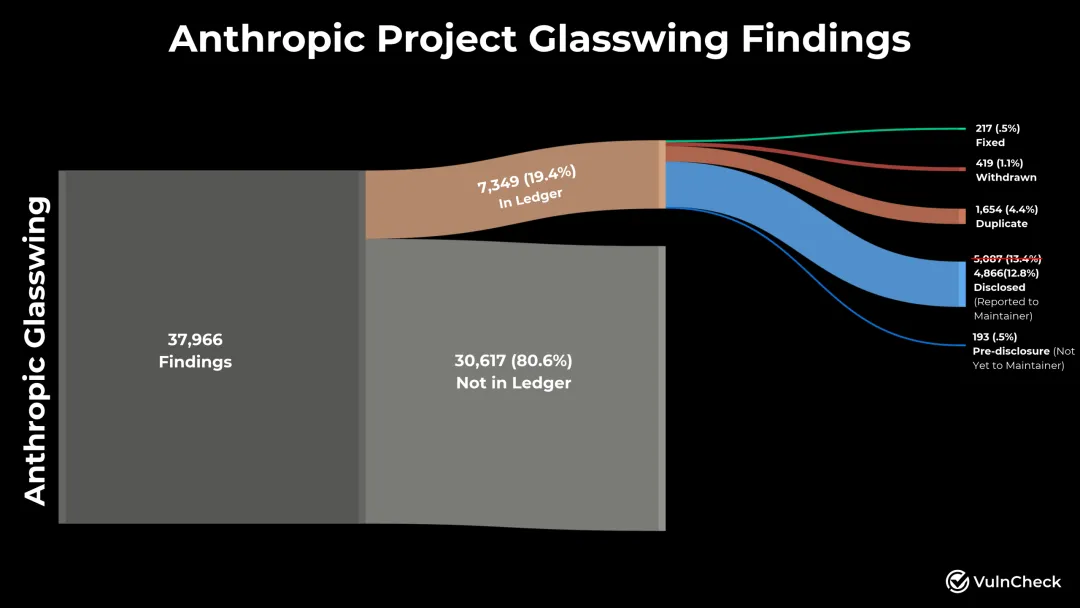 △Source: VulnCheck
This gap is expanding rapidly.
In the last two months alone, nearly 12,000 candidate vulnerabilities have surged, but only a few have been corrected.Weakness added 15 more。
In addition, VulnCheck tracked 442 CVEs attributed to Anthropic, accounting for only 0.5% of the total global publicly available CVEs in 2026.
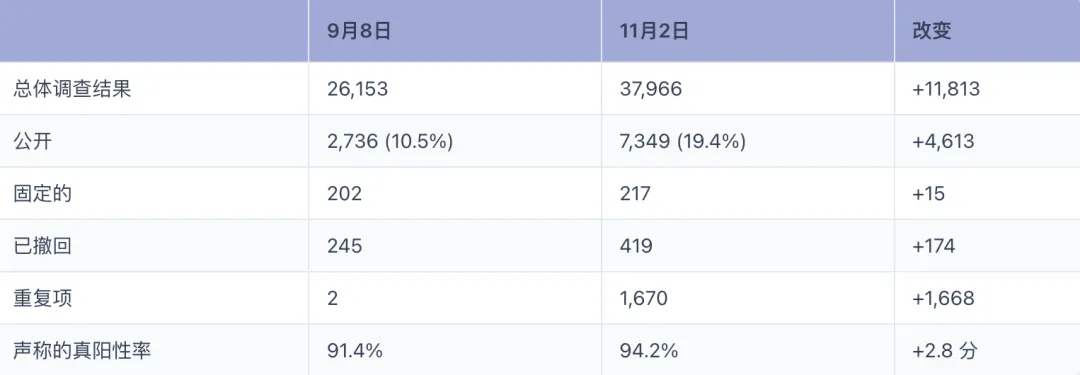 △Source: VulnCheck
According to official data released by Anthropic, as of November 2, 6,376 out of 37,966 candidate findings have been reviewed by external security experts, 6,009 have been found to be valid, of which 5,087 have been reported to software maintainers, and 629 have received up-to-date patches.
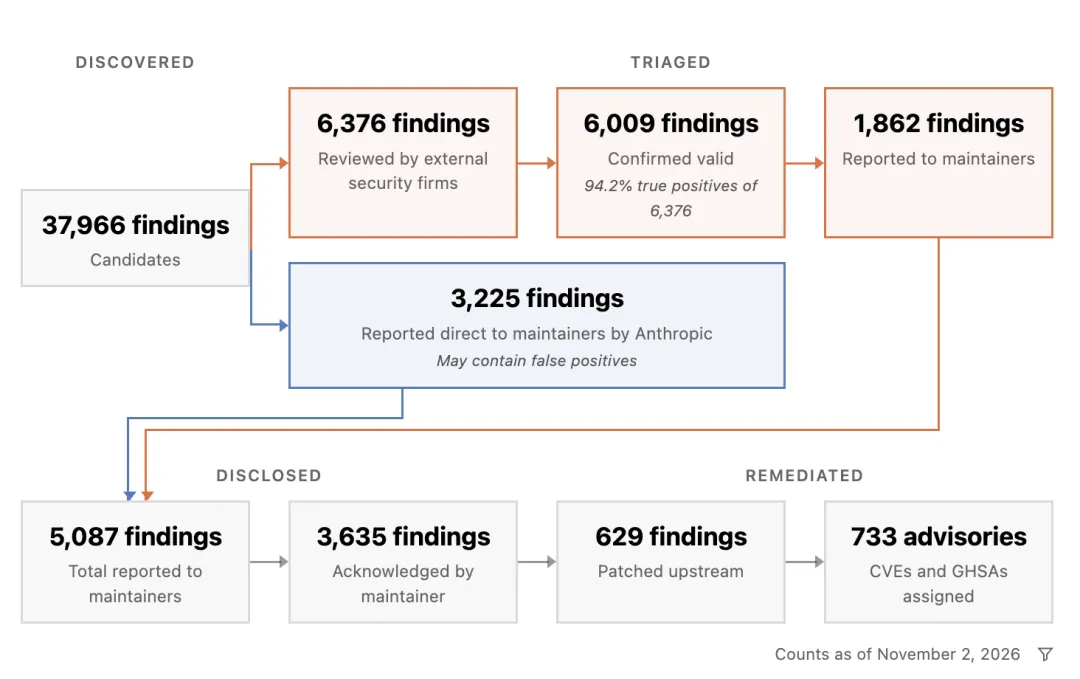
Although there are some differences in the number of repairs due to the different quality of the data, there is one thing that both parties have discovered.
That's the intensity of AI digging holes that AI auditing can't beat.
Anthropic itself has long been aware of this, and officials admit that the serious bottleneck of artificial verification capabilities has greatly limited the effectiveness of vulnerability auditing and disclosure.
On October 8, it launched a service called OSS Scanner.
Open source project maintainers can actively sign up to let Claude scan their own code for free, so that the model-generated vulnerability reports can be sent directly to the maintainers, without having to wait for the Anthropic organization to audit them manually.
Open source maintainer can't be repaired
AI is forcing us to pay off our 40-year technical debt immediately.
The main culprits behind this data breach are open source advocates, such as VulnCheck, which cites the example of the web data transfer tool curl.
In early November, curl keeper Daniel Stenberg also received a large gift package from Anthropic.45 reports of vulnerabilities。
Earlier in the day, Daniel wrote on his blog that core advocates have been overwhelmed by reports from sources.
We aim to not drown.)
In response to so many reports, Daniel announced changes to curl's security vulnerability management rules.Ask more community developers to help with the audit.
Currently, 19 of the 34 reports that have been made public by curl have been found not to constitute a security vulnerability, and six have been identified as low-risk.
The VulnCheck report has been quietly saying that if it wasn't all serious danger, what is happening now?It seems that the glass wings are not very useful except for the simple amount of auditing work to be done.
But the truth is that Anthropic has dug a big hole in curl.
In September this year, Anthropic helped Claude discover a Use-After-Free memory error in curl. When certain conditions are met, the malicious server may even use it to execute remote code.
According to Daniel, it is one of the most serious curl flaws in years.
So back in the day, VulnCheck's report was like an advertisement for itself, because it criticized the issue of glass wings, and it was very much in line with the vulnerability intelligence and priority management services it provided.
One More Thing
Speaking of which, some might wonder, since Claude is so strong, why didn't you just fix it when you found the problem?
In fact, Anthropic has allowed AI to generate candidate patches.
However, the developers are struggling with the AI bug... It's not really hard to make it easy for LLM to generate repair programs, and the difficulty is that open source projects don't want to adopt it.
Reviewing an AI patch is sometimes equivalent to rewriting an AI patch yourself.
It's often a trick to light a candle to light a darker candle, where the AI discovers a problem and starts fixing it, adds more complex logic to the code, and finally fixes a bug and brings in ten new problems.
AI is very good at adding things, but it doesn't realize that things can also be removed...
At least for now, the craters that these strongest models have dug need to be filled by humans.
The link is as follows: