“While embodied intelligence competes with large visual models, tactile perception is becoming the invisible key that determines the upper limit of robot dexterity.
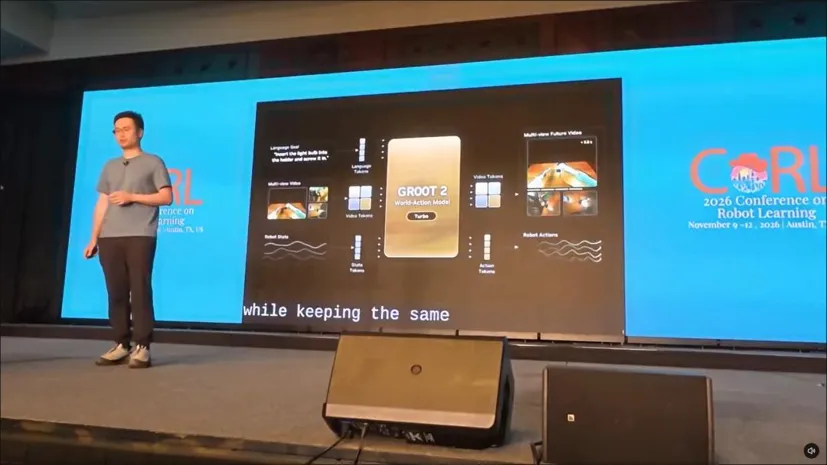
On November 9th, U.S. time, CoRL 2026, a leading robotics learning conference, was held in Austin. Jim Fan, co-leader of the NVIDIA GEAR team, released GR00T 2, a large robot model with 2 billion parameters, in a keynote speech. He also announced a complete open plan covering models, simulations, data sets, and hardware design. The speech did not lead to the argument of a cold winter for the industry. Instead, it ended with "Summer is coming", judging that the robot track is ushering in a critical development window.
According to the plan, the DexUMI hardware design has been open sourced, the first batch of 100,000 hours of Human1M demonstration data is now online, and the model weights and complete code are expected to be open sourced in December. We looked back at NVIDIA's public DexUMI hardware bill of materials, and found that the manufacturer and model of the parts list identifies Tashan Technology as the supplier for all 12 tactile sensors on the exoskeleton. Prior to this, Tashan was already a tactile simulation partner of NVIDIA's Isaac Sim.
Jim Fan made a key observation in his speech: In order to complete high-level semantic understanding, the visual encoder will actively discard a large number of low-level details, which are precisely the indispensable input for the robot's dexterous operation. The positioning of DexUMI is to supplement the contact information lost by vision. Independent single-channel collection of contact signals has been implemented and verified in multiple benchmark projects: DexUMI’s open source BOM clearly lists 12 tactile sensor models, and Isaac Sim simultaneously includes corresponding simulation models. In September this year, Reward AI’s OM-1 also placed touch at the core of the link. The model side recognizes the information shortcomings of vision, and the hardware side standardizes tactile sensors as purchasable devices. This is a consensus formed at the top level of the industry.
The reason why Tashan's capacitive haptic solution was chosen is not only to achieve software and hardware simulation alignment, device procurement, and standardization of specifications, but its underlying technical capabilities are also a key weight. The solution natively supports three-dimensional force detection and proximity sensing, the signal-to-noise ratio, dynamic response, and multi-point consistency of the tactile signal itself, and is suitable for fine interactions such as dexterous hand grasping and slip judgment; it can be natively connected to DexUMI's open source acquisition link, and the sensor's physical output characteristics, noise model, and deformation response can all be mapped to the simulation model in Isaac Sim. For NVIDIA's demonstration data set system for dexterous operation, the tactile performance of the sensor itself, high-fidelity alignment of simulation-physical objects, commercial implementation, and reproducible specifications are four priorities.
To understand the value of DexUMI's tactile supplement mechanism, we need to go back to its predecessor. NVIDIA has previously made a handheld acquisition device called UMI, which looks like a claw held in the hand. People hold it and perform actions in real scenes. The camera records the trajectory of the hand, and the human operation is converted into demonstration data that the machine can learn.
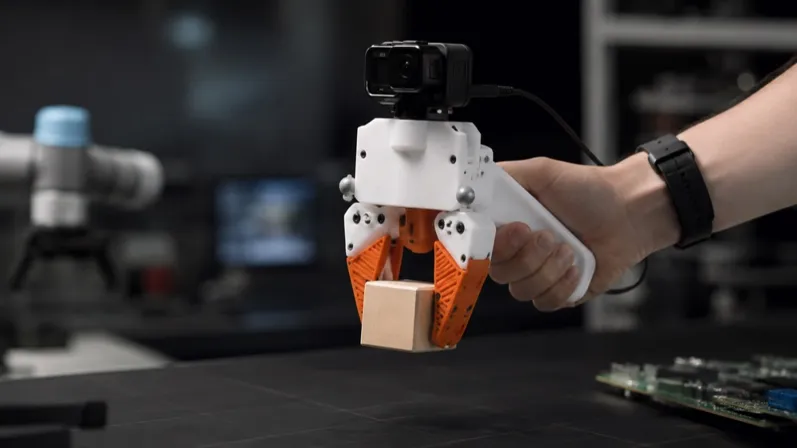
NVIDIA's early UMI handheld acquisition gripper, people hold it to complete actions in real scenes
DexUMI moved this collection idea from "handheld" to "whole hand": the gripper was replaced by a wearable exoskeleton, and the finger joints of the exoskeleton established a one-to-one mechanical mapping with the robot's fingers. As much as the human hand bends and twists, the robot's fingers will bend and twist accordingly. People wear it to complete the actions of cutting, cutting bananas, uncovering, and scooping. The encoder records the joint angles, the tactile sensor records the contact force, and the camera records the position of the object. Several signals with completely different sampling rates are pulled onto the same timeline and placed on the disk simultaneously.
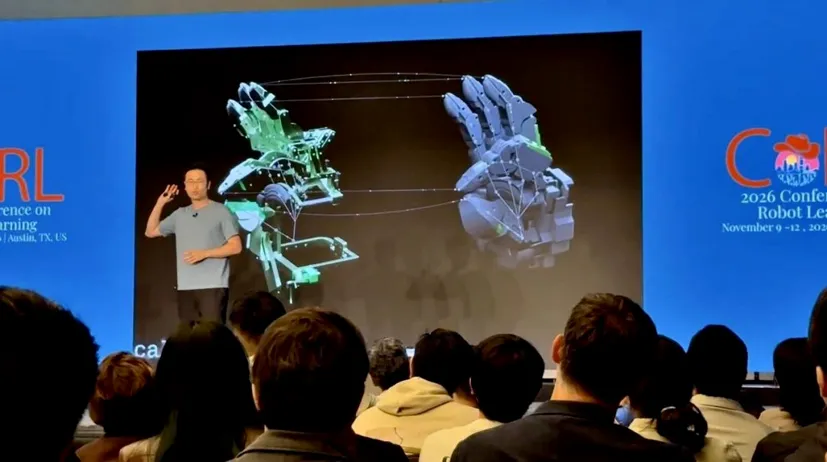
Jim Fan demonstrated the joint correspondence between the DexUMI exoskeleton and the target dexterous hand in his speech
The public hardware material list of the project clearly marks the entire composition of the device: the entire exoskeleton is equipped with 12 Tashan tactile sensors, including 10 fingertip sensors and 1 sensor on the left and right palms. The manufacturer and specific model are also stated. The sensor supports one- to three-dimensional force detection, has a force measurement resolution of 0.01N, and has a 2 cm proximity sensing capability. Before DexUMI, Tashan Technology was already a tactile simulation partner of NVIDIA Isaac Sim.
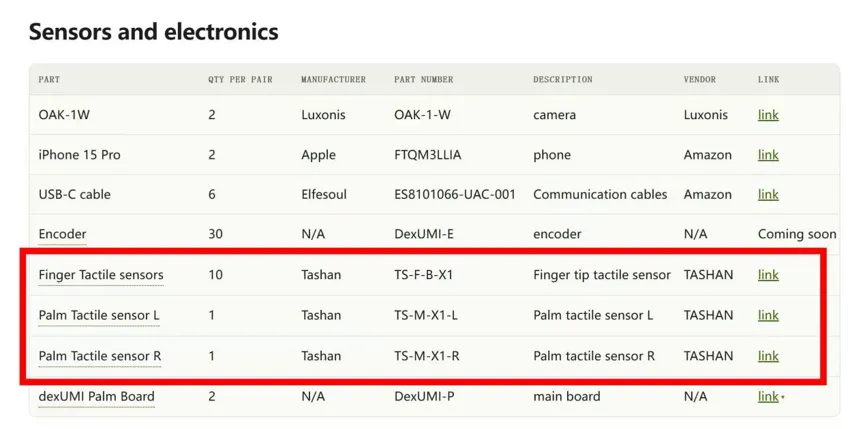
Compared with the superficial event of "domestic sensors entering NVIDIA's hardware list", a more noteworthy change is that tactile sensing has changed from an optional accessory for dexterous robots to a standardized hardware item that cannot be omitted in this open source acquisition system.
01.
Vision is born with a lack of contact power, and a separate signal must be supplied.
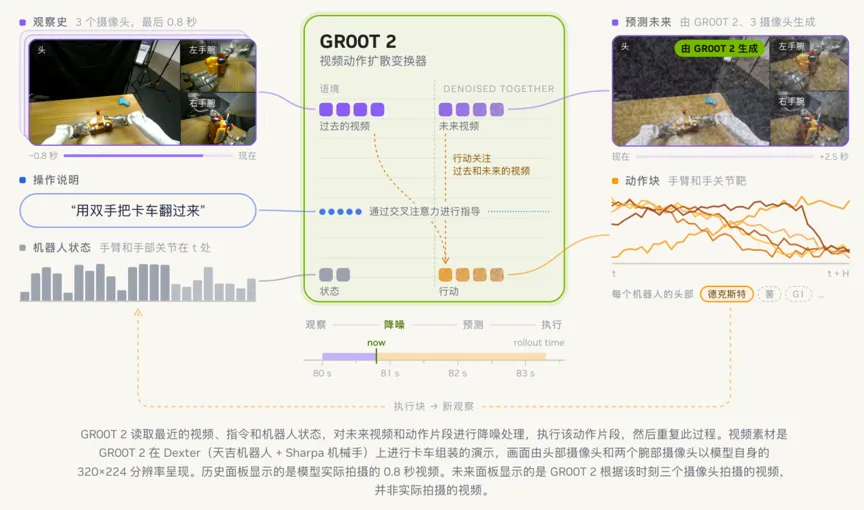
GR00T 2 can receive language commands, multi-view images, and robot state, and rely on the same diffusion model to jointly predict images and action sequences. Its pre-training data is mainly based on a large number of human first-view videos, but the entire model input link itself does not contain the force signal of the contact surface. No matter how large the model parameters are, physical quantities that do not exist in the data cannot be deduced out of thin air.
The camera can record the movement of the hand and the result of the object being grasped, but it cannot capture a large number of key intermediate states: the strength of the fingertips when pressing the peel, the critical point when the bottle cap is screwed to loosen, and the tiny slippage of the object inside the fingertips. The time scale of this type of contact event is extremely short, often shorter than the time resolution of a single frame of video, and one signal can only be collected individually by sensors arranged on the contact surface.
The grabbing scene for high-speed sorting is very illustrative of the problem: from seeing the object, reaching out, to touching and grabbing, and completing the delivery, the entire set of actions is often compressed in a very short time window. Vision, touch, proximity, and hand gestures each have their own native sampling rates. If the high-frequency tactile signals are simply forcibly aligned to the visual frame rate, key information such as slippage and rapid changes in force direction will be averaged out during resampling.
This capacitive sensor outputs a continuous time series signal, which can record three things simultaneously on the same time axis: the distance of the hand from the object, the moment when the actual contact occurs, and the magnitude and direction of the force after the contact. This is something that simple visual collection cannot do.
02.
12 sensors cover the complete contact process in segments
Knowing why a contact signal needs to be supplemented, it also depends on how this device completes it. The answer given by DexUMI is: use a set of hardware layout with clear location and model to record the physical changes in segments before contact, at the moment of contact, and after contact. In addition to 12 tactile sensors, the complete bill of materials also includes 2 OAK1W cameras, 2 iPhone15 Pro, 30 encoders, and 2 DexUMIP main line boards.
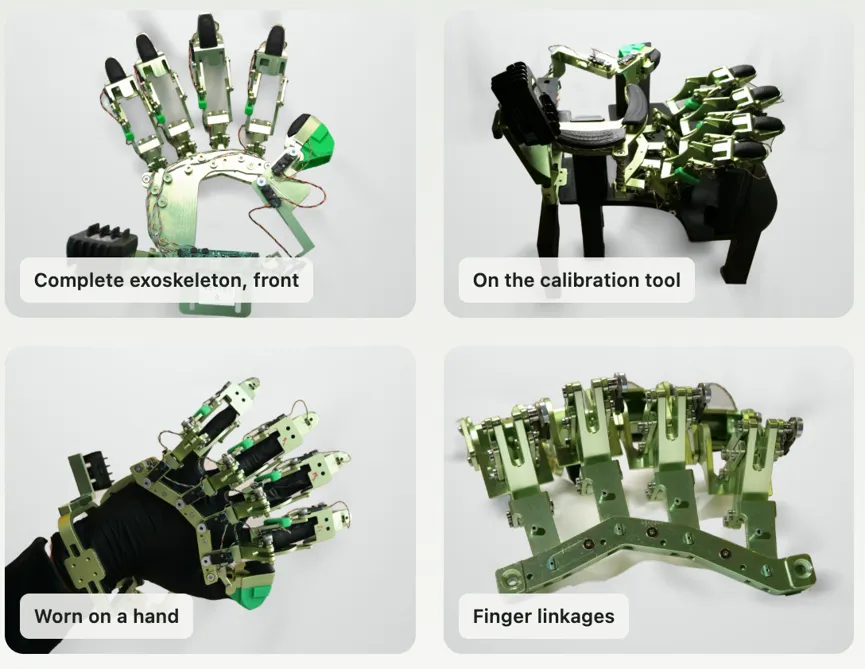
The 12 sensors have a clear division of labor, and each type corresponds to a type of physical event.
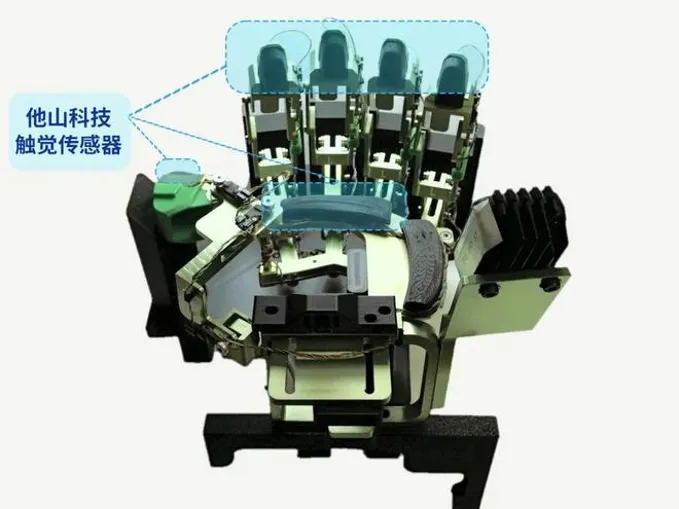
DexUMI Deshan Technology tactile sensors at fingertips and palms
Before contact occurs, the 2 cm proximity sense takes effect first. The capacitive field can sense distance changes before physical contact, accurately marking the starting moment of the contact event. After actually touching it, 10 three-dimensional force sensors on the fingertips catch the rod. The resolution of 0.01N is enough to capture extremely weak contacts. It can detect subtle changes such as the blade touching the peel or the yogurt cap starting to crack slightly earlier than the image, and restore the multi-directional force. For scenes where large areas of force are applied to the palm, such as holding bowls, holding pots, and transferring objects with both hands, a sensor on each left and right palm reads independently to ensure the timing alignment of force data when the hands interact.
In the breakfast mission demonstration of GR00T 2, the entire set of experiments relied on DexUMI to complete the demonstration collection. The resistance of the knife, the downward force of cutting the banana, the slippage of the fingertips when removing the lid, the load of scooping out the cereal, the distribution of force between hands, and the support force of holding the bowl in the palm of your hand are all physical quantities that the camera can "only see the result, not the process."
Putting the number of sensors, installation locations, and hardware models in the public list has far more significance than just material procurement. When each sensing point can be checked one by one, it is possible for an external laboratory to replicate the collection device; once the designated sensor is missing, there is no basis for attribution of data differences between different experimental groups.
03.
Among the many routes, why does Tashan Technology adapt to this set of equipment?
Putting the model number in the list solves the problem of "whether it can be reproduced"; as to why it is the capacitive type from Tashan Technology, we have to go back to the device itself. There is not only one technical path for robot haptics. Visual tactile, capacitive, piezoresistive, magnetic induction, and optical solutions all have mature products. Different solutions have their own trade-offs in range, accuracy, and cost, and are suitable for different working conditions. However, if the scope is narrowed to scenarios such as wearable smart teaching and multi-point distributed tactile acquisition, industry selection has obviously converged, and the capacitive route is becoming the preferred choice in this direction. Many solutions have outstanding single parameters, but have outstanding shortcomings in overall machine constraints such as thinness, multi-point consistency, signal synchronization, simulation adaptation, and long-term stability, making it difficult to adapt to equipment such as DexUMI.
It is an exoskeleton worn on the human hand. The fingertip space is narrow, and the fingers need to flex and extend greatly. The 12 sensing points are scattered on the fingertips and palms, and they also share the same wearable structure with the encoder and camera. These conditions fall to the sensor level. Volume and power consumption first set a threshold that all routes must pass: the sensor must be embedded in the fingertips and palms, without hindering the fingers from greatly flexing and extending, and without requiring an additional imaging unit and computing power.
DexUMI is more serious about the following items: 12 points must output the same continuous measurement, and they can be compared with each other on the same time axis before contact, at the moment of contact, and after contact; the performance of each point within the same sensor must be consistent enough. When an external laboratory replicates the list, the differences between the two sets of data can be attributed. This is exactly the advantage of Tashan's capacitor solution + self-developed chip link package.
Another requirement is not on the sensor itself, but on the entire link. DexUMI needs to record joint angles, images and contact forces at the same time. The encoder gives the angle, the camera gives the image frame, and the tactile sensor gives the time series value of the force. The three types of signals must be aligned on the same axis and placed on the plate. Capacitive sensors such as Tashan's output are continuous values with timestamps, which can be directly entered into the link; if it is switched to a sensing method that first needs to be saved as an image and then solved by an algorithm to obtain a quantified force value, this set of equipment will require an additional conversion and synchronization process.
Therefore, the logic of this selection is to put together several realistic conditions such as size, power consumption, embeddability, and signal form under the specific goal of wearable multi-point acquisition. Each of the capacitive types falls within the available range. It does not rely on a certain parameter to win, but on the comprehensive controllability of the full-stack solution - this is also the reason why the selection is finally settled.
04.
The same set of principles, from a single point OM 1 to the entire hand DexUMI
This capacitive sensing isn't the first time it's appeared in cutting-edge robotic systems. In September this year, the OM-1 wearable collection system released by Reward AI also placed touch at a key position in the collection link.
The underlying hardware principles of the two are the same, but the collection range and mission goals are completely different. OM-1 also relies on high-frequency tactile + proximity perception grasping interaction, focusing on high-speed grasping scenes of less than one second; DexUMI spreads the same type of sensing units to 12 points on the entire hand, and each point independently collects proximity distance and three-dimensional force, completely recording the force changes in the entire process of dexterous operations.
DexUMI is equipped with TS-F-B-X1 fingertip sensors and TS-M-X1-L/R in the palm. The suffix is used to distinguish the left and right hands. The simulation side corresponds to another set of models: the TS-F-A registered in NVIDIA Isaac Sim has received official Certified certification. It is a simulation version modeled after real sensors for developers to call in a virtual environment, rather than a physical object to be installed in their hands. One collects real data, and the other restores the same set of tactile characteristics in the virtual environment. Each of the two layers has its own model, and each has its own purpose.
The coexistence of physical models and simulated models is what makes this solution different from ordinary sensor manufacturers: what is handed over is not only a sensor that can be installed on the hand, but also a corresponding model that can be adjusted in a virtual environment. Tactile perception therefore not only holds true at the physical level, but also has a reproducible counterpart in simulation.
05.
The hardware is completely open source and verification is left to external laboratories.
NVIDIA has made DexUMI’s hardware design open source. Universities and scientific research teams can directly purchase corresponding types of sensors from public lists, complete assembly according to documents, and then call the certified tactile simulation model in Isaac Sim. With the already online Human1M data set, the entire set of tactile data collection links can be completely reproduced, and then the collected data can be used to fine-tune the model.
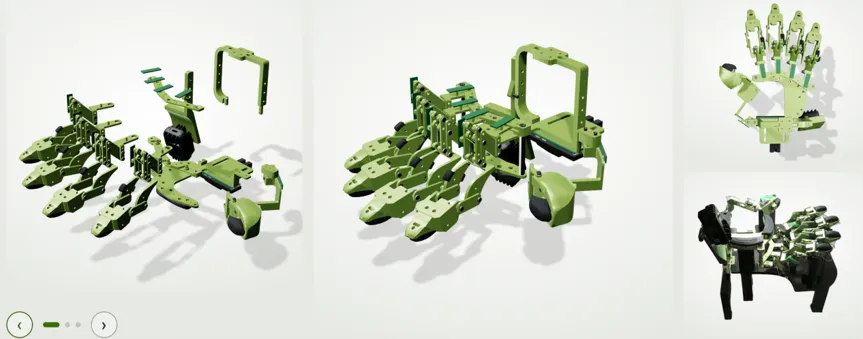
DexUMI official open source XHand exoskeleton CAD model (Source: dex-umi.github.io)
The real value of this openness is to allow more people to come in. After the sensor models, installation points, and simulation models are all made public, any team does not have to spend several months to find out the details of the hardware. They can just purchase and assemble according to the list and get up and running, and focus their time on the algorithm and the task itself. The more people participate, the more scenes will be collected, the types of contacts covered by the data will become wider, and this set of links will have the opportunity to grow into a real public base for the industry. Horizontal comparison is the natural result after enough participants - only when everyone is on the same set of hardware can the data be comparable.
In his speech, Jim Fan covered the open scope to the four layers of model, simulation, data set, and hardware; GEAR team scientist Yuke Zhu also confirmed that the hardware and the first batch of data sets have been opened, and the complete model and code are planned to be released in December. The BOM sensor model, simulation model, and demonstration data set are handed over together, which is equivalent to positioning this tactile acquisition link as a basic component that can be reused by the industry.
For robotics research, whether a tactile route is worth following ultimately depends on how many teams can run it themselves. Only when the hardware is reproducible and the collection method is reproducible will latecomers be willing to continue based on it; the more people who are willing to get started, the more times this route will be tested. Whether it works well or not will be answered by these hands-on teams.
06.
Conclusion and the future
The competitiveness of hardware startups is slowly moving away from pure parameter competition and towards the reproducibility of the entire solution. What Tashan Technology has provided this time is not only 12 sensors, but also index parameters that can be checked one by one, as well as an officially certified simulation model.
This set of tactile sensors has entered the open source link of top international robotics projects. The most practical value is that the entire solution can be reproduced point by point. When the sensing capabilities of the contact layer change from product parameters to standard items on the public bill of materials, this tactile technology route truly has the foundation to be repeatedly used by R&D teams across the industry.