 Alibaba says its redesigned flagship architecture cuts the cost of a representative task by nearly 60%, positioning the model for use in real workflows.
On November 16, Alibaba’s Qwen team officially released its new flagship model, Qwen4-Max. The preview, qwen4-max-preview, appeared in the company’s Token Plan five days earlier; the full release now details the model’s capabilities.
Qwen4-Max has 2.4 trillion total parameters (2.4T), supports text, image and video input, and offers a context window of up to one million tokens. However, what is more eye-catching than the parameter list is the pricing announced alongside the release: In an evaluation that simulated real work scenarios, Alibaba reports that average cost per task on its Work360 evaluation fell from RMB 26.58 on the previous generation to RMB 11.16 on Qwen4-Max, a 58% reduction.
The Qwen team’s message is that flagship models should move beyond benchmark scores and prove useful in real workflows, including long-running tasks.
01
"Reducing the burden" on the giant beast with 2.4 trillion parameters
In the past year, the industry has seen many models that advertise context windows of up to one million tokens. But if you really throw hundreds of thousands of words of project documents or an entire code base into it, many models will start to lose focus, output will be stuck in the second half of the process, and the bill will be horribly expensive. In order for the "new colleagues" to run stably and efficiently with a one-million-token context window and on long-running agent tasks, it is no longer enough to just rely on peripheral engineering patches, the underlying architecture must be touched.
Qwen4-Max has made three key adjustments to the base this time. The aim is to use compute more efficiently.
Let’s first look at the attention layer responsible for memory. When a model processes a long document, repeatedly attending to the entire preceding context can drive up compute costs. Qwen4-Max uses a hybrid attention design combining GDN with Qwen Sparse Attention. In each group of four layers, three compress prior context into a fixed-size state, while the fourth uses block-level selection to attend to key details. This is like a seasoned secretary who keeps the main thread of the meeting minutes in his mind and only turns to the original page of a specific page at critical moments. The design is intended to reduce the cost of processing long contexts.
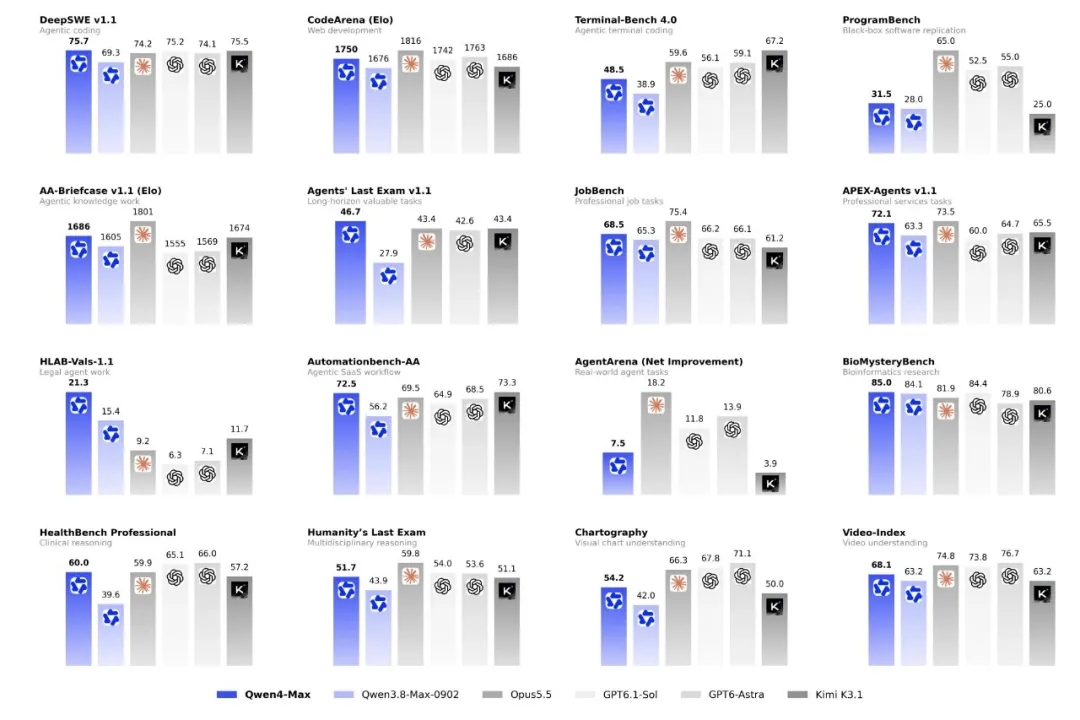
Comparison of Qwen4-Max model in model functions|Image source: Qwen
The model has 2.4 trillion total parameters. During training, the biggest fear is that the data flood will overwhelm the network, which is what engineers often call a loss spike. Qwen introduced a gating mechanism (Gated Residual) in the residual layer, expanded the original single-line transmission information channel into four parallel branches, and added adjustment switches at the intersections. The company says this design helps stabilize pretraining at the model’s 2.4-trillion-parameter scale.
In the embedding layer, Qwen also added 328 billion parameters’ worth of N-gram Embeddings in the second layer. For common token combinations, the model can retrieve learned features directly, adding capacity without a comparable increase in compute.
After these three changes, each token of Qwen4-Max only activates 71B parameters, which is about 25% less than the previous generation, but while maintaining or improving capability. In the internal comprehensive evaluation of knowledge, code, Q&A and STEM, the base model’s bits-per-byte (BPB) score Qwen4-Max-Base dropped to the lowest among the five participating models, which was 5% to 13% lower than the previous generation Qwen3.8-Max-Base.
Although I said I didn’t look at the list, Qwen4-Max still scored well. In the Work360 industry benchmark test covering 26 first-level fields, 182 second-level sub-fields and 721 third-level subdivisions, Qwen4-Max scored 52.69 points, which is a bit higher than the 47.74 points of the previous generation Qwen3.8-Max; at the same time, under the two levels of thinking intensity, Xhigh and High, its token consumption was reduced by about 24% and 35% respectively, reaching a more hard-core level. On Terminal-Bench 4.0, token use fell by about 48% and 49% under the two settings.
Coupled with the simultaneous price reductions of Alibaba Cloud Bailian, Alibaba says the lower prices further reduce serving costs. In the domestic North China 2 (Beijing) node, standard pricing for Qwen4-Max in the North China 2 (Beijing) region is RMB 10 per million input tokens and RMB 30 per million output tokens, which is a bit cheaper than the 12 yuan and 36 yuan for the previous generation. New users are also directly given 1 million free tokens; for scenarios where the Agent repeatedly reads background information, the listed cache-hit price for explicit and implicit caching is RMB 0.50 per million tokens. Cache creation costs RMB 12.50 for five minutes or RMB 20 for one hour. The pricing of the international version has also been reduced to $1.50 for input and $4.50 for output. The implicit cache is as low as $0.075, and the cache reduction reaches 70%.
02
From 3D snow village to automobile production line
Whether the model is useful or not ultimately depends on the actual running pictures and code. In the past few days, the technical UP masters on site B have used the preview version to run a lot of interesting actual tests, and Qwen officials also released a hard-core demonstration of the official version today.
Let’s take a look at the fun actual test of the private preview version first. Station B’s UP owner “eddieliugd” only used a prompt word to let the preview version of Qwen4-Max take shape in one go and create a 3D Alpine snow village with light, shadow and undulating terrain. The entire set of code generation only cost 64,000 tokens in total. Another Bilibili UP master "AI Suifeng Suifeng" used the preview model to create a playable 3D low-polygon drift racing mini-game in a single file, complete with track, vehicle control and dashboard UI.

Qwen4-Max preview version generates a 3D Alpine snow village in one sentence, consuming 64,000 tokens|Video source: B station UP master "eddieliugd"

A 3D low-polygon drift racing mini-game generated from a single file of the Qwen4-Max preview version|Video source: Bilibili UP Master "AI Suifeng Suifeng"
As of today's official version, the official demonstration directly raises the level of complexity to a higher level.
In the game development demonstration, Qwen4-Max independently built the scene and gameplay logic to create a 3D Cat Mage RPG game that can actually be played. The interface has equipment backpacks, mini-map HUD and boss battles. When developing web applications, Qwen introduced the "Continuous Delivery (Live Delivery)" mechanism this time and open sourced the corresponding Qwen-Live-Delivery-Plugin. The model no longer waits for an hour to give you a bunch of semi-finished products. It will first hand over a working first version, and then interrupt and modify it at any time based on your feedback. In the official demonstration of the Chinese physics popularization website, it not only continued to expand the complete course page, but also directly embedded a 3D optical total reflection interactive experiment with manually adjustable parameters into the web page.

Qwen4-Max independently completes the scene construction and gameplay logic development of the 3D RPG game real machine demonstration|Source: Qwen official

Qwen4-Max generates a Chinese physics science website and 3D optical interactive experiment through a continuous delivery mechanism|Source: Qwen official
Going beyond entertainment and science popularization, Qwen4-Max directly took over the industrial software flow in the automobile manufacturing demonstrations of Sanfeng Intelligent Equipment and Tonglian Precision. It can convert 2D drawings into 3D production line layouts, perform parametric modeling of components such as car doors, and automatically identify the problem of "local overcutting caused by excessive tool diameter" during the processing tool path simulation verification. In terms of code security, its function and security pass rate in the Last Secure Code Bench test also increased to 31.8% from 22.0% of the previous generation.
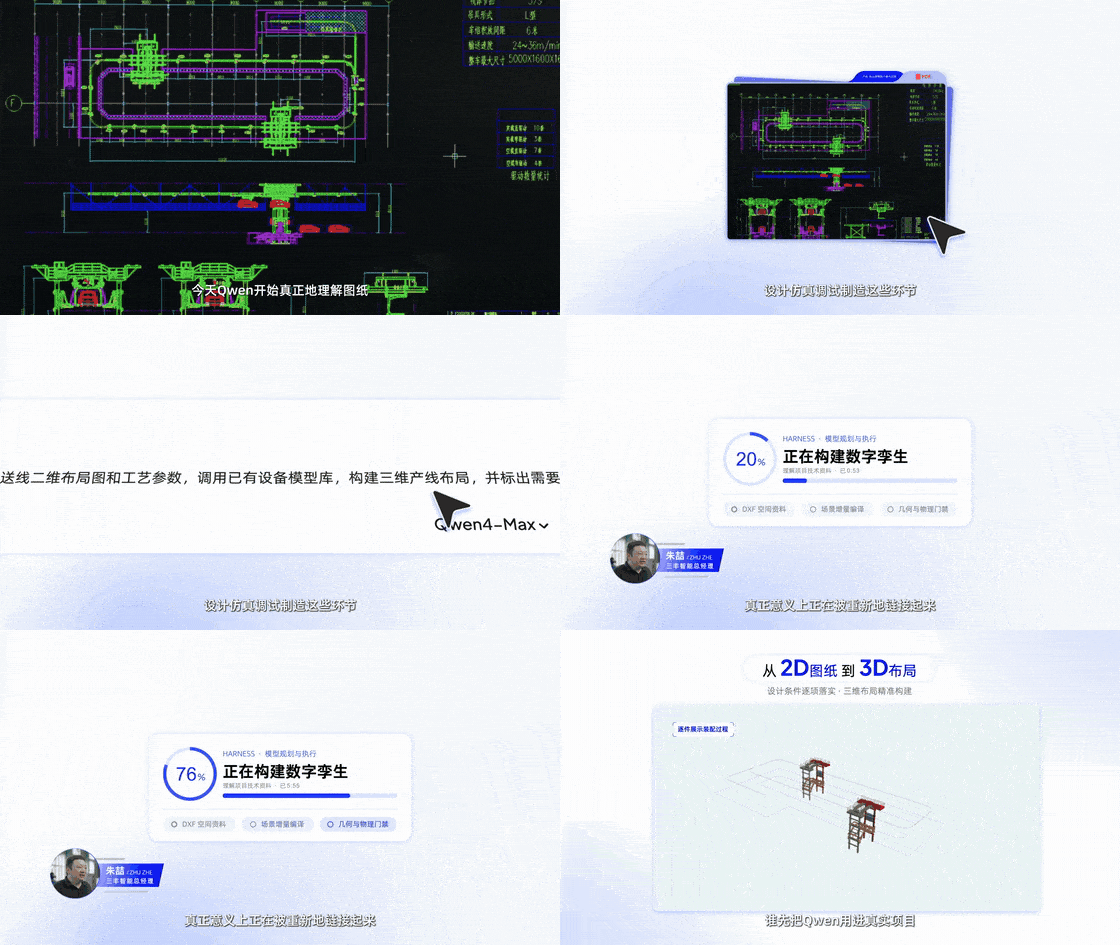
Qwen4-Max assists automobile production line 3D layout and parts processing simulation verification|Source: Qwen Official
03
How to play the domestic flagship game
It can be seen from the demonstration that the implementation data of Qwen4-Max in real business is more realistic than the animation itself.
In the actual production scenarios of Mitutoyo Intelligent Equipment and Tonglian Precision, it used to take a master craftsman an average of about 475 minutes to compile a workpiece processing program. After the introduction of Qwen4-Max assistance, the manual investment was reduced to 24 minutes, saving about 95% of the time.
In the financial and legal circles, it can also handle the most tedious desk work. When doing financial investment research, it can dispatch 90 MCP tools to capture multi-source data in one go, and finally hand over Excel manuscripts and editable PPTs with traceable numbers. Faced with 198 scattered manuscripts with confusing names in IPO legal due diligence, it can classify and cross-check public information by itself, identify hidden dangers in gambling agreements, and finally write 86 pages, 6 A complete report of more than 10,000 words.
It can even be seen in critical illness clinical decision-making, as well as in the 48-hour screening of new coolant materials in cooperation with Deep Principle (candidate molecules are selected from 2.69 million molecules and linked to experimental verification).
In order to allow developers to use these capabilities smoothly, Qwen4-Max has now fully launched the API and token Plan of the Qwen AI platform, and is connected to Qwen APP, Qwen Office, Qoder, Qwen Studio and QwenWork. It is compatible with the API formats of OpenAI and Anthropic, and supports three levels of thinking intensity adjustment: low, high, and xhigh (the high level is enabled by default). According to the official statement, small and medium-sized models of the Qwen4 series will also be open sourced one after another.
In the domestic large model competition in November, each company actually has its own focus.
At the beginning of the month, Tencent Hunyuan released the official version of the open source Hy4, and Baidu also released Wenxin 5.5 Flash Base and Preview versions in early November. However, by directly rewriting the entire underlying architecture on the 2.4 trillion-parameter flagship base and cutting the single bill for long-distance missions by nearly 60%, the Qwen4-Max is still the most important flagship move this month.
From recording parameters and benchmarks last year, to entering factory workshops and law firms with a 58% reduction in single-task costs by the end of this year, the competition for large-model flagships has begun to change tracks.
The technical capabilities have already been amazing. What ultimately determines whether companies keep a model in their workflows may be its monthly compute bill.
*Source of header image: Qwen