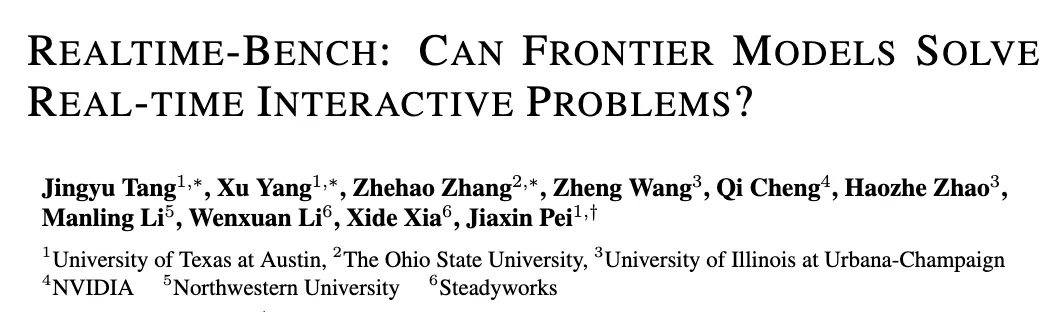
Some authors describe:
Zhang Yan: PhD student at the Chinese University's School of Artificial Intelligence, studying game intelligence.
SUYUT: PhD student of MMLab at the University of Hong Kong, studying world models and physical intelligence.
Roan: A PhD student at the National University of Singapore, studying the fundamental model of the whole model.
He is the head of the AI NPC & Gameplay technical team.
Li Yi: Assistant professor at the Institute of Artificial Intelligence at Qinghai University, founder of Qinghai Intelligence, and former research scientist at the University of China.
Recently, a collaboration between academic institutions such as the University of Tsinghua, the University of Hong Kong, and the National University of Singapore has opened the first generic game model GameScaling series: covering 0.8B, 2B, 9B, 27B four-tier scale, a total of eight models, weight and reasoning code released under the Apache 2.0 protocol.
The main page of the project:https://gamescaling.github.io
The address of the model:https://huggingface.co/THUSI-Lab/GameScaling
The code repository:https://github.com/THUSI-Lab/GameScaling
GameScaling can mine, synthesize, kill zombies, fight in Doom, navigate, and find a way out of a scene-escape mission. It generates keyboard and mouse operations based on images, mission cues, and recent interaction history to determine the next step as the game changes.
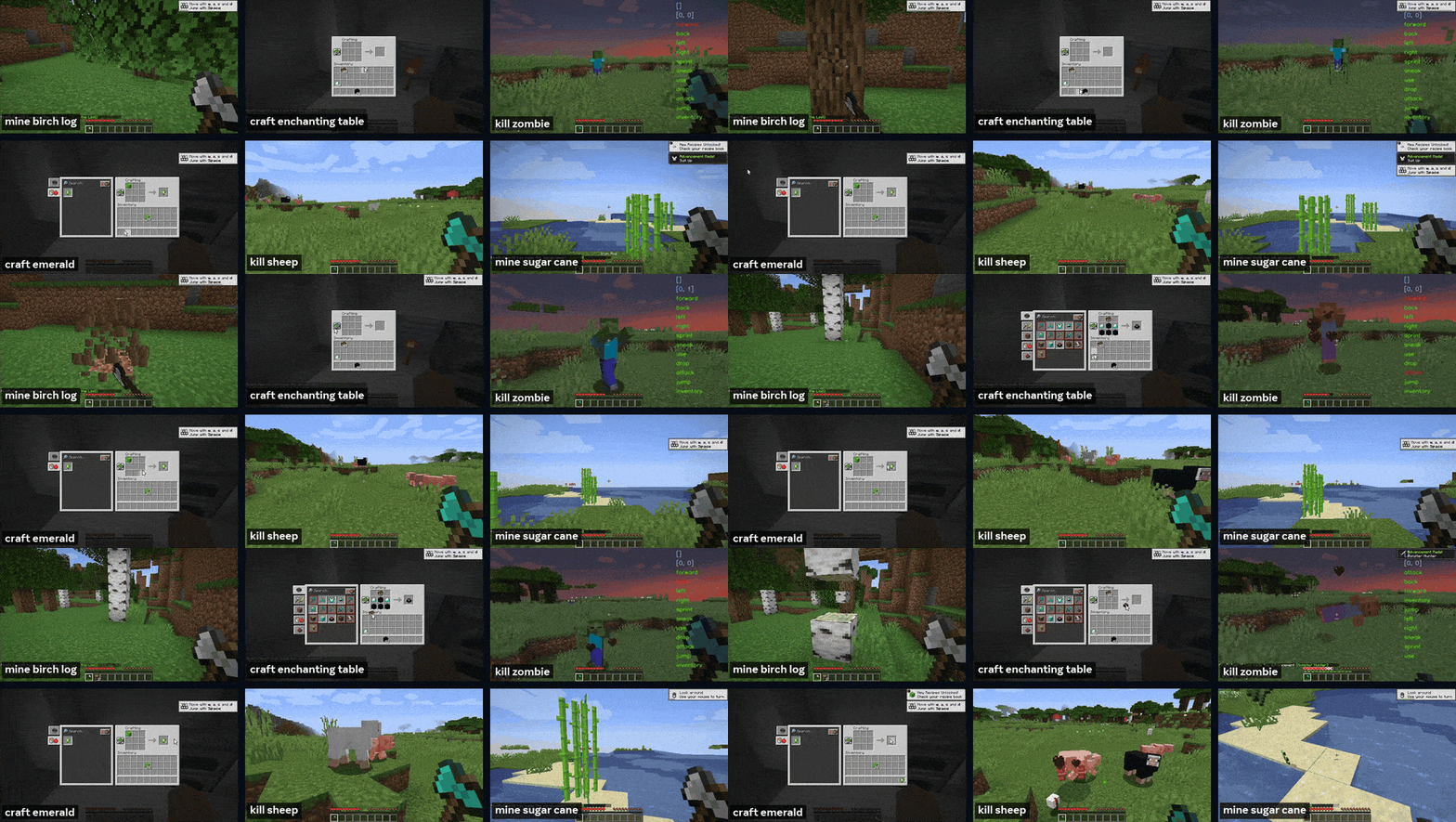
Figure 1 GameScaling-2B-S3 real-time demonstration footage of collecting, synthesizing and fighting missions in Minecraft. Source: GameScaling website promotional video
The GameScaling model's cool operation also has a solid rating score: The average success rate of GameScaling-27B-S1 was 63.3% on 30 missions on the My World Cup MCU benchmark. According to the team, six models of 0.8-9B on the single H200 or RTX 5090 can achieve real-time game interaction of nearly 5 observations per second, 30 steps per second.
This is also a new topic that naturally emerges after a long period of playing with AI. In 1997, Deep Blue defeated the chess world champion; since the outbreak of deep learning in 2012, AlphaGo and AlphaStar, respectively, won the world championship in Go and Jump II, OpenAI Five demonstrates multi-intelligent collaboration in Dota 2. In the big model, Voyager is also exploring the environment and accumulating skills in my world. Similarly, "going forward" may be behind a 3D movement from the first person's point of view, a plane movement from God's point of view, or a platform jump in a transverse world.
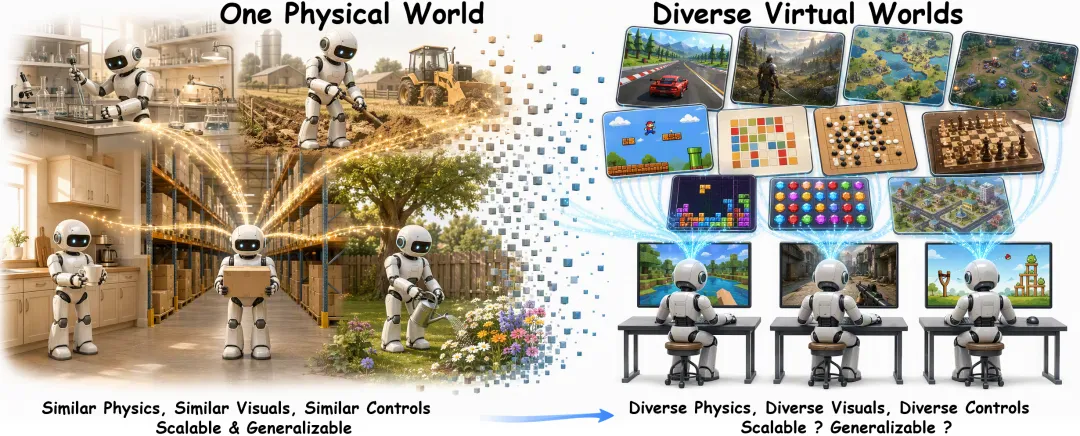
Figure 2 The real world follows a set of fixed physical laws that provide the basis for experience accumulation and scale chemistry learning; the game's image style, physical mechanisms, action spaces and mission objectives can be changed to maintain or not.
Can the Scaling Law continue to work when the rules of the world itself are changing, increasing the amount of data, enriching the diversity, expanding the model, which has never been unfavorable?
To answer this question, the GameScaling team conducted continuous pre-training based on the Qwen 3.5 series, using the game trajectory of the open source community, to connect the knowledge of the visual language model to executable operations. The model, based on the game's snapshot, task prompting and recent interaction history, produces the next 200 milliseconds of keyboard and mouse operation. See the picture, think quickly, make moves, receive new images, and then decide the next step, forming the basic cycle of the intelligent body's actions in the game.
The experiment divided the model, data length, and data diversity into three variables: a four-dimensional model scale of 0.8B to 27B, a six-dimensional game data budget of 50 to 1600 hours, and a game trajectory of five data diversity mixtures from all over the game world, forming a total of 120 sets of controlled configurations. Evaluations also extended from the trained worlds of MineCraft and Doom to the unprecedented close-knit 3D worlds, as well as the larger 2D and 2.5D worlds of perspective and operating mechanisms.
The study first discovered an interesting learning rhythm: early models were familiar with their "hands". After initial training, predictions of key, mouse, and action formats improved rapidly, and gains appeared in the uncovered worlds of training. The team called it the "interface stage"; it then entered the "world stage" to further improve increasingly depending on which games the model experienced, with gains mainly focused on the training covering and nearby worlds, and losses to distant worlds would even increase.
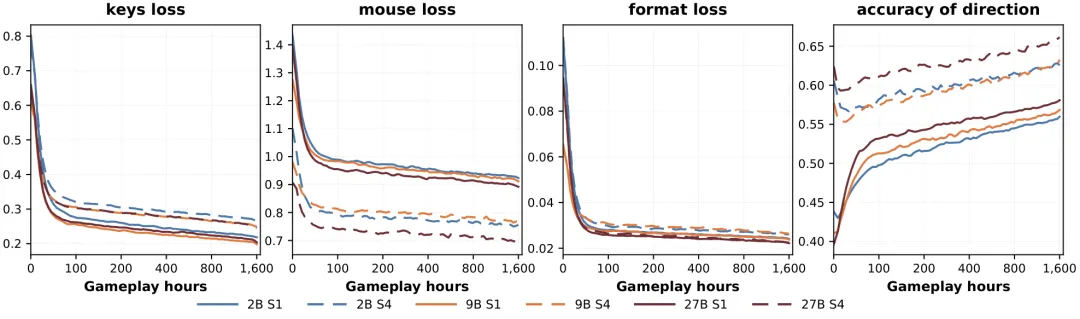
Figure 4 In early training, prediction errors in key, mouse, and motion formats decreased rapidly. The four graphs were followed by key loss, mouse loss, format loss, and mouse directional prediction accuracy. Figure 1 for single-game trajectory mapping and Figure 4 for multi-game trajectory mapping.
This makes the value of data diversity concrete. Under the same budget of 1600 hours, multi-game mixed training in seven unprecedented 3D worlds across the OmniGame Arena, cross-district, cross-model scale averages about 2.8 times the experience of training MineCraft alone.
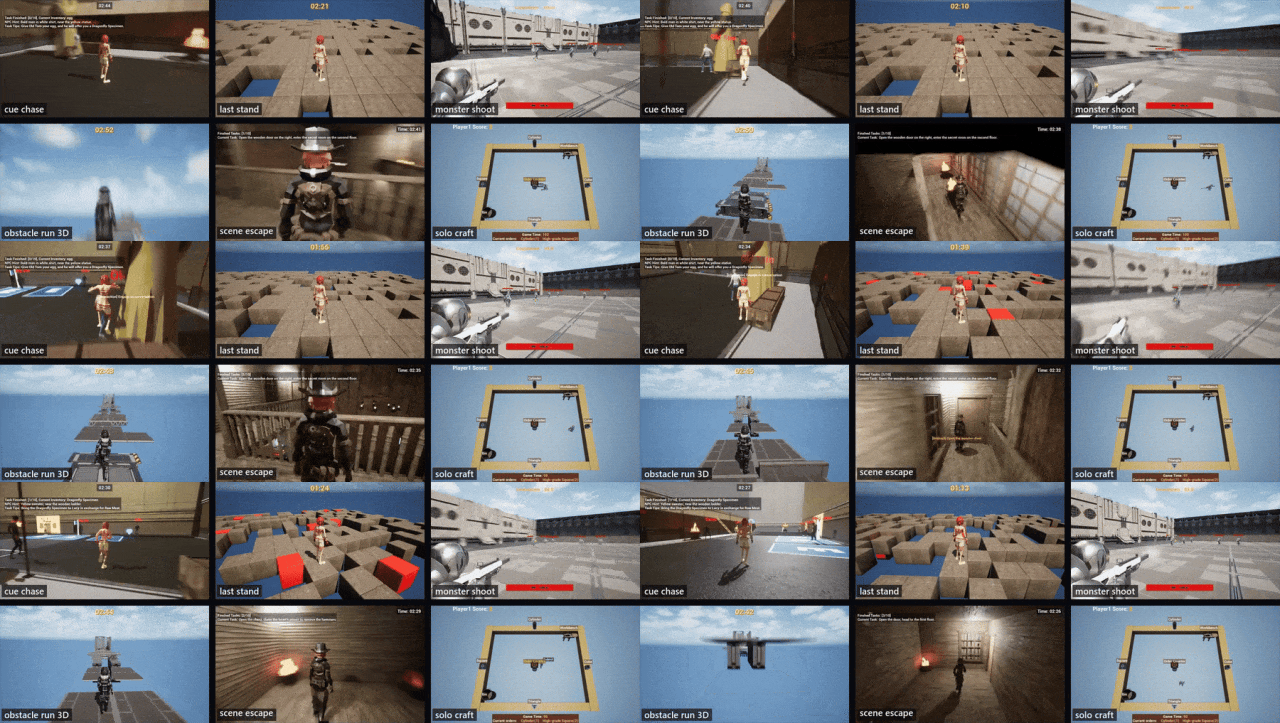
Figure 5 GameScaling demonstrates missions in relevant 3D environments that have not been seen in OmniGameArena, including moving, shooting, obstacle crossing and scene escape. Source: GameScaling official promotional video.
Larger models typically absorb limited experience more efficiently, but if only one game is trained over a long period of time, it may decline more noticeably in a world of greater differences. This suggests that researchers, parameters, data volumes, and data allocation need to be co-designed: learning faster does not automatically mean moving further away.
The team further adapted the verifiable loss experience of Scaling Law, which correlates these three factors, to provide a basis for estimating learning gains in a world where training covers. However, for a world where large differences are not seen, continuing to increase training data and model sizes has not brought steady improvement. Game Scaling therefore presents expanding potential and boundaries: existing continuous pre-training can accumulate movable operating experience, and broader generalization also requires exploring more comprehensive world coverage and interactive learning mechanisms.
In addition, if the model wants to get into a game that really works, there is another factor that must be avoided: time.
The enemy is approaching, the target is moving, and the correct judgement a few seconds ago may have failed. For this reason, the team tested two modes, "Model Thinking Suspends Game" and "Game Continues Running", respectively. In the real-time assessment setting of the paper, GameScaling-9B-S3 averaged 25.3 on four benchmarks, higher than the peak of 19.2 measured by OpenAI, Anthropic, and Google's front-end models. This comparison revealed a practical requirement for game intelligence that decisions must be changed despite the impact of deployment and service delays.

Figure 6: Real-time combat demonstration: Left side for Claude Opus 5.0, right side for GameScaling-9B. The game continues to run while the model generates moves, and the screen time is recorded for the clip, containing the effects of the respective deployment and calling methods. Source: GameScaling official promotional video.
According to the authors, GameScaling is currently focused on exploring the phenomenon of cross-world scaling, with no specific optimization for the final game's performance. It is hoped that the experience of GameScaling will guide the collection, construction and comparison of subsequent game data, make training scales more reliable, and provide a direction for building stronger and more adaptable game models. At the same time, it is still necessary to explore broader game experiences across more distant worlds, as well as the mechanisms for using successful feedback learning in real interaction. This also gives a clearer goal for the next step in general game intelligence.
The appeal of the game is in the world of rules and partners who can share adventures. Towards a future like this, virtual content needs to be expanded, and there needs to be an understanding of the rules, and there needs to be an intelligent companion who actually participates in them.
We believe that as technology develops, the future smart game NPCs may be able to observe the terrain, select locations, and adjust actions as the player says "help me guard the entrance"; the player and his smart partner can retain the experience of one world and go on the next adventure together. The open source of the GameScaling model provides a testable starting point for research: exploring how to turn what they have learned in one world into the ability to move into the next.
© THE