“ I'm not sure if I'm going to be able to do that.
01.
It's not like you don't have senses when you're out of a factory, you make your own when you're working.
To get the robot to do more than one thing, there are usually several ways: dismantle the body-loading parts, hang a module on the outside, or let the software give the old hardware a new use. Curiosity used this last thought to measure the gravity of Mars using the accelerometer that was originally used to navigate.
However, the two pathways have one thing in common: the new capabilities come either from the reassembly of existing components or from external installations.
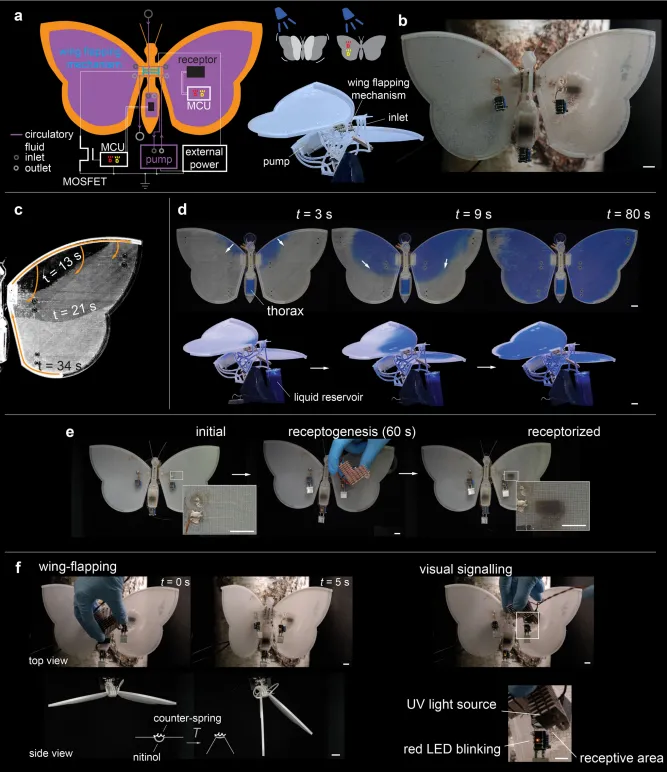
Recently, a collaboration between the University of Tartu in Estonia and the Italian Institute of Technology (IIT) has taken a very different path: to make a completely new sensor for a robot inside its own body, based on a chemical reaction site.
The team named this process receptorogenesis, which can be understood as "receptor occurrence".
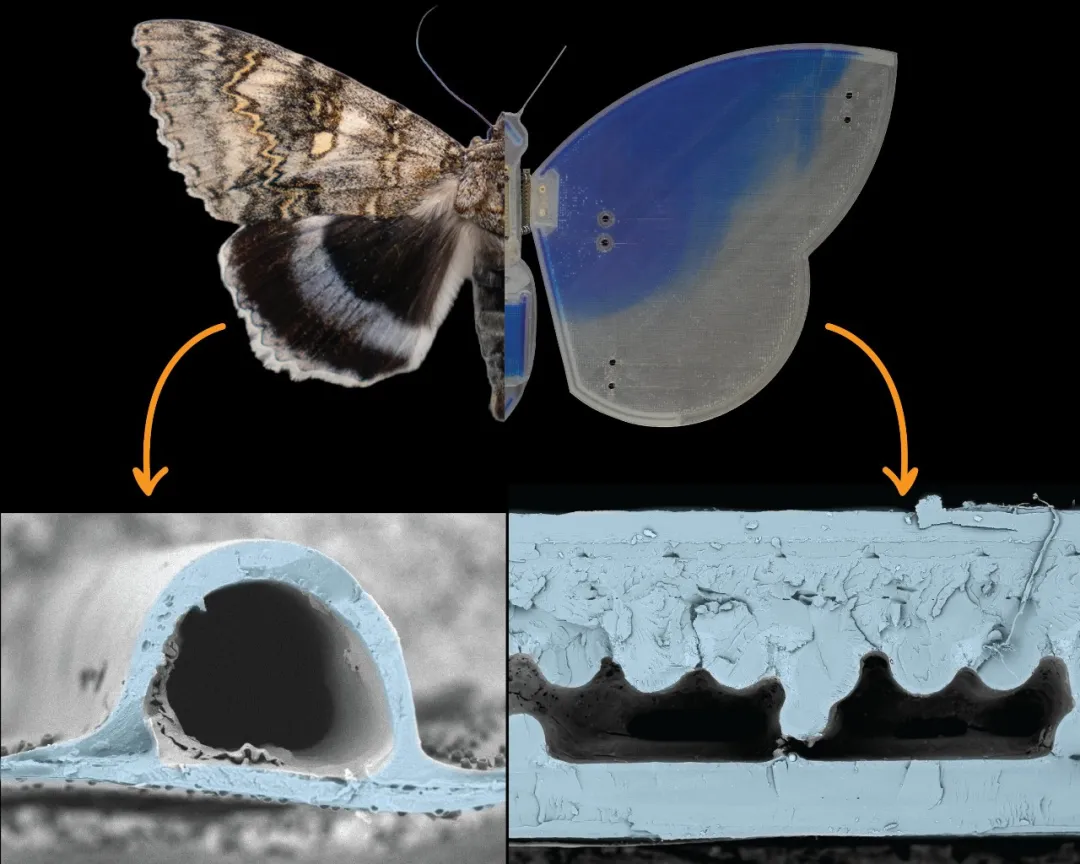
They made a flying saucer robot. When it was ready, it did not react to UV rays at all. After being illuminated by strong UV rays, the chest collapsed into a sensitive area. From this point on, if it touches the UV rays again, it stimulates the wings, flashing LEDs.
The research has been published in the journal Advanced Science.
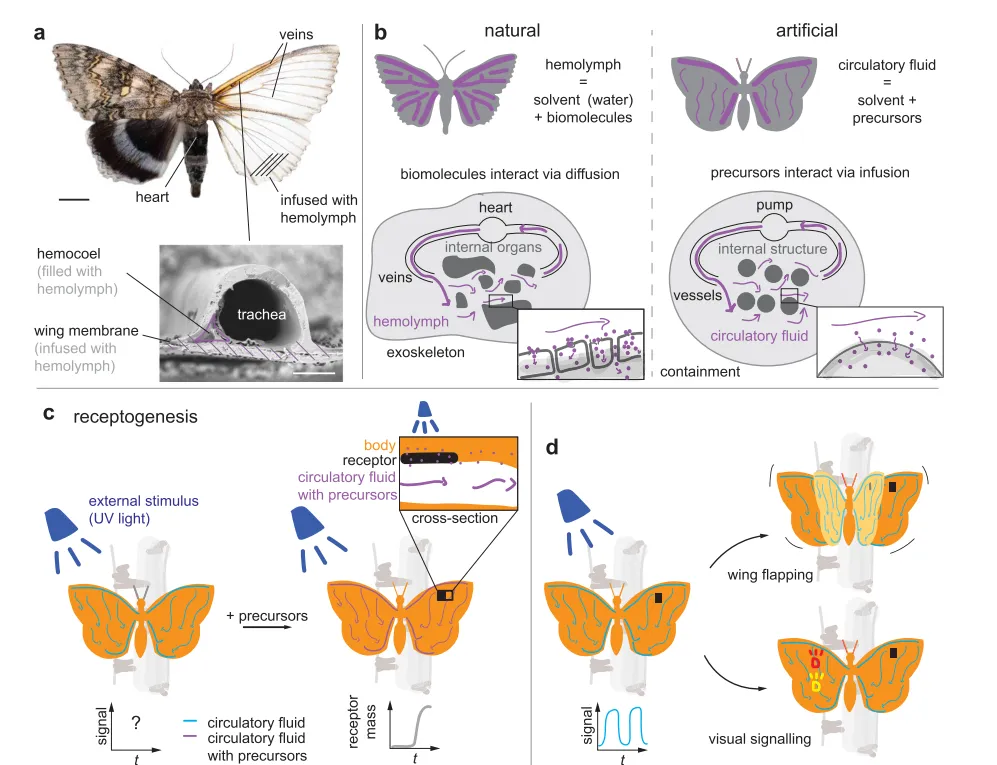
The researchers also compared several types of existing schemes: self-repairing materials can heal damage, but ultimately only return to their original form; plant-like growth robots do add new material, which can be accumulated at the growth end of the outer edges of the body; and on-site 3D printing adds parts on the outside.
02.
Inspired by the "blood" in the wings of the fly
The material basis for all this is a "vascular system" that mimics insects.
Insects have an open circulation: the heart pumps out lymph nodes, flowing blood through the body, and infusing the wings. The wings of butterflies and moths are actually living tissues, and the blood lymph is involved in regulating the hardness and temperature of the wings, as well as in transmitting signals.
The team recovered a specimen from the Estonian National Biodiversity Monitoring Project, which was collected in the summer of 2023 with insect trapping lights.
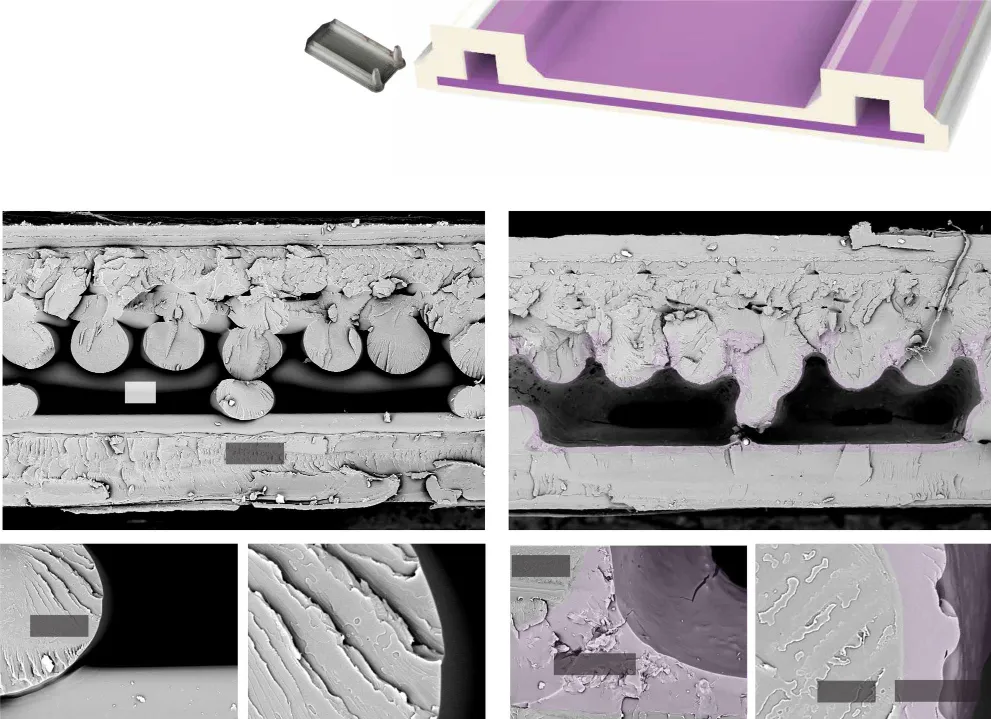
The "body" of the robot is 3D printed with transparent PETG material, and the internal transmission network is divided into two layers.
The first layer is the "main channel", which prints channels 1 mm wide and 1.4 mm high, responsible for transporting fluid throughout the body. The second layer is the "capillary vessels": when the print is filled internally, spaces are left between adjacent print lines, and the team intentionally uses these spaces to connect them to a network of tightly woven micro channels.
After the liquid enters the micro channel, it will slowly penetrate into the PETG material itself. In about 20 seconds, the depth of penetration can reach about 10 micrometers.
In this way, a single printing process enabled transmission ranging from tens of centimeters to several micrometers.
The actual robot, with a single-winged vessel covering an area of about 86 cm2, is about 25 times the size of the chest, and the total vessel capacity of the entire system is about 3 milliliters. The whole body uses only one valve, no valve or other flow control components, and the common bubble problems in the pipeline have little effect on it.
03.
When the UV rays flash, the transparent wings turn black.
The "blood" that flows in the robot is a good chemical raw material: hydrogen (which is both a solvent and a solvent), a phosphate-salted light catalyst, and phosphate-phosphate cellulose, which is used to improve mechanical performance.
PETG can pass through ultraviolet rays with wavelengths greater than 310 nm, so the 365 nm ultraviolet LEDs used by the team can be directly illuminated inside the material.
After absorbing ultraviolet rays, the light-inducing agent decomposes, causing the polymerase to be synthesized. The polymerase is dark in color, and the region that was originally transparent becomes visible to the naked eye, slowly darkening, and the reaction progresses.
The key was that the reaction only occurred where it was taken. The team performed a "light sculpture" test using a shading model, with a pattern resolution of 0.3 mm, mainly due to light scattering restrictions caused by surface roughness.
In other words, the raw material can fill the whole body, but only the part that actually becomes the sensor is exposed to light. The researchers envisioned that in a real environment, body posture, self-shadowing and the distribution of light around the sensor will jointly determine where the sensor head is, and in this experiment, this role is played by the mask model.
Why does it feel light?
The newly generated polymers, after being exposed to ultraviolet radiation, briefly form internal polarizers and bipolarizers, with elevated conductivity, resistance to decrease, decreased amplitude and dose of ultraviolet in proportion. After the light is stopped, the signal is restored for about 300 seconds.
The control experiment was intuitive: when only the raw material was infused, before it was accumulated, the 0.9W LED was shot at 20 millimeters, without any reaction; the 1.6W LED was shot at 43 millimeters, and after the synthesis was completed, it could be perceived by both light sources.
Next is the closing ring. The chest buries two metal wires with a diameter of 30 micrometers as an electrode, at a distance of about 130 micrometers, and is read by a small battery that is distributed by an ATtiny single-piece machine at 10 micrometers. The resistance to decrease exceeds the threshold value (about 1%), red LED flashes; five consecutive detections to decrease, entering a "reaction mode" of 65 seconds: the aluminum memory alloy wire is heated for 5 seconds, the wings are joined, then naturally cooled for 60 seconds, and then the spring helps to replace.
04.
Each sensor is unique and accumulates experience.
There's a particularly interesting part of the study.
The resistance of different samples varies greatly, ranging from €200,000 to €2 million.
The team did not eliminate this as a defect, but instead used the relative variability of resistance as a signal. This is somewhat similar to a biological sensor, focusing on "how much has changed" rather than absolute numerical values.
More specifically, the sensor will "experience for a long time". During repeated testing, the residual mercury around it continues to accumulate, the higher the sensitivity, and the higher the resistance.
Researchers describe it as a "leak pointer" and argue that the material structure itself is a physical record of a robot's personal experience. After more than four months of storage, the system can still function normally.
Of course, this is a proof-of-concept, presently demonstrating only a pre-designed chemical pathway, rather than a truly autonomously evolving system; what raw materials are injected into the blood vessels, this time by humans; where the raw materials come from, how they are supplemented, and not within the scope of this study.
However, the scope of this framework is clear. Only polymers and synthesis conditions can be used to refer to different functions such as bioelectron interfaces, ion sensing, anti-corrosion, electromagnetic shielding, let alone to other raw materials. The huge toolbox of chemical synthesis is expected to become the "upgrade package" of the robot body.
It is worth noting that the paper's methodology in this study specifically notes that the team used Microsoft's Copilot (GPT-5.2) and Anthropic's Claude Sonnet 4.6 and Opus 4.7 when writing the single-camera and Python data analysis scripts.
After that, robots may no longer be what they were when they were manufactured.
What kind of environment they are exposed to and what kind of body they can grow into.