


Smart bodies are moving from single-minded to multi-minded collaboration.
Today's frameworks such as the Claude Code, the Codex, and others have allowed models to pull up their own intelligent agents while running, or even directly write down their executable workflows: how to dismantle tasks, what each sub-intelligent body gets in context, where the intermediate results are tested, and finally how to integrate.
This means that multi-intelligent organism sorting itself is a critical skill. Similarly, a group of intelligent organisms, well organized, can do half a dozen things, and poorly organized, will drag each other along. But existing assessments either only look at whether the task is ultimately completed or test in a collaborative structure predetermined by the designer, and always do not answer one question:
"In the face of real long-range tasks, can big models organize their own multi-intelligent systems?"
To this end, the Navers Lab of Einsia AI has released a WorkflowArena, which evaluates the multi-intelligent organization capabilities of large models. The benchmark includes 145 long-range tasks, covering software engineering, business operations, scientific research, mathematical inference, finance, law, content design and 3D production in eight major professional areas, and a comprehensive assessment of 25 logic configurations across nine mainstream front-end models.
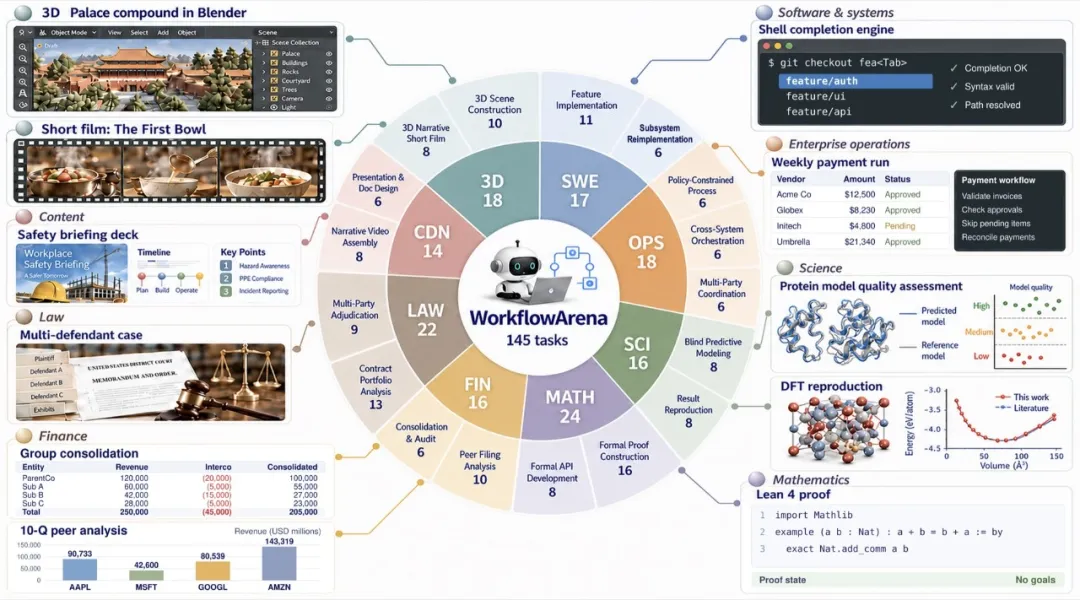
WorkflowArena's 145 tasks are divided into eight main areas and 17 task formats.
Workflow Arena: Benchmarking Executable Workflow Orchestration in LLM-Based Multi-Agent Systems
The main page of the project:
GitHub:
Arxiv:
There are no rules on how to divide jobs, just look at the final delivery.
Each task in the Workflow Arena is a real professional delivery: modifying an open source library, reproducing a scientific result, completing a Lean formalized proof, compiling a multi-subject merger report, analyzing multiple defendants, or building a complete architecture in Blender.
What these supplies have in common is that the parts of the ring are interconnected: code changes have to be done through the original regression test, financial data has to be matched between different entities, legal conclusions have to be consistent across multiple document spaces, and the components of 3D scenes have to be tightly packed together.
It is possible to dismantle, but dismantling must be coordinated, which is the place where organizational skills are used: for example, contract portfolio analysis, each contract can be examined separately, but the conflicts between contracts must be combined to see.
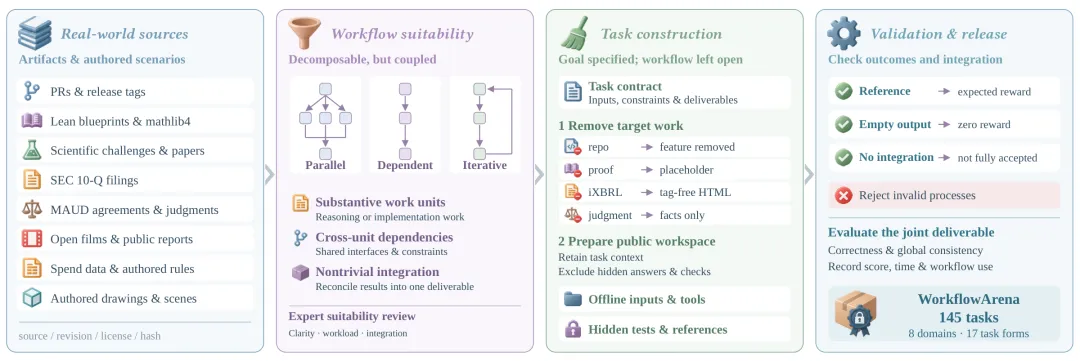
WorkflowArena build process: real material → Select "divisible but interconnected" work → Just set goals, don't set workflows → Test results and integrations.
In the evaluation, the model received an empty "command post":
How to organize is determined by the model itself. It can work by itself, or it can coordinate multiple sub-intelligences simultaneously through the Workflow tool, and can view, terminate, modify the workflow at any time.
Planning is also time-consuming. The main and all sub-intelligent entities share the logic of budgeting, planning, scheduling, and returning to work.
The model does not see the test subject and the standard answer, the score is based only on the results of the delivery, and has nothing to do with how many sub-intelligent agents were used; at the same time, each scheduling is fully recorded.
In this way, the Workflow Arena can not only see "how it's done" but also "how it's organized".
The strongest system solves only 36.95%, with no all-powerful players.
WorkflowArena uses a strictly complete resolution rate: only deliveries that meet all acceptance criteria are truly resolved.
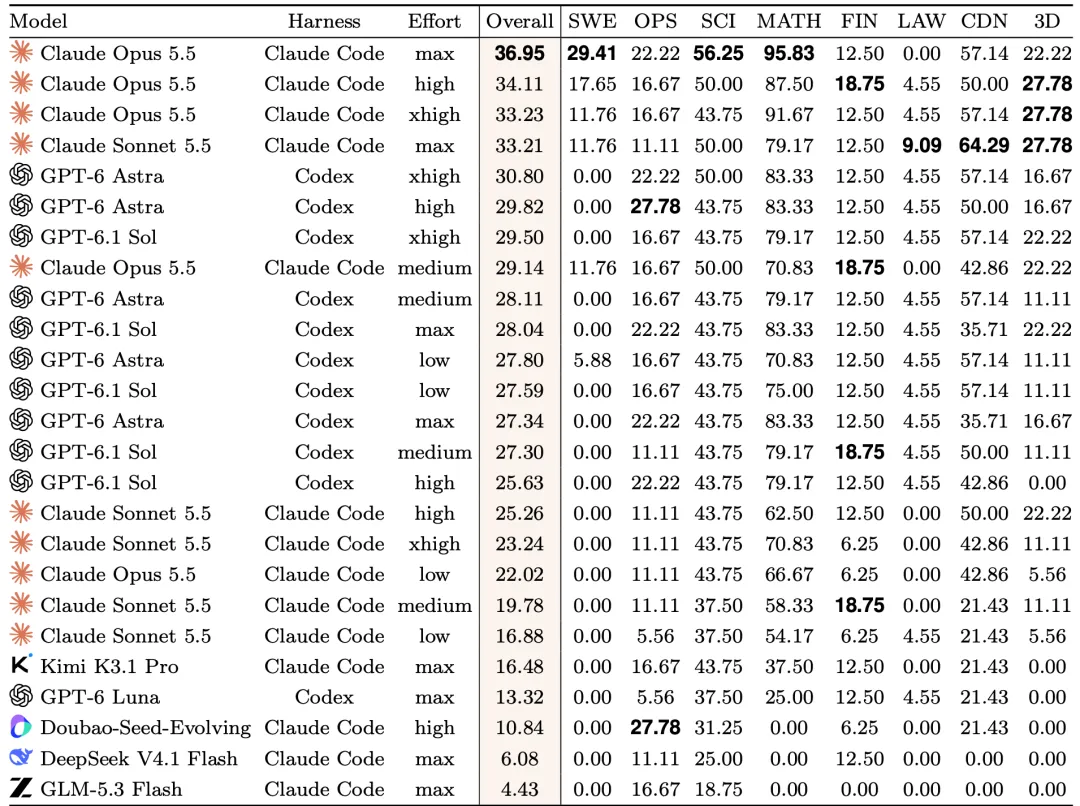
25 configurations in 8 major domains with a total resolution rate of 7%, ranked according to overall results.
The top ranking is Claude Opus 5.5 ((max), with an average of 36.95% complete resolution. In other words, even the most powerful system currently has more than 60% of missions that are not fully delivered.
The gap between fields is even more disparate. Formal mathematics is close to zero, and Claude Opus 5.5 solves 95.83%; but software engineering is only 29.41%, finance is 18.75%, and law is only 9.09%.
Moreover, there is no single system that caters to all fields: Claude Opus 5.5 leads software engineering, science and mathematics, Claude Sonnet 5.5 takes the law and content design, and GPT-6 Astra and Doubao-Seed-Evolving take the parallel top of enterprise operations.
Claude and GPT: two very different editing styles
As each scheduling is recorded, WorkflowArena places different models "how to organize multi-intelligent agents" on the same chart.
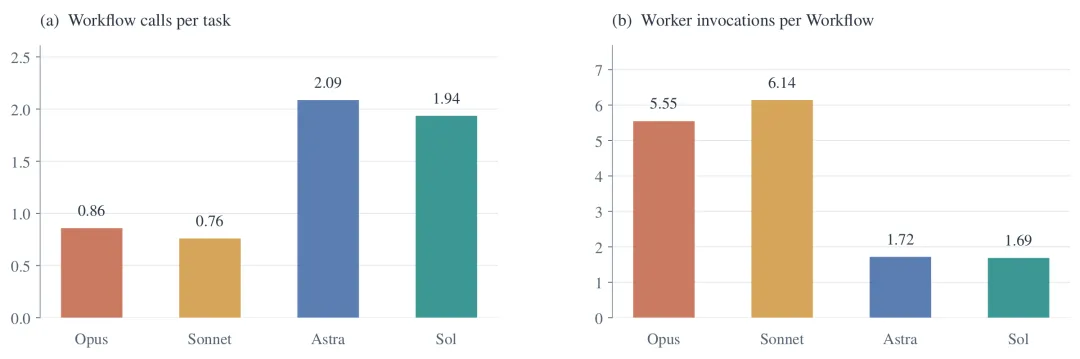
The average number of times the workflow is called for each question (left) and the number of sub-smart objects that are tuned for each workflow (right).
The results show two distinct styles:
Claude's workflow: small and large. Claude Opus 5.5 and Claude Sonnet 5.5 average only 0.86 and 0.76 workflow calls per piece, but average 5.55 and 6.14 individual smartphones per session; large-scale layouts of nine or more smartphones account for 30% of Sonnet's workflow.
GPT is a "small-scale fast run": calls are small in size. GPT-6 Astra and GPT-6.1 Sol average 2.09 and 1.94 calls per task, but only 1.72 and 1.69 individual smartphones are tuned each time, and about 99% of the workflow is no more than four.
This variation in style also varies with the mission area.
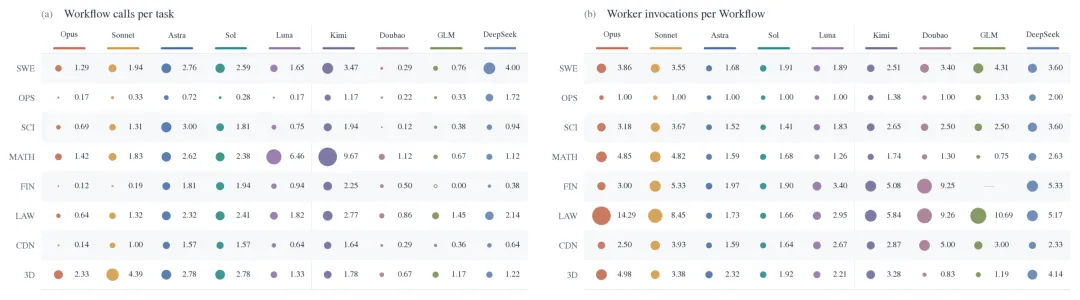
9 models are assigned frequency in the 8 major domains (left) and assigned scale (right), the larger the circle, the higher the numerical value.
In the legal task, Claude Opus 5.5 averaged 14.29 sub-smartphones per workflow, while GPT-6 Astra averaged only 1.73; in the mathematical task, Kimi K3.1 Pro summoned 9.67 workflows per task, but only 1.74 sub-smartphones per task.
Weak models can also become significantly stronger by replacing an organizer.
System scores are mainly determined by two parts: workflow design and model execution capability.
The team designed a clever experiment: to run the model unchanged, replacing only the written workflow. Claude Opus 5.5 and GPT-6 Astra as editors, Kimi K3.1 Pro, GPT-6 Luna, DeepSeek V4.1 Flash, Doubao-Seed-Evolving as executives; the editor could not personally modify any file, all actual work was done by the executing model.
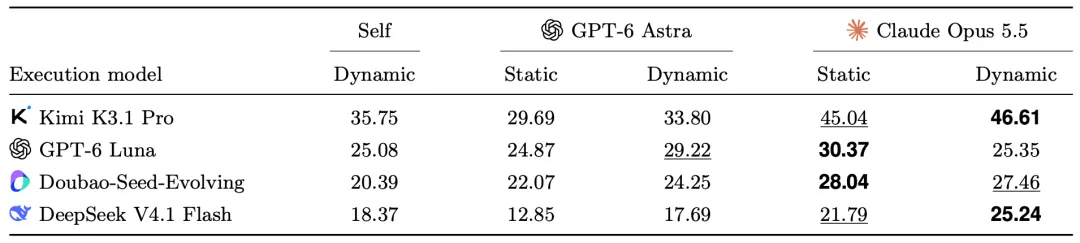
The result of the workflow migration on the core subset. Self organizes the execution of the model itself; maximizes and sub-maximizes each row, respectively.
Note: This is a comparison of continuous scores (partial completion also counts). The subset difficulty is significantly higher, with Kimi K3.1 Pro averaging 62.73 points on all missions, only 35.75 points here.
The workflow of Opus is organized so that all execution models are strengthened.
Kimi K3.1 Pro improved from 35.75 points to 46.61 points, earning almost 11 points;
DeepSeek V4.1 Flash has been upgraded from 18.37 to 25.24;
The four execution models improved by an average of 6.41 points (static) and 6.27 points (dynamic).
Since Claude Opus 5.5 has not touched any files in its entirety, these enhance the workflow from its design, as well as the instructions it gives to each sub-intelligence.
What's even more interesting is that you do it yourself, not that you're organizing it.
The GPT-6 Astra itself is a much stronger system: it averages 77.29 points on all 145 pathways, significantly higher than four execution models (up from 62.73 for the Kimi K3.1 Pro). However, its compilation workflows are handed over to others to be executed, but the results are poor: the static mode decreases by an average of 2.53 points, the dynamic mode improves by an average of only 1.34 points, and also lowers the performance of Kimi K3.1 Pro and DeepSeek V4.1 Flash.
The above results show that multi-smart organism sorting is not a by-product of task completion, but a capability that needs to be measured separately and optimized separately.
Accounting: How much does it cost to prepare a question?
Putting the total solution rate and the average cost of reasoning for each problem together, you get this sex ratio map.
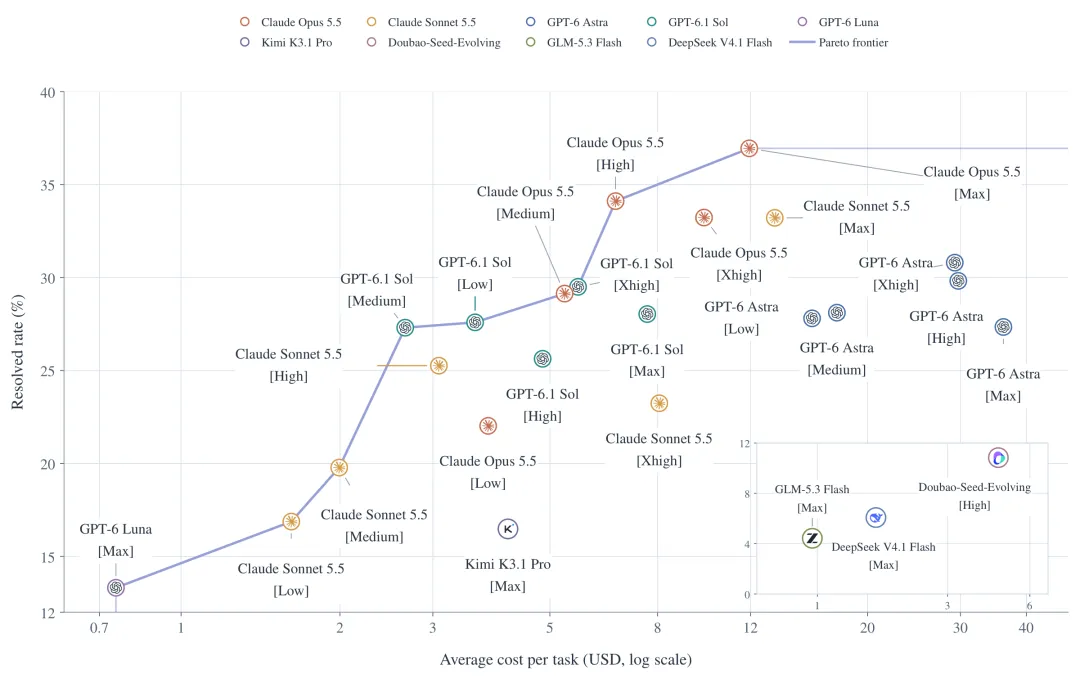
Overall, the total solution rate is equal to the average reasoning cost of a single problem (the pair of coordinates), and the curve is the Pareto forefront.
The cost of organizing different systems varies dozens of times. The same is true for the sub-intelligent organisers who complete a long-distance delivery, saving less than a dollar for each assignment and tens of dollars for the most expensive.
The GPT-6 Astra cost several times Claude Opus 5.5 for each problem, but the resolution rate was never as good as Claude Opus 5.5. The same model upgraded the reasoning intensity, greatly increased the cost and limited the benefits.
The upper limit is not how many tokens are burned, but how badly they are organized.
The same building, two ideas for organizing
The 3D construction task makes the differences in layout visible. Models need to be changed according to construction drawings and design changes, to create a complete architectural scene in Blender.
In three missions to the palace, cathedral, and fortress, Claude Opus 5.5 and GPT-6 Astra contrasted the delivery results with the workflow.
Palazzo: Claude Opus 5.5 simultaneously sends seven sub-intelligents to build the various palaces, then assemble, inspect, repair multiple rounds (78.86 points); GPT-6 Astra first builds a shared foundation and then hands over to individual sub-intelligents the unified assembly (73.86 points).
Cathedral: Claude Opus 5.5 opted for two overall constructions (77.95 points); GPT-6 Astra divided the cathedral into three sub-intelligible bodies by region and then integrated it separately (81.59 points).
Fortress: Both were built by a single master builder, but Claude Opus 5.5 sent seven sub-intelligible designs to read before the start of the project, while GPT-6 Astra was on the verge of constructing a border survey.
The same is true for 3D construction, where some layouts are used to make parallel components, and others are used to prepare drawings for the main builder.
From executable to organizational collaboration.
As the tasks become longer and more complex, the limits determine not just how strong a single model is, but how the entire system is organized.
The results of the WorkflowArena show that today's large models still have a lot of room for improvement in multi-intelligent organization; while a good workflow will itself allow the same models to produce significantly better results.
WorkflowArena fully records the workflow of each item delivered and produced, and leaves room for further research: allowing strong models to organize and weak models to execute heterogeneous multi-intelligent systems, perhaps the next step.
From "One Agent Finishes a Thing" to "One Agent Organizes a Group of Agents to Finish a Thing", the race for system intelligence has just begun.









