


GEAR enables researchers to build modular RSI algorithms like Scikit-learn. It organizes the algorithm modules needed for sampling, candidate evaluation and diversity management with parallel reasoning and measurement facilities to quickly build, compare, and replicate RSI algorithms. Experimental improvements to GEPA's Genetic-Pareto algorithm demonstrate that GEAR-optimized Agent has achieved significant improvements in both marketing customer service and code tasks.
One, the study's significance, highlights and main results:
Building a Scikit-learn modular RSI framework
Researchers from institutions such as Imperial College London and Duke have proposed the open-source framework GEAR to provide a general toolkit for recursive self-improvement (RSI). Its positioning can be summarized as toolkits for RSI: allowing developers to combine, replace and compare different evolutionary strategies, and duplicate existing task execution, evaluation, and version management capabilities.
GEAR: An Open General Evolutionary Architecture for Recursive Self-Improvement of LLM Agent Harness is scheduled for release on October 26, 2026.
The paper was written by Yehui Tang, Guanqi Zhu, Shao-Jun Xia, Xin Chen, Mengzhe Geng, Hongyang Du, Yuhao Tang.
The project's main page is: rsi-gear.github.io
This is the first time I've ever heard of this game.
The paper:
GEAR breaks down the parent version selection, modification program planning, task sampling, scoring, and candidate sequencing into replaceable modules. Researchers can develop new algorithms around these links, and each candidate's code version, operating conditions, and evaluation evidence are recorded by shared facilities, allowing results to be checked and continued experimentation.
The paper is validated by the evolution of the harness. It is possible to modify prompts, tools, skills, workflows and context management, keeping the weight of the target model unchanged. In the fixed GPT 5.6 Luna model, using medium reasoning ratings, the evolution of the GEAR DeepSeek Harness (DSH) will increase the marketing task rate from 27.0% to 40.0%, customer service tasks from 17.0% to 25.0%, and code tasks from 52.8% to 62.9%.
These results demonstrate the potential for systematically optimizing the way Agent works. Through open shared experimental tools, GEAR hopes that further research will be able to develop and test new evolutionary methods on an existing basis, accumulating replicable versions and experimental results.
Context of the study: The three core problems of self-development
Work around recursive self-improvement (RSI) is continuing to emerge. From optimizing prompts, evolving workflows, allowing agents to modify their own operating code, training new models, different studies have given their own evolutionary schemes.
First, how better, more efficient Sampling? evolving search space is large, but the computing budget is limited. From which versions to start, explore which improvements to make, and prioritize which tasks to collect feedback on, it affects how far a search can go.
Producing a new version is just getting started, and it's more important to determine whether it's improved: the increase in scores is the modification that worked, or the difficulty of the task, the rationality of the ranking or the fluctuations of the run? and how much evaluation should be used to support the decision to keep it or eliminate it?
Third, how to maintain diversity in the evolutionary process? If each round leaves only the version with the highest aggregate score, the search may be prematurely focused on one route. Some temporarily lagging variants may excel in a class of tasks, or take different solutions. How to retain these valuable differences and give them an opportunity to be the starting point for further evolution is an important question to continue exploring.
Sampling, Variable Assessment, and Diversity Management are a set of common problems for understanding and comparing methods of evolution. Different studies may propose different strategies in these areas and require a common set of facilities to perform experiments, preserve candidates, and test the effectiveness of strategies.
Agent Harness is a specific study scenario for these problems. The actual task requires calling tools, organizing context, dealing with abnormalities and verifying results, which will affect the model's ability to complete tasks and provide objects that can be modified for automation.
When researchers attempt new sampling strategies, evaluation schemes, or diversity mechanisms, the bottom line is to simultaneously execute tasks, preserve versions, and manage evidence. GEAR's starting point is to organize these common links so that different approaches can be compared under clear experimental conditions.
Three, framework design: a two-tiered framework for self-evolution based on meta-learning
GEAR models Agent's evolution as a meta-learning problem: improving the method of solving subsequent tasks from the execution experience of a set of tasks. Specifically, it divides the system into two levels: the internal level of solving current tasks and the external optimization of replicable Harness.
The internal layer is the execution and adaptation at the task level. The task agent uses a given model and operating framework, interacts with the environment, calls tools, and adjusts the current task plan according to feedback. At the end of the task, the system records the execution trajectory, the final results, and evaluates feedback. Temporary adjustments in this layer serve only the current task and do not automatically become the running rules for subsequent tasks.
Meta Agent brings together trajectory and evaluation evidence for multiple tasks, identifies recurring problems, and proposes modifications to cue words, tools, skills, workflows, or context management. Candidate versions are evaluated and selected to become the new Harness for subsequent tasks.
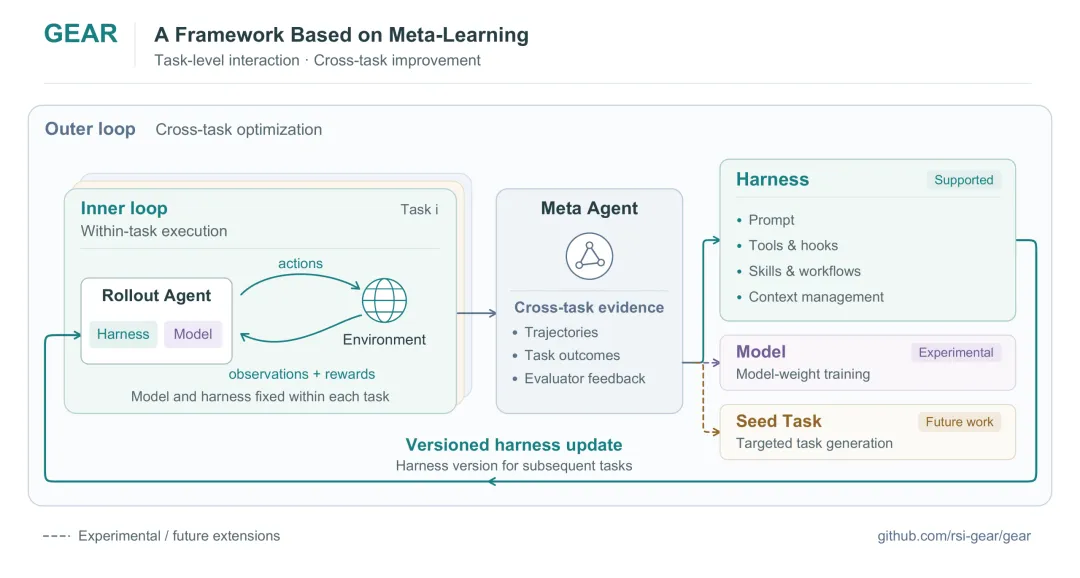
Figure 1 provides a two-tiered framework based on self-learning. The inner layer performs specific tasks and generates evidence, the outer layer uses cross-task experiences to improve replicable operating frameworks. The inline represents the currently supported harness evolution path; model training and automated generation tasks are experimental and future expansion, respectively.
There is a two-tiered cycle: task execution generates experience, cross-task experience drives framework improvement, new frameworks participate in subsequent tasks and generate new experiences. Temporary remedies in a task can only be organized into verified framework modifications to enter this continuous accumulation process.
The above-mentioned Sampling, Variant Assessment and Diversity Management can be configured externally with different strategies: choosing which historical versions to start from, how to evaluate candidates, and what versions to keep for follow-up.
The two-tiered structure of task execution and cross-task improvement is reflected here. The evolutionary harness of this article is to keep the weight of the target model fixed, and to make improvements through the search and selection of running frameworks, without requiring the internal layer solving process to be minimal.
Four, detailed results, experimental analysis and future applications
After the fixed model and the reasoning grades, all three areas have improved
The study used 100 Marketing tasks from AutomationBench, 100 Support tasks, and 89 Command Line tasks from Terminal-Bench 2.1. Each model and operating framework configuration was evaluated on each task.
The most direct control comes from the GPT 5.6 Luna, Medium Logic Grade. The study consists of keeping tasks, models, logic grades, meters, and running settings consistent, comparing the initial DSH to DSH that evolved for the corresponding dataset.
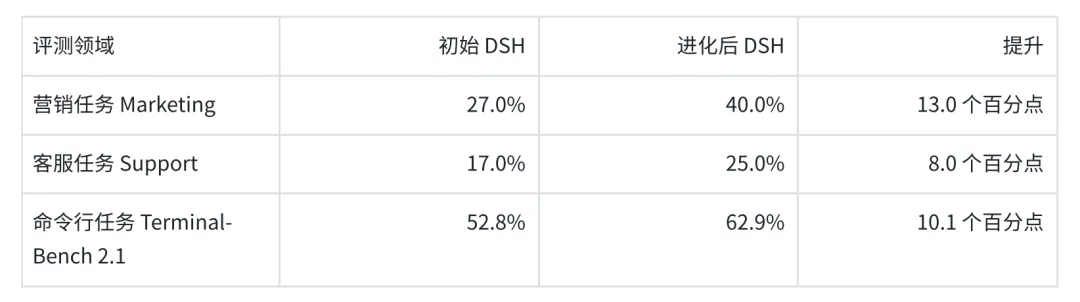
The GPT 5.6 Luna and medium reasoning rankings are subject to rate controls. The data comes from Table 1; the three fields evolve their respective operating frameworks respectively.
Marketing, for example, ranges from 27% to 40%, meaning that more than 13 of the 100 evaluation tasks were passed. It suggests that system optimization of the way work can help the same model accomplish more tasks.
The study also examined "target completion". A task may include multiple final status checks, which first calculate how much percentage of each task meets the scoring requirements, and then averages for all tasks. Under the above configuration, the target completion in marketing increased from 75.4% to 83.9%, and support from 72.9% to 81.3%.
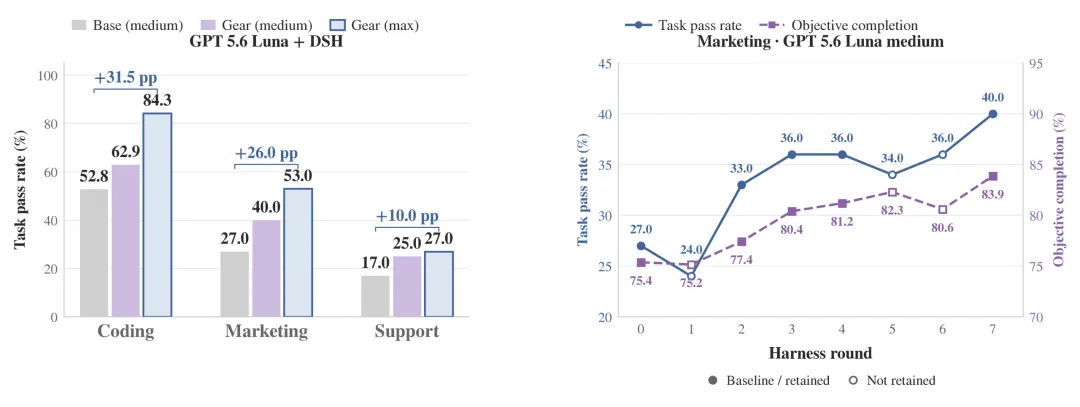
Figure 2 shows the results of experiments using Figure 4 and the project's homepage. The left shows the performance of the three fields under different configurations, and the right shows the evolutionary process of Marketing under the fixed Luna medium configuration. The left shows the blue brackets of the comparison between the initial medium and the post-evolutionary max, which contains a change in the reasoning ranking; the peer-to-peer increase in the above table corresponds to the difference between the gray and purple columns.
The improved way of working can be used on another model
GEAR's experiments also explored a practical question: Does the operating framework that evolved on one model still work after a new one?
The study used the corresponding operating framework evolved on Luna for GPT 6 Astra's max reasoning grades. The pass rates for the Marketing and Support tasks were 61% and 39%, respectively, and the corresponding Codex comparisons in the paper were 57% and 35% respectively. This provides preliminary evidence for the improved way of working that can be replicated across models. In Terminal-Bench 2.1, the evolved operating framework combined with Luna max and Astra max achieved 84.3% and 87.6% pass rates respectively.
Some candidates were higher, but were not accepted
The evolution of marketing explains why self-improvement requires clear acceptance mechanisms.
From the right side of Figure 2, you can see that the initial version had a pass rate of 27.0% and a target completion rate of 75.4%; the final retained version of the 7th round reached 40.0% and 83.9% respectively. But this search path was not up every step, and the 1st, 5th and 6th round candidates were not retained.
The fifth round was particularly representative: compared to the then-reserved fourth round, the goal completion rate increased from 81.2% to 82.3%, while the completion rate decreased from 36% to 34%.
Although the pass rate of the sixth round was still 36%, the target completion rate dropped to 80.6%, it was not adopted. The system blocked these steps with explicit rules, retaining versions that could simultaneously meet acceptance requirements.
This also illustrates the role of recording and evaluating facilities in GEAR: allowing researchers to see the losses in the improvement process and to examine what changes the changes actually make, rather than just getting a final score.
From research toolbox to business process optimization
For researchers, GEAR can be an experimental platform for comparing methods of self-improvement. Based on shared task execution and evidence-recording facilities, researchers can experiment with different search strategies, task sampling methods and acceptance rules to further analyze which methods are more effective under the same budget.
For developers, a direction worth exploring is to bring business testing into this cycle. For example, building repeatable task sets for custom processing or development of runway processes, taking advantage of failed trajectories to improve skills and workflows, and deciding whether to adopt a new version through regression evaluation. Artificial experts can also view modified bases and runway records, participate in analysis and labeling.
For real-world business scenarios, the framework is based on the leading architecture design of toolkits for RSI, which can quickly build targeted algorithms in different scenarios, and has achieved the same level of top-of-the-line models with smaller models in customer service, marketing and code tasks.









