Dreams from the Monastery of Phineas
QbitAI is public.
It's a great model, and it kills a black horse!
And this time, it was confirmed personally by Silicon Valley's hardcore AI technology media, Latent Space.
On November 10, Latent Space launched a completely new model measurement directory dedicated to "non-position" testing.
In the first phase, it focused on the open-source model of Chinese company NaiveAI.Naive-N0.5-Flash。
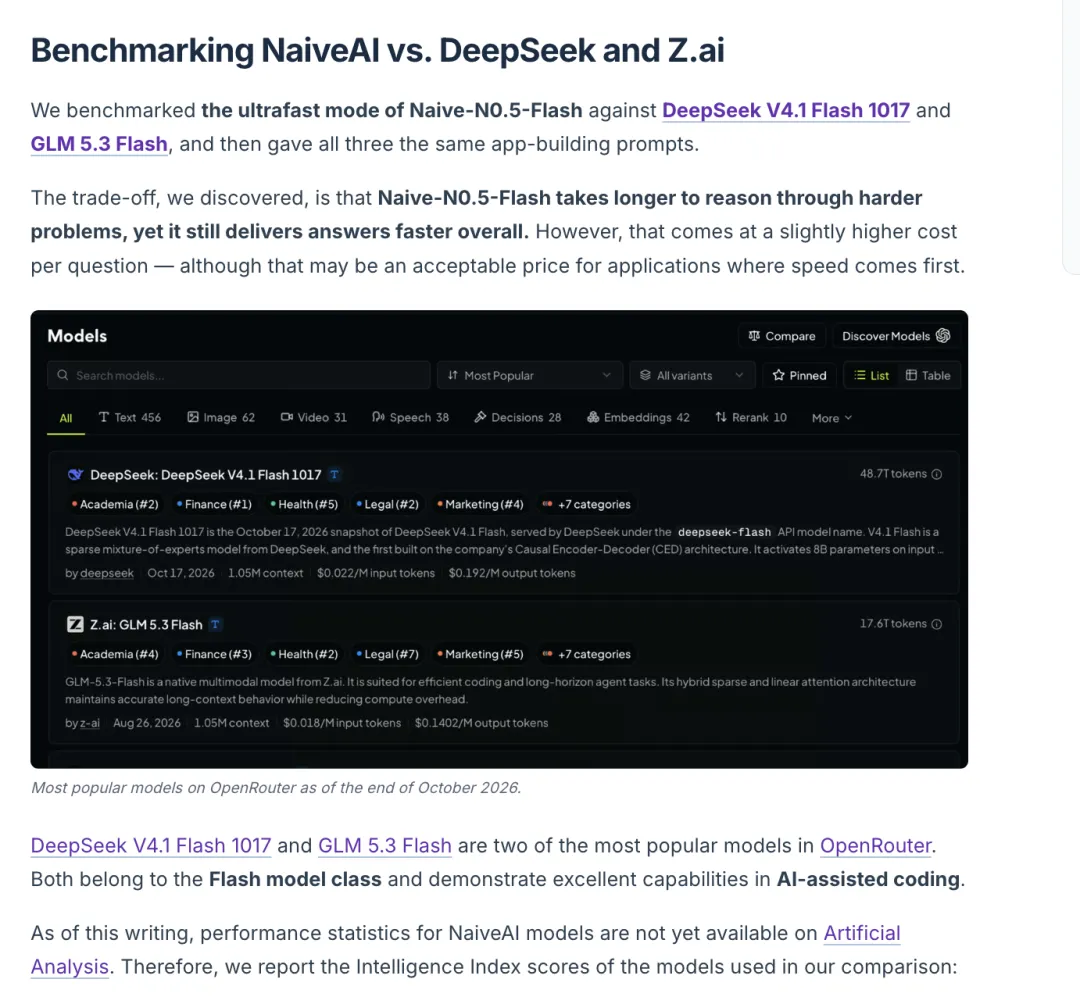
Latent Space's opponents were the two most popular Flash models on OpenRouter: DeepSeek V4.1 Flash 1017 and GLM 5.3 Flash.
I hadn't thought that the Naive-N0.5-Flash, which was pulled from the same platform as the two previous models, would yield a very competitive scoreboard.
Comprehensive capabilities: between the DeepSeek V4.1 Flash and GLM 5.3 Flash, the first tier of the mainstream domestic model.
Programming capabilities: Overall performance is intermediate between the two, with individual assessments achieving counter-extreme performance; 3D solar system applications perform best; 3D growth trees parallel to DeepSeek.
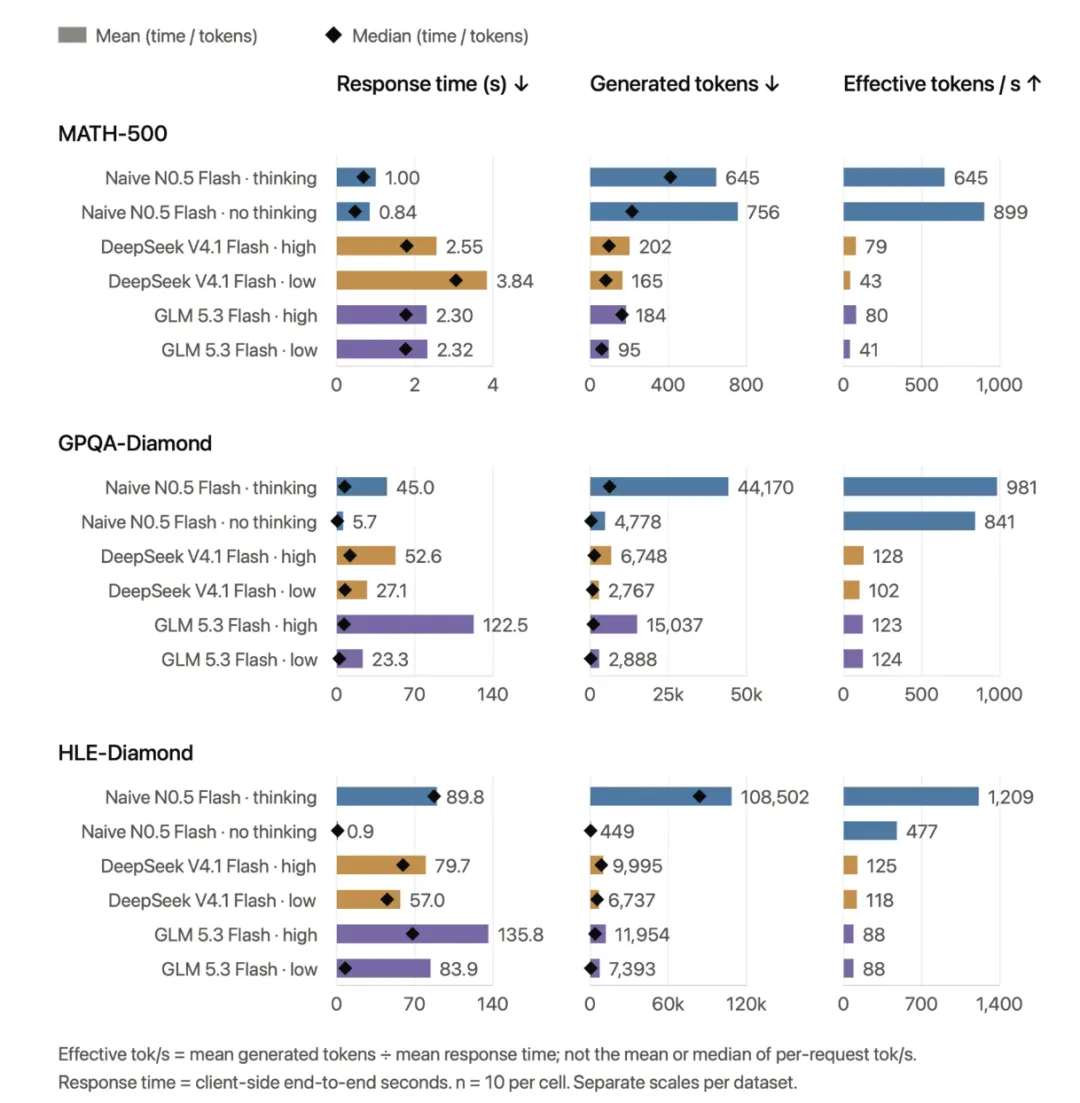
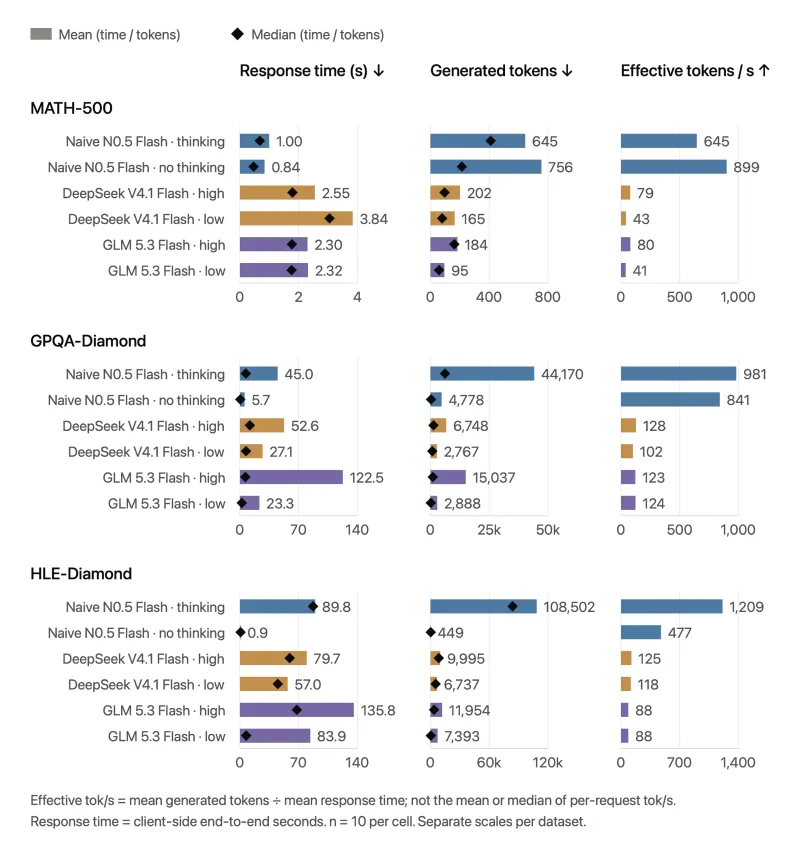
Reasoning speed: A peak of 2100 Token/s per second in the ultra-fast mode, thinking and answering phases of 984 and 1816 Token/s respectively, average response time of only 3.1 seconds, results bright.
Speaking of NaiveAI, the founder of the player is also not unknown to you as an associate professor in the Department of Electronic Engineering at Tsinghua University.The peak of the season。
And this model has a rather special origin: model architecture, training systems, and reasoning optimization are all developed by AI itself.
It is obvious that the new black horse, NaiveAI, is now running out of place among the top players.
Latent Space: Chinese supermodel black horse killed in front of a ladder
First of all, let's talk about why this assessment is worth considering.
In the world of overseas AI engineers, Latent Space is a name many friends should have heard of.
It is an independent technology media focused on AI engineering, long-term tracking of big models, AI Agents and AI infrastructure.
Even industry figures such as the legendary Google engineer Jeff Dean have been invited as guests to explore in-depth topics such as large model architecture and engineering optimization.
Moreover, Latent Space's content has always looked professional, hardcore, and close to "real engineering practice".
From AI engineering practices, to the underlying architecture of large models, to how Agent enters the real production environment, it focuses on the problems that developers are solving.
In other words, the measurements of the media are directed at a group of people who will actually use the model to write the code and make the product.

It is also worth mentioning that the Chinese company NaiveAI's open-source model Naive-N0.5-Flash is the lead character in the first installment of Latent Space's new assessment kit.
From a technical point of view, NaiveAI is focusing on increasing the efficiency of reasoning.
On the one hand, allowing AI to participate in the optimization of the self-developed NaiveRT system will push the generation speed up to 2000 Token/s.
On the other hand, by using techniques such as scant attention, while supporting the context of millions of tokens, calculation costs are reduced as much as possible.
In terms of product positioning, NaiveAI clearly targets the two areas of focus for current developers:
Quality of completion of complex programming tasks and reasoning efficiency in high frequency calling scenarios.
But what really makes this measurement quantifiable is the reference object selected by Latent Space.
It directly pulled out DeepSeek V4.1 Flash 1017 and GLM 5.3 Flash, both of which are very popular Flash models on OpenRouter.
So the amount of gold that came out of this match, which NaiveAI is facing this time, are two players who have already run out of some size in the real developer market.
The question is, how far can this model go?
Latent Space first ranked the three models in a "public" rating.
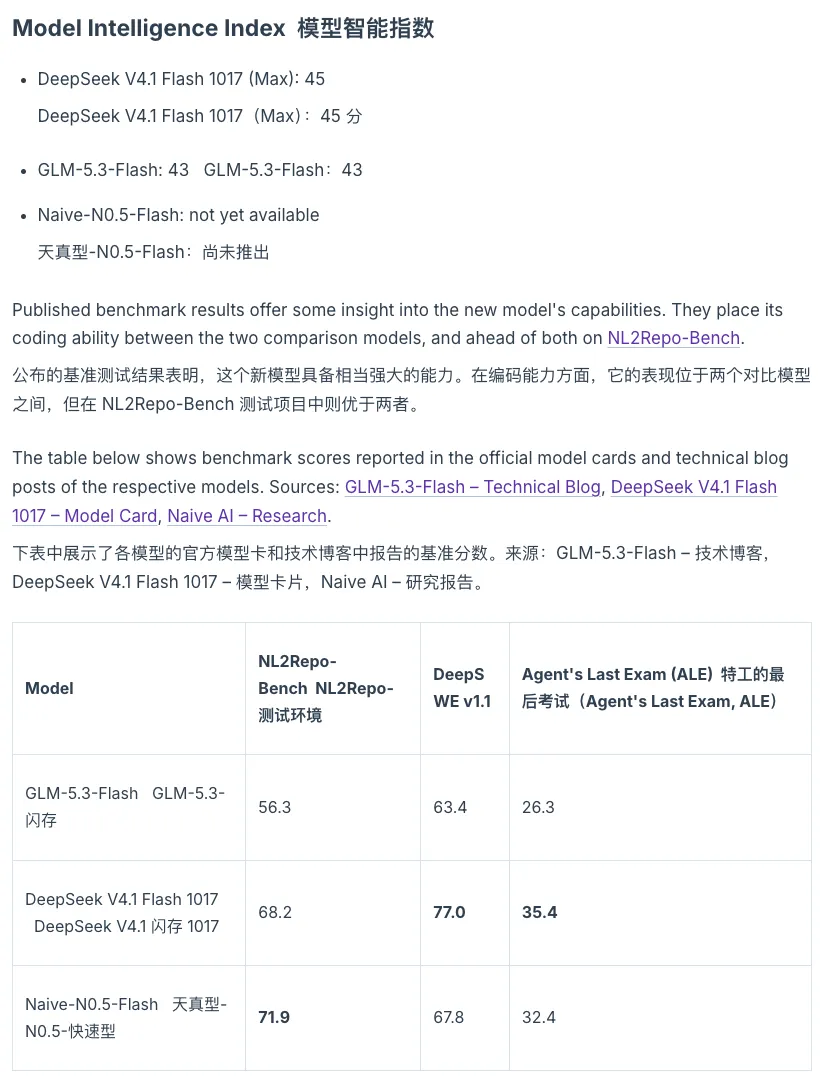
In terms of overall performance, Naive-N0.5-Flash is the leading competitor in the domestic mainstream model between DeepSeek V4.1 Flash1017) and GLM 5.3 Flash.
Among them, the programming benchmark test, NL2 Repo-Bench, was more of a mouthpiece than DeepSeek and GLM.
Naive-N0.5-Flash took 71.9 points ahead of DeepSeek and GLM by 3.7 points and 15.6 points respectively.
The test is the model's ability to build a complete code repository based on natural language requirements, which is closer to real software development tasks than generating a single function.
This also means that the Naive-N0.5-Flash achieves an unmatched public evaluation of the two flagship Flash models for the entire project-generation task.
DeepSeek is hard to program and speeds up to 2100 Token/s.
Of course, public scores are only one aspect, the real performance of the model, and it should also be based on test results.
This time, Latent Space is the first to hit the shelves, and Naive-N0.5-Flash is the most handy."Speed shows".。
According to official data, a single user output speed of about 50 Token/s in model standard mode, switching to an ultra-fast mode of up to 2000 Token/s.
As a result, Latent Space's results were even more impressive than the official results.

In the test, Latent Space specifically selected 30 problems, covering three levels of mathematics, scientific knowledge and high-difficulty reasoning.
The three models each answer the same difficulty questions, measuring the speed at which tokens are generated, the length of output, and the time it takes to complete the entire request.
As a result, the Naive-N0.5-Flash directly knocks out the speed advantage.
One-second peak2100 Token/sThe thought stage is about984 Token/sIt's been a while since we've had a formal response.1816 Token/s。
What's even more impressive is the response time: Naive-N0.5-Flash's average response time after starting the thinking mode is only 0.5.3.1 secondsDeepSeek is 10.1 seconds.
In other words, for the same request, the Naive-N0.5-Flash takes about 69% less time than DeepSeek, and the response is about 60%.3.3 times as much。
This result is more specific in the real development scenario.
AI programming and Agent workflows often require multiple rounds of model calls to complete code generation, debugging, tool execution, and result feedback.
Several seconds of single-request savings can be transformed into shorter task execution cycles and higher development cycling efficiency as the number of calls accumulates.
It's one thing to be fast enough, and "programming skills" have to pass a real-world test.
For this purpose, Latent Space allows three models to use the same prompts to complete three sets of web application development tasks in different thinking modes.
Covering 3D scene construction, programmatic modeling, physical effect simulation, and graphic rendering, there are requirements for the model's ability to generate code and implement complex functions.
Let's take a look at the first scene: Handmade 3D photos of the entire solar system.
Models need to independently generate the Sun and the planets, supporting lens rotation, planetary rotation and speed regulation, while achieving planetary surface texture through code.
As a result, the Naive-N0.5-Flash takes the best of the best immediately after the thought mode is activated.
The blackness of the sun's surface is clearly visible, and the Earth's back light even reflects city lights at night, and the details and completeness of the overall scene are more pronounced.
Even in the face of the two main players in DeepSeek and GLM, they still have their advantages in terms of scenic completeness, visual detail and interaction:
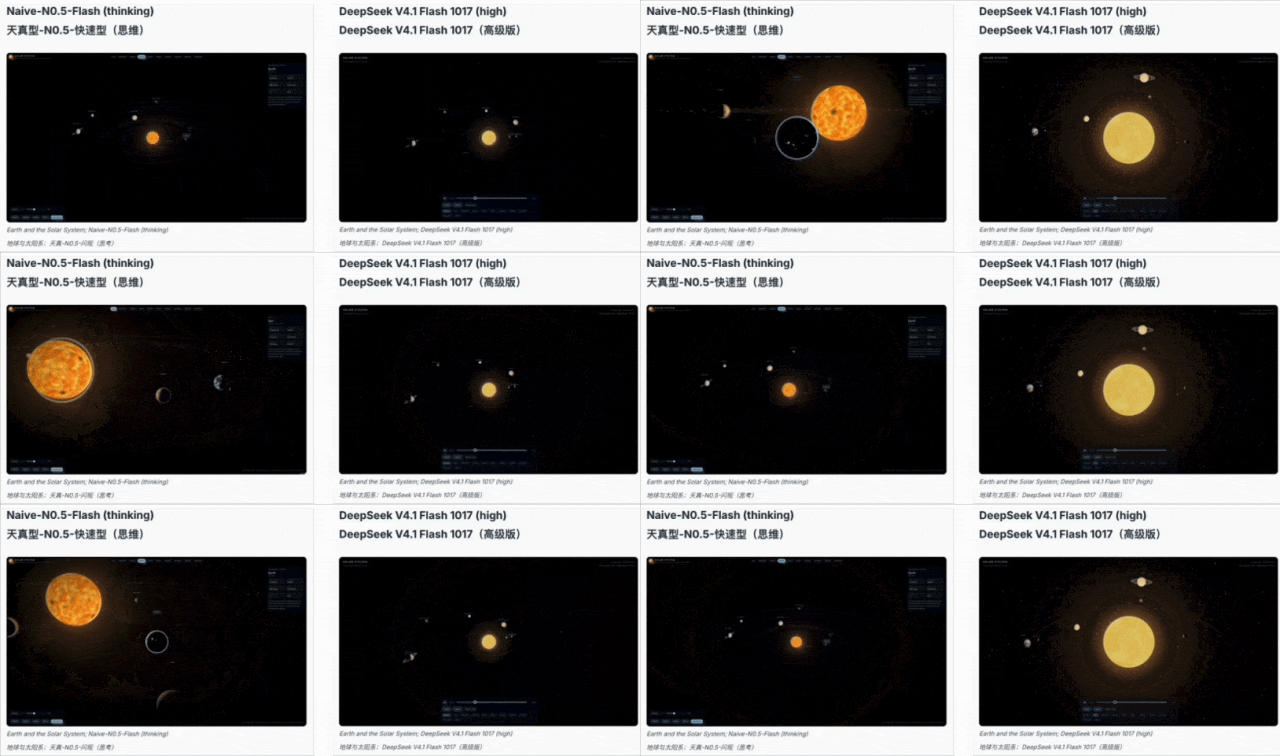 △Left: Naive-N0.5-Flash (thinking) Right:DeepSeek V4.1 Flash 1017 ((high)
The second task is to generate a 3D tree that can "interact in real time".
From tree branches, leaf distribution, to bark textures, grassland shadows, to dynamic changes under the influence of wind, models are required to be implemented through code.
In this round, Naive-N0.5-Flash (thinking) and DeepSeek V4.1 Flash 1017 ((high) performance are close, both of which generate higher quality work after starting the thinking mode.
Compared to the solar system, this question further tested the model's ability to handle dynamic scenarios.
Thousands of deciduous leaves need to be reasonably distributed, and the branches need to show natural fluctuations under the influence of wind, while also taking into account real-time rendering properties.
Naive-N0.5-Flash's ability to stay close to the quality of completion of DeepSeek shows that it already has a fairly robust capability for more complex programming tasks such as scene modeling, dynamic effects, and interaction logic:
 △Left: Naive-N0.5-Flash (thinking) Right:DeepSeek V4.1 Flash 1017 ((high)
The final task was to further test the model's "graphic programming" capabilities.
Latent Space requires three models to convert classic graphics tutorials such as Ray Tracing in One Weekend into real-time light tracking applications in browsers.
Models need to simulate the reflection and refraction of light on different materials such as glass, metal, and complete scene rendering.
These types of tasks have high demands on the efficiency of mathematical computation, graphical algorithms and code execution, especially requiring models to understand the optical properties of different materials and convert them into functional rendering programs.
In the end, all three models delivered operational applications, and NaiveAI also successfully implemented core functions.
Of course, the three sets of tests are not enough to represent the full capability level of the model, but at least provide an intuitive signal box.
Faced with the demands of different types of tasks, the new Naive-N0.5-Flash model is already capable of matching the performance of the previous models such as DeepSeek.
China's big model is out in the sea to usher in the Qing Dynasty
NaiveAI has received attention from Silicon Valley's renowned AI media outlet Latent Space, which reflects a more worthy industry change.
China's big model is accelerating the emergence of overseas technology circles.
Once upon a time, overseas developers talked about open source models and API calls, and the first thing that came to mind were European-American players like Lama, Mistral and others.
But in the past two years, the competitive landscape of the global big model has changed significantly.
From DeepSeek's high-performance, low-cost global reputation to Qwen's continued expansion of the open-source ecosystem.
Furthermore, Chinese models such as GLM, Kimi, and MiniMax joined the horizons of overseas developers, each gaining attention in fields such as programming, reasoning, and agents.
From model lists to open-source communities to actual API calls, the image of Chinese models is becoming increasingly dense.
The overseas tech community's awareness of China's big model is now expanding from a handful of star products to a growing Chinese model ecosystem.
 △A.I. generated
What is even more remarkable is that the overseas competition of China's big models is shaping a new ladder pattern: leading manufacturers are continuing to lead, and new forces are connecting.
Naive AI is a prime example of this.
As the industry grows, the headline tables may have been set, and new players are roaming around in an increasingly difficult environment.
The company, which was founded less than a year ago and still uses cutting-edge technologies such as high-speed reasoning, bottom-up optimization, and AI-involved model research and development, has achieved comparable results with its head model.
In addition, NaiveAI has chosen the technological route of "AI-driven AI research and development" since its inception.
For AI to be involved in coding, running experiments and continuous iteration, human researchers are responsible for direction and critical decision-making, exploring new paradigms to improve model R&D efficiency using AI.
For this purpose, the company has built a massive AI R&D infrastructure that supports almost 10 million sandbox operations per week, peaking at 100,000.
The idea has also attracted the attention of Gabriele Beltramo, author of Latent Space, who believes that NaiveAI is exploring a pathway to the potential of embroidery:
Let AI optimize its own reasoning core for CUDA and look for a model architecture that is more suitable for large-scale reinforcement learning.
From a single-point breakthrough in the head model to a head-to-head race, the Black Horse Power Ladder competition.
China's big model is now forming a thicker and more sustainable industrial ecosystem.
NaiveAI's performance in overseas testing, this time, adds a vivid foothold to the trend.
Even though the pattern of the head is becoming clearer, there are still Chinese black horses that come in with new technology, new ideas, and run out of their place among the well-respected players.
The link is as follows:
[1]