It is possible to model the 100 billion parameter edge of Vibe Coding.
In 2024, Apple has yet to officially announce Apple Intelligence, which model companies could become Apple's AI partner in China, once becoming the stealth list for domestic models. On this list, the names of Baidu, Ali, Tencent, and byte jump have been mentioned continuously.
AI has not yet really landed, and the market has already written a new script for Make Mobile Phone Great Again.
It wasn't until the end of October 2026 that Apple finally announced an online version. The next generation of Siri AI, an upgraded version assistant capable of understanding complex needs and working for users everywhere, is still a long way off, and the first deliveries of writing, translation, and photo processing have not exceeded the range of traditional edge AI.
In a time when big models have infiltrated every aspect of working life, why is Apple jumping the ballot again?
The memory wall is the answer.
Usually, when a large model is running, all parameters are loaded into memory, and when the answer is generated, the device must continue to read the parameters involved in the calculations. The memory of mobile phones and laptops is limited, and is also allocated to the system and various APPs. A 35B, or 35 billion parameters model, uses the common 4-bit characterization, and the weight occupancy may still be close to 20GB, far beyond which mobile phones can usually provide space for an application.
That's why, even though cloud models have been evolving for a thousand years, the edge model is still stuck in an impossible triangle between intelligence, memory and IO.
A side-by-side model that wants high intelligence and doesn't want to overwhelm memory with weight will have to activate on demand with scarcity, the cost of IO bandwidth being constantly consumed, a simple question that may take a few minutes to answer.
If you want low IO, low data transfer, and high intelligence, you'll have to take all the weight off of permanent memory and squeeze it into other permanent APPs; if you want to control permanent memory while reducing IO expense and waiting time, you'll only have to accept small models with the smart limit locked down.
But is the upper limit of the edge model really locked in here?
A company called Infinite Ark offers a new puzzle idea.
01
100 billion parameters,
First available on the edge
In September of this year, Infinity Ark released Edge 0-35B, which for the first time puts a 35 billion parameter model that typically requires close to 20GB of weight space into the memory budget that a mobile phone can run.
According to official test data, Edge 0-35B has a peak operating memory of about 2.5GB, generating more than 37 tokens per second.
In other words, the model still retains 35 billion parameters in size, but only a portion of it needs to be stored in memory at some point, which can be quickly activated. The rest of the power is stored in the storage space of the device, which is pre-prepared by the reasoning framework and fed on demand.
In addition, Edge 0-35B was released shortly afterwards, with over 1.2 million readings in overseas communities, as well as numerous technical experts and researchers from OpenAI, NVIDIA, Qualcomm and other companies, and the model quickly rose to the top of Hugging Face's overall Trending list.
In addition, since the Infinite Ark also opened up a model weighting and unified reasoning framework at the same time, the scheme later became a standard solution for end-user enterprises and research institutions. Subsequently, the discussion of end-user models in the industry rose from a few billion parameters overall to 35 billion parameters.
If the idea in the past was that mobile phones could only load small models, it would be a good idea.Edge 0-35B attempts to answer this question: Can the phone only load the current portion of the large model each time, while keeping the waiting pressure low enough?
It's a great way to get to know each other.The Infinite Ark also pushed the end-side model to a scale of 145B.Today, Edge0-145B has opened the model weight on Hugging Face, and the all-new end-to-end unified logic engine is also open source on GitHub, and provides one-key deployment tools and complete hardware adaptation guidelines. With this model, complex tasks such as writing code, operating software, building three-dimensional scenarios, and executing and modifying continuous planning around a target can be accomplished.
In terms of hardware compatibility, Edge0-145B released Day 0 on the first day, which fully supports macOS, Windows, Linux and all three major operating systems, covering chips from the Apple M series, as well as platforms such as the NVIDIA GPU.
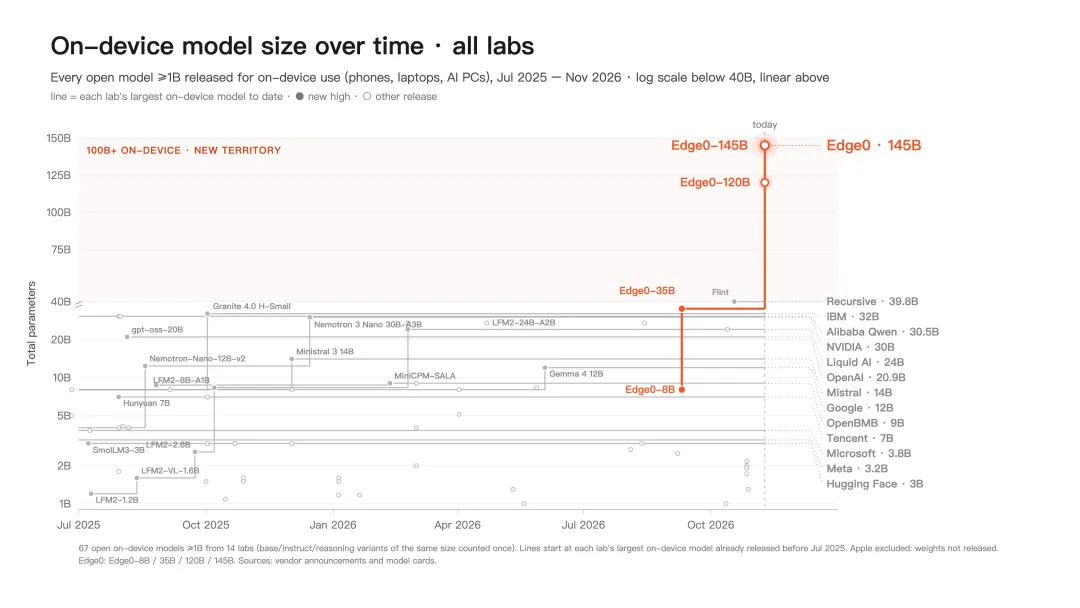
* End-side model scale evolution chart: the parameters of end-side models are constantly pushed up to the limits of intelligence, and the first end-side model to be raised to 100 billion parameters is a truly available, non-theoretical study.
If the previous 35B's 10 billion parameter edge model represents the first time AI on the high-intelligence edge moves from the lab to an industrial landing, then the 145B's 100 billion parameter edge large model represents the first time that an edge model's intelligence level is higher than a shoulder-to-shoulder cloud model. Specifically, Edge0-145B's breakthrough has five main points:
- I'm going to go back to the library.With a peak memory of 29GB, a personal laptop such as a MacBook Pro can run without the need for a server;
- The headline is as follows:A pre-fill speed of 1,100+ tokens/s, dozens of pages of code are thrown in, and the first word appears instantly;
- It's like this:Decode at 80+ tokens/s, faster than human readings, without staring at the screen word for word;
- Power consumption is depressed:Typical power consumption is about 120W, continuous operation without decreasing frequency;
- Long-term tasks are not slow:Support for 128K and 256K in context, long-text subtitles generally do not slow down, and long-term complex tasks do not run as slowly.
As a reference, the current mainstream edge-side model is focused on 1B10B. Edge0-35B on the iPhone 18 Pro Max achieves 37+ tokens/s, about 2.5GB of memory. Edge0-145B's parameters are four times that of Edge0-145B, running at speeds of up to 80+ tokens/s on laptops, with peak memory of only 29GB.
02
There are 100 billion models.
How to use it from side to side
After solving the problem of availability, a new problem arose.
A 100 billion-parameter model, even if it can be loaded locally, but are users really willing to use it?
Starting the model is only the first step. After entering dozens of pages of code, how long will it take to start answering? Will the generating speed keep up with the reading? Will the task last for half an hour, will the device slow down due to heat?
These issues are directly related to the actual user experience.
The solution to the Infinite Ark is to simultaneously adjust the model structure, weight storage and computational scheduling.
First, the first step is structural adjustment.Edge0-145B uses a rare expert structure that is group-shared: in the past, each expert had a complete set of matrices, and now the same group of 64 experts share two large matrices, each with only a small number of differential parameters. The number of experts has remained the same, and the weight of storage and transportation has decreased significantly. Total parameters pile up to 145B, with only about 6.6B of the actual computation involved per reasoning.
After the architecture is determined, targeted model training is carried out according to the needs of the architecture and the edges.
After that, the problem of loading is solvedRare architecture only reduces the amount of computation and does not automatically solve the problem of where the weight is placed and how to get it in time when it is needed. Even if it is temporarily unnecessary, its parameters will still occupy some storage space.
The choice of Edge0-145B is to let different levels of storage do their job: the parts that are frequently called stay in faster storage, while the rest are distributed in system memory and SSDs. The model calculates while the system prepares the data for subsequent needs, while minimizing the amount of weightless files that are needed to wait for the next batch.
The final step is to adjust.CPU and GPU synchronization, then speculative decoding, multiple candidate tokens being submitted and validated at a time, distributing part of the computing and reading expenses to more outputs.
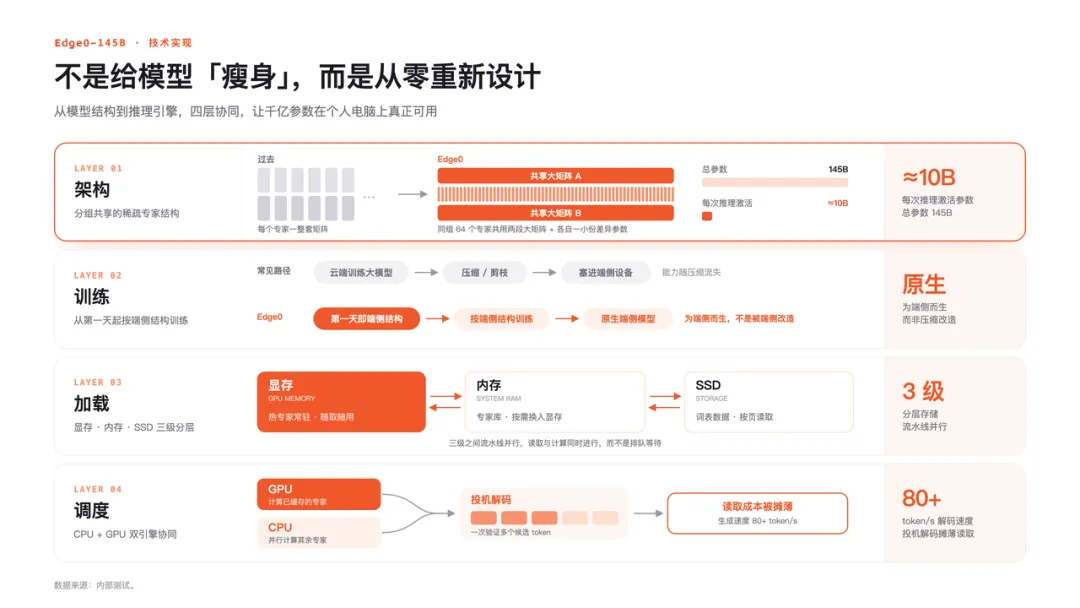
With these steps of optimization, 100 billion models are loaded into the end-to-end devices and streamlined efficient operation is no longer a problem, and the next thing it has to answer is how much this model can do.
03
From being able to talk to being able to work
If 100 billion models are deployed to the end if only they can interrupt the chat, then the real goal is not just a setup for show muscles, but to be able to complete complex tasks truly independently.
Of the six mainstream ratings released by Infinite Ark, Edge0-145B is at the same level as mainstream open source cloud models such as DeepSWE 1.1 64.6, Terminal-Bench 2.1 86.5, HLE 35.4, GPQA-Diamond 90.4, IFBench 80.6, AA-LCR 79.3, and integrated with mainstream open source cloud models such as DeepSeek-V4-Flash. Its strengths are in smart and programming.
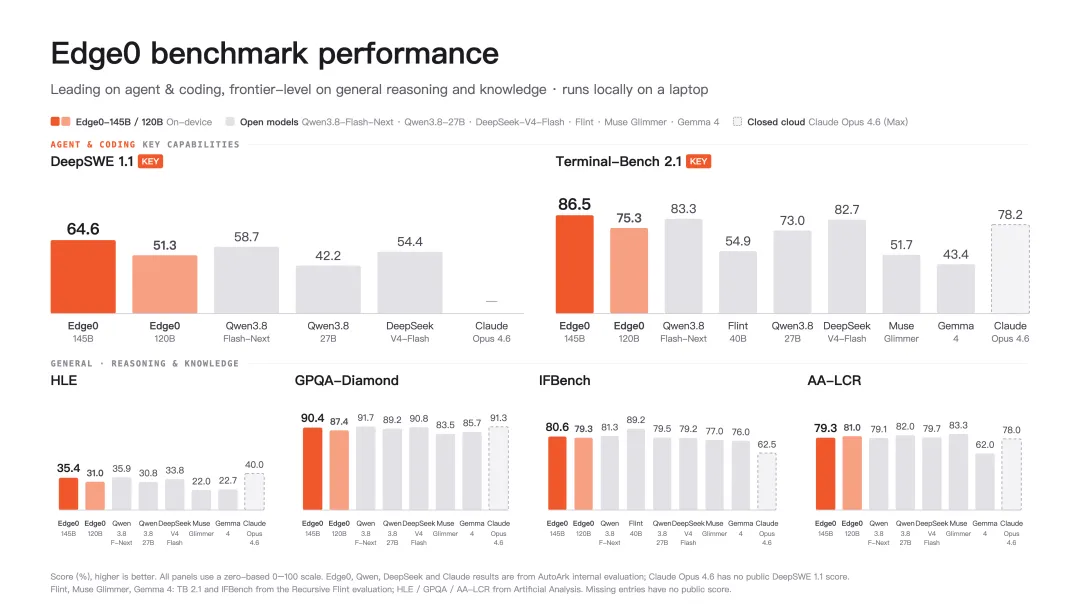
*Edge0-145B evaluates leading peer-to-peer open-source models in smart entities such as DeepSWE, Terminal-Bench, and the edge-side model's smart cap for the first time approaching cloud-top models
Compared to the mainstream edge-side model of 10 billion parameters, Edge0-145B was the most noticeable improvement in intelligent and programming tasks: Terminal-Bench improved 18.5%, DeepSWE improved 53.1%; reasoning and knowledge class tasks also improved by 1% and 15% respectively (HLE +14.9%; GPQA +1.3%; IFBench +1.4%).
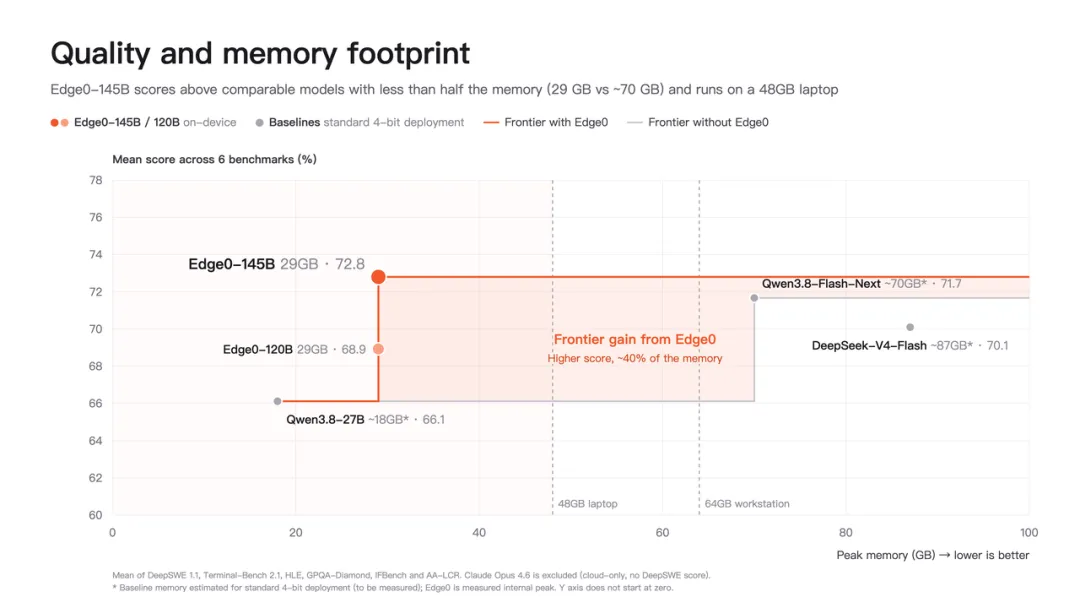
* The same or higher level of intelligence, Edge0-145B requires only about a third of memory, and a 48GB laptop can run 100 billion parameters locally.
But benchmarks are just pieces of ability, and the real world requires models to do things.
With Edge0-145B, users only need one natural language instruction to complete the entire workchain locally: first dismantle the requirements, plan the steps, rewrite the code, call the tool running, encounter faulty self-testing repair, finally screen screen the image effects, and continue to change until a fully available work is delivered. The entire process often involves dozens of rounds of planning, execution, and self-checking, which in the past was only the cloud model's preferred long-link intelligence task.
Now, for the first time, the link is enclosed in a laptop: no need to go to the cloud, no token billing, no code and data left the machine, and the disconnect can work as normal.
For example,That's what it's about.Edge0-145BProducing a video explaining the RoadsterIn this mission, Edge0-145B can independently complete technical principles research, script writing, material generation and creative clips.
In the past, the cost of making an AI video could have been hundreds to thousands of yuan, but now it's zero. It would have required editing, 3D modeling, editing, and physicists to work together for a month to produce a video in an hour.
The same ability is also used in the creation of three-dimensional scenes.
In 3D creation scenes, Edge0-145B can operate the Blender, creating scenes from text and reference graphics, adjusting materials and lighting, and continually mutating based on the rendering results. We make it generate a city model in Manhattan that not only sees pixels, but also understands objects, spatial relationships, and creation goals. In the past, the process of breaking through images, writing code, and then modifying them artificially, now the model in Blender is rendering three steps directly without leaving the site.
In terms of cost, previously man-made Manhattan-class city 3D scenarios cost around 80,000 to 120,000 yuan, and the cycle starts a month. If generated by a cloud top model, the cloud token fee is 1,000 yuan. Edge0-145B can be completed in an hour and costs zero tokens.
Based on 3D modeling, Edge0-145B can also build a whole world directly for the game.In this mission, Edge0-145B independently planned the overall design, building from scratch walls, thousands of old town dwellings, square fountains, Gothic twin towers, ribbon towers and stained glass windows in Blender, and finally painting in a fixed line of lens. In a similar scene, any pattern, shadow or distortion of proportions will be exposed to the lens.
The same task was given to cloud top models to counter: using the same prompts, the same set of reference charts, the same lens route. Cloud models completed hundreds of tools at a time, consuming hundreds of millions of tokens. Formerly artificial city scenes for a game promotional video level, art teams often took weeks, costing tens of thousands of yuan. While Edge0-145B could be delivered on a laptop, tokens cost zero.
This link can also be extended to hardware development.
In the drone case, the team's request to the model was: "Write a drone program, cross obstacles, find a red backpack". Then we saw that the model generated a flight control and visual recognition program, and the drone crossed the obstacles indoors and positioned itself at the target.
In addition to video, 3D modeling and games, we also tested more difficult tasks, getting into the workplace of a hardware engineer and designing a PCB from scratch to one.In the case of PCBIn this case, the model needsAt the same time, understanding and usingThere are two types of software:In KiCad, complete the component layout with a two-tiered runway, then import the circuit board into the virtual engine 5, set the lens and lights, and generate demonstration animations of the manufacturing and assembly process.
In the past, it took hardware engineers and 3D designers several days to complete this task; now, a computer can deliver it independently.
04
Why the Infinite Ark
End-of-the-road models are not new, and Neo Lab, which is valued at tens of billions of yuan, is already working abroad, with few papers, but few end-of-the-road models that can actually run on consumer hardware.
On the downside, this requires model companies not only to deliver one model weight. It also has to answer: what configuration the model operates under, how much memory it uses, how it coexists with other tasks in the system, and how hardware manufacturers integrate it into their products.
And this is the advantage of the Infinite Ark:
The first is the complete model product line configuration.Over the past year, the Infinite Ark has released a total of four model families, 200 models that collaborate like a human brain: Audio8 voice models that are responsible for hearing and speaking, Decision0 decision models that are responsible for thinking fast and making judgments in about 40 milliseconds; Edge0 end-side models that are responsible for complex intelligent body tasks and Vibe Coding; Embedding0 vector models that are responsible for memory.
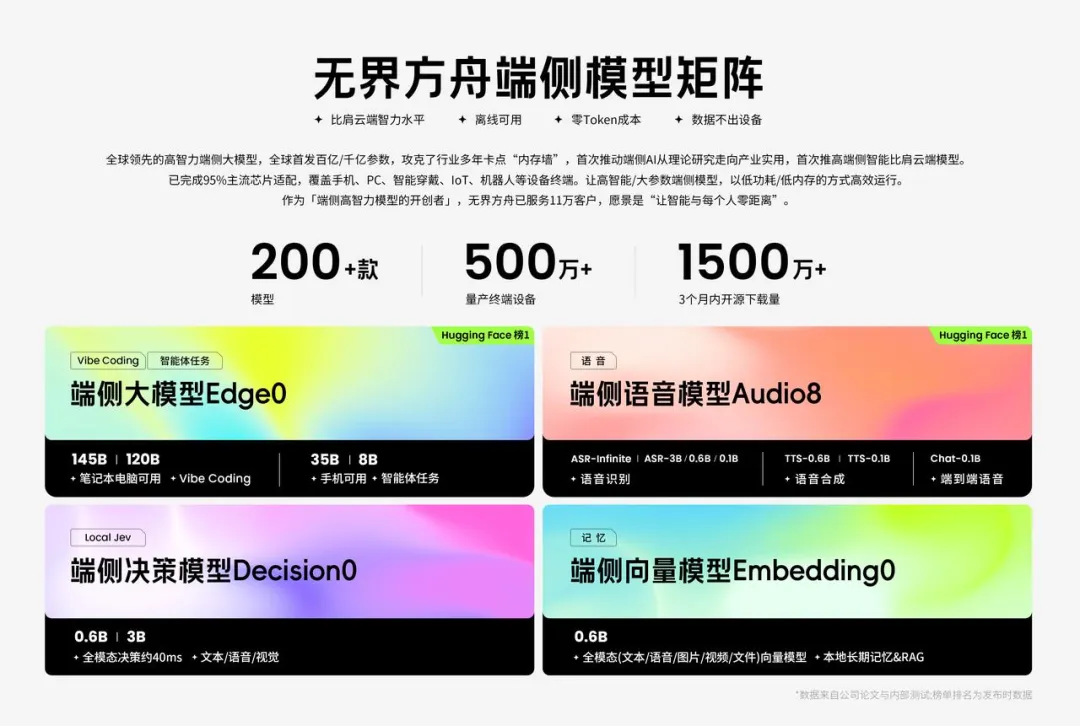
The second one is the entire pipeline.For this reason, the Infinite Ark is both an edge model and an edge frame of reasoning: from the training stage onwards, it optimizes the model for hardware characteristics, while modifying the reasoning engine to make the model run efficiently on different chips.
The third is industrial aircraft.Currently, the end-to-end market is highly fragmented, the NPU architecture of different chips varies, the support for computational accuracy for INT4, INT8, FP4, general models are different, and it is difficult to deploy the hardware performance directly.
As of now, the open-source model has surpassed 15 million downloads in three months, and Hugging Face has topped the overall trend list multiple times; as of October 2026, the number of customers has surpassed 110,000.
05
The end.
In retrospect, changes in end-to-end model capabilities may further affect the positioning of cloud models.
In the past, end-to-end cloud computing was often determined by capabilities: on-device processing of awakenings, identification and simple instructions, complex requests handed over to the cloud. Users wanted to make AI smarter, and often had to accept networking, waiting, and ongoing call charges.
As the end-side began to take on more complex tasks, the conditions for the creation of the default division of labor began to be gradually relaxed.
The first thing that will change is the need for high frequency, relatively clear, and closely related to the device itself.
Cost is their first choice of logic.
With a purely cloud-based system, every time a device is sold, there may be an ongoing reasoning expense, the more active the user, and the higher the cost of service. While the hardware is low in gross profits, the business model that relies on SaaS charges over the long term, it may not be a short-term route for members to borrow domestically. Putting the right tasks on the reverse side can reduce this part of the ongoing expense, making service costs easier to predict.
The second is data compliance.After AI starts reading code libraries, orders, financial reports, customer data, and hardware design documents, businesses are concerned not only with the quality of the answers, but also with which data needs to leave their devices. Local reasoning allows some tasks to be done where the data is located, reducing the need for uploading and remote processing.
There's also a kind of change that happens where the network is unreliable.If a device has to be connected to understand the user, its capabilities are always limited by the network conditions. This is especially true of headphones, glasses and robots: users do not expect immediate feedback because of poor signals. The stronger the lateral capabilities, the more functionality the device can retain when the network is weak or disconnected.
Cost, data, and networking have always existed. The problem in the past is that users often have to make concessions in order to get stronger modeling capabilities.Now, the level of intelligence at the end of the spectrum is starting to improve, and the choice is really on the rise.
However, this does not mean that all missions should be relocated.
From the perspective of the Infinite Ark, the border between the end and the cloud has shifted three times with the breakthrough of the AI intelligence level on the edge.
Prior to September 2026, it was cloud-driven and edge-side-side. Apple Intelligence was representative of this stage: privacy protection was done, but little could be done on the edge, and real intelligence remained in the cloud.
After the open source Edge0-35B on September 10, 2026, it became a daily task on the edge, on complex tasks in the cloud. The edge for the first time took up the high frequency, daily, need for immediate response. For example, in one headphone manufacturer, Infinity Ark has built an end-to-end cloud collaboration solution for it, with 92% of AI used through end-to-end models, and only 8% through the cloud. In wearable consumer hardware, daily conversations account for most of the demand scenarios.
After the Edge0-145B opens on November 13, 2026, the border will be pushed further.
On the one hand, clouds are dominant, on the other hand, clouds are the future, and perhaps there are days ahead.