


The main package has recently been related to research data, and also heard some numbers, expecting and more classmates to ask for advice, interested classmates can be trusted.
At last night's dinner, we discussed how data can be collected, cleaned, aligned and trained, from Ego, UMI to machine data, from human action to robot action representation, the real difficulties of cross-body migration, and the relationship between data size, markup quality and model capabilities.
The State of Robotics Data In 2027 is a simple industry market observation: who is collecting, who is buying, what data is more expensive, and where the next wave of demand will flow.
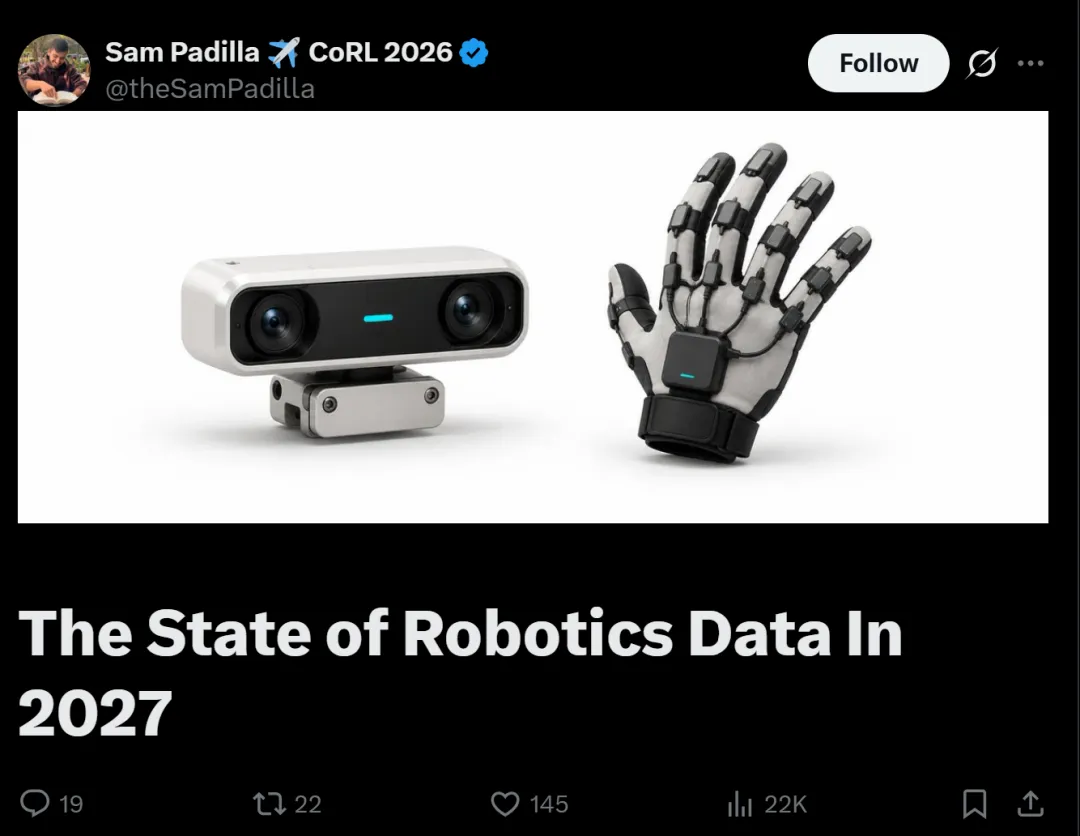
In 2027, what data labs are buying, how much they are willing to pay, and where robots' data will eventually flow.
Over the past 46 days, I've attended 180 conferences. I've interacted with dozens of investors, researchers and entrepreneurs in the field of robotics since I published a review article about @Eidon_AI.
In addition, we have reviewed 47 data producers and collected their detailed data specifications since the introduction of the @ByCrux application form.
Over the past two weeks, I have interacted with many buyers and producers in the field of robotic data.
Many of you should know each other.
Tell me what you are collecting, buying or researching, and if both sides match, I will help you draw the line.
Combined with these exchanges and the amount of research that @_varunnair and I have spent on the industry, I have a fairly clear understanding of the current market situation.
Market demand is not slowing, but the direction of demand is changing rapidly. At the same time, some players in larger, more mature industries are starting to enter.
This paper presents the current state of the robotics data industry as of November 2026, and the direction the industry will take next year.
How much is an hour worth of data?
In subsequent sections of this article, I will repeatedly mention the price of hourly data. These prices are the best estimates based on exchanges and research. Price information in this market is always opaque, so please be cautious about the following estimates:
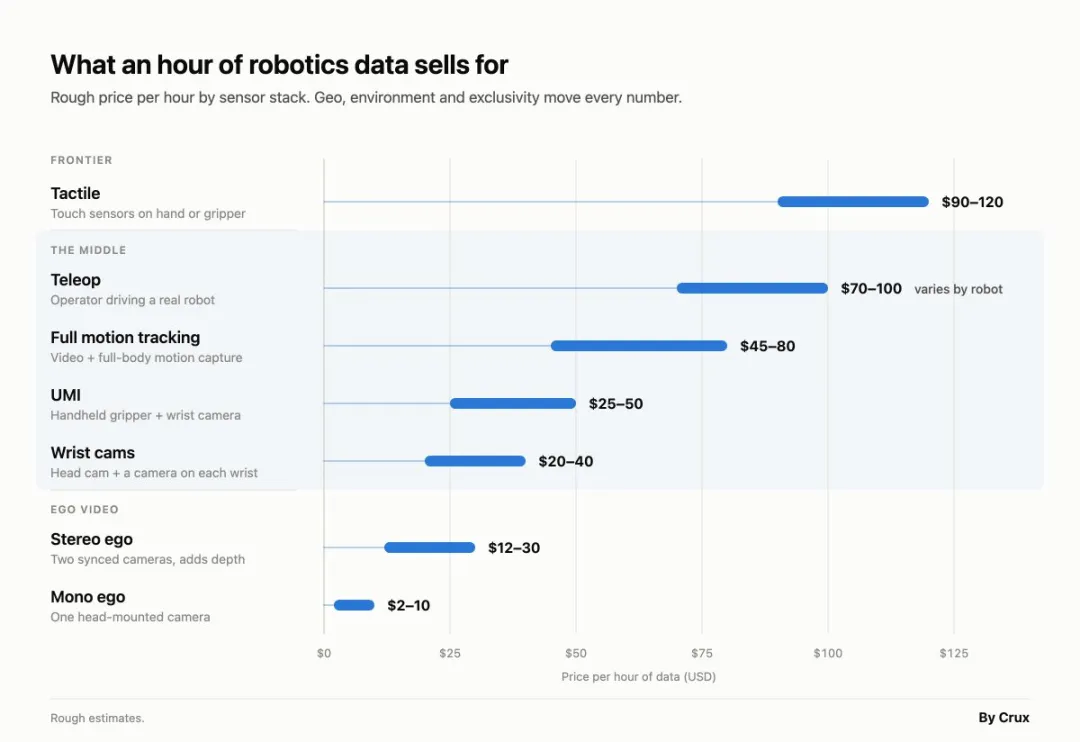
The value of an hour's worth of robot data is largely dependent on five factors: Modality, data modeling, Geos, geographic area, environment, exclusivity, and annotations.
Modality / Sensor Stack
The most fundamental goal of robot data collection is to record movements. However, the movement data required by different laboratories is not the same, and different collectors record these movements in different ways.
This difference is the biggest factor in determining the price of data training per hour. It keeps the price of data going from about $5 to about $120.
I've divided the different data models into a single level according to their roughly complexity.
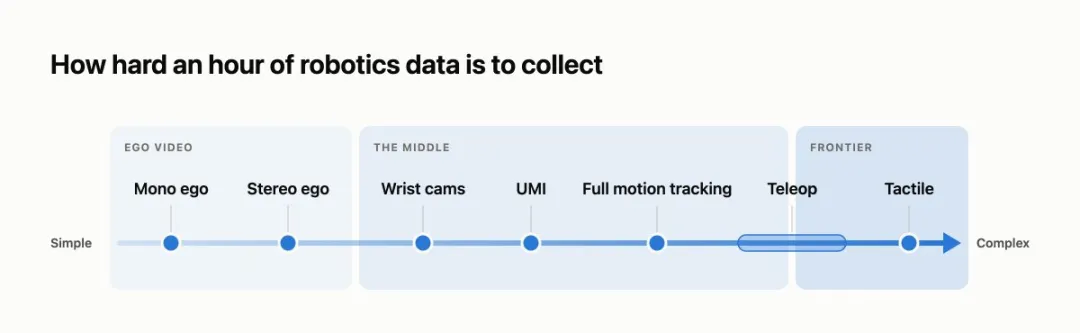
One end is Ego Video (first-person video). It is mainly divided into two: Mono (single) and Stereo (twice).
Mono uses a single camera to capture scenes, such as by attaching a mobile phone to a head restraint. Stereo requires a dedicated camera to capture scenes through two sets of different lenses and image sensors. This dual view information allows us to infer the depth of the object from the video.
At the other end of the spectrum is Tactile Data, or tactile data. Several sensing schemes that collect tactile data have already emerged. There are still a number of questions about the portability, availability and durability between the different schemes, and no tactile sensor scheme has yet gained a clear advantage.
But the industry as a whole has formed a broad consensus: touch is the next frontier in robotic data.
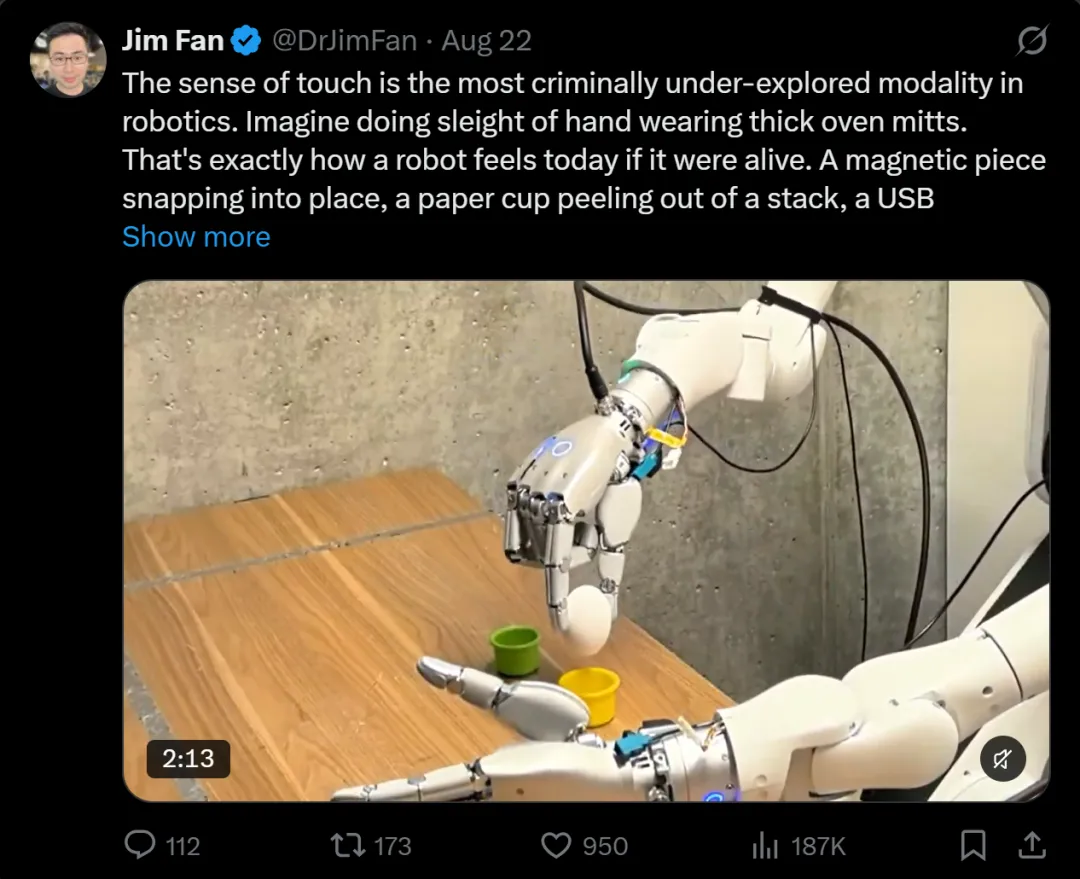
Touch is the most underestimated and under-explored model in the field of robotics. Imagine performing hand magic with a thick oven glove. This is what today's robots would feel if they had life. A magnetic part is absorbed, a paper cup is extracted from a cup, a USB...
The middle section is a combination of various video viewpoints, sensors, and data points that provide more context information for pure Ego Video.
For example, wrist cameras, UMI, handheld and clutch claw, whole-body motion data (which we collected at Eidon), and even Teleoperation, remote operation, all belong to this middle layer.
Geos, Environments, Exclusivity and Annotation
Modality determines the price range, while four other factors determine the specific prices within the range.
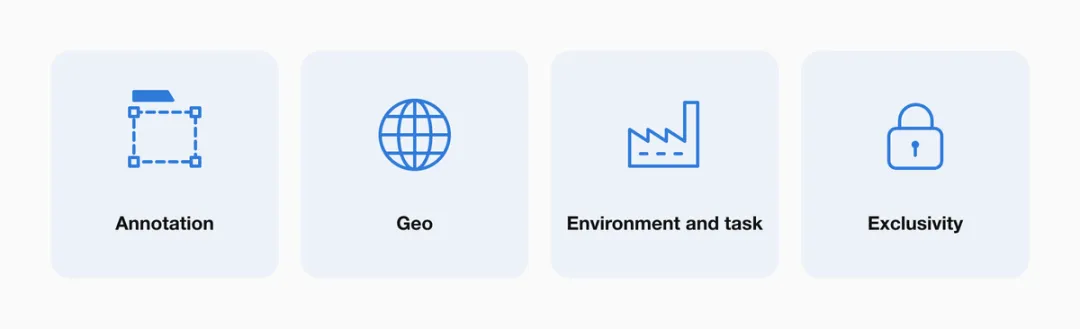
Geographical origin and geographical origin
U.S. data is at the top of all price ranges. It is the largest geographic source of market demand, as U.S. robotics companies are primarily focused on deploying to these environments.
Ego data from India and Southeast Asia are at the lowest end of the price range. Supply in these regions has been steadily declining, and the data available to buyers has even exceeded actual demand, so prices are lowest, and some buyers have stopped buying such data altogether.
Environment and Task
The data value of a business environment is higher than that of a residential environment.
Most data collection takes place in home settings. Commercial premises are more difficult to access, so videos in real work settings are more scarce and valuable. For example, HVAC technicians or electricians perform actual work.
Exclusive (exclusivity)
Exclusive data can be sold at a higher price. Buyers pay a premium while also ensuring that competitors do not have access to the data.
Moreover, a considerable number of data collection operations are currently being carried out under exclusive agreements.
I'm not sure if I'm going to make it.
Marked data is obviously more expensive than the original data.
But I found that some companies and entrepreneurs overestimated this factor. In my experience, the impact of labeling on hourly data prices is far less than most people think.
If you understand how these factors interact and how they change over time, you can start from the basics of where the industry will go next year, how market demand will change, which investment directions are not worth trying, and where the next step should be to invest resources.
Mono is dead, Stereo is for sale
Humyn Labs,CC BY 4.0
Humyn Labs,CC BY 4.0
In 2024, when we founded @Eidon_AI, the idea of getting people to pay to tie their phones to their heads and record the process of performing their tasks sounded pretty... strange.
At the time, there was a huge gap in demand for Ego Video in the field of robotics, and people didn't care where the data came from or what devices to use to collect it.
As a result, after only two years, many laboratories have stopped buying Ego Mono data, especially from specific regions such as India, China and Southeast Asia.
The market has been steadily declining, and research interests have surpassed the information available to Mono.
In the data submissions we received, Ego Mono Video is the largest data type to be supplied, far more than any other type, and its sources are highly concentrated in India, the Philippines, Pakistan and Southeast Asia.
With the exception of a handful of large-scale exclusive Mono data acquisition businesses for the US market, almost all of the Ego data acquisition companies we've contacted have either switched to Stereo or are actively trying to switch to Stereo.
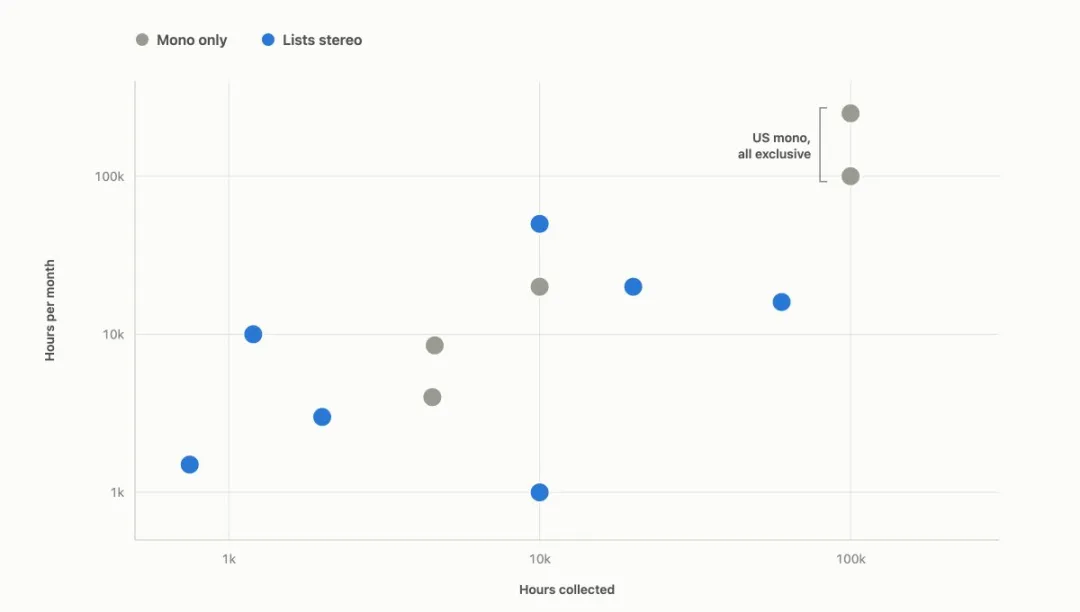
This represents a new benchmark for value data types in the industry, while significantly improving the industry's access thresholds.
Low-end Stereo cameras cost about $200 (BOM) and high-quality Stereo cameras cost more than $1,000.
Now, if you deploy a Stereo device for 100 recruiters, the hardware investment could be as high as $50,000. This is no longer the simple task of developing an app and releasing it to the App Store.
And it's because of this new gateway that the vast majority of Stereo data supplies I've been exposed to have been locked up by buyers or partners through a partnership agreement.
Many data collectors have signed rev-share agreements or exclusive agreements with buyers or partners to fund the deployment of Stereo Ego's data collection business.
About a quarter of the manufacturers we reviewed claimed to be able to provide Stereo data, but only two of them have live Stereo data available directly, with a combined total of about 1,750 hours.
Most other producers operate under exclusive agreements or on-demand procurement.
This in itself represents a good market opportunity: there is a high demand for Stereo camera manufacturers who understand the economic model of data collection and are willing to bet on the industry.
In short, Stereo has become the new industry standard, but hardly anyone can provide current data, and the market is struggling to find quality camera suppliers that meet the needs of the industry.
Tactile: The next frontier direction
Tactile is the type of data everyone is looking for right now, and it will dominate the robot data collection market in the coming years.
Earlier this year, when we were considering developing Eidon Gloves, we received a touch data offer of up to $120 per hour.
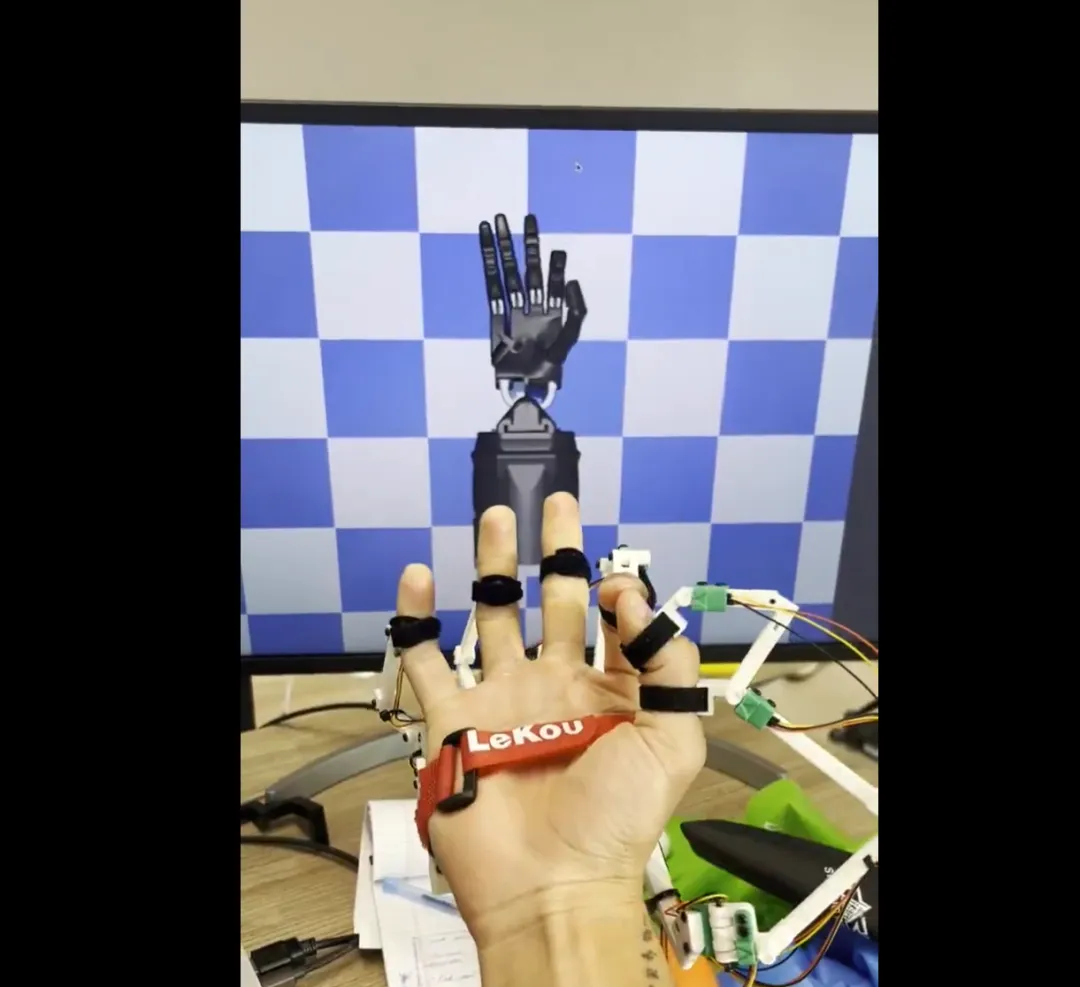
The demand is very high, but the current supply is far from meeting the demand.
Currently, touch data sets are smaller in size, mainly for research purposes, and scattered across different sensor systems.
This data can be used to fine-tune existing models (e.g. T-Rex: Tactile-Reactive Dexterous Manipulation) or to train strategic models for specific tasks.
But the distance to Pretraining (pre-training) is still a long way off.
It is worth noting that a few years ago, Ego Video data was at a similar stage. At the same time, people thought it was incredible to have enough Ego data for pre-training.
And now we have an open-source data set containing 100,000 hours of data.
Chris Paxton @chris_j_paxton · September 8th
100 thousand hours of high-quality Ego data from @bgxc and @LightwheelAI team. This is a huge contribution to the community and an important step towards being physically intelligent.
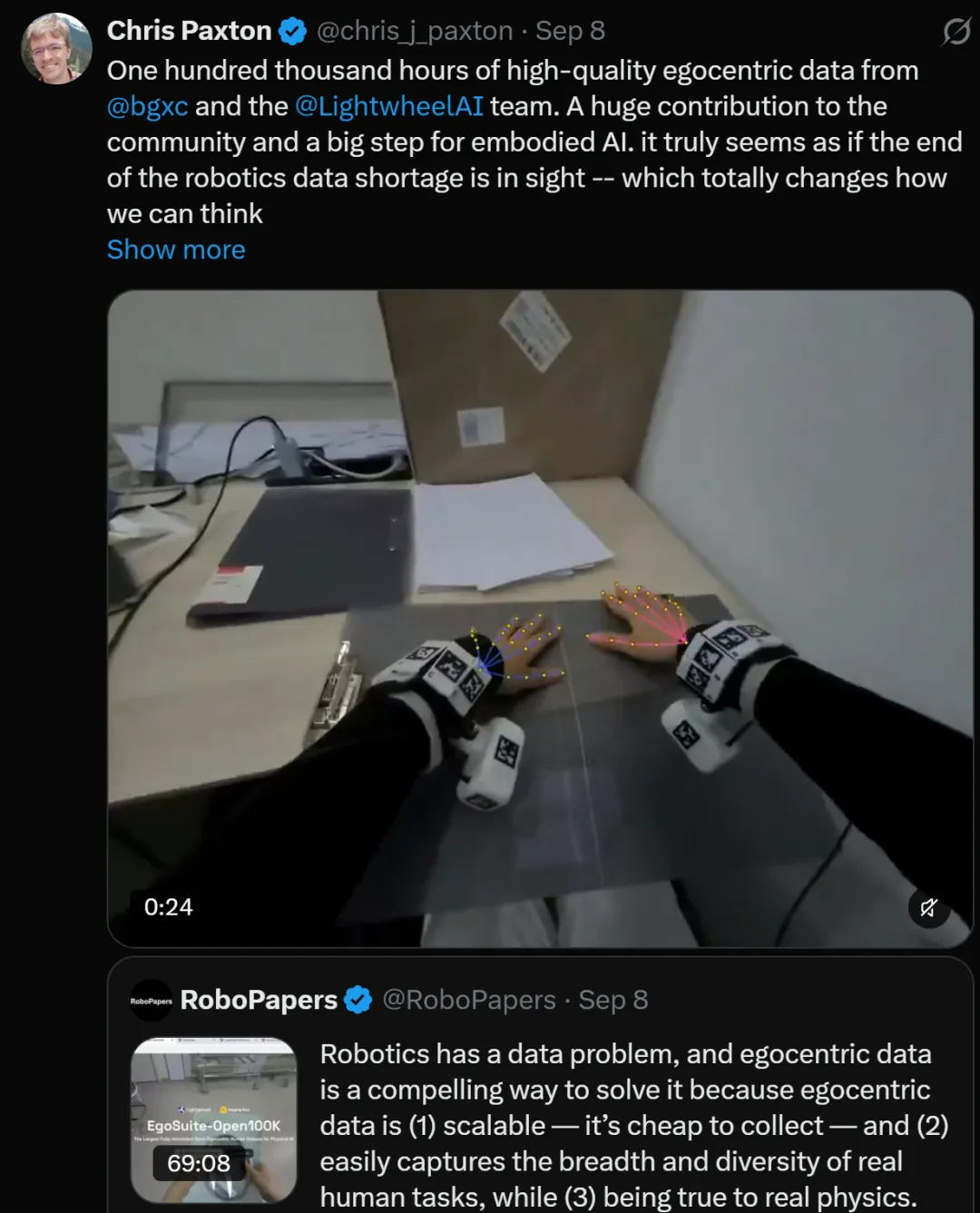
Robots face data problems, and Ego Video is a very attractive solution because Ego data has the following characteristics:
(1) Strong scalability and low cost of harvesting;
(2) to be able to easily cover the breadth and diversity of real human tasks;
(3) Be faithful to the real physical world.
Lightwheel recently...
The complexity of collecting Tactile Data is several levels higher than that of Ego Video. However, the competition for tactile data has already begun, with the goal of building the first large-scale tactile data set to support Pretraining in sync with Ego Video.
However, the field is still very new. The industry has not yet developed a unified sensor standard, and touch signals are tightly bound to the hardware that collects them.
Whether data collected by different sensors can be effectively migrated, and whether models can migrate knowledge from one sensor to another, remains an open research question.
In addition to these unresolved engineering and research problems, there are some practical issues that need to be considered.
Gloves on people's hands are usually heavier, affecting the flexibility of the hands. The durability of most gloves has not been independently tested.
The cost of each pair of gloves ranges from $4,500 to $8,000. If 100 recruiters were deployed, the hardware cost would be $450,000 to $800,000, about 10 times the Stereo cost.
According to a sales price of $100 per hour, 45 to 80 hours of touch data is needed to cover the cost of the glove hardware itself.
This has not yet calculated the cost of manpower, denied recording data, data processing and equipment maintenance costs.
Every data collector wants to claim that they're collecting Tactile silicon data, but it's not easy to do that, let alone scale it.
In addition, it is interesting that a segmental industry has emerged that mainly revolves around data collection hardware. In my opinion, this is one of the areas to look forward to in 2027.
As manufacturing expands, prices will gradually decline. But for now, the economic returns of data harvesting hardware are very attractive as long as market demand is willing to pay the corresponding price.
There's a lot more to talk about in this direction. I'll be exploring Tactile in more detail in another article.
The market is maturing
In January, Defined.ai announced at CES that it would expand its business to Physical AI data.
Shortly after the announcement, we partnered with them to sell our full-body sports data collection.
In March, DoorDash launched Tasks, a paid video app for delivery workers to shoot everyday tasks such as folding clothes, to train AI and robot models.
In addition, a number of other non-robot companies are actively engaging in this field from different parts of the industrial chain.
The size of the late funding is equally astonishing.
XDOF financed $70 million in June and is reportedly talking about a new round of financing valued at $1.2 billion.
Mecka completed a $60 million round of B funding in October.
As one of the largest providers of LLM data, Micro1 says that the robotics business currently accounts for more than $100 million of its operating rate revenue.
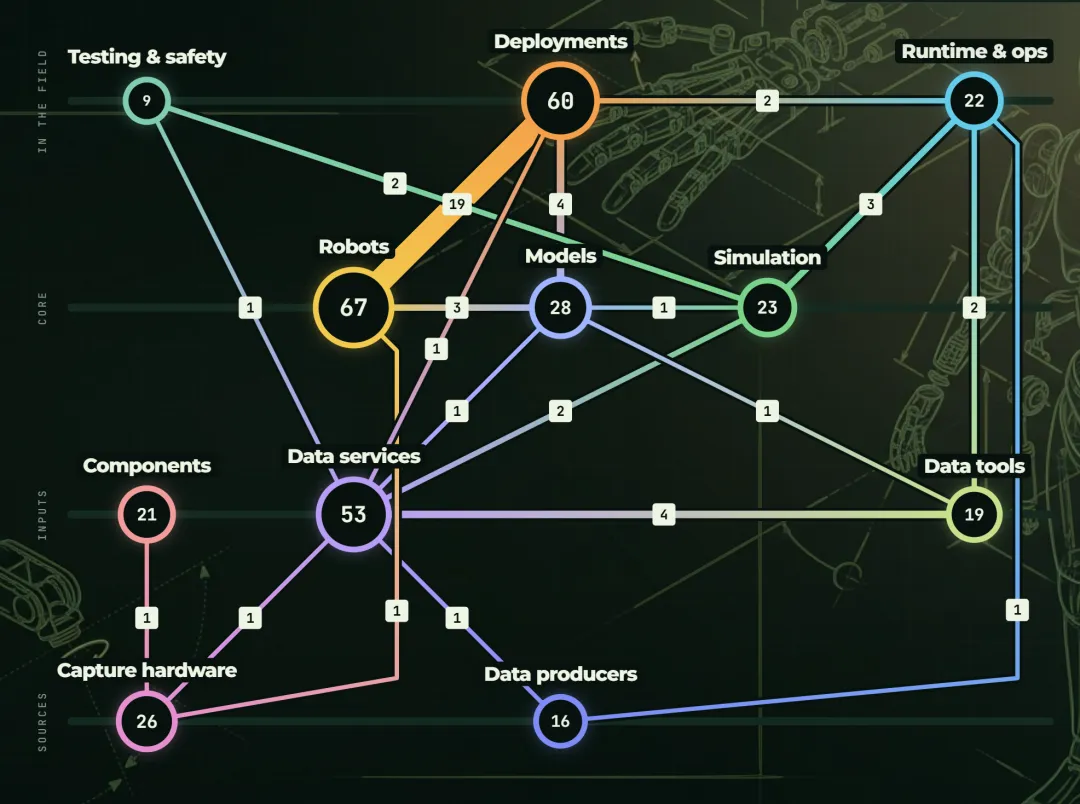
In our industry map, Data Services (data services) is the third-largest category after robot manufacturers and robot deployments.
Moreover, almost every week new participants are added to this category.
Companies that sell products and services to AI labs are also entering the robot data market.
Polyshares is a good example. Originally known for selling operational data and CAD data to AI labs, it recently expanded its brokerage network into robotics by announcing a partnership with Amelia Robotics.
This again points to a core understanding that we have gained from these 180 meetings:
The two remaining fortresses in the field of robotic data are hardware and relational networks.
All other aspects, including data processing, QC, quality control, operations, marking, data visualization, and even Sim Tooling (simulation toolchain), while having value, have become core capabilities in the industry.
As the new year approaches, I am increasingly unsure that these capabilities alone are enough to constitute a long-term competitive barrier for a company.
That's why everyone who owns a network of laboratory relationships is trying to commercialize it, and it also explains why this side of the cluster - the side of the network of relationships - is rapidly becoming crowded.
The final thought
Now there is a saying that the problem of data in the field of robotics is close to being solved.
There's a reason for this: Over the past two years, millions of hours of Ego Video data have been generated.
Today, Mono has become commoditized data, Stereo has become the new benchmark, and Tactile is lagging behind Ego Video in terms of data availability, even in 2024.
If every data model follows a similar developmental curve, I don't think the demand for Stereo or Tactile will slow down in the short term.
But in the field of robotic data, where time and money should be invested is not an obvious question.
We can look at this question from the number of hours of data needed to achieve $1 million in revenue.
If the price of Mono data was $5 per hour, it would take 200,000 hours of data to sell for $1 million.
This is a competition that relies heavily on large-scale data, but with very low and declining profits.
If the price of Tactile data was $100 per hour, it would take 10,000 hours to earn the same income.
But touch harvesting hardware has not matured, costs are high, and the actual use of touch data remains an open research issue.
However, at present, from an economic point of view, the middle class is a more reasonable investment direction.
Stereo, wrist cameras, UMI, and full-body motion capture data are the same revenue targets, requiring only about 1/4 to 1/12 of Mono's hours of data.
At the same time, the hardware required for this data is already in place and can now be deployed and delivered at a relatively low cost.
Market demand has not slowed down, but industry thresholds are rising, demand structure is changing, and market competition is becoming increasingly crowded.
The window to build a competitive robotics data company is still in place and is likely to last until next year.
But I don't think this window will last much longer.









