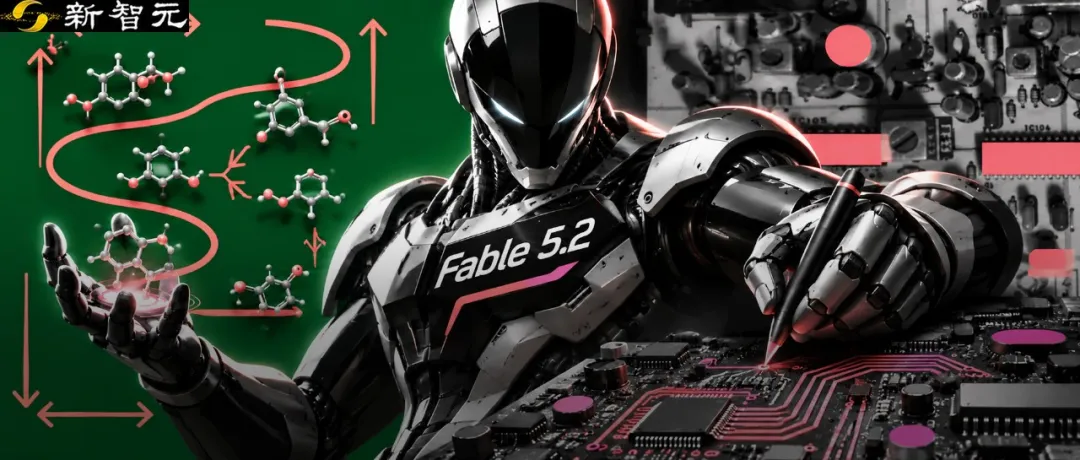
Claude 5.2 "Twin Stars" is thrown out, and the AI circle is hot!
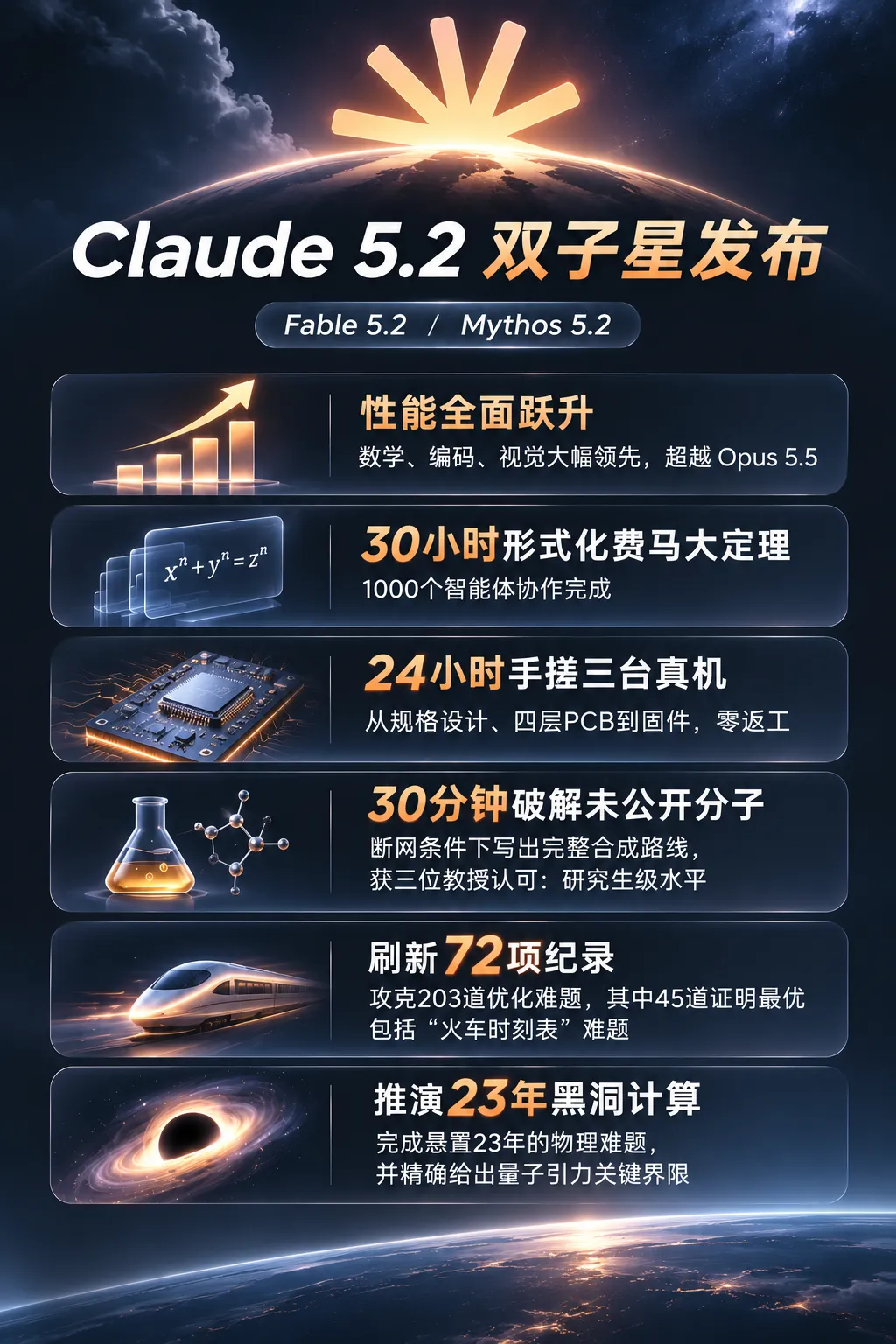
This morning, Anthropic finally released the next generation of dual flagships, Fable 5.2 and Mythos 5.2.
In less than 30 hours of formalizing Fermat's theorem, the new Anthropic kings Fable 5.2 and Mythos 5.2 have really come out of the blue!
The four official pre-release "Real War Tests", which have just been released, have put the entire engineering and technology community at a standstill.

Just give me a short word.Fable 5.2 picks up parts, paints four layers of circuit boards, models the outer shell and writes the fixtures, and in less than a day, he makes three lighting machines at a time.

And then I went back to the chemistry classroom.Mythos 5.2 was pulled from the network and connected to the small black house, and a half-hour later, the three leading universities demonstrated a complex molecular synthesis route that had not yet been published.
It has also hand-written 72 records from the International Functional Library, and even physicists who have spent years working hard in black holes can count on it.
Eventually, a 173-page paper was released, allowing physicists to stay put and say, "I can only understand part of it".
There's no denying that the Fable 5.2 wave has really exploded.
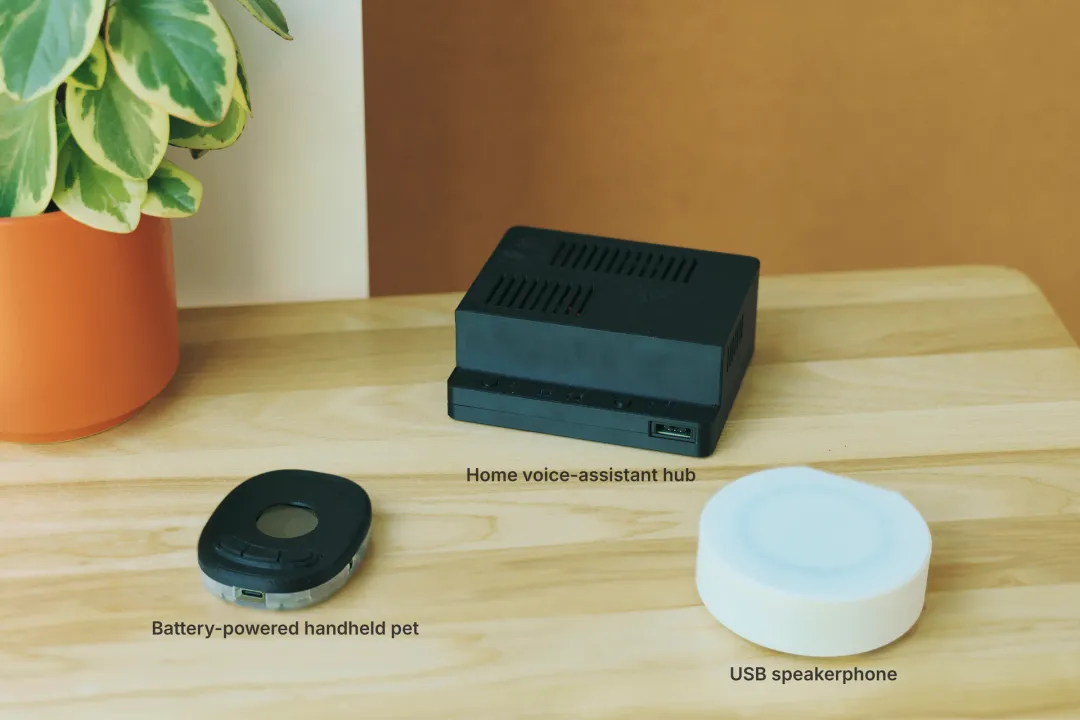
24 hours to paint the circuit boardFable 5.2 handheld three-wheel driveDuring the testing phase, Anthropic pulled on board manufacturer Diode and sent three hard drives to Fable 5.2.
The task list included a USB-free microphone, a home voice center, and a handheld electronic pet with a screen.
The suggestion given by humans is as short as a word that says, "Make a USB-C round pie with a microphone, horn and a bluetooth antenna on it".
Throughout the process, the two most frequently quoted words by Diode engineers are "clean up the principles" and "continue".
The rest of the dirt is alive and well, and Fable 5.2 is all wrapped up.
It wrote its own specification book, drew its own principles, and went to the U.S. distributor's website to pick up items.
It then packed 249 components, filled with four layers of copper wire, with 3D printed outer covers and underlying solids.
Electronic hardware is most afraid of losing it, the circuit can only pass by the line, the shutter is secured, and the microphone can't resonate.
It's all right.Throughout the design process, Fable 5.2 is like a ten-year-old hardware engineer with a compulsive illness.
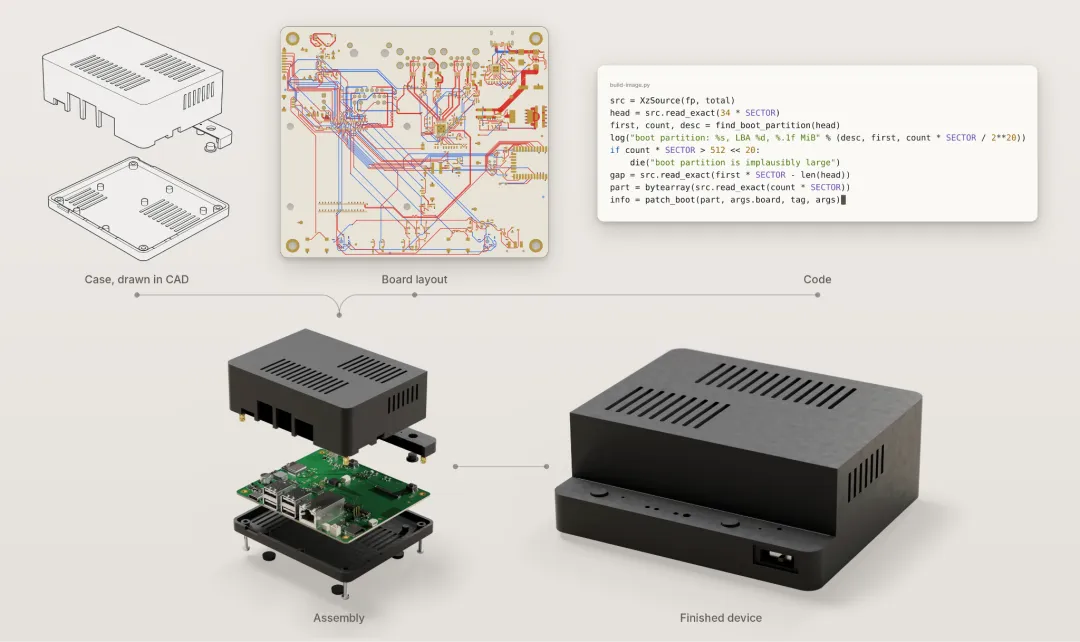
When drawing the voice center main board, it refuses to open source software KiCad wiring that can only connect one line at a time.
It just stopped working for half an hour, wrote a set of grid automatic wires, laid a long line for a second, and encountered a sensitive signal line that could actively rotate distant points!
Fearing that the speaker would be burning too loudly to exceed the USB power limit, it also buried a concoction in the solid, and the higher the volume, the more the LED lights would be automatically dimmed to save electricity.
Three design drawings were made at the manufacturing plant, each of which took less than 24 hours to design, so that electricity was turned on all at once, with zero switching and zero return to work.
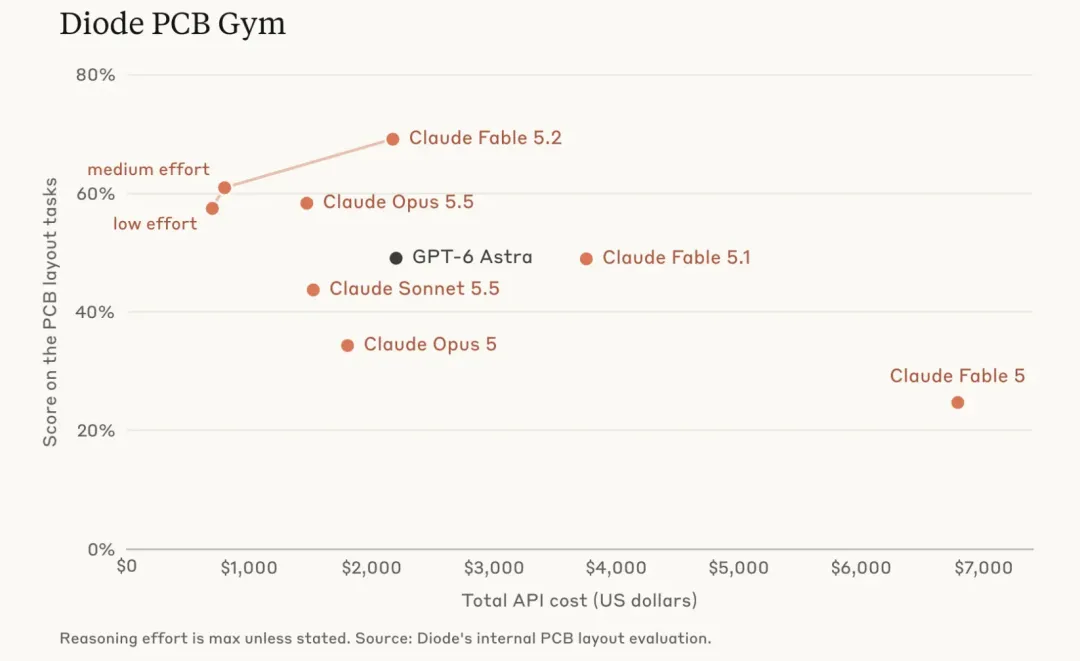
In the internal layout test at PCB Gym, Fable 5.2 scored 69%, a far cry from Fable 5, which was only 25% six months ago.
Open hardware benchmark BenchCAD 2.1's self-report score also climbed to 83.5 points, nearly double its predecessor's 44.4 points.
 Remove the net.30 minutes to blindly push four unidentified molecules
The next test was a complete synthesis of the burning brain's organic chemistry.
The "synthetic pathway" designed for complex molecules is a step-by-step process, like the next few dozen steps of a blind chess, whereby a complete set is lost.
The subjects were three top synthetic chemists from Stanford's Noah Burns, Yale's Timothy Newhouse, and California's Sarah Reisman Laboratory.
The four target molecules they came up with, all of which were press box topics in their lab that had not yet been publicly developed, ruled out the possibility of a model "back-to-back-to-back-to-back" library.
Of these, Stanford's GDGT-4 is the most difficult to digest, with the 68-membered ring attached to 22 manual centers, and the Ph.D. thesis will be completed in 2025.
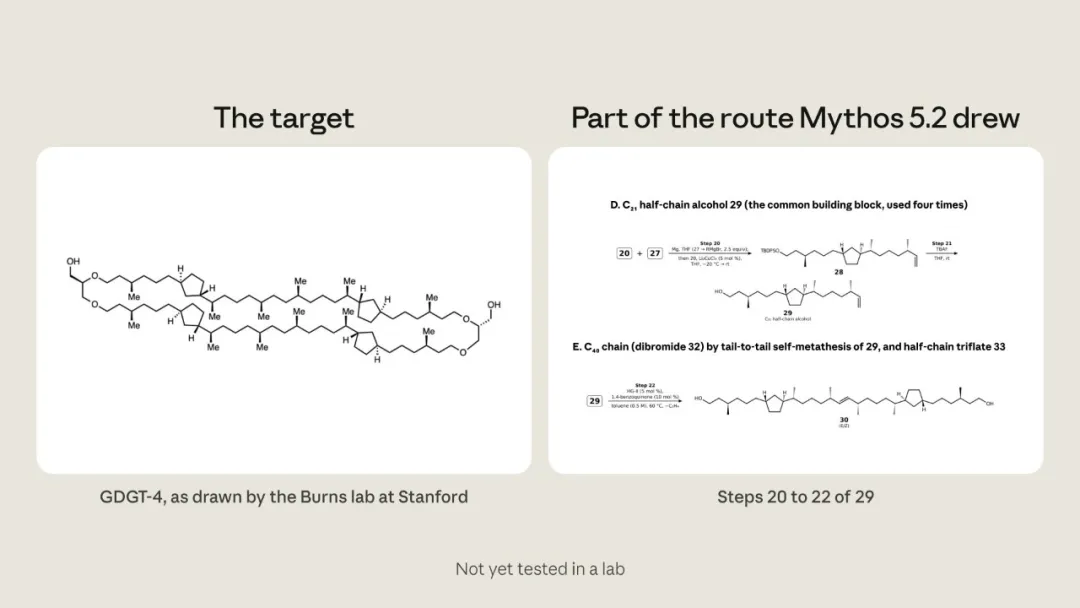
The rules of the site are rather rigid, giving only one molecular structure chart, removing the grid, prohibiting documentation and reaction databases.
The only model that can be used is a local code tool, with only one chance of rolling each question.
The pre-release version of the same model, Mythos 5.2, takes about half an hour and less than half an hour to deliver a complete route of 26 to 35 steps.
One of the tricks was to write the code "self-examination" while performing a performance.
The model uses the local RDKit library to build a three-dimensional model of the atomic nucleus, with each atomic pair aligned, like a chemist's pinch-ball model, to see which side of the nucleus is not blocked.
Once a reaction is found to be capable of causing acid to destroy the molecular structure, it replaces the reagent on the spot, actively spinning out some of the most easily overturned steps and preparing a replacement.
Although these routes have not yet been used in wet vents, the three professors gave a unanimous assessment of "a student's level of synthetic chemistry research" after a blind test score.
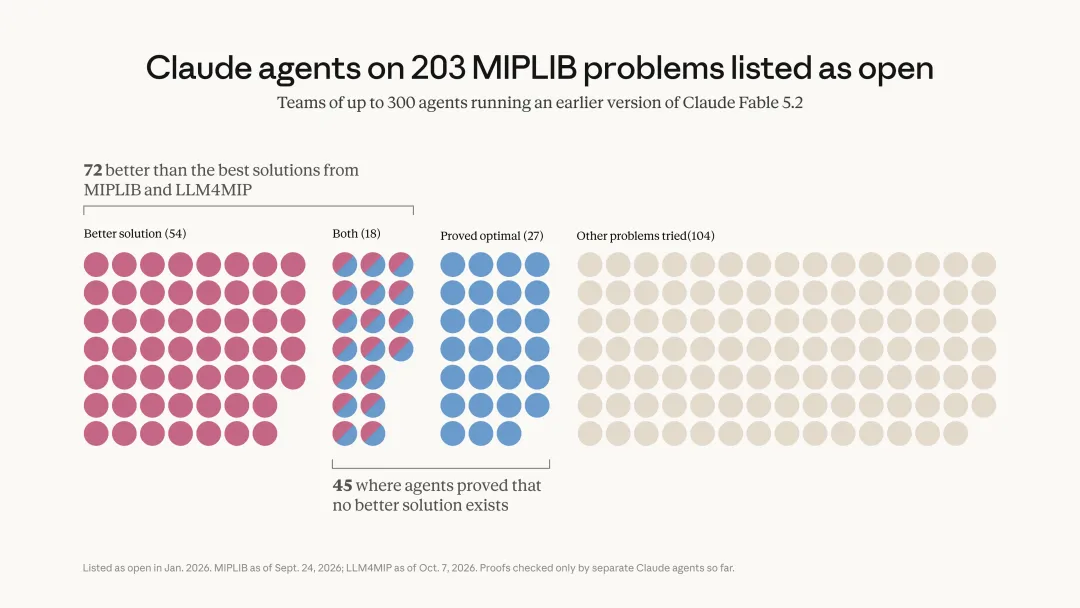
A breath of fresh air to set 72 recordsEnding the difficulty of the train timetableOut of the chemistry lab, up to 300 teams of Fable 5.2 Agents entered the classical campus of MIPLIB in the field of operations research.
Since its inception in 1992, the library has been equipped with real business hardware, such as driver assembly, class logistics truck scheduling.
More than one plane or one truck, the combined number of explosions is in the index, and there are hundreds of ways to prove the best solution to the "Chenyang hangover" in the yearbook.
When the new edition of the book went online in 2018, the Committee for the Preservation of Nature also specifically appealed to the global academic community for help.
This time around, Claude picked up 203 hangings.Hardin-Jones has broken the all-time best record of 72 questions, and 45 of them have been proven to be the best in mathematics!
One of the most picturesque questions is to arrange timetables for 42 trains.
Several trains would be pulled out of a scary electrical peak if they were to accelerate the start of the electric fence at the same time.
In less than two hours, Claude Agent produced a new timetable that was 2.6% below the peak power of the best program in the history of the puzzle library.
Subsequently, it added rigorous mathematical proofs confirming that there is no longer any more energy-saving emissions in the world, replacing the old problem with a "conclusion" and returning it to the official database.
23 years of computational difficulty in black hole physicsIt's all over.In the field of theoretical physics, Fable 5.2 is a breath of fresh air that pulls out two long-standing nails.
As early as 1983, Hawking and Don Page figured out that when the larger theoretical universe warms up, black holes will suddenly form, like burning water bubbles.
But once changed to a very small scale, in a microcosm that can only be described by quantum theory, this "mutation" is no longer present and becomes a mental illness of the physical circle.
In 2003, physicists invented a test algorithm that looked at a positive negative number with three quadratic coefficients that was too large to calculate and had not been calculated for 23 years.
Fable 5.2 takes this hard work and calculates the coefficient as negative in two separate ways, with a fixed tone confirming that black holes in the microcosm have suddenly appeared!
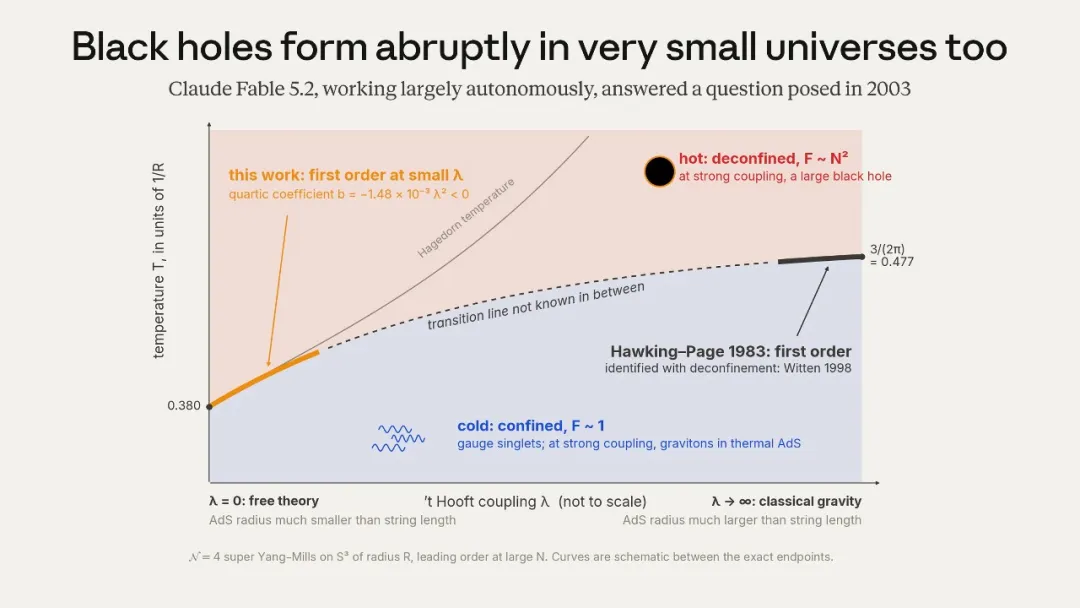
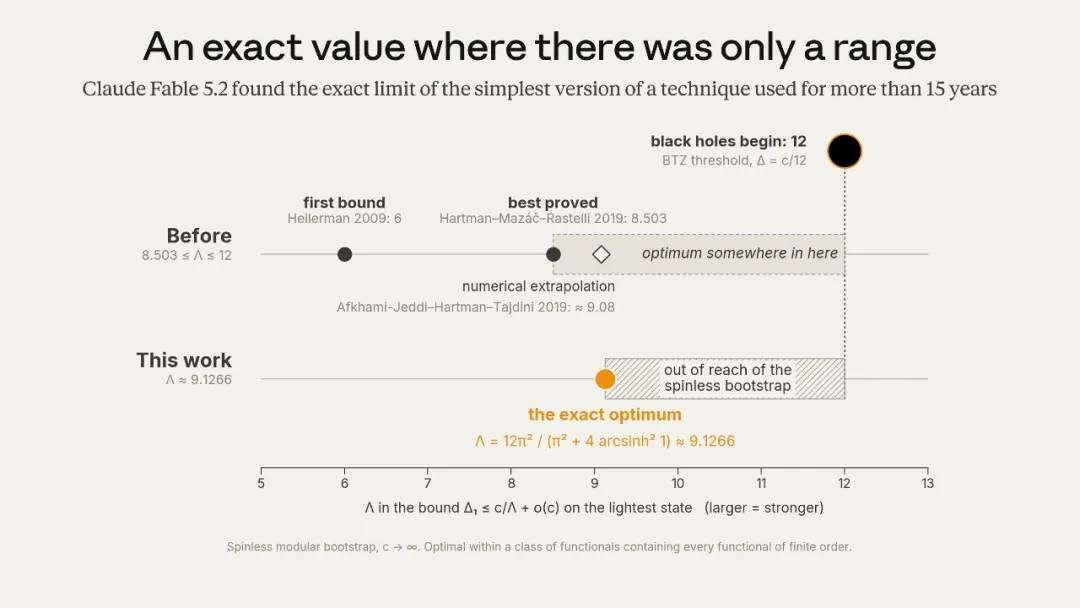
The second question is aimed at physicists using a 15-year-old tool called "modeling", which is specifically used to dispel the hypothesis of unstable quantum gravity in the theoretical universe.
Over the past decade, we've only known the simplest version of the border card is between 8.503 and 12.
Fable 5.2 released a 131-page pre-printed edition that pinpointed the precise resolution at approximately 9.1266.
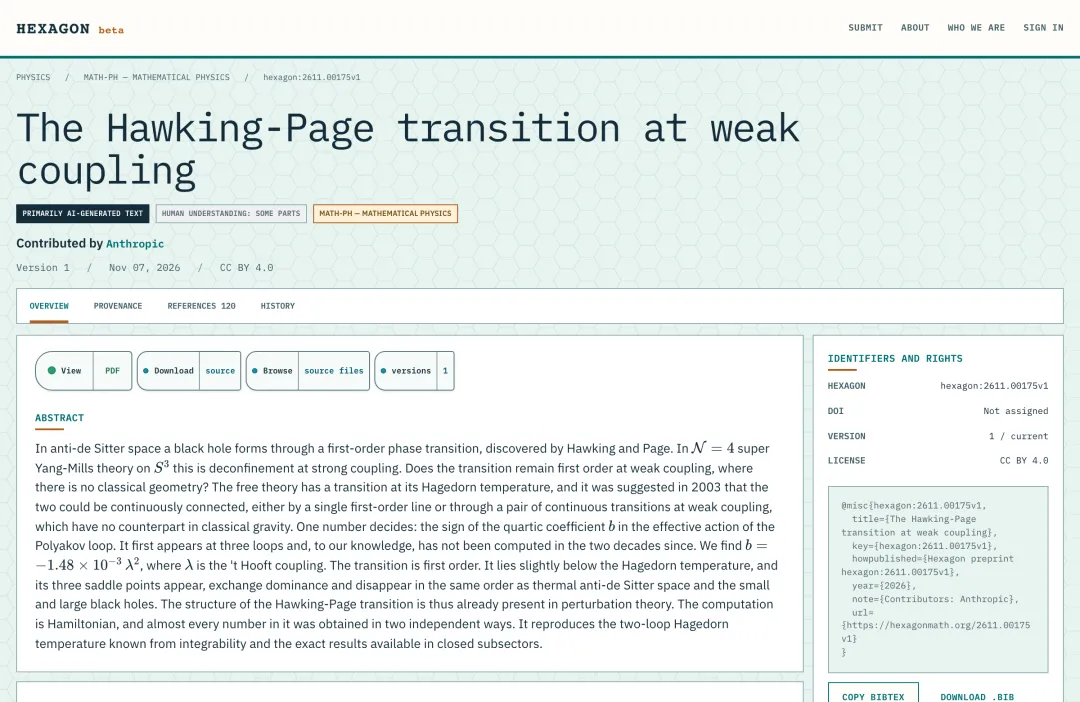
The most curious scene appears on the publication page of the paper, where the two combined 173-page physical pre-prints have been double-attached to the Hexagon platform.
Anthropologists can only put a label directly below the title, "The extent to which humans understand, only a part of it".
 This time, 5.2 is really silent.
This time, though not Fable 5.5, the 5.2 release of the scoreboard is scary enough.
After several years of molecular synthesis, Ph.D. Ph.D., it cut off the net for half an hour. Physicists put 23 years of hard work behind the black hole, and it was written into a 173-page paper.
In the past, it took several professional teams of electronics, structure, chemistry, and physics to work hard for several years, and a model began to fail from end to end.
Of course, the three hardware prototypes have not yet passed commercial safety certification, and the four-molecule synthesis routes also lie on paper waiting to be tested in the vents.
The digital world's drawings and projections have been turned upside down...
The next most exciting thing was to open the door for them to get into the real physical world.