


If a robot learns to have a lineage, it's called RoboLineage.
A traceable evolutionary chain
To teach a new skill to a robot, it is often necessary to go back and do many rounds: collect samples, train models, run tests, and then continue to adjust according to the results.
However, in real work, this information is often dispersed in different people's records and different tools, which is why the first round does not necessarily lead to the next round.
Organisations such as the Hong Kong University of Science and Technology have proposed RoboLineage, which allows intelligent agents to organize and advance the complete process of robot learning according to a common set of working standards, and leave each round of evidence, judgement and results to follow-up work.
The relevant paper has been collected by the International Conference on Robot Learning CoRL 2026.

Let the smart body take over the whole learning process
Collecting, reviewing and training are often the responsibility of different people. What to do with the task, what records can be used for the training, and what scenarios to complete the next round will depend on their own experience.At the same time, someone is concerned about whether the action is completed, someone is more concerned about the end result; changing an operator may also change the way judgments and records are made. The team needs to repeatedly adjust these arrangements to get the job done.It is important that the entire process follows a common working standard. The intelligent body combines the execution of images, task requirements and historical records to understand the current situation and to call on data processing, training and evaluation tools to complete the work at different stages.
RoboLineage takes this idea through the whole process: from robot access to tasks, to organization collection, data review, training preparation, to model version management, evaluation, and the next round of arrangements.
Each intelligent organism must make it clear what it is responsible for, what inputs it reads, what results it delivers; when making judgments, it must keep the basis and also explain the uncertainties.
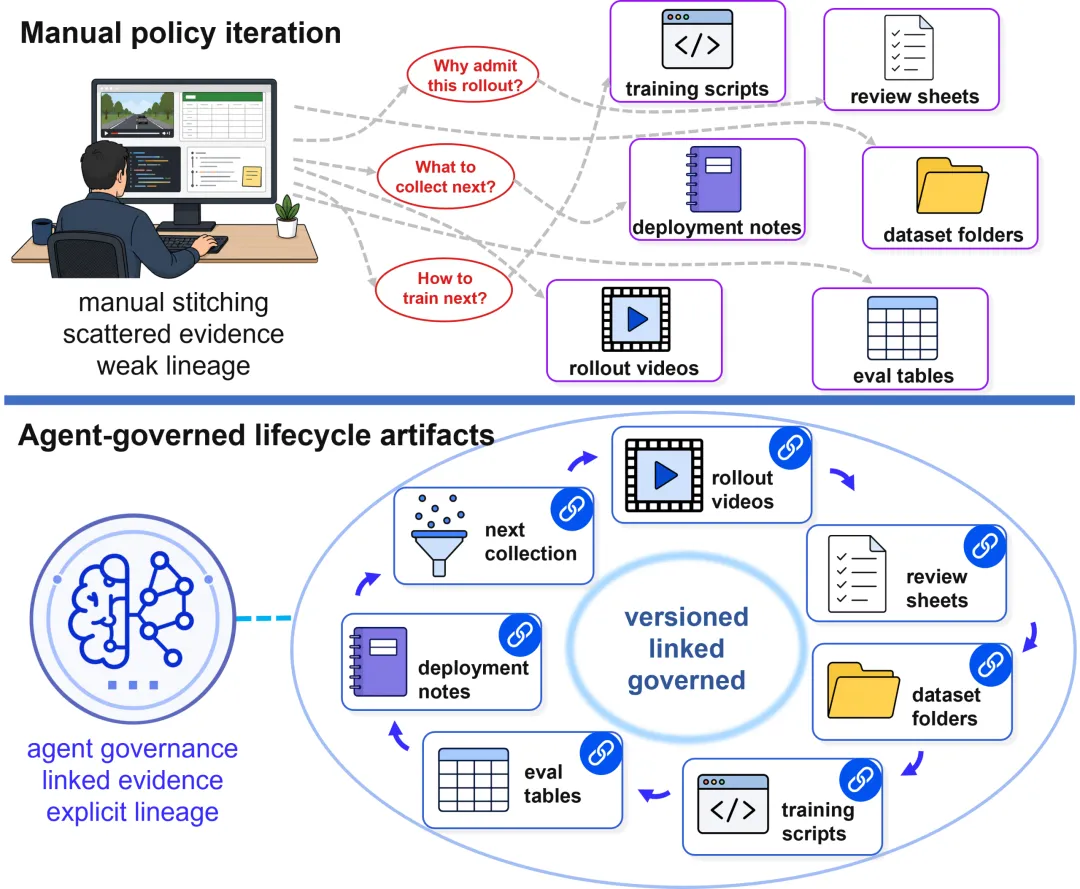
▲I'm going to tell you a little bit about this.It's a great way to get started.
With this arrangement, different tasks can still retain their respective success conditions, and different robots and learners can use their own configurations and adaptations.
At the same time, a consistent approach is used to determine how the data is recorded, how the data is qualified for training, and how the training results correspond to the model version.
 Lineage connects every step of the way to memory
Each phase has a common standard and needs to know what each other has done. To find the corresponding execution of the results of the review, data selection to find the basis of the review, training, model and evaluation must also be linked together.
RoboLineage connects these works to a continuously updated working state, so that smart bodies at each stage can read, update, and bring in the next round.
This is exactly what the name lineage means: where a result comes from, what processes it has undergone, and what it affects.
Along these lines, corresponding training data can be found from a model, where the data came from, why the training was authorized, or from a failed test to look at the training background of the current model and its previous improvement processes.
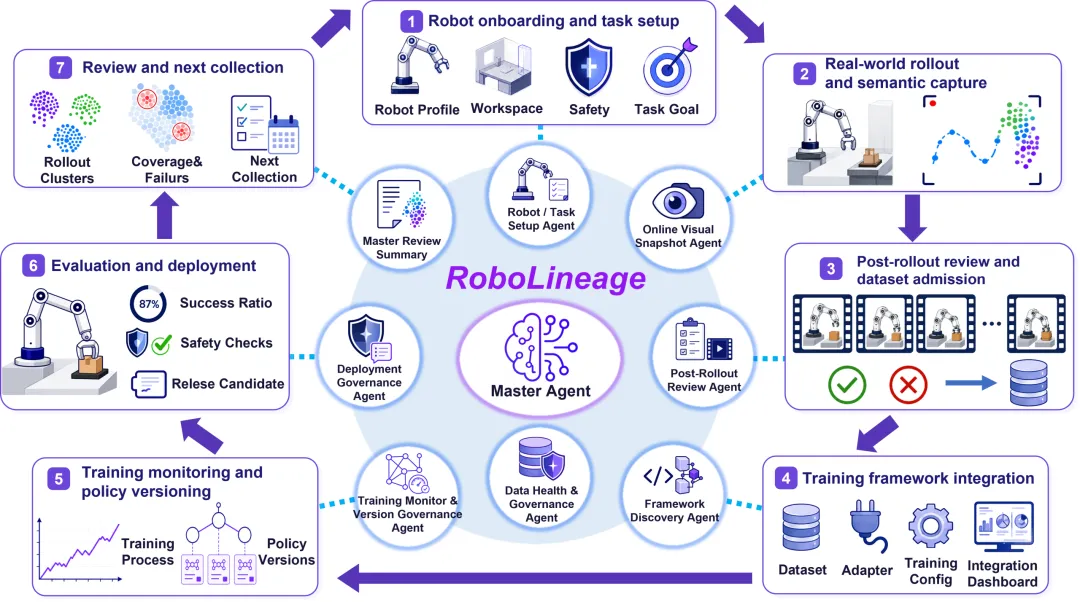
▲Figure 2 is a map of the paper system.It's a great way to get started.
These contacts also determine how the follow-up work will continue.
Before each round of training, the system fixes the selected data and associated configurations; the trained model is associated with the current input; the training record is associated with the model version it inherits. When the data is converted to the format required by another learner, the link to the original record is retained. The test results are then associated with the corresponding model and become the basis for judging the next step.
On this basis, the Master Agent summarizes the current state and past history, organizes the issues to be resolved, and makes recommendations for the next step.
This shared learning experience at different stages also forms the backbone of RoboLineage: judgments and results from before can continue to be used by later work.
 From one execution to available training data
The first question to be answered is whether this data is worthy of training.
In the case of overlapping blocks, the robot has moved the blocks to the top of the target, which may still slip when released. The middle looks smooth, but the last few blocks may change the review conclusion. Judging an execution phase, it is necessary to understand the task standard, execution process and final state at the same time.
RoboLineage will execute the processing arrangements of the recordings on three lines: continuous collection of the original image and the state of the robot; online visual snapshot smart body (VSA) marking the critical movements and risks; asynchronous review and re-combination of the critical segments, final status and pre- and post-processing after the completion of this collection and online processing.
When the response of the model is slower, the original collection is still carried out as usual, and asynchronous review can overlap with subsequent collection.
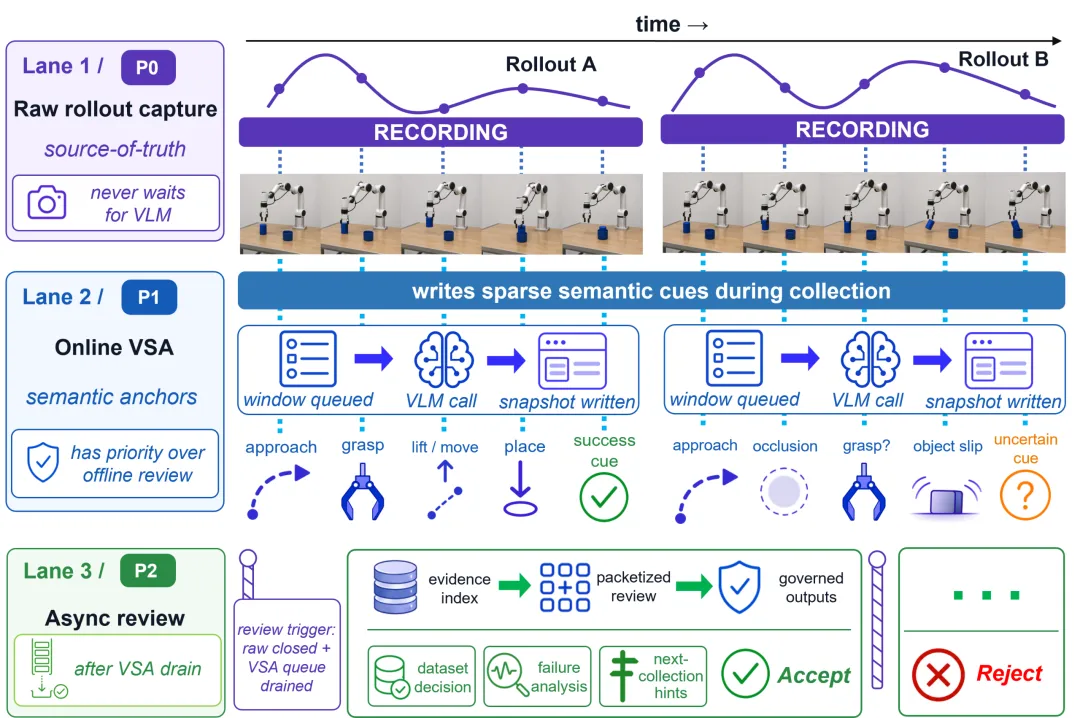
▲Figure 3: The three-line mechanism of the paper.It's a great way to get started.
The execution results are processed separately from the use of the data.
Censorship leaves conclusions and evidence, and data governance decides whether to incorporate training in accordance with the rules of the task. Evidence is unclear and records are handed over to artificial replication; failures with diagnostic value can be left in the failure pool for analysis of gaps and provision of replenishment. Thus, a failure can also leave useful information for further learning.
The same standard of work extends to training and evaluation.
The smart body checks the data formats required by the learner, prepares information for adaptation, tracks training with model versions, and then organizes test results. Strategic training is still done by the existing learner, and the selection, input and results in the process remain related in the lineage.
Operators view these tasks through the front end: reviewing the execution images, examining the evidence cited, reviewing or modifying the use of data, and preparing training, comparing models and checking replacement adoption recommendations.
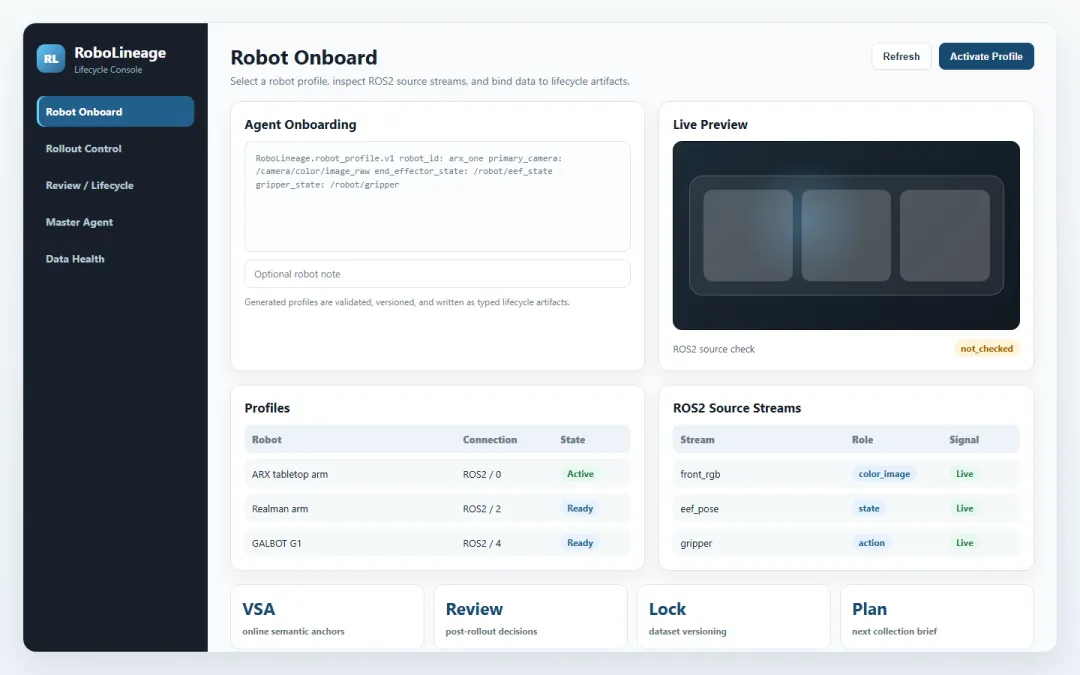
▲Figure four: Operator desk.It's a great way to get started.
 Common processes and how to test in real missions
The paper examines the process on three sets of robots and existing learners: the ACT style strategy on ARX, the Diffusion Policy on Realman, and the VLA/LeRobot style workflow on GALBOT G1.
The task involves scenes such as seizing, placing, operating containers and pulling open the container.
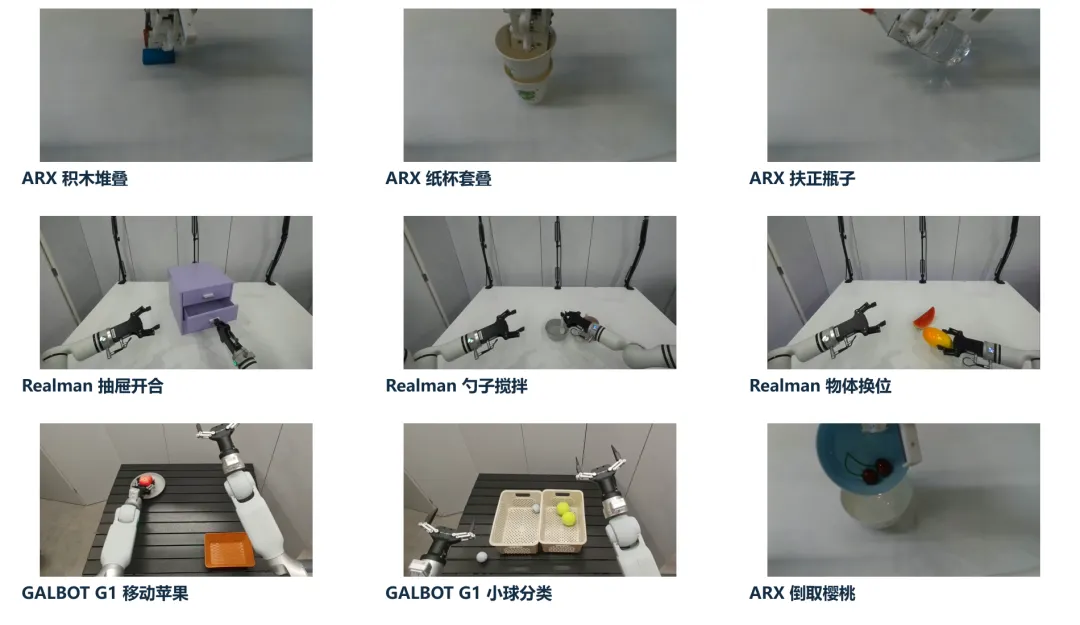
▲Figure five: The real mission is nine.It's a great way to get started.
The first thing that needs to be checked is whether the system can reliably judge data usage.
On a benchmark of 25 tasks, 500 execution records, according to results prior to operator modification, the entire system's expert consensus on the use of forwarding data was 96.4%, and direct video review control was 79.6%. Among the 194 execution records that experts judged should be rejected, the percentage of misplaced main training sets decreased from 16.0% to 2.1%. Both methods use the same execution record and review model.
The way evidence is organized also influences judgments.
Only when the output format is restricted, the error rate is 11.3 percent; the focus check on the final observation and end state is removed at 6.2 percent; the visual snapshot is combined with the original snapshot for a single review; the split-out processing is cancelled at 4.6 percent. The entire system is at 2.1 percent. These mitigation results support evidence processing in the process.
After judging for reliability, we'll look at how much human labor is required for daily replacement.
After completing robotics and training framework access, 12 groups of pairs of experiments processed 30 execution records per round. The time required for manual input before training decreased from an average of 130.2 minutes to 54.3 minutes, reducing by about 58.3%. Physical acquisition time is basically the same, saving mainly from review, access sorting and training preparation. This measurement includes actual operations and blockage waits, with no one-time hardware access, adapter development modeling and GPU training time.
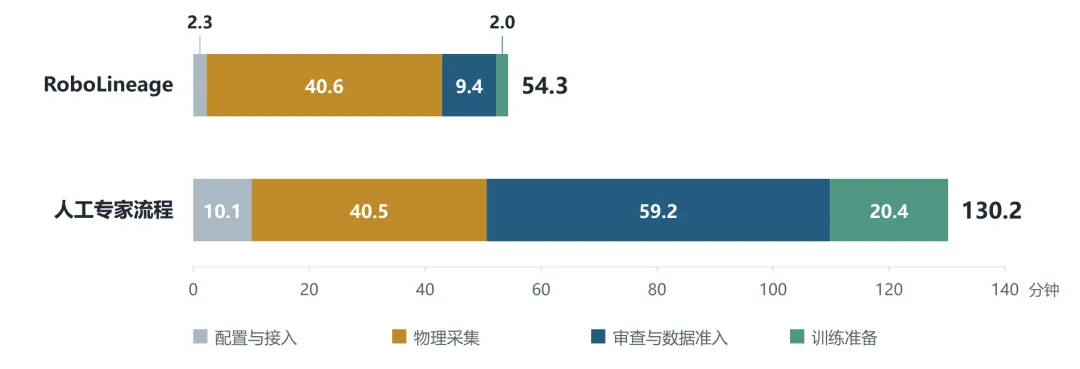
▲Figure 6. PPT 15 is a comparison of working time.It's a great way to get started.
The data collected will also be needed to support further training.
In eight missions, each task used the same set of 100 candidate records, 60 samples for each of the two processes, the same training setting, and 60 tests for each. The average success rate for the AI process and the RoboLineage process was 93.1% and 92.7% respectively.
 Learn how to use experience to help your next round of learning
After the successful completion of one round, there is a longer-term question: can the previous experience make the next round less difficult?
While current failures indicate where the model is still poor, the previous rounds of records can tell the system which scenarios have added to the data, what changes have been made to the model since then, and what problems have not been solved.
Examples of piles of bricks show this change.
Initially, the failure was concentrated in the initial position of insufficient coverage, which needed to be complemented by successful sample grabbing of these positions. After grabbing improvements, the robot would be able to loosen hands in advance when not yet stabilized, so that the focus of the grabbing shifted to alignment, stop-stability and release. Later, the remaining difficulty would turn into a delayed loosening of the clavicle, which would need to be supplemented by timely release and clean evacuation of the sample.
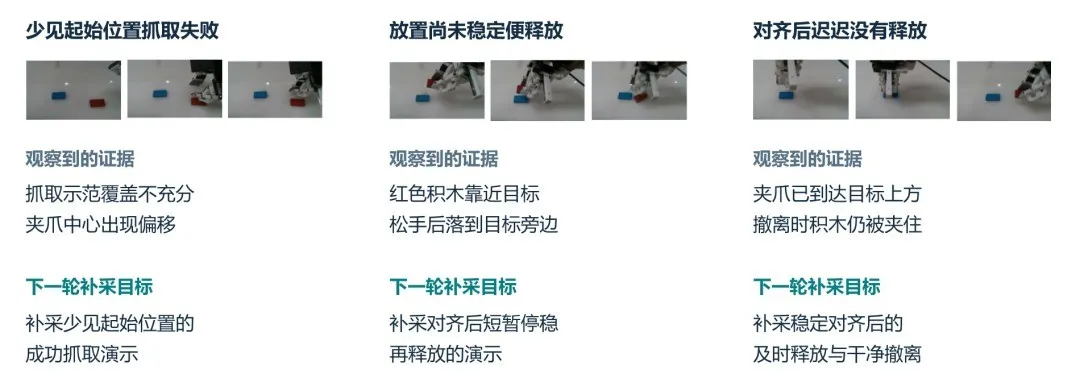
▲Figure 7 Failed to make the cut.It's a great way to get started.
The study examined closed-loop adoption on two tasks of building stacking and drawing. Each method performed three separate runs, each three rounds; each round added 30 licensed training samples, and failed with 30 diagnostic test analyses.
Among them, one controller uses only this round of information: it also retains a visual snapshot of the current round, reviews and data coverage summaries after completion, but does not read the results of the evaluation of the previous round, historical data status and previous models. Based on the final test averages of three independently run blocks, the controller's success rate with RoboLineage was 70.0% and 83.3% respectively; and the open draw was 66.7% and 78.9%, respectively.
The experiments also compared methods such as random replacement, failed-phase replacement, and manual expert guidance as a reference. In both of these tasks, the cross-cycle history assist system chose a more efficient replacement direction.
▲Figure 8 is a close-up of results.It's a great way to get started.
The learning process itself can accumulateCurrently, the paper evaluates review and routine processes on three groups of already configured robots and learners, and verifies routing through two missions. Operators are still involved in reviewing uncertainties and confirming key decisions; migration of cross-mission experiences and long-term autonomous operation require further verification.
As the task of robot learning increases, iteration accelerates, and how to organize this process will also be part of capacity building.
RoboLineage enables intelligent agents to work together according to common standards, and lineage connects each judgement with relevant data, model versions.
At the end of one iteration, the remaining bases, choices and outcomes can still be involved in the next learning.
The paper is entitled: RoboLineage: Agent-Native Data Lifecycle Governance Across Robot Policy Iterations (CoRL 2026)
Written by Qian Luo, Wentao Guo, Zhennan Qin, Nanchun Guo, Yunhan Zhao, Yi Ma, Yanchao Yang
TranscEngram, the University of Hong Kong, the Beijing Institute of Technology, and the University of Hong Kong.
Link to the paper:https://arxiv.org/abs/2606.22142
The main page of the project:https://robolineage.github.io/









