


This is a typical pain point for the precise assembly of the earpiece demonstrated by the Thousand Robot at WAIC this year. It is very easy to deviate from the cardboard when placed inside the earpiece. The robot detects edge collisions, gestural deviations and small slippages in real time through visual touch sensors, thus completing autonomous positioning, steady positioning and dynamic deviation correction.
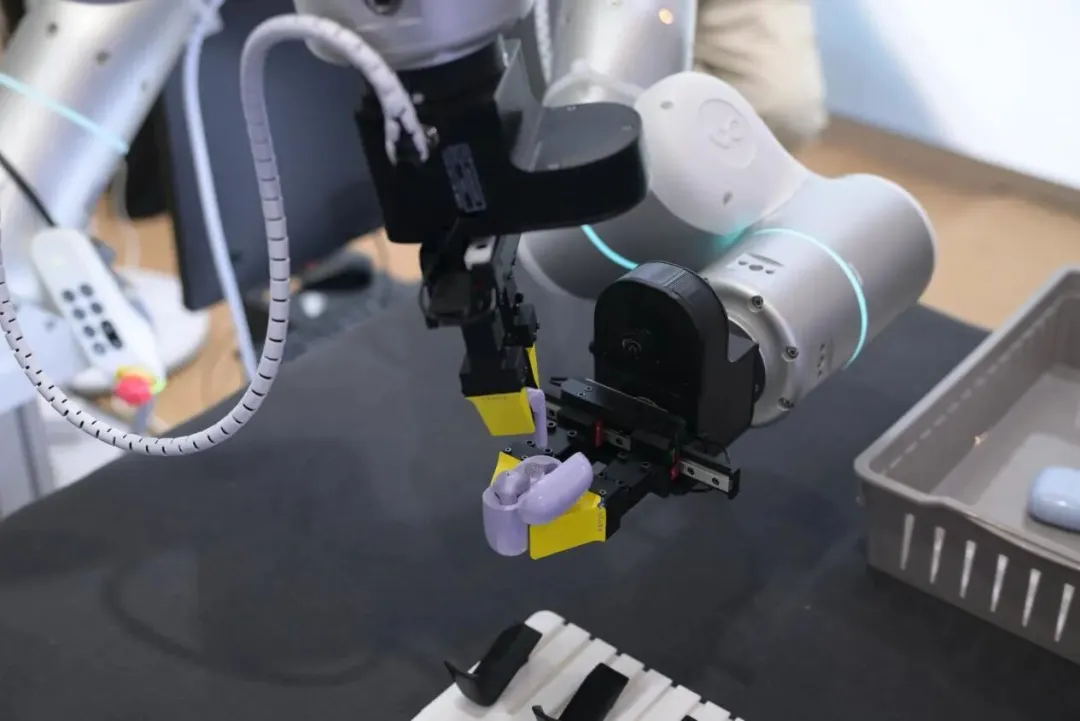
Image source: Thousand Thousand Robots
In mobile phone production lines, touch sensors have also entered the phase of mass production application. For example, the application of touch sensors in the co-axis wiring process of the Xiaomi phone, the wiring connector is equipped with touch sensors, and real-time perception of force and displacement by multiple modules can both prevent the pinching of fibrous strands and ensure that the connector is in place.
Similarly aimed at this scenario are AI robots, which work in close collaboration with AI models, AI robots carry out POC verification in areas such as 3C precision manufacturing and flexible manufacturing, high-precision operations tasks such as handling flexible objects, precision assembly and customization operations, promoting AI models and touch capabilities in real production environments. The value of these processes is not only in achieving precision operations, but also in significantly reducing the marginal cost of production line types.
In a multi-variety, small-scale production model, the device is extremely cost-effective. If the robot can rely on touch feedback to achieve flexible adaptation, cost and time savings for customers, it is the most direct reason to pay for touch sensors.
Food processing
For food factories, the introduction of robotic improvements in automation is not new, and various types of food-grade industrial robots, and connecting robots with collaborative robots are rare. But these devices are mostly focused on rough links such as sorting, coding, and transportation. Once deep into front-end processes such as food cutting, precision processing, and other processing, artificial operations are still mainstream in the face of different shapes, soft hard and fragile materials, which provide an excellent landing stage for touch sensors.
He picked a highly representative differentiated scenario for the extraction of small lobsters. In the long run, the processing link for small lobsters is highly dependent on manpower, not only because the cost of manpower is high, and the consistency of production is difficult to guarantee, while the core premium of the lobsters is precisely whether or not they can fully retain yellow, because the price of specialty lobsters with yellow is 2.5 times that of non-yellow products.
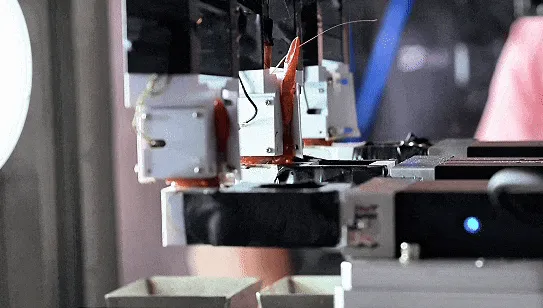
Image source: he mountain tech
To this end, he developed specialized intelligent dehumidification equipment for dehumidification using real-time integration of visual and touch dual-mode data, which will increase the dehumidification success rate to 95% and retain mercury in its entirety.
Japan's FingerVision will ship robots with touch endings to cooking factories for use as ingredients and soups.
In the ready-to-eat packaging scene, ingredients are numerous, irregular in shape, easy to break and frequently changed. FingerVision's flexible finger tips are embedded in marking points, the camera tracks the location of the marking points, in exchange for power and slippage.
Food factories' consideration of touch sensors is full-dimensional, and not only must they be tightly sewn and tightly sewn, but they must also meet the requirements of hygiene compliance, ease of cleaning and high beat, which directly determine whether the touch sensor program will remain on the production line for a long time.
Automotive manufacturing
In many of the processes of automotive manufacture, the automation of the embossing and coating workshops is already high, but the assembly workshops still have a large number of man-made jobs. The assembly faces of the beams, seal bars, interior pieces are more flexible, whether the card buttons are attached, whether the plug connections are fully locked, whether the seal bars are attached, hand sensing feedback from the hands of all workers in the past, now these links also provide new landing places for touch sensor companies.
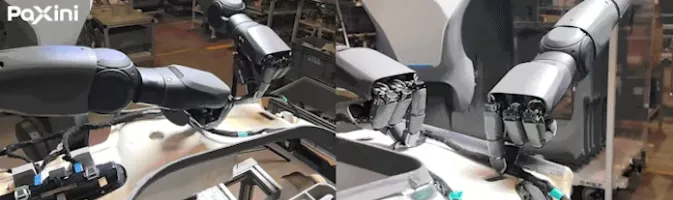
For example, in the case of Pasini, the two core processes of assembly and fastening of wires in the assembly process became the focus of Pasini, and TORA-ONE, a multi-dimensional touch human robot with multi-touch sensors, has been installed at the Shenzhen manufacturing plant in Chile.
During installation, the robot grabs flexible cables with multiple fingers in synchronization, performs perforation and fine tuning based on multidimensional feedback at the terminal insertion stage, and senses resistance changes to complete the plug-to-site calibration; at the adhesive link, the robot dynamically adjusts the pressure according to the body's curvature, material and friction state to avoid excessive squeezing or sticking stiffness.
This is the first time I've seen this.
The data provided by Pasini is: 8 hours of continuous operation with zero abnormalities, a 99.8% success rate, which can fill a manpower gap of about 30%. And the touch can perform both operations and quality checks at the same time, whether the terminal is in place, previously confirmed by hand sensing and retraction by workers, can now be directly verified by force-point constraints.
This business logic is now being extended to a larger automotive manufacturing system, and in August this year, BYD signed a strategic partnership agreement with Pacini to collaborate on the assembly line, focusing on highly hand-held cartridges, graphite, plugs and fasteners.
By introducing more than 15 new models a year, the overall assembly line takes an average of less than nine days to replace a new process, and the traditional demonstration programming + rigidity curing model is unreliable at extremely high change frequency and must rely on tactile sensing flexibility to adapt to rapid transformation.
At this year's WAIC, the first technology showcased the intelligent claws of touch sensors, which can sense the touch and fine-tuning angle in real time during the process of grabbing and installing, achieving 100% accurate installation without damaging the car connector.
In the car battery pack plug-in scenario, the first technology, through the touch feedback program, shortened the time from 100 seconds to 15 seconds, twice as fast as the man-made. It is easy to see that the more frequent the car assembly line changes, the more flexible the parts, the more easily the value of the touch sensor can be magnified.
Manufacturing of cosmetics
The production of everyday products such as make-up, bananas, and other products is generally faced with the challenges of bottle bulk, large material ranges, and frequent replacements in small batches. Such movements as grabbing, spinning, and placing rely heavily on the tactile feedback of skilled workers. For single fixed bottle types, rigid fittings and traditional automation schemes are well established; however, once product styles are updated, fittings must be redesigned and control procedures rewritten, making it difficult to balance costs in small batch orders.
In the production line of one of the world's leading cosmetics ODM manufacturers, the Apple Robot combines mechanical arms with touch sensors to capture, rotate, sort shapes and materials in a variety of bottlenecks, based on real-time touch feedback adjustment of grip strength and operation.
For the generic ODM plant, the difficulty of production is far more than the bottle itself: fragile pies are very easy to leave fingerprints in contact, and the candlestick core is soft and roughly uneven and belongs to the traditional soft materials that are very difficult to process by automation. The common characteristic of these materials is that the standard for lightweight bottles only existed in the past in the perception of skilled workers.
Touch sensors convert this abstract sensing cuff into precise force control parameters that can be executed by a robot; changing a product requires only the use of different parameter packages, without the need to replace the physical equipment.
Validation and research
In addition to industrial manufacturing, commercial identification and scientific experimentation involve a strong need for touch sensors to protect the credibility and authority of the end result.
For example, the AI identification robot, built in conjunction with the Thought Robot, successfully brought touch into the authentication link of high-value goods. After the mechanical arm grabs the sports shoes, the soft hardness and microscopic shape of the shoe surface and shoelaces are perceived by visual touch sensors, and the shoelaces are removed and restored without damage. The collected touch data can be accessed in real time by the object's self-development verification identification system, which can generate identification reports in about 5 seconds.
Shoe removal may seem like a simple move, but it is directly related to the business logic of identifying the business: if the wrong operation causes the shoe to break, the goods will not be able to return to the customer as they were; if there is a small deviation in the mechanical perception of softness, the conclusions of identification may be false.
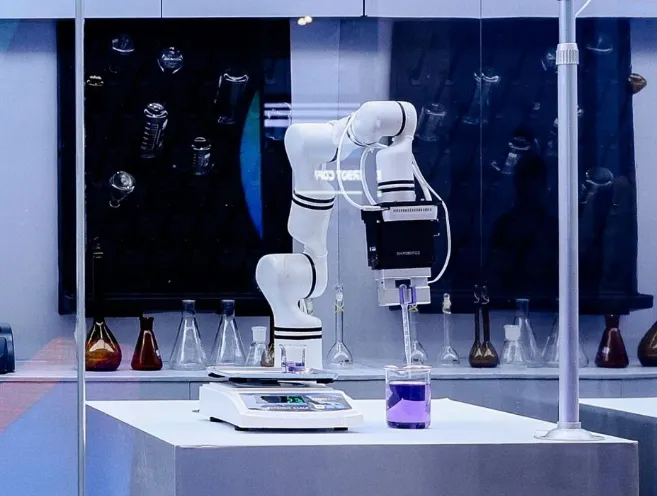
Image source: The first is technology
Scientific experimental scenarios are equally logical, such as the perception of tiny displacements of liquids in the hands of the experimenter is extremely demanding: holding the drop tube tightly can lead to more squeezing of tiny liquids, the slipper is easy to slip, and minor operational errors can lead to the discarding of the entire set of experimental data. In the first demonstration of technology, the claws of integrated visual touch sensors can accurately perceive the area of contact between the drop tube and the tips of the fingers, the power state and distribution, and the milliseconds of sliding detection and gesture correction during fluid transfer, ensuring steady grabbing.
The boundaries of touch and imagination
Despite the key to breaking the boundaries of tactile application, there are still certain scenarios that have not yet been touched by tactile technology.
For example, in heavy-duty industrial situations, such situations place extremely high demands on the impact resistance, durability and calibration of sensors. Currently, flexible touch sensors have inherent short boards on both the durable and large-physical calibration scales, which are still dominated by high-precision six-dimensional sensors, special heavy-duty fittings and industrial vision guidance programs.
In addition, real-world scenarios that take full advantage of the advantages of flexible multi-finger collaboration, hand-in-hand adjustment, are still to be developed. Although there are more and more flexible hand schemes with touch sensors in the exhibition, there are not many continuously running touch-finger schemes in customer factories, and the mainstream landing mode is still dominated by two/three-finger claws with touch sensors.
It has taken decades for manufacturing to give machines the ability to control visual detection and movement, and touch sensors are the core experience of many workers, who are now making a breakthrough in the commercialization of touch enterprises.
This huge market eventually belongs to the enterprise that can turn hands into data: the experience of a teacher who is collected, copied and mutated while appearing in hundreds of jobs.
On December 15-16, 2026, the award ceremony for the Golden Ball of the High-Tech Industry Robot, organized by the Institute of High-Tech Robot Industry (GGII), will be held in Shanghai Airport at the Kaiyut Hotel in Shenzhen.
At the multi-modal perception exhibition, industry leaders from Silicon Valley will explore the key issues surrounding the technological closure of the silicon industry's physical intelligence, the fusion of silicon touch and vision, language, motion, silicon sensors from silicon to silicon and what's wrong with silicon.
Welcome to the two-dimensional codebase link or scan below.
* Article cover for AI mapping









