


In the latest issue of RoboColiseum's weekly chart, MXI-SimWorld ranks first overall with a score of 0.9656, space understanding, and general operators.
When large models began to enter the physical world, how to make robots understand instructions, perceive environments and complete operations became an important topic in the field of physical intelligence.
On November 11, RoboColiseum officially released a new edition of the weekly list, which shows that as of 12:00 noon on November 11, 2026, the MXI team, under the leadership of Prof. Zheng Zheng, of the Beijing University School of Mathematical Sciences, is using the framework of physical AI.MXI-SimWorld v0 Preview, by0.9656The RoboColiseum's overall scores are based on an assessment of physical intelligence.Number one overallThe MXI-SimWorld v0 Preview also has no shortcuts: Space Understanding, General Operations, Command Following, Disturbing Adaptation, and All four dimensions are in the top two.
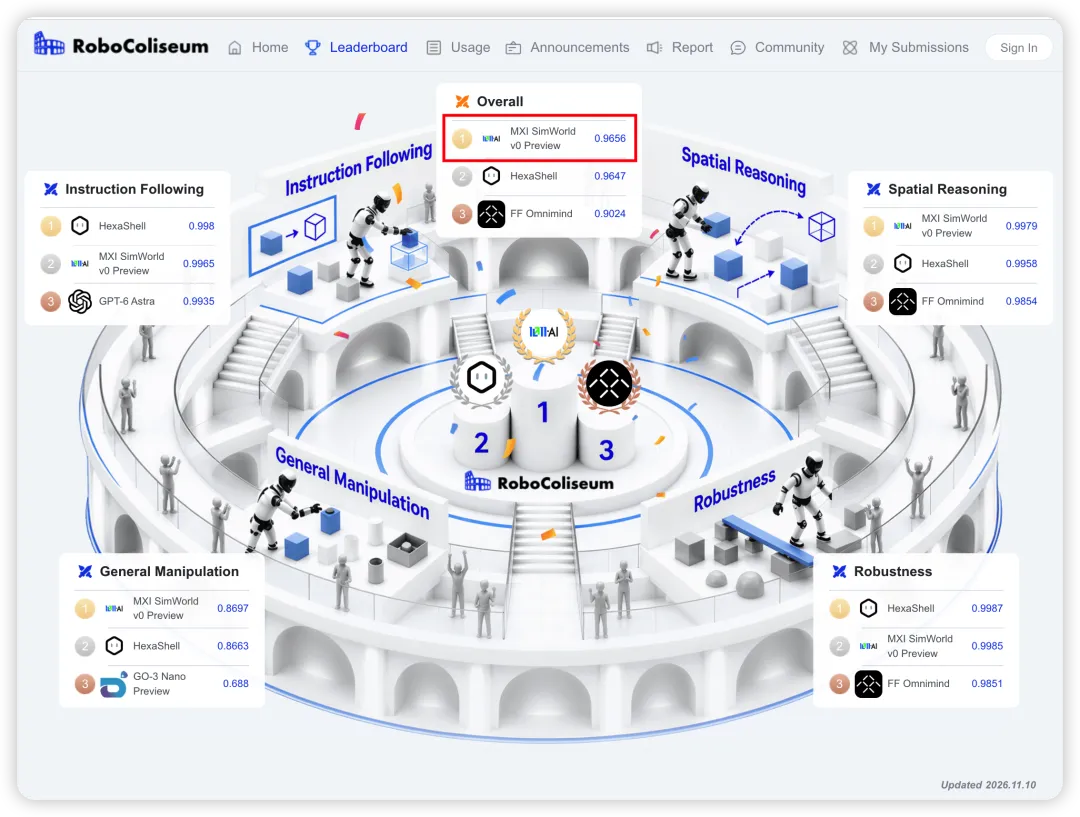
Robocolisuem overall list as of 11 November 2026 Source: Robocoliseum
As an authority assessment platform jointly launched by Hugging Face, NVIDIA, Qingdao University, and nearly 20 universities, businesses, and research institutions around the world, RoboColiseum is currently the most gold-containing virtual machine benchmark in the field of physical intelligence. It rejects paper brushes, avoids adaptation through rigorously isolated rules of field automation mechanisms, training sets and test sets, and covers both distributed and out-of-distributed double-blind testing, with the final evaluation results being close to 90 percent correlated with real robot performance, with the same model having less than a 10 percent difference in performance on both ends of the simulation and the real machine.
List set upDirections to follow、Spatial understanding、Disrupting adaptation、General operationsIn the four dimensions, the first two test models test the cognitive ability of the mouse to understand, and the last two directly test the physical landing ability of the mouse's hands to do things.
As the generic big model progresses, there is a growing concern about:How can the ability of a model to understand a task be transformed into the ability of a robot to perform physical operations?
When large models are able to streamline coding, complete complex logical reasoning, command robots to complete desktop crawling, object placement, and other tasks, they still face problems such as object location, spatial relationships, and action execution. General models such as the GPT-6 Astra, GPT-6.1 Sol, Claude Opus 5.5 and Gemini 4 Argon have also participated in RoboColiseum evaluations. In a previous round of evaluations, their overall performance has approached the leading professional feature model.
However, AI understands the instruction to put a pen into a pencil holder, but it needs to determine further from which angle the mechanical arm should approach, where the object will slide after being touched, and when to loosen it. Large models understand the world from mass text and images.
The physical world does not have a cancellation key. A single error in the execution of an action will irreversibly change the state of the environment, which is the deadly shortcut to the general big model landing robot scene.
One, SimWorld: Let's get robots in the simulation.
What would happen if robots tried different schemes before they actually took action and saw what they could do?
This is exactly what MXI-SimWorld (abbreviated as SimWorld) thinks:Before you move, line up first.
The SimWorld desktop organizes the demonstration of long-range tasks.
The first step for the robot is to put the black pen on the table into the pencil. But where does the pen come from? What path does the mechanical arm take to move without touching the object next to it?
SimWorld obtained observations from the head and wrist cameras, identified objects on the desktop, retrieved similar simulation assets, adjusted their size, shape and position to create an interactive simulation scene.
Next, the system starts from the same desktop state and attempts different grappling gestures and movement paths in multiple simulation environments in parallel. Programs that encounter obstacles or fail to complete tasks are phased out and successful tracks are retained.
Finally, SimWorld will take the selected trajectory back to the original mission scene, allowing the mechanical arm to grab the black pen and put it in the pencil.Prior to the execution of an action, the system had previewed multiple possibilities in a simulation.
From scenario observation to action selection, simulation is no longer only used to generate training data, but also to participate in the decision-making process of the model.Simulation as Policy: Strategic decision-making supported by simulation。
Second, the simulation allows the model to have a world that can be tried repeatedly.
The task of organizing the desktop in the video is merely a summary of the robot's interaction with the physical world.
Putting the pen into the cylinder requires judging the position of the object, the direction of grabbing and the movement path of the mechanical arm. If an object changes position, changes shape, or an obstacle is added to the table, the original motion scheme may no longer be applicable.
For robots, the real world is not a fixed set of problems. The shape, material and layout of objects can change, and the results of the actions performed may be different from what was expected. Models need to have enough interaction experience under different conditions to learn how to cope with these changes.
The most direct way is to get robots to practice repeatedly in the real world.
But real interaction requires equipment, space, human resources, and time. Every time an experiment is completed, researchers may need to reposition objects and replace robots to begin the next experiment. Repeated collection is even more difficult for hazardous, rare, or easily damaged situations.
Similarly, there is another way of thinking about these issues.
In simulation environments, the same scene can be replicated, adjusted, and reset. Researchers can change the position, shape, or scene conditions of objects, allowing models to attempt movements in different situations; or allow multiple candidate paths to start from the same initial state, observing what results they each produce.
This means that the value of simulation is not just in generating more training data.Interactive, reversible and parallel preview environmentsWhen the system needs to make a choice, try it first and then judge the next step based on feedback.
Of course, in order for the results of the previews to have real reference value, the simulation environment needs to reflect as much as possible the contact, collision and movement between objects. Real data is still important because it can both help to calibrate the simulation and can be used to test the performance of models in the real world.
From Isaac Sim, Inc., to World Labs, the acquisition of the robotic simulation company SceniX, space understanding, physical interaction, and simulation capabilities are gaining increasing attention.How can AI better understand and act on the physical world?
In the MXI team's view, simulation can go even further: it serves not only to train models, but also to participate in action decisions, providing the model with an environment for pre-action observations and comparisons.
But to do that, we need to answer a few specific questions:How to create a simulation environment based on the present scenario, how to bring the interaction of objects as close to reality as possible, and how to effectively preview multiple actions?
This is exactly the problem that SimWorld is going to solve next.
Three, how SimWorld is ranked:
Scene configuration, interaction calibration, action previews
The first step in making a model decision is based on observation.It's about creating an interactive scene.Then let the virtual objects move when they're touched.Generate feedback that is of reference valueAnd finally,Try different solutions in multiple simulation environmentsSimWorld combines these links to form the basis for the choice of action.The sceneRebuilt、Calibration,PreviewsThe whole process.
Step one: Rebuild, move the scenery in front of you into a simulation.
The core component of SimWorld is the Interactive World Simulator, which transforms online visual observation and mission commands into an operable simulation environment.
The system first identifies objects and missions associated with them, combining deep information to estimate their three-dimensional position, orientation, scale and interrelationship.Similar Asset Retrieval Not seen Asset generated Asset instance-level editIt's a re-creation scene of the flow of water.
The geometric grid is responsible for the appearance and the collision object is responsible for the computation. Parameters such as size, position, friction can be adjusted. After all the assets are inserted into the same scene coordinate system, a visual image becomes an interactive scene of geometrical structure, spatial layout and physical properties.

The following is a summary of the results of the survey:
Step 2: Calibrate, so that the simulator not only grows like a mouse, but also moves like a mouse.
The scenes look the same, but the force of the object, the impact and the movement after the loose arm are not necessarily the same.
For this reason, SimWorld was introduced.In-Context Learning is a form of literary education.It uses the interaction of objects in the training sample as a reference, analyzing the interaction between movement and movement of objects: where contact occurs, how objects move after a collision, how the hand rolls, and where it stops.
Next, the trajectory is repeated. The system simulates the results and the motion process in the reference video, compares the final state, and repeatedly adjusts the physical parameters.
After this step, the reconstructed scene is transformed from a visual arc to an interactive arc under the action.

This is a video source for the simulated calibration interaction process: 1011.
Step 3: Preview, try it simultaneously in multiple parallel worlds and choose the best to perform.
With a credible environment, SimWorld's Self-Evolving Policy will replicate the current state into multiple independent simulation worlds. Different candidates will start from exactly the same starting point, checking transportation paths, approaching directions, releasing location and placement movements respectively.
The system screens the program based on whether it can reach the mechanical arm, the path of the collision, the point of landing and the stability of the object, and then executes the selected one in reality. After execution, the new visual observation updates the state of the object and aligns the actual results and simulation predictions as the starting point for the next round of searches.
Multiple schemes are used to verify before execution, and continuously modify after execution. The MXI team calls this the idea.Simulation as Policy is a simulation-supported strategy decision-making tool.

Multi-Environmental Parallel Previews and Candidate Trajectory Screening Process Video source: 1011.AI
It is worth mentioning that RoboColiseum is a limited time assessment. More attempts are made in simulation, and action must be given within the time budget.
This requires that the entire chain of decision-making to filter out the results of the projections is faster: the longer the projections, the more you can see the rolling and unstable behind the scenes; the thinner the steps, the more you can see the contact process. But both increase computation.
This is exactly what 1011.AI is good at. An animal simulation engine optimizes algorithms and hardware for two aspects:Shortening the timing of the single-item candidate trajectoryOn the other hand,Multiple independent environments running simultaneouslyIncrease the number of programs that can be verified in unit time.
Existing test data shows that under the dual-precision computing conditions of the RTX 5090 platform, the self-developed physics simulation engine pets achieved the physical resolution speeds of mainstream physics engines like Genesis, MuJoCo, Newton and others in typical rigid, rigid, and flexible combinations, as well as in large shapeshifting scenarios such as fabrics and cables.More than twice that.。
This is a comparison of animal simulation engines and Genesis, Newton's complex environmental missions.
From scene observation, interaction previews to action execution, how does SimWorld apply these capabilities to specific tasks? The video below shows the team's exploration in the RoboColiseum and the system's performance in simulation tasks.
SimWorld demonstrates some of the demos at the RoboColiseum.
However, if the simulation is done well, it will eventually go back to the test machine.
The MXI team performed Sim2Real verification on missions such as quantitative spill water.Fluids and their interactions with containers are recognized as one of the most difficult to simulate categories.In these missions, the simulation results of cats and real-machine performance are better aligned.
The video shows the simulation of waterfall missions as opposed to real-time demonstrations.
Fourth, the Northeastern Department of Mathematics team:
Starting with mathematical principles, reconstructing physical intelligence
To emulate high-level security in every decision made by a robot, it takes two simultaneous capabilities:Accurate physical modelingandIt's time to press computing to engineering ability fast enough.These two capabilities are the foundation of 1011.AI.
In 2016, he led the team to win the ACM Gordon Bell Award, the highest international award in the field of supercomputing, achieving China's breakthrough in this prize. He is also the first recipient of the prestigious Young Scholar Award for Excellence in Teaching, a long-term commitment to high-performance computing, numerical simulation and artificial intelligence.
1011.AI, founded in June 2026 and focused on physical AI infrastructure and model research and development, has completed hundreds of millions of yuan of financing since its inception. The team is building a full-scale technology system of high-performance computing + physical simulation + AI. According to the team, models such as MXI-RoboICL, MXI-Hybrid-v0 will also be released.
The big model is already able to think about it. To make it work well, it must also know what the consequences of its actions will be.
The real world does not allow repeated attempts to make mistakes, but it gives the robot a credible, interchangeable, infinitely repeatable world.
This is the answer given by SimWorld and the reason why it is at the top of the RoboColiseum list.









