I'm going to tell you something.The shadows
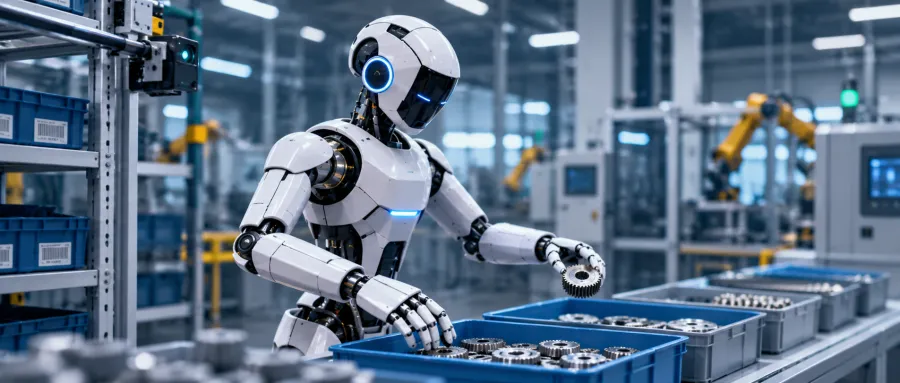
Formerly, Tesla revealed in its latest earnings report that its Optimus production line at its Fremont, California, U.S. plant had begun production, and the first human robots to reach production-grade standards were officially put into production.One million.The year 2026 is considered to be the year of mass production of humanoid robots, and Tesla has taken a key step to scale production, and domestic humanoid robot manufacturers are also accelerating mass production deliveries. According to data released by the Ministry of Industry and Communications, in the first half of 2026, the total production of humanoid robots in China has exceeded 40,000 units, and is expected to increase.It's going to be over 100,000 a year.The leading manufacturers accelerated the scale, shipping around 9,700 Xiaoyu humanoid robots and more than 7,000 Yu trees.The demand for underlying hardware stored inside the integrated system is also growing rapidly, along with capacity, power management, motor drives, and sensors.In an interview with the robotics pioneer, MPS field application engineer Kim Ming mentioned one change: in the past, most robot customers wanted to adopt mature, stable solutions, but now are willing to experiment with new technologies and even want to explore the technological boundaries with chip manufacturers. High power density, high integration and fast response capabilities are becoming the focus of increasing customer attention.Thanks to its accumulated technical capabilities in the fields of power management, motor drives, sensors and more, MPS is increasingly exploring the core components of humanoid robots, developing layouts in the areas of agility, power supply systems and overall machine development.
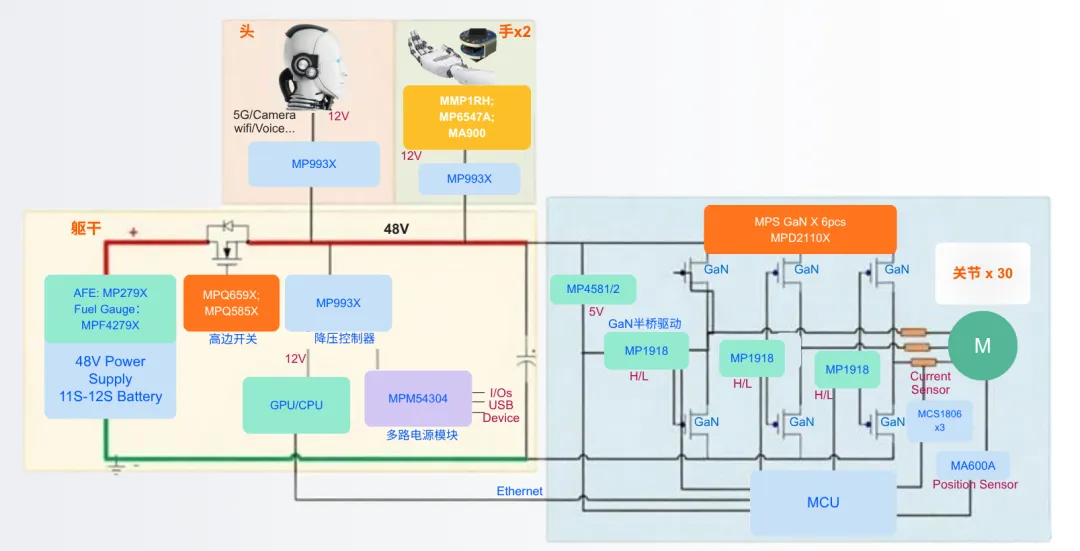
MPS hardware solutions for human robot applications
01.
The more skillful the hands are, the more subtle they are.How does MPS solve high integration and cost problems?In order to accomplish tasks such as grabbing, spinning, and fine-tuning, robot manufacturers are increasing the freedom of their hands while pursuing higher control accuracy and response speeds. These capabilities need to be enhanced with the help of motor drives, position sensing and control systems. However, the space for hardware is limited: multiple micro-motors, drive chips, sensors must be integrated into one hand at the same time, and heat dissipation, power consumption, and cost issues must be considered.It's important to make sure that these components work together efficiently in a limited space.The idea of MPS is to improve integration. In order to combine miniaturization with critical performance in tight connective spaces, MPS is designed to be a key engineer.It's a high-integrating chip design.Driving, controlling and protecting functions will be integrated as much as possible into a single chip or small packaging so that space occupies less space.It has a high-precision sensor and a closed-loop design.Under the premise of maintaining a small volume, high-precision angle/current sensor enhances the control quality of the closed loop, ensuring that high-performance movements of the joints can still be achieved under miniaturisation.EZmotionIt was also launched.It's the end-to-end solution.FOC vector control algorithm, location/current/speed tricycle control, PID regulation and magnetic encoder are highly integrated, forming integration modules that can greatly save PCB board size and installation space, reducing system integration complexity. Specifically, in addition to EZmotion's MMS1RH space cup machine, MMP1RH micro drive, MPS also introduced three-phase brushless motor drives such as MP6543, MP6547A, MP6540H, and high-precision angle sensors, covering motor drives, position feedback and control connections.It's a good idea to integrate the MCU with the motor-powered chips.The controls on the tail of the mobile phones will be upgraded from dual-panel connections to single-panel designs, thus improving the structural compactness, reducing the thickness of the tail and further compressing the structural size. More importantly, the increase in integration can also lead to real cost changes.Reducing overall program costs by about 30%.Improving the reliability of mass production.02.
It's a lot more joints, it's a lot more computation.Robotic power is a new challengeIn many demonstrations where robots are active, we often see situations like this: before a few rounds of action are completed, the robot has to stop charging. Behind the problem of durability, the robot has raised increasing demands on the power system. The number of human robot joints is increasing, and the control of movement is more complex, plus large models deployed to the edge, and the whole machine.Both high-intensity motion and AI computing require instantaneous power demands, as well as controlling the energy loss generated by long-range machines.In the field of robotic brains, micro-brains, MPS has introducedA new generation of integrated high-voltage Buck power systems.The SoC platform used by many customers is generally characterized by higher peak power and relatively low conventional power consumption, while the newly introduced MP9931 synchronous buck controller and its derivative GaN Buck-powered MP993xN, which provides a high-power first-level power supply solution for different power devices to be input from the battery mother line, can meet the demand for such computing platforms.Improve power integration, further reduce the size of peripheral circuits, optimize heat dissipation.Compared to previous controllers with external MOS pipes, the new MPS MP4586/7 provides a 6A or 8A output at 48V input, reduces the layout of the two external MOS pipes, and supports instantaneous power of close to 75W/100W, the peak demand for a single-chip SoC power supply system, as well as power supply capacity, compactness and thermal dissipation control.
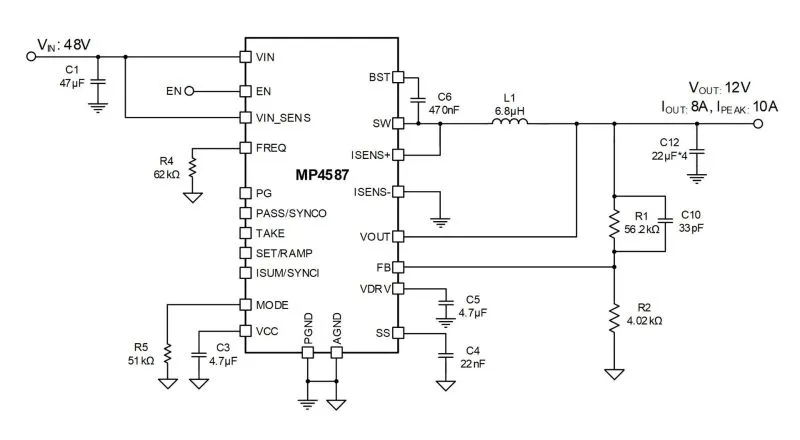
Map of the MP45867 Application Principles
On the small power supply side, MPS is also promoting product miniaturization. Previously, the company had 1A to 3A module power product MP4581/2/3, and is currently developing on this basis an integrated electrical sensing miniaturized power module MPM35x1, further reducing power size by reducing external devices and board area.MPS is also developing high-power density integrated power modules with a target power of 200W to 500W.The program focuses on the power supply needs of the SoC of the robotic brain, providing higher power output in limited space and reducing the power design complexity of robotic computing systems.03.
I'm going to build a silicon chip + algorithm + silicon triad system.Full chain of robotic mass productionMPS observes that some automakers will launch a new generation of products in six months, leaving less and less time for underlying hardware selection, development modeling and reliability verification. In order to reduce the amount of work that underlying hardware is repeatedly developed by robot customers, MPS has been created.“Chip+Algorithm+System Triangle solutionIn addition, the company plans to transform the drive, perception, control and communication capabilities into products that can be applied directly, providing robotic customers with a complete solution that can be applied directly.The chipAt the same level, MPS is both positioning power and perception trajectories: in the field of motor drives, for different power and space requirements, MPS has launched three core three-phase brushless DC motor drives, including MP (Q) 6547A, MP6539, MP6540/H; in the field of perception, the company has launched the MA900B, MA9x0, a high-resistance axle mounting system, and the MA600A, a two core encoder system that supports high-precision axle/side mounting systems.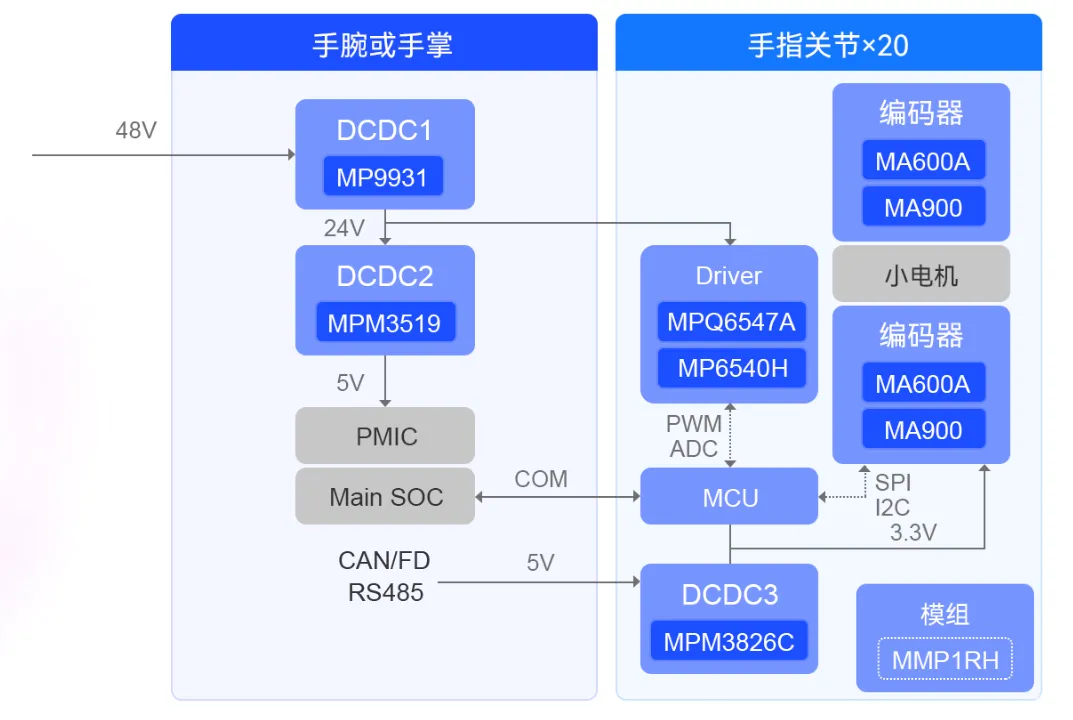
MPS product portfolio for robotic joint modules
It's not.Algorithms andThe systemAt the level, MPS will embed self-developed micro-server control algorithms into hardware and, through system-level products, integrate chips and algorithms into ready-to-use solutions that directly address the challenges of integration difficulties, development cycles and synthesis.It's a big deal.Reducing early development cycles and accelerating product conversion,Without repeated underlying hardware selection, development and debugging, more effort can be put into clever hands and machine design.Standardized Delivery and Customization,After completing first-generation product or demo testing, customers may have higher control accuracy, peak power, or sensor performance requirements. MPS can be optimized based on existing programs, and customers with stronger R&D capabilities can use mature board card autonomous development and continue to iterate based on initial verification.If the integrated MPS scheme is adopted, some customers will be able to get the product in about half a week after confirming the demand.。In addition to deep product-level integration, MPS as a chip design company has also established a supply chain system in mainland China that covers wavelength manufacturing, packaging and testing links, and through its own testing plants and external collaborative resources, provides customers with appropriate production and delivery support to ensure the stability of the supply chain. In terms of local R&D and technical support, MPS has also established support resources.04.
In short, the competition for robot mass production is at the bottom of the ocean.The role of chip manufacturers is changingHow to further improve the integration of motor driven machines, meet the growing demand for power supply, shorten the overall development cycle while controlling overall costs, is becoming a topic that robotic manufacturers are facing together with upstream suppliers. MPS continues to expand product layout around agility, power management and systemic solutions, and to further engage in the production of robotic machine manufacturers through joint development with local supply chain support. In the future, the volume production capacity of robotic enterprises will largely depend on the maturity of underlying technologies, while MPS has a long-term vision of developing semiconductor technology accumulation and system integration capabilities, which will play a more important role in the smart chain industry.