AI, we're going down to sea.
Recently, Shenzhen startupsHow to Get SmartCompleted10 million seed round financing。
The company doesn't go deeper or harder than anyone else's submersible. It's going to build an underwater "brain".
The result that it wants can be summed up in one word:
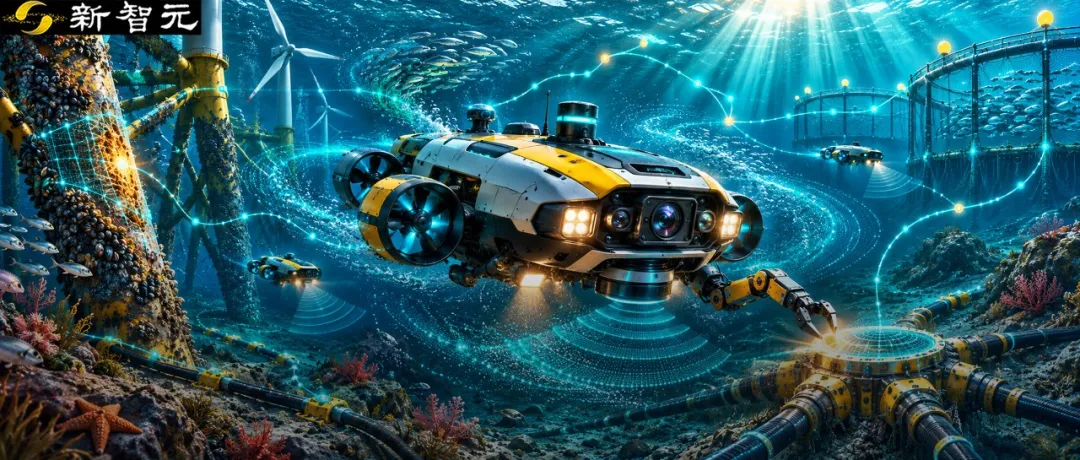
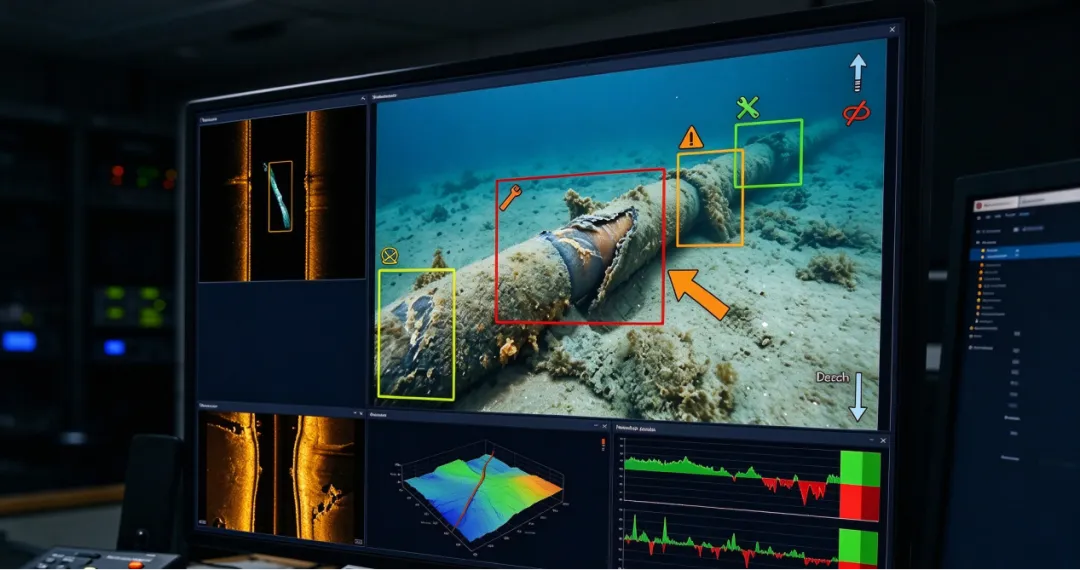
The machine is put down, without anyone looking at the screen, and the task is done by itself, returning with a report of "seeing what, where there is a problem".
Instead of the traditional way it is today, the traditional way is not only high cost, risky shore handling and risky underwater diving; the key is to collect "dead data" and further analysis is a bottomless pit.
The key breakthrough in AI is not only avoiding the high costs of artificial risk, but also moving from "only responsible for acquisition" to "direct delivery analytics".
3D animation with autonomous underwater robots
Does that sound reasonable?
But underwater, almost no one has done it yet.
Earth's surface71%It's covered by the ocean, and humanity understands the bottom of the sea.Less than one percent。
AI has learned to see, learn to speak, learn to walk, but it has never really been able to "sink".
The goal of AI is to get it out of the hands of humans underwater for the first time, where humans are most unable to do so.
It's crazy in the sky and under the ground.There's still a hole in the water.This year, physical intelligence is one of the hottest investments.
Everyone is letting the AI out of the screen. It can go as far as possible, but only on land and hundreds of meters away in the air.
In other words,AI in the physical world has completed its "two-dimensional opening" and has not yet completed its "three-dimensional sinking".
The most difficult dimension in three dimensions is water.
It is difficult, not to say that no one needs it. On the contrary, the demand under the sea is intensifying.
"Ocean Power" and "Deep Sea Technology" have been repeatedly written into planning: wind farms, trans-ocean channels, submarine cables, deep-sea farming, focusing from "building" to "feeding".
It's a one-time thing to build; it's an unstoppable thing to maintain for decades.
And one of the most expensive, and the most difficult to scale, of these long-term bills of lading is:"People are drowning".
These are alive, expensive, and dangerous. Today, they are either landed by humans themselves or operated by people on ships who are constantly on the ground.
Who can turn "human wastewater" into "machine wastewater" and who is stuck in the most cost-effective part of the entire industrial chain?
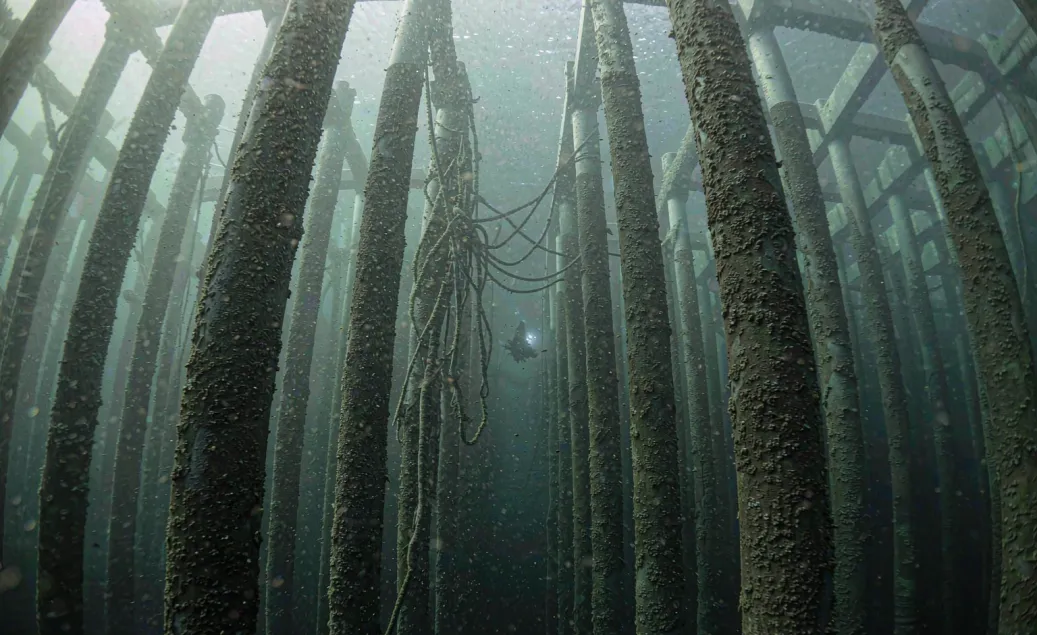
Hardware is the ticket, intelligence is the price.Pressure-resistant propellers can be compared, and the ability to "let go and do it yourself" is difficult to replicate.
How hard is it to work underwater?Why does AI run well on land and fail when it's underwater?
Think of it this way: You're blindfolded and you're driving in a pool of water.
There is no navigation signal, because there is no GPS underwater. The eyes cannot see clearly, because light decreases rapidly with increasing intensity.
But if your eye says to your left, or your ear to your right, judge first who you believe.
This is the first Kan.The perception of changeA mature model of perception on land has largely failed to work in water.
The second way, Khan.The data is poor.。
Data from land-based robots can be retrieved repeatedly in the laboratory. Every single piece of data underwater has to come out of the sea: for ships, for people, and for window periods.
It's not uncommon to see a pair of samples of sounds, images, and movements compared to the above. The gap between simulation and reality has not yet been bridged, and the data from each house is an island.
The third is Khan.Big Models Don't Know the Physics of Water。
When a general model goes underwater, a "decision hallucination" occurs: the task of dismantling the head is a path, and the action is physically impossible.
The upper brain is responsible for planning, and the lower brain is responsible for controlling the hands and feet, in the long run, are two systems, and there has always been no one in the middle.
It's the fourth one.It's all in the hands of teachers.。
Today's underwater operations rely heavily on artificial manipulation, poor performance, and personal experience of the operator. To go from "human assistance" to "total autonomy", the entire control and decision-making chain has to be pushed back.
There is another fundamental and most counterintuitive question:
Every time a machine moves underwater, it's like,The result is that the flow of water is pushing it" and "it moves itself".
The two are inseparable, and the machine thinks it's moving forward, but it's actually being pushed along by water.
In light of this, the experience accumulated on the ground is completely wasted.

Dynamic demonstration of models of the underwater world
The four corners were joined together to form a high wall.
It's not easy to make money, and it's not easy to get around a big, general model.Underwater engineering, physical modeling, and actually going overseas.。
The higher the wall, the first to arrive, the more valuable the time window is.
It's the "brains" that are focused on being intelligent underwater.In the face of this wall, the head of intelligence has chosen a pragmatic path:
Instead of writing hardware, he focuses on "leting machines get their ideas underwater".
It's the most valuable part of the whole thing, and it's the least done by anyone.
Some people are more intelligent than deep, more resistant to pressure, more powerful than power, but "how do you do it when you're in the water?" is almost never systematically offered.
So the chieftain gave himself a position,Underwater-equipped general intelligence base layerThis is a layer of AI Infra.
For example, some people make all sorts of "bodies", while others use "brains" to make all kinds of bodies.
This is a very clear book behind this choice.
The whole machine is an isolated project, selling a calculator one by one. The smart layer is different, it can be charged repeatedly and continue to generate returns.
Individual integrated projects have ceilings and no infrastructure layers.
Historically, every time an AI Infra layer emerges, an industrial value distribution is rearranged.
Underwater intelligence is at a special stage today:The demand has exploded and the bottom is still missing.
At this stage, the pioneers won not only market share, but also market share.The right to defineThey defined what is called "working underwater machines" and defined who should be equipped underwater to buy "brains".
Low-level economies have been written into the valuation model, and deep-sea intelligence is not yet there.
Whoever builds it first will become the layer that cannot be turned around under water.
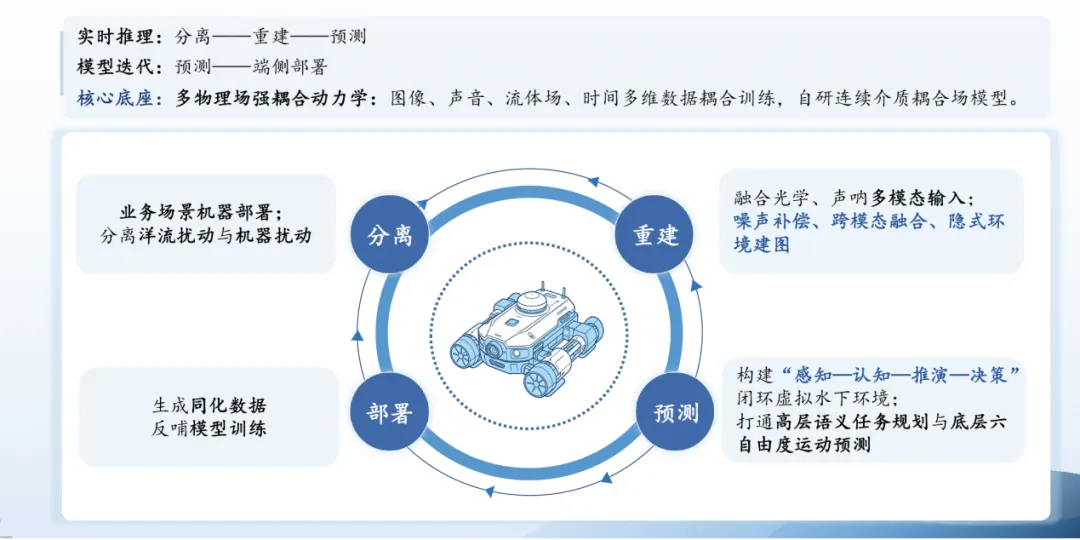
A closed-loop system for the construction of autonomous underwater models
What does this "brain" actually do?
First of all, stay calm.
Water is not air. The ocean currents, waves, and dark currents change every second, and traditional devices drift away when the current is stronger and can only be corrected slightly by humans.
The collar allows the machine to control water flow.PrejudgmentWherever it flows, wherever it is pushed, the machine decides for itself.
The second thing is to do it yourself.
Staying steady is just the beginning. In a control system, the machine itself decides which way to go, where to hang up, how to get started.
It will decide for itself whether to circumvent it or to withdraw first.
It's very clear in comparison:
In the past, a cable, a ship, and an operator staring at a screen could only serve one machine.
Now, all you have to do is give the target a command and not give him every step of the way.One person can operate multiple machines at the same time。
In terms of capital, this is one time."The lifting of human constraints".
In the past, underwater operations could not be expanded, and bottlenecks were too scarce for high-level operators.
What can be scaled up deserves to be valued.
In the past, we had to rely on human-powered devices, but now we can do it ourselves.
Underwater AI is not a temporary task force.
The core team of leading AI comes fromHong Kong University of Science and Technology, China University and Georgia Institute of TechnologyThe company, which covers the entire chain of technological R&D, product development and commercial operations, is the first group of startups in the country to focus on unmanned underwater systems.
They have accumulated underwater intelligence that can be traced backwards.Nearly two decades。
The Gulf of Mexico oil spill site, where they have gone down. They have tracked the ocean floor between the Atlantic and Pacific oceans, and they have done so.
The time when this squad was in the water, it was seen as the capital of the race.It's been decades.。
Money can make a company run faster, but it can't be the result of 20 years of sea trials.
This also explains why this round of money comes from a special group of people.
The investors in this million-seed wheel are:Entrepreneurs with decades of experience in manufacturing。
This group of people who see hard technology is always challenging: not to listen to stories, only to see if it can't land, if it can't enter the scene, if it can't become a real productivity.
Underwater, the concept is not worth a sentence, and every hour underwater is calculated.
When the most pragmatic group of people start making money for something on the cutting edge, it often goes from "can't do it" to "who does it".
Written at the endOver the past two years, the entire AI industry has been chasing "like humans".
They talk, they paint, they walk, they dance.
But "like a man" is the theme of the demonstration era."For People" is the theme of the age of infrastructureDemonstrations can be copied and infrastructure can only be occupied.
The last generation of infrastructure, the bottom of which is steel reinforced concrete. The next generation of intelligence, which can still operate reliably when no one is present.
AI is not only going into the physical world, it is also going to be able to do it on its own where humans are most unable to do it.
This is exactly the question that the head of intelligence wants to answer.
It's like the team has always insisted:
The wisdom of man goes to no one.