It's the first time in the history of the world.
In 2026, the big model sold the Token business, which has been wrapped up in obscurity.
Google released a number at this year's I/O conference:Each month, 32 trillion tokens are processed, seven times as many as a year.
In the first half of this year, the size of the Chinese MaaS market jumped to 10.6 billion yuan, almost nine times the growth of the previous year; the consumption of tokens amounted to 28.57.9 trillion, an increase of more than 430%.
Token, a word that was once understood only by the tech community, is becoming a real deal.
The logic of this business is not complicated:Model makers put large models in the cloud, developers don't have to train themselves, they don't have to buy them.Display cardsIt's just that I'm not going to pay for it.
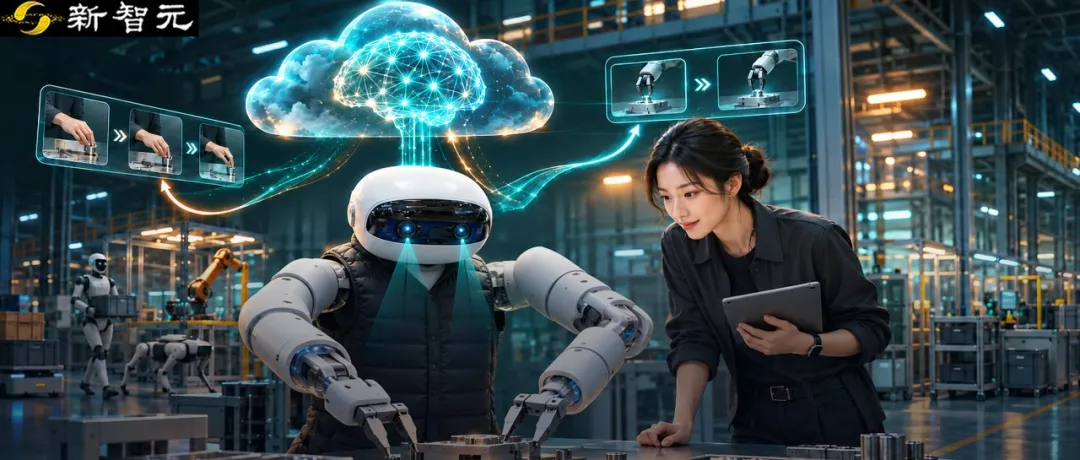
Now, someone wants to move this logic to robots.
The robot grabs a cup, scrapes a table, looks like it's moving, but there's actually a model behind it that's in charge.
Since the AI model of command language can be placed on the cloud by call, why not a physical model of command action?
This battlefield is calledIt's a very smart MaaS.
A robot's "brain" doesn't fit into its "body".Before we talk about MaaS, let's say one thing:Right now.The robotsIt's not enough to have a "brain" in your body.
It's not that the model isn't smart enough, it's that the body of the robot is too small, too hot, too expensive.
The total cost of a body-smart robot is about 100,000 yuan, with 30,000 light chips being the most used by British Thor.
But even this top-of-the-line robotic chip, which has completed the camera's visual processing, basic motion control, and calculation, is almost at the bottom of the list, where is the power left to run a large model of the 10B parameter to reason?
The robot is sealed, stops for a while under the sun in the summer, and the temperature rises.
The better the chips, the hotter the heat, but the bigger the space, it's a dead end.
So there's always been a debate in the industry: should a body model run on a robot or run on a cloud?
This debate has largely been answered to this day. Because of the race between mathematics and models, models have won.
The mainstream body model in the industry, with parameters generally below 10B, is likely to be much larger than 10B by the end of the year.
And the chips on the robot, which are generally on a scale of several hundred to a thousand TOPS, can barely run, are two or three B's small models.
The chip is progressing, but the model is growing faster. This gap shows no signs of shrinking in the short term.
Can't put it down, can't run, can't spread the heat, can't dieMoving model reasoning to the cloud is almost the only way out.
It's not enough to have a model, it's a tough fight to train.But cloud reasoning only solves the problem of "running in motion", and there is a more fundamental challenge: how to make the model really work.
In the age of big models, people are used to using zero-shot models as an answer to questions.
But being physically intelligent isn't all it's cracked up to be. Getting a general model to operate a mechanical arm screwdriver is like letting a child who has just learned to walk run a marathon for 180,000 miles.
A real business scenario has a hundred details: what a robot looks like, what the shape of the object is, what the environment lights up, how high the precision is required. A model that can be demonstrated in a lab, reaching the factory production line, may even be unstable.
After training, post-training is the only way to be physically intelligent.DemoA key leap forward to mass production.
This is similar to the fine tuning and alignment of the larger model. ChatGPT's use of the pre-training base is of course important, but what really makes it "talk" is the post-training process of both SFT (supervised fine tuning) and RLHF (human feedback reinforcement learning).
It's the same with physical intelligence:The general model is baseline, and post-training is the key to turning the baseline into a truly functional scenario expert.
The problem is that the threshold for post-training is too high. You know the model, you know the data, you know the training strategy, and you have enough computing and engineering skills.
One day, a real-life manufacturer came to my door and wanted to talk about "how to get your model". Unfortunately, the tech team was busy, and the market leader had to go hard and explain the basics of the model, how big the parameters are, how to train and how to deploy it.
At the end of the conversation, the guest politely asked: "Are you the technical director?"
He nodded. To find out, he was faced with a man who was sent by a robot company to match the models.
This is the current state of the industry.
MaaS: The smart Android momentLooking back at the big model over the years, there is one detail that is easily overlooked:Most of the people who really use the big models are not the ones who model.
The first to play the big model was to design, customize, and analyze data, and countless businesspeople were unfamiliar with the model, but they didn't need to know how to pay attention to the Transformer, they just needed an API Key to integrate the capabilities of the big model into their products.
MaaS is the infrastructure that pushes the technological threshold to the ground.
Now, physical intelligence is on the same level.
In July 2026, at a conference of developers, the first general-purpose MaaS service in the industry was launched. In October, Physical Intelligence (π) followed by the launch of Pi API Beta, Dream Labs also launched a $90 million seed round of financing and a Dream API upgrade.
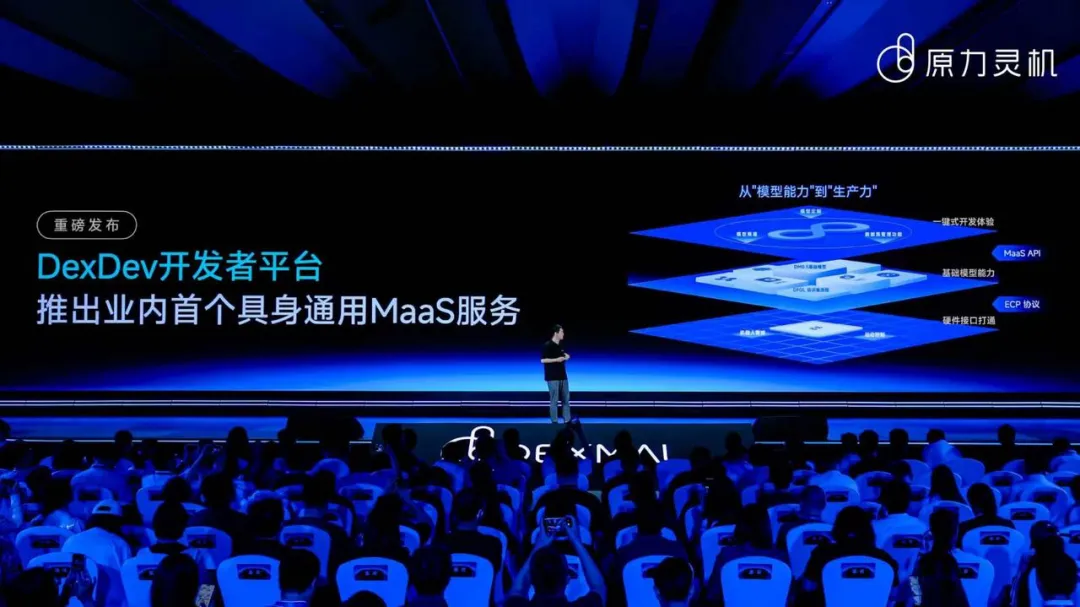
Three months, three months, in the same direction.
But the three approaches are very different.
Pi's API is an "invitational system" where you have to apply, review, etc., and they think you're in the right direction to use it.
Dream Labs prefers entertainment and education. The $3 an hour price tag is familiar enough, and it's cool enough to play robots in a browser, but it mainly supports the simple operation of arm clawing.
This is the third time that a nuclear reactor has taken a third path:It's a real mission, a real scene.
Three pipelines, pushing the success rate to 100%.The most recent upgrade of the Maas, the core technological breakthrough is:The first platform in the industry to support three simultaneous post-training methods.
These three approaches correspond to the three phases of the model, from "learning" to "learning" and "doing well".
Stage one, SFT: The Church's basic action.The user uploads the demonstration data of successful operations, the model follows the lessons learned. Like the teacher's apprentice, the standard moves are done correctly.
Stage two, DAgger (rectification of bias): The Church recovers from the error.In real-life operations, robots inevitably make mistakes such as bending their arms, sliding objects, and distorting angles. Dagger collects these failed data to help models learn "how to recover from a mistake". The success rate is further increased to over 90%.
The third stage, RECAP ((strengthening post-training): eliminating the final defeat.It's a real "war of aggression". The platform trains a value model, scores the robot every step, tells it "this step is closer to completion" or "farther away", and allows it to optimize itself for higher scores, focusing on the occasional but suddenly bad ones.
When the three pipelines are superimposed, the success rate of the atomic mission (single-step action) can be close to 100%.
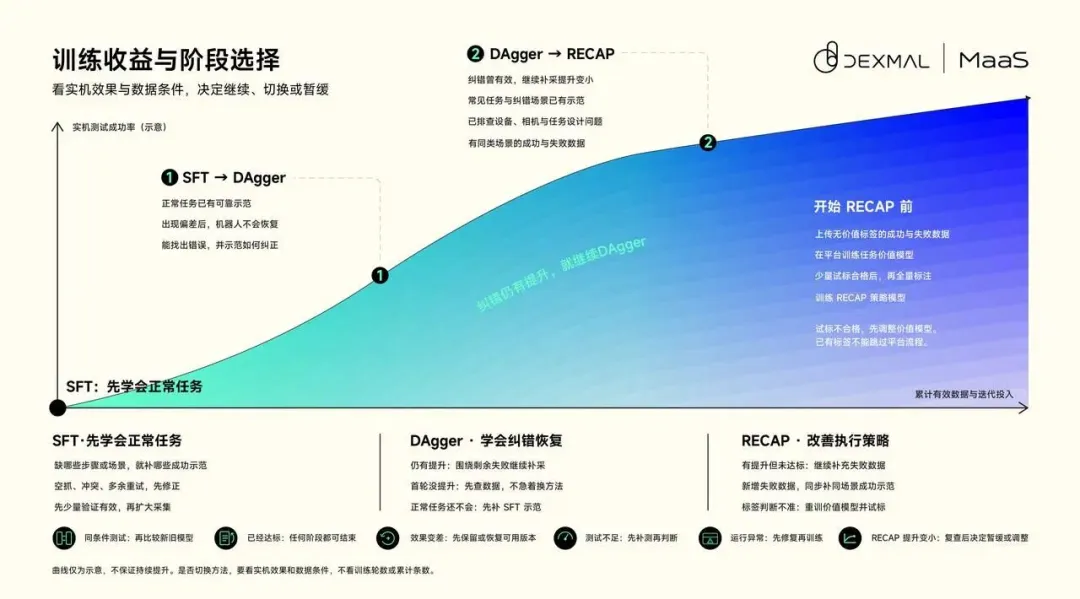
Complete post-training process
If you are familiar with the evolutionary path of the big model, you will find this idea unusual.
GPT is first a mass-text pre-training to get it out into the world; then SFT, a high-quality written questionnaire that teaches it how to answer; and finally RLHF, which lets people give it a score, a good score, a bad score, and push it in the direction of a high score.
The body model goes almost all the way, only replacing "words" with "actions".
DM0.5 is the equivalent of pre-training, which looks at a lot of real-machine operation data and first-person human action data, knowing what "crawling" is, what "putting" is; SFT is the standard answer; DAgger is correcting; RECAP is the physical version of RLHF.
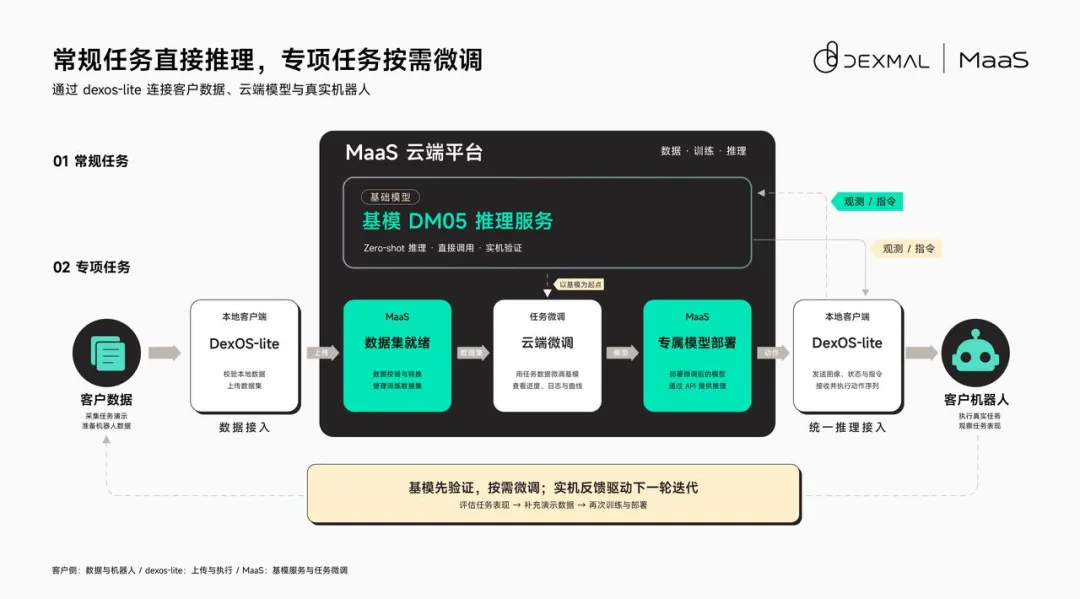
There's only one difference: the big model answers a wrong question and reproduces it; the robot grabs a wrong part and the output line stops.
So the post-training requirements for success are much more demanding than the big model.That's why three pipelines have to be overlapped and kept pushing to 100 percent.
The primary mechanism is to move the large model's proven post-training methods to the field of physical intelligence with a complete set of ready-made tools.
And unlike Pi, it's an open platform: developers need only basic engineering skills to complete the entire process of uploading data, training models, and deploying reasoning on the platform without building their own training clusters, writing their own training scripts, or even understanding model principles.

 Get it!
 Stacking
 The color

Order sequence
This is the real value of MaaS.
Life-saving scraps of body manufacturersSo who needs the most MaaS?
The answer is that the automakers are behind the companies that make robots.
The corporate intelligence industry today has a structural dilemma: corporations do not have the capacity to model, and corporations do not make corporations.
The actual manufacturer's robots were built, but without reliable models to drive, they couldn't enter the scene; the scene didn't go in, the shipments didn't come up.
This is almost the same as the situation for SaaS providers at the time.
Before the big model came out, the SaaS companies that did CRM, that did data analytics, that had customers, that had scenarios, that had data, but they wanted to add "smart" to their products, they had to have their own algorithm teams, their costs were high, their cycles were long, and most of the functions couldn't be done at all.
Big models like MaaS go online, and the situation changes instantly: they don't have to understand the model, they go online for a few weeks as long as they put the API into their products.
It's logical to replace the SaaS vendor with the physical vendor and the big model with the physical model.
The Maas nuclear reactor has already done this.
In the logistics warehouse scene, desktop robots are already alive and well alongside the transmission lines, delivering over 1,200 bits per hour, with a success rate of over 99 percent; in the mobile production line, mobile robots are recycling waste; in the precision industrial scene, sub-millimeter precision quality checks are also being deployed.


These numbers are actually running on the production line.
Is it a good business to have a MaaS?In return, the question remains: can the built-in MaaS become a Token business like the larger model MaaS?
There is a key variable here: trans-essential generalization.
In fact, a model can eat all sorts of robots.
The main reason why MaaS is large is that the same model can serve multiple applications in different scenarios, but the model is universal.
Can a physically intelligent person do that?
To be honest, we can't do that right now. There's too much of a robot, with two arms, one arm, a man, a wheel, four legs, each with its own control logic, and no sign of convergence in the short term.
But this, in turn, illustrates the value of post-training platforms: because the body is different, each body needs post-training based on the scene.
It is better to share a mature platform with each of its own manufacturers to build their own training infrastructure from scratch.This is the most economically viable option.
Furthermore, the diversity of the body also means that the physical MaaS and the larger model MaaS may have different business logic.
The larger model, MaaS, is priced for Token traffic, depending on the size; the larger model, MaaS, may be more prone to "platform+customization", relying on post-training services and scenario solutions to earn more money for each customer.
The market is expanding rapidly. Data released by IDC at the end of September showed that global shipments of humanoid robots in the first half of 2026 amounted to almost 25,000 units, an increase of 432% compared to the previous year; of these, more than 19,000 units were shipped from China, accounting for nearly 80% of global shipments.
The value of this platform will only grow when more and more robots need to be "brain-clouded", need training, need continuous iteration.
This is a bad step from demo to productivity.Over the past two years, smart people have watched too many beautiful demo robots fold their clothes, pour their coffee, dance, and fight.
But a demo isn't about productivity, and a craft isn't about business value.
From demo to productivity, there is a gap in the middle: post-training is too difficult, reasoning is too expensive, thresholds are too high, success rates are too low.
I'm not sure if I'm going to be able to do that.
It's not sexy, it's not an eye-catching robot show, and it's not a breakout paper.
But in retrospect, every step that a wave of technology really changes the world is the moment when the infrastructure is laid: AWS makes cloud computing popular, the App Store makes mobile internet boom, and MaaS makes big models enter thousands of industries.
Next, it's the robot.