Moving a polygonal brain into the realm of industrial logistics
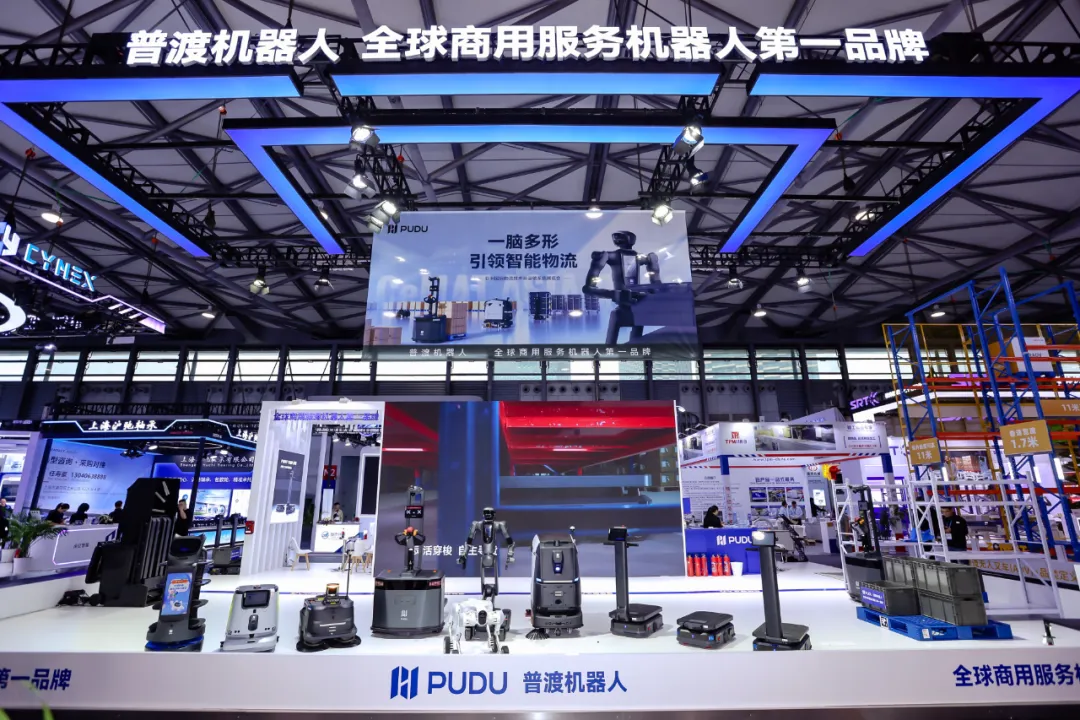
The single performance determines what tasks the equipment can perform, and the collaboration between the devices affects whether the process can be completed continuously. In the CeMAT field, in order to demonstrate the ability to collaborate in depth with multiple products, Purdue robots transformed the stand into a real inbox workflow line.
After the transfer orders were received by the staff, the PUDU T series of industrial robots were first released from the depot, followed by the PUDU D7, a man-made intelligent operating partner. After the T series transferred the materials to another location, the PUDU D7 moved the container back to the ground tray, closely following the original AI tray transfer robot PUDU MP2000.
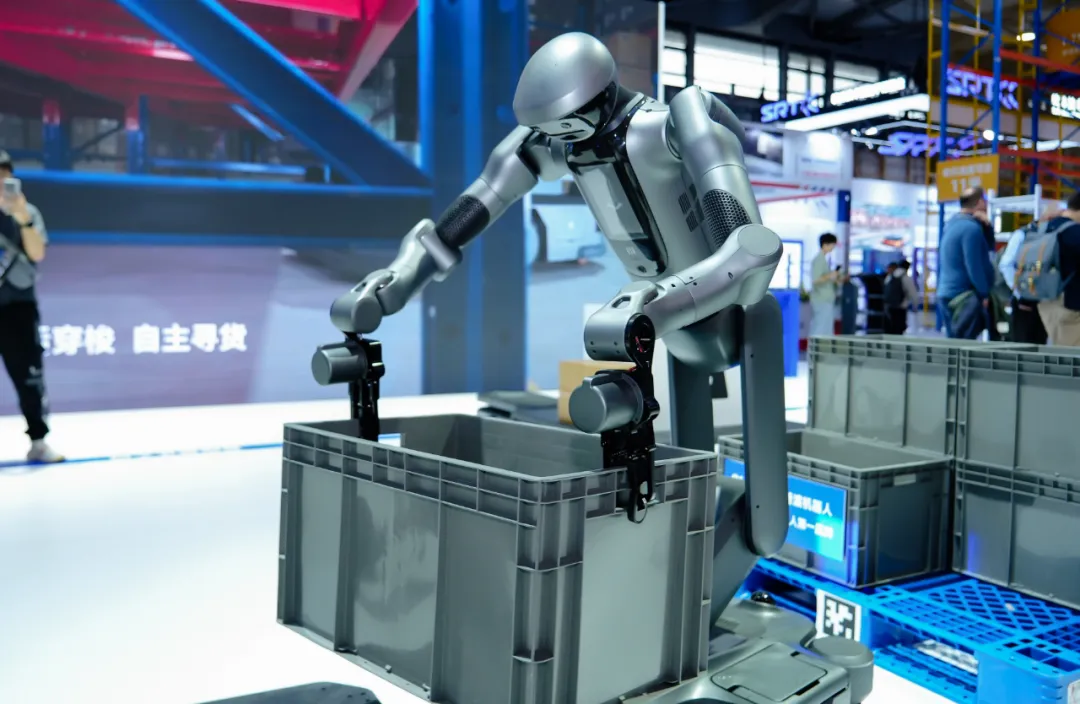
Several robots with different shapes are able to perform collaborative work between multiple processes, relying on the same shared brains behind them. As early as 2024, when PUDU MT1 was being developed, Purdue began designing products based on the concept of multi-mode generic, which laid the foundation for later cross-form replication. Today, robots with different shapes share a unified set of underlying models and software architectures, allowing navigation, avoidance, and interaction capabilities to be used directly between different entities.
The body is a robot of various forms; the system is the robot intelligent operating system PuduAgent OS, responsible for understanding tasks, planning decisions, accumulating experience and ensuring operational safety; the skills come from the body intelligent base model PuduFM, which allows the robot to understand the environment, predict outcomes, make actions, and modify according to feedback.
From the point of view of task division: tray transportation focuses on loading and transportation efficiency, container handling requires operational capabilities, and linear distribution needs to adapt to the passage and production rhythm. The assignment of different tasks to suitable robots, followed by a unified system welding process, can further discuss the efficiency, cost and adaptability of the entire system beyond the single-machine capabilities.
The underlying architecture of the brain, based on the idea of autonomous driving. Purdue robots introduced end-to-end paradigms first to indoor robots, constructed navigation algorithms based on VLA (Visual-Language-Action) + WM (World Model), then superimposed on physical navigation, physical operation, and physical interaction.
To make the brain really smarter is to scale the deployment of real machines. As of May 2026, Purdue robots have cumulatively shipped more than 130,000 units, operating over 90 million kilometers of devices in restaurants, hotels, and factories, producing more than 50 million hours of real operating data per year.
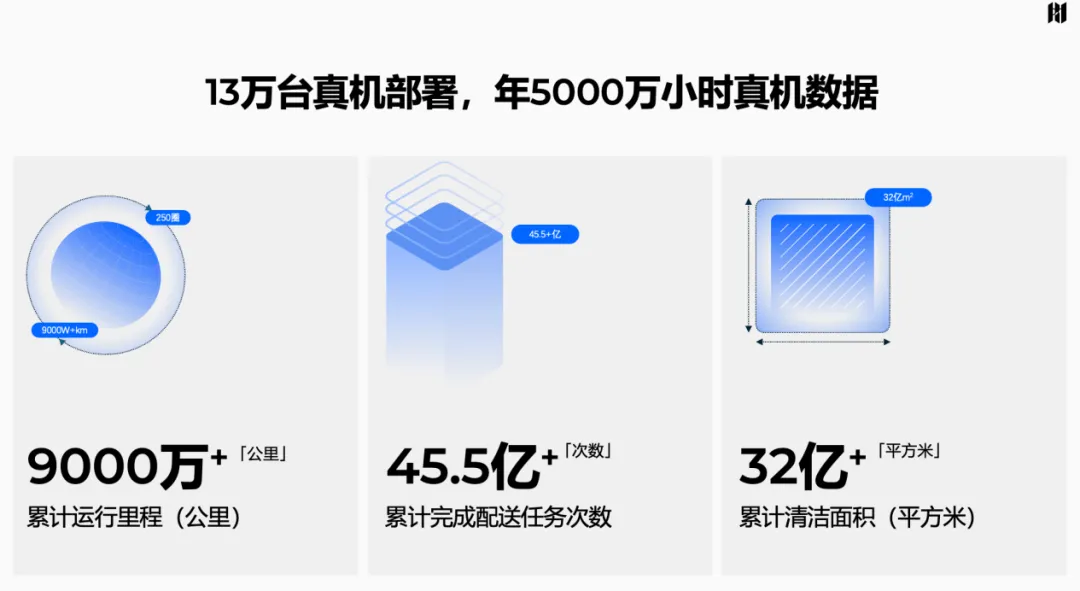
As a result, Purdue robots built a set of commercial landing craft data accumulation craft models to enhance craft capabilities to extend craft scenarios. The deployment of multi-forms and multi-scenes led to a highly diversified data distribution, large-scale operations that overwhelmed unrepeatable data barriers, real-world anomalies and artificial correction data, which are the most valuable training models for model generation.
As deployment expands, model generalization capabilities continue to improve, and skills learned on a single model can be transferred to other entities, new models do not have to go from zero to the marginal cost of development, R&D and deployment.
Farewell to customized aluminum
It's time to get started with the Minutemen.
At the CeMAT exhibition, in order to demonstrate the content of this multi-machine connectivity demonstration, Purdue robots also demonstrated on-site the robot's limited space positioning, load detection, obstacle response and navigation performance.
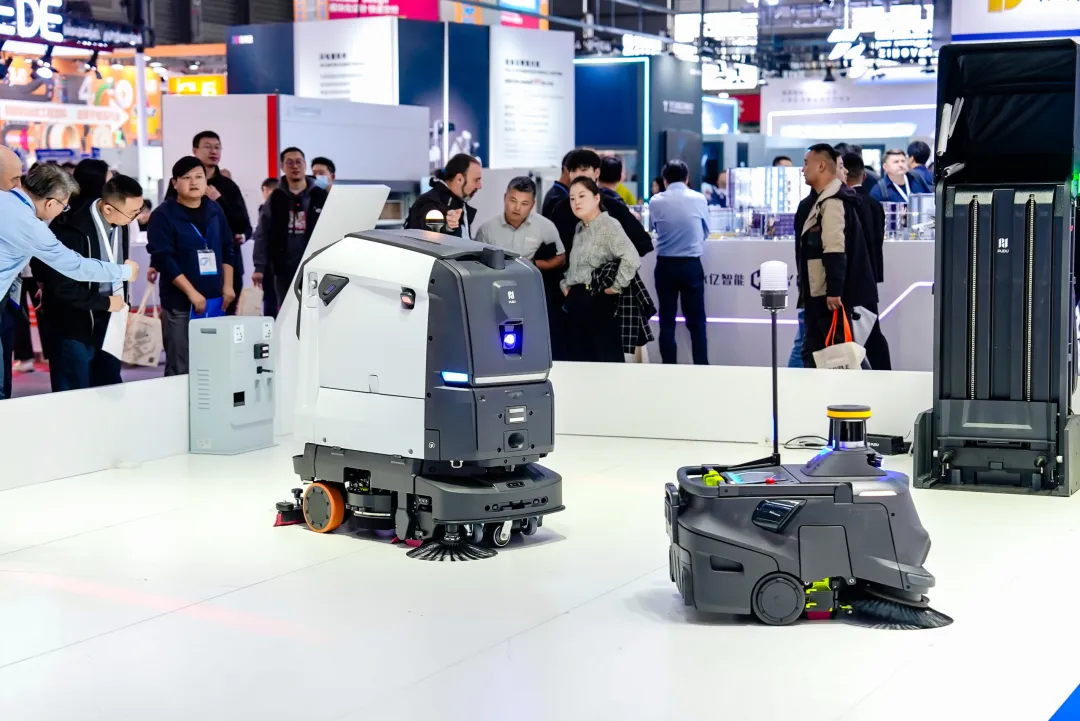
The T series is a line of industrial distribution robot products for industrial scenarios, comprising three models: the T150, T300, T600 and T600, with a rated load of 150kg, 300kg, 600kg respectively, in multiple model portfolios to suit different loads and scenarios. Once the equipment is in place, users can independently complete the design, deploying the thresholds and significantly reducing them.
The T-Series is capable of matching in-house devices with workflows through rich IoT integration capabilities, flexible adaptive linear distribution, transmission, and transfer tasks, and relies on central scheduling and distributed scheduling combined to support the expansion of collaboration from single-to-multi-machine applications.
Even under narrow channels, the T600 submersible version can be deployed with the native rotation function, without the need to reserve the width of the rotation radius. At the same time, with the combination of VSLAM and laser radar navigation, the T600 can be deployed without magnetic strips and two-dimensional codes, achieving positioning stability and intelligent avoidance.

The D7 Wheel Semi-Human Robot is an important practice of the multi-brain robotics concept, positioned as a human-type intelligent operating partner for complex operations such as industrial logistics, high-level disposal, material transportation, adaptation to real-world scenarios such as factories and warehouses.
The D7 wheeled semiconductor robot supports two arms with a maximum load of 20 kg and an operating height of 2 meters, with the lower half of the heavy body shifting smoothly, focusing steadily. With the support of the full-chain sensing system, the PuduFM-equipped smart base model and the PuduAgent general-purpose body intelligent, the D7 wheeled semiconductor robot can autonomously identify the position deviation of loaders, such as trailers, and adjust operational movements to ensure the steady success of transportation tasks.
PUDU MP2000 is a newly introduced AI native tray-carrying robot by PUDU Robot, designed for tray-carrying logistics, capable of 20 seconds of forklift-efficient loading, up to 1.6m/s of unladen operation, and supports 2 tonnes of tray-carrying. In addition to the standard tray-carrying tray that is compatible with traditional Kawasaki trays and field trays, the MP2000 can be self-learning through dynamic storage to identify with AI loaders, and can autonomously learn to adapt to on-site non-label loaders, saving customers time to replace loaders and rebuild the tray-carrying management system.
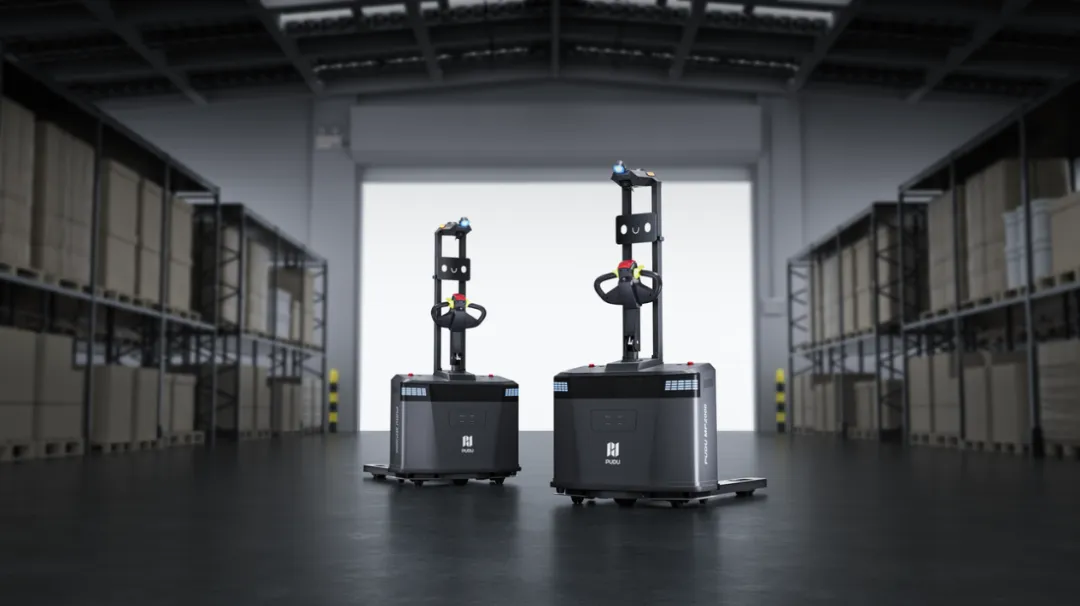
It is these product characteristics that make it possible to automate the delivery of industrial logistics in standardised cosmetics. Purdue robots prioritize adaptation work on the product itself, and the differences in the field environment are digested by the robot's perception, design and AI self-learning capabilities, without customers having to customize and modify each project individually.
Standardized delivery therefore has a more specific meaning: customers can use relatively uniform products to meet transportation needs in different locations.
This also makes open-box aluminum a product capability that can be dismantled. Less paving of positioning accessories means reducing one type of site construction; compatibility with original trays means reducing one type of asset replacement; support for expanding from single to multiple machines makes it easier to match initial inputs with actual business volumes. Judging whether delivery methods change can be done from these specific links.
The value of achieving standardization will be directly reflected in the input rate, with the equipment being able to start up quickly on a single stage after arrival, without the factories having to automatically upgrade for a long period of time. Customers can first increase the number of robots at a transport link pilot, and then gradually increase the number of robots according to the volume of operations, so that automated inputs are synchronous with real demand. This step-by-step method of advancement also allows small and medium-sized factories and distributed multi- warehouse layouts to have a workable route to introduce robots.
In terms of operational performance, PUDU MP2000 has an average investment recycling period of less than one year and an efficiency improvement of more than 50%; the T-series has been able to increase the efficiency of pick-up from 30% to more than 80% by supporting the pick-up order to the man-made efficient pick-up mode.
From the first wave of trade to the industrial landscape
Multi-machine connectors, single brains, and open boxes are all up to the test. For factories, the robustness of long-term use and reimbursement of costs is more convincing than a demonstration on the stand.
Purdue Robot revealed that its industrial product line grew at a rate of 87% in the first half of this year. Specifically, the T300 delivered more than 4,000 units in its first year on the market, with customers including dozens of the world's top 500 enterprises.
In an application from one of the world's leading electronics service providers, Purdue products have entered four factories in the United States, Mexico, Romania and the United Kingdom. The project carries out the transfer of parts to the SMT production line, PCB materials and rack rotors with the T300 and configures PUDU CC1 Pro and PUDU MT1 for ground cleaning; through the privatization of Cloud Veil deployments, the operation data will be retained locally by customers while supporting centralized management at multiple sites.
This case provides a concrete basis for the ability to replicate the observation program. The same customers use robots in different factories, needing to simultaneously face production processes, spatial conditions and data management requirements. Continuous cross-site application, which explains the scope of application of the product more than a single stand demonstration, also provides a further verification direction for judging the platforming ability.
Supporting this growth curve is the overall size and manufacturing base of Purdue robots. Its products have reached 85 countries and regions, serving more than 50,000 customers, covering 16 major industries; core components such as joint modules, motion controllers, self-development, cumulative patent applications for more than 1,900 pieces, and the annual capacity of 130,000 units at the three major manufacturing bases in Salt Lake City, Guangdong, and Jiangsu, providing the basis for large-scale manufacturing and bulk delivery of products.
In Purdue's view, the commercialization of physical intelligence has progressed from a single-point technological breakthrough to systematic closed-loop competition with the emergence of hybrid models+Agent+Body+Data+Scenarios, with the emergence of scenic intelligence as a key breakthrough.
Purdue's modeling capabilities, real-time data, and large-scale delivery systems are at the heart of the industrial landscape.
In terms of shape layout, PUDU Robot has been making industry judgments for the PUDU specialty, humanoid, and humanoid three-dimensional coexistence layout since 2023, and introduced the full-size two-legged humanoid robot PUDU D9 in 2026, the first in the industry to complete a full-size layout.
From restaurants, hotels to factory workshops, Purdue robots took a decade to get out of a path of expansion from commercial service to industrial sites. The T series, an industrial logistics product matrix consisting of smart robots such as MP2000 and D7, covering linear distribution, transshipment to the complete chain of ready-to-carry transport, allowing industrial logistics automation in the form of standardized products to enter more factories.
With the continuous expansion of the four product lines of distribution, cleanliness, industrial and general-purpose intelligent, Purdue Robotics has grown from a leader in the field of commercial service robotics to an infrastructure provider across multiple scenarios.