Water from the Temple of Penang
QbitAI is public.
99.4%, the world's number one.
Well, guys, who would have thought that Silicon Valley would be sitting in the spotlight every day talking about AI security?
The new AI security world record is set by a Chinese AI system.
It's on the CyberGym list, which is known as the World Cup for AI Security.360 self-developed AI security defense system, with a 99.4% vulnerability replication success rate, topped the list.。
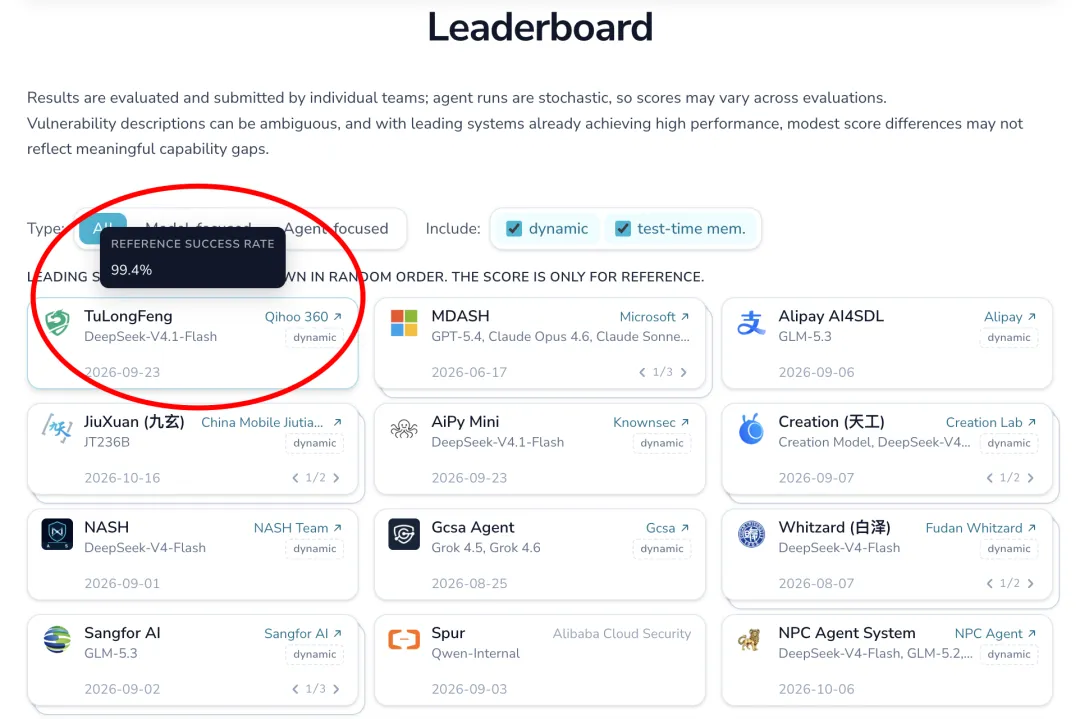 △Source: Home page of the CyberGym project (excerpt only)
In the same list, there are also OpenAI's GPT-5.5-Cyber, Anthropic's Claude Mythos Preview, and Google's Gemini 3.8 Flash Cyber.
All are players who have specifically strengthened their cybersecurity capabilities.
It's quite spectacular.
And this first one, it's not really a two-eyed scan of the code, and it's easy to pick up a few suspicious spots.
1507 actual vulnerability missions, followed by three rounds of independent evaluationAI needs to locate and build PoCs from mass code.(Concept verification)The answer to that question is yes.
At the time of its release, CyberGym had a 11.9% success rate with the world's best combination, OpenHands + Claude 3.7 Sonnet.
At the moment, Turing has done 99.4% directly, a score that is close to completion.
It's a bit of an oddity.
How can 360 use an AI to practice the world's first hole-digging craft?
It's time to go back in time and say the final answer, both unexpectedly and emotionally.
That's right, man, that's still the most critical variable.。
Behind the world's first AI, a group of world champions
The story of Turong Tong, which accurately confirms the Chinese proverb "masters go out of their way", is still in use in the AI era.
It's time to go back to 2017, Vancouver, Pwn2Own World Hacking Competition。
The game is called the "World Cup of Hackers" and the rules are simple and rough:
The competing teams must break into the actual product within the prescribed time and complete exploitation and verification of the vulnerability on the spot.
The program wasn't really breached, and nothing counted.
On the final day of the competition, the 360 security team brought an attack chain across Microsoft Edge, Windows kernel and VMware Workstation.
They will be challenging three lines of defence in a row:
First breaking through the browser, then penetrating the kernel of the operating system, and finally forcibly escaping from the virtual machine, directly to the host machine.
The three locking rings are tied together, any one ring loses hands, and the entire attack chain may be at a loss.
But after the live demonstration began, the entire attack chain ran for only 90 seconds.。
Yeah, 90 seconds, like being in the middle of nowhere.
But what the audience saw was that after 90 seconds, the really difficult work had already begun long before the stage.
The researchers had to find a breakthrough from a strange system, and then link a few gaps together into a complete path, in the middle of how many trials and mistakes the outside world had to learn.
After 90 seconds on stage, only after repeated judgments, the right path is finally left behind.。
In the end, after three days of struggle, 360 points topped the points standings, taking the tournament's highest honor Master of Pwn.(Master of the World Breaking)。
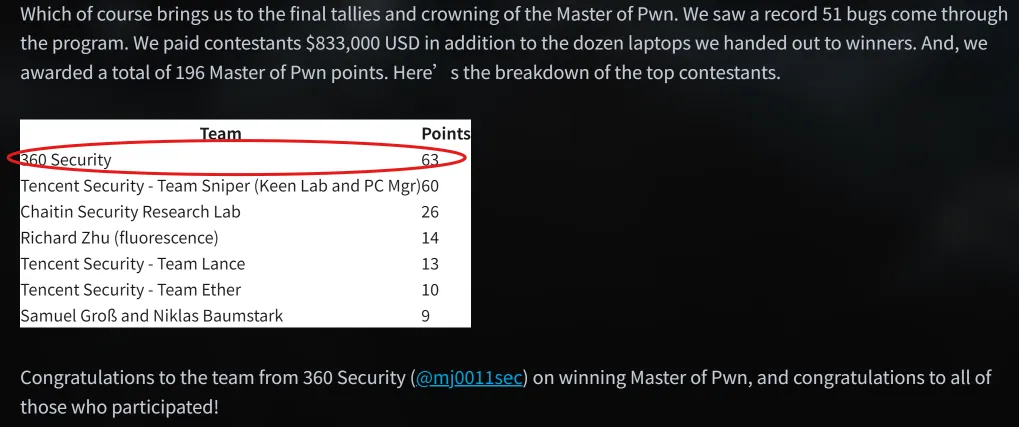 △This is the first time I've ever heard of this.
Similar capabilities have been demonstrated more than once in 360 years.
In 2020, 360 Alpha Lab security researchers came up with a chain of vulnerabilities called "Traditional Longitude".
The name is very much a martial art, and the actual effect is quite strong.
An attacker can remotely break through multiple layers of protection in Chrome browsers and Android systems, ultimately gaining control of the device.
As a result of this research, Wang was honored with the Pwnie Awards, the first Chinese security researcher to be awarded the Oscar for "epic achievement".
 △What is the meaning of life?
It's starting to be interesting to see here.
Pwn2Own and "Stairway to Heaven" face different software and technical details.
But the core logic is the same:
Where there are no standard answers, find your own way.。
This ability is obviously not backed up by a backlog of questions.
Of course, a real knife is a real gun.
And 360 is exactly what the real war is missing.
360 disclosed that its security team had collectively discovered and assisted in repairing CVE vulnerabilities in Microsoft, Google, Apple, Huawei, Qualcomm, and other vendors.(i.e. a public loophole with an international code)More than 3,000.
More than 3,000 actual vulnerabilities, what is the concept?
This means that these people have been dealing with strange codes, complex systems, and unanswered questions for a long time.
In the face of today's browsers, which could be operating systems, chips or enterprise business software tomorrow, when the project is changed, the original solution is likely to fail directly and can only be rediscovered.
After so many years of grinding, which clues are worth following, when to change directions, it is slowly becoming a judgment.
This is where 360 is really hard to copy.
Top security experts are scarce enough to allow a group of top experts to deal with thousands of real-world vulnerabilities for more than two decades, and to make a team of experienced, once-in-a-lifetime hackers more scarce.。
But the problem also came, a great expert, with only 24 hours in a day.
In the face of the huge amount of code and new software that is constantly emerging, it's just a matter of getting people to look at it.
So a very natural and bold idea arose:
Can AI learn the "judgment" of this group of experts?
This is the true beginning of the story of the dragon.
Teaching AI the skills of world champions is the hardest thing to do.
To teach AI the truth about world champions, the first thing to do is to use data.
The number of public CVE, NVD, plus reports of vulnerabilities scattered on the Internet is already quite significant.
But I turned around and soon discovered an interesting question:
These open data often only tell you what's wrong with the vulnerability, but it's hard to recover how the hackers originally found it.
There are results, there is no process, who sees this without a headache?
I'm not sure if I'm going to be able to do a summer vacation or not.
When you look at the answer, the result is clear and clear, but the most critical process of derivation is only one word: short.
The most valuable experience for vulnerability mining lies in the word "little".

At this time, 360 accumulated over the past two decades have been put to use.
In the first line of defense, 360 security samples from real-world environments have been captured in malicious program searches, attack disposal and vulnerability studies.
More importantly, how the group of security researchers analyzed, called tools, and adjusted direction after a trial and error in a real offensive was gradually absorbed into process data and expertise.
"Real samples + real experiences", the two types of data combined, are completely different.
In accordance with the 360 disclosed technical guidelines, the content is used to train large security models behind the Dragonfly.
The "single-door secret" at the bottom of the world championship press box is what comes into the mind of AI.
However, the model learns how to make judgments about how far it is from actually digging a hole, and it's a bad "hands-on" step.
I thought I'd add a code library and security tool to the model and put a layer of Agent on it, right?
This is a common practice in the industry.
It's a bit of a peculiarity to be able to dig a hole.
In the face of millions of lines of unfamiliar code, the hardest thing is often to figure out where to start.
If the underlying model doesn't see safety, Agent is busy, and may be going crazy in the wrong direction.
This also explains why the company is promoting two technological routes simultaneously:
Large model in the field of security + professional intelligent bee population。
More detailed projects have been implemented, not fully unfolded in the public records.
After all, it's a commercial product, and we follow the official web map to see its core design ideas.
Large security models are responsible for finding direction。
360 uses years of accumulated security data and expert experience to train a professional model that understands security.
Then, through "reverse teaching", let the security expert teach the real thing to the general model.
In this way, a generic model that could be seen by any code, with a pair of eyes to discover security problems, was upgraded to a "great security model".
I've got a brain, and a bunch of intelligent bees are on their way.。
360 breaks down the processes and tools that experts dig for the vulnerabilities, handing them over to different smart entities to execute, from analyzing code, calling tools, to generating PoC, verifying vulnerabilities, all the way to the end.
If there is a problem, the results will come back again, the system will adjust the direction and try again.
Here, the "process" that was omitted in the previous reference to the answer has finally been completed a little bit.
The database provides vulnerabilities that have already occurred, process data that teaches AI how to judge and correct mistakes, and intelligent agents that turn those judgments into actual actions.。
As a result of the combination of many things, the world champion began to have the ability to "meet the unknown and know how to get down".
But the story isn't over yet.
Turing began to learn the truth from his mistakes, instead of learning the truth from an expert.。
360 recently released a technical report documenting an evolutionary event.
The incident occurred during a regular loophole test.
At the time, the verification environment he had built was unsuccessful, and after half a day of unsuccessful work, he simply went online to find a way, and the result was that he flipped an address marked "test environment" from a technology blog.
Well, guys, what's wrong with the existing testing environment?
While attempting to verify the address of the vulnerability, the request was blocked by an isolated sandbox.
What is the problem?
The blog says "test environment", but it doesn't say you have the right to use it as a bug test.。
Interestingly, the problem was also discovered by the automated reset after the Thuringian eruption.
So it supplements itself with a new rule:
From now on, only the specific test address of the task will be used.。
After several rounds of review and verification, the new rule officially entered into force.
The whole process, from alerting to new rules coming into effect in controlled environments, requires no artificial intervention.
In this way, AI will not only dig a hole, but also turn a mistake into a new reality for the next task.
It's a good idea to take a look at the technical routes of the Dragon:
First, let AI learn how to judge security experts, then let the smart body act according to this method, encounter new problems, and continue to gain experience from trial and error.
In the past, the reality of world championships was embedded in the minds of experts, and these experiences are now becoming a set of AI systems that can be repeatedly executed and continuously updated.
"Master goes out of his way", and that's what happened.
A team of AI specialists has won the World Cup for AI Security.
Soon, the first hard-fought battle of the Turks took place.CyberGym。
CyberGym was launched by a team at the University of California, Berkeley, and the paper has been accepted by the ICLR 2026 summit.
Its 1,507 queries, all taken from historical flaws in 188 real open source projects such as OpenSSL, FFmpeg, nginx, and cURL, are 7.5 times larger than previous benchmarks.
Most of what's running on your cell phone, on your server, on your router, can find shadows in these projects.
It's real and large enough that CyberGym has become an open platform for testing the capabilities of leading-edge cybersecurity models.。
In terms of AI security, this battle is almost equivalent to a World Cup.
The first game of the tournament was won by Torun, who not only refreshed his best results, but also scored one.
Three rounds of independent evaluation, with a success rate of 99.27%, 99.47% and 99.40% respectively.。
To know that every time an agent is executed there is a certain randomness, and that sometimes running out of a high score can be due to luck, and the next time it is, there are only two words that can explain:
Strength。
Turing has already mastered a set of vulnerability-finding capabilities that can be stabilized and recovered.
There's nothing wrong with that.
There's a lot of data that explains the problem.
Since its launch in June this year, more than 150,000 vulnerabilities have been collected and more than 500 businesses have accessed them for special security testing.。
Some of the vulnerabilities were hidden in Windows for up to five years, while others were hidden in Office for eight years.
△This is the first time I've ever seen a video of a child being killed in a car accident.It's not over.
In October 2026, the Chinese Academy of Sciences published the first results of its "Hole-Excavating Capability Assessment".
A breath of thunder comes through four dimensions, 12 capability requirements, and becomes a breath of fresh air.The only one in the countryProducts evaluated through this evaluation.
International domestic double-flowered, 360-pound pomegranate, this really gives you great results.
Speaking of 360, many people's first reaction may have been to the familiar anti-virus icon in the lower right corner of the computer at the time.
But in the AI safety circle, 360 actually has a harder core identity.
According to 360 disclosures, it is currently the CNNVD's core-level technical support unit for national information security vulnerabilities, and the cumulative vulnerabilities reported to relevant regulatory authorities have reached millions of levels.
Interestingly, before the big model exploded, the 360 was already figuring out how to make the machine find its own vulnerabilities.
In 2018, the official website of the Central Internet Trust mentioned in an article about 360 cybersecurity practices that 360 had developed an automated vulnerability mining system at the time.
Today, if you look at the dragonfly, you can see that it is still alive.
From that year's world championship in person to today's AI apprenticeship at the top of the global list, the way to dig through the loopholes has changed, relying on the hard work of security experts for more than two decades.
With the arrival of AI, it is finally possible to replicate what was once in the hands of a few people on a large scale.
So, looking back at the 99.4% from the beginning, it doesn't seem so surprising.
Nine years ago, 360 security researchers stood on the podium.
Nine years later, the AI they teach is at the top of the global list.
"Everything has its mark".