Water from the Temple of Penang
QbitAI is public.
A month after being acquired by AMD for a high price, Lee Fye-Fye returned to World Labs with new results!
The money is in place, the calculations are in place, and they have broken the barrier of interaction:
This is the last time we've had an Atlas that we've been able to see in tears.This is an optimised version of "Great to Play" by Frameboy.。
How exactly do you play?
Team member Andy Cheng, who didn't say a word, directly put the self-replicating generation system into a physical controller.
That's... that's cool.
It's a little bit of a shock, but it's a bit of a shock.
At 15 fps, the cloud GPU creates a whole new world for you.
Arey Bhatti, we are one step closer to the endless game!
The steering wheel as a shaker
Don't think it's a 3D model that's been streamlined by Napalm machines.
Even though traditional game engines are realistic, the art is essentially a polygonal, polygonal scene tree pinched out in 3D software.
The model is larger and the logic is also a pre-set physical crash box.
But it's not the same with Frameboy.
It's running at the bottom, and it's got what we call a pixel-level camera controlled by World Labs.(pixel-perfect camera control)It's a self-reported model of Atlas.
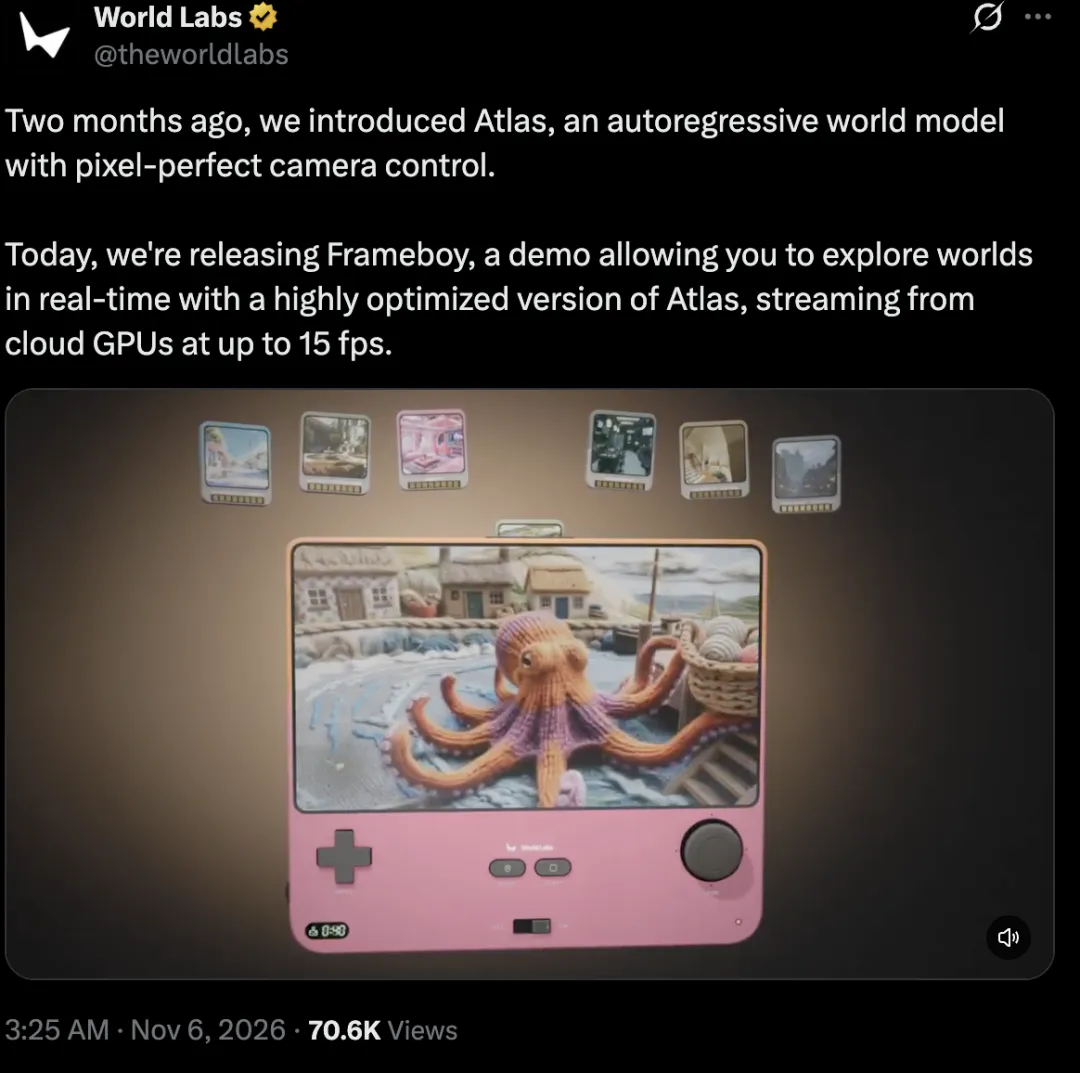
What was the world model we used to play?
Throw a picture in, wait a few minutes, spit out a shaky video, and you're just an audience.
The camera pulled a little backwards, and the image began to collapse.
This interaction with Andy Cheng took control of the machine and changed the game:
Free travel from perspectiveSwing poles to the left, camera parameters to the cloud, and models start to speculate on physical details, shadows and depth of field that never existed on the left.
Generate three-dimensional fields in a single diagramWith a simple overview map or a Prompt, Atlas can use this layer of pixel to replenish an entire Stanford Square, Gothic Courtyard, or Shenyang Village.
Clouds are becoming more and more resilientThe image is streamed from the cloud GPU to the screen at up to 15 fps, and the delay is controlled within the range of sensory acceptance.
To put it bluntly, every directional key you press is re-calculating the physical details of the model site.
It was a bit of a shock for a while.
Originally, they thought that the world model would be moving towards real-time interaction for another two generations, and as a result, they directly pushed the line of progress forward.
How to optimize
How is it possible for an Atlas as big as this to run at 15 fps?
It's the first time I've ever heard of it.
Last year's lightweight model of RTFM, while fast, was essentially just plugging values between several known viewpoints.
It's easy to fill in the gaps between a few good shots.
And it's a real, big model built on massive data that can "create a world without life" from scratch.(Even if it's just a picture or a sentence)It also maintains a fairly strong 3D spatial consistency.
But the cost of the big model is the delay in the reasoning of "sexual enrichment".
In order to generate instant feedback on fingers and pixels, World Labs has played a vital role in engineering architecture:
Frameboy is run not by the full raw weight of Atlas, but by an extremely optimized special variant that maximizes the computational expense of single-channel generation while retaining the extremely new viewpoint synthesis capability.。
Not only that, they've also integrated this set of real-time pipelines into their own editor, Viewfinder.
Developers can stack their own worlds with the Atlas button, while directly pulling up the real-time floating layer of the Frameboy, running the first-person shooter scene like a game.
From algorithm giants to handheld toys, the stored cache and token ledgers in the middle are evidently traces of the hardware engineering underpinnings being cleaned after AMD's entry.
As the cost of computing continues to decline, the threshold for real-time interaction will naturally decrease further.
You can visit the official website of Frameboy and register to experience:
The entire interaction interface is a retro control panel with multiple real-time scenarios built into it for people to wander around at will.
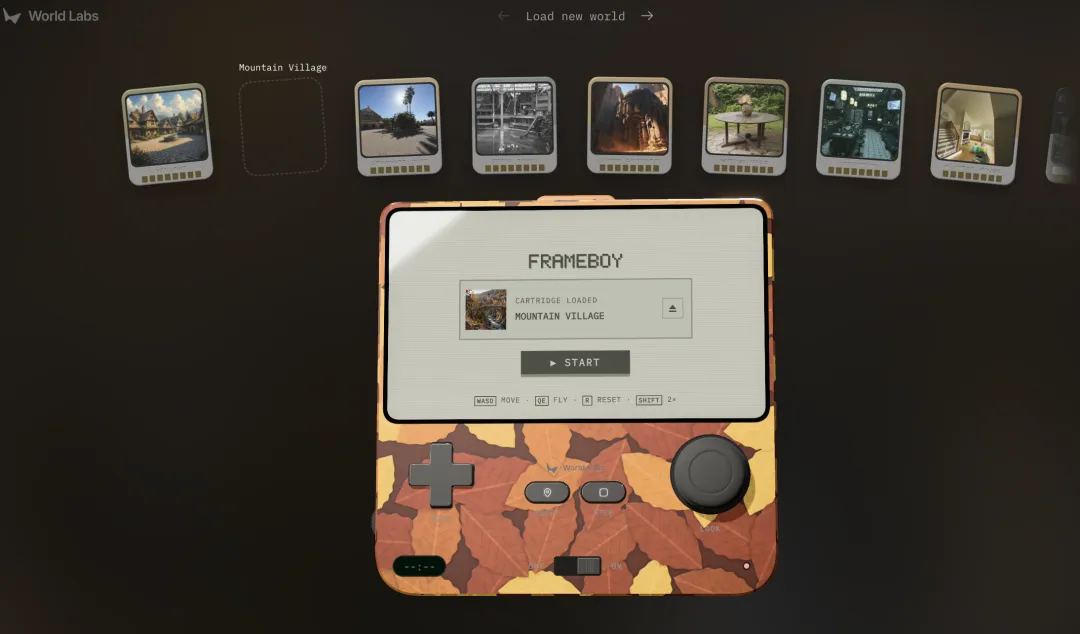
It is also possible to drag a real-life photo of yourself or input a cue word, which the system uses as a point of reference to extend it outwards.
Networker Aarav Kothari shared a video of a real-life experience:
10 points, see how many you've scored?
The link is as follows:
[1]
[2]
[3]
[4]