The Vice President of the platforms department of Zhejiang Systems, Zhang Zhengsheng, said:The pain points of traditional automated storage can be summarized in three ways:
The first is:Flexible short boards.Traditional automated production lines, AGVs, and stacking machines are rigid systems. Once SKUs are updated, business processes have to be modified, procedures have to be modified, production lines have to be modified, and large amounts of human resources and money have to be invested to adapt quickly to business changes.
Second, the process.Cut it out.Storage, transportation, and outsourcing have been automated, but the precise operation of picking, cleaning, and packaging is highly dependent on humans, which is an extremely large part of the process of warehouse operations.
Third, the lack of proactive optimization skills.Traditional systems rely on preset operating rules, encounters with order peak waves, equipment failures, order structural mutations, systems can not move autonomously, dynamic optimization, can only rely on the operator's artificial torch rescue, system robustness is insufficient.
Traditional unmanned warehouses are essentially dehumanization under the fixed business assumption: business form, SKU, processes do not change, the whole package can be stable, but the real scenario is always uncertain.
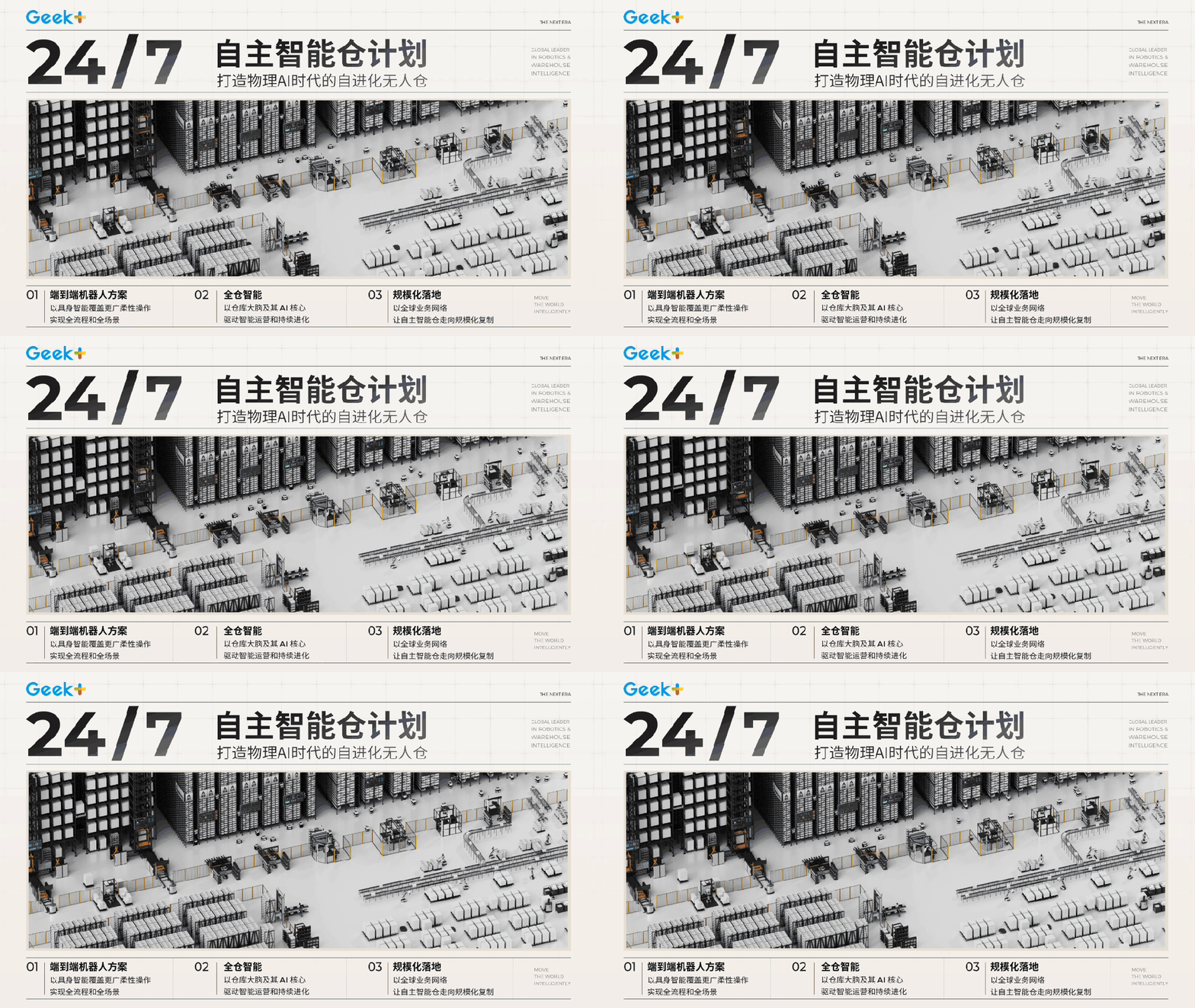
The key difference between autonomous smart stores is:Upgrading the unchanged execution rules to a self-organizing mode that the system can autonomously execute in the physical world.Autonomous smart warehouses are not single-point hardware upgrades, but a set of software hardware integrations, logistics infrastructure that can be subscribed to continuously evolving. Its goal is not statically unmanned, but in the real scenario of business changes and abnormal frequency, to maintain 7×24 hours of unmanned autonomous operation over the long term.
IOP+WES+RMS triad
Whole warehouse intelligence builds a global decision-making loop
The software core of an autonomous intelligent warehouse is the Intelligent Warehouse Brain, which consists of the IOP intelligent operating platform, the WES warehouse execution system, and the RMS robotic management scheduling system.Breaking down the traditional layering problem of storage software, integrating orders, inventory, robots and all kinds of devices into a unified state space to achieve real-time optimal solutions across the globe.
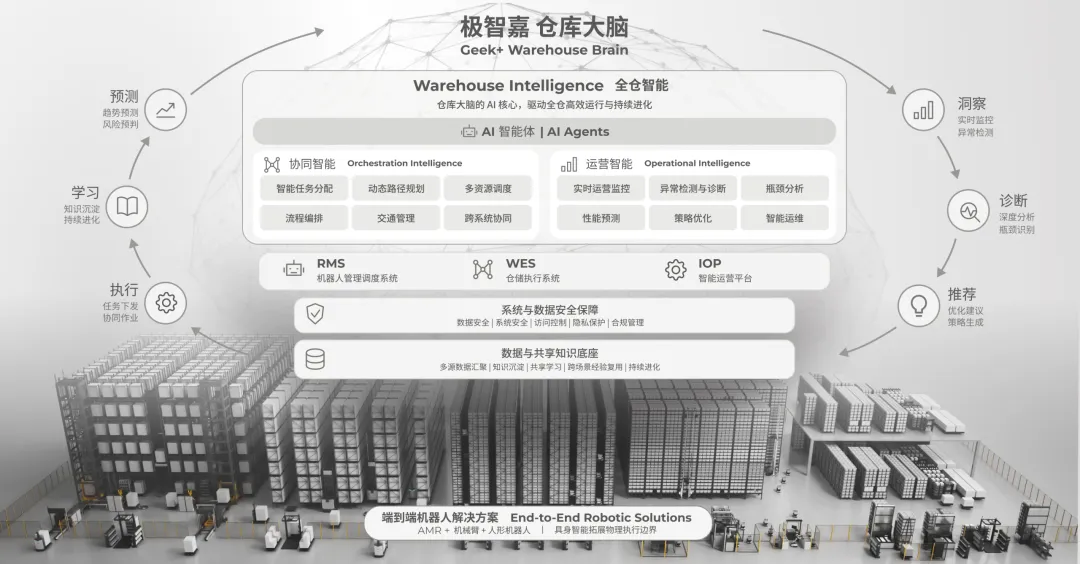
Build a whole systemPerception→ Recognition→ Analysis and Evaluation→ Execution of Verification→ Continuous feedback closed loopThe coordinate layer supports minute-to-minute dynamic adjustment, full-link optimization, and continuous strengthening of the three major AI agents deployed based on perceptual monitoring, data analysis, and deployment.“Collaborative intelligence”and“Operating intelligence”。
According to Liu Feng, the ability to evolve autonomously is based on the belief that human beings can evolve autonomously.Scene coverage, operational efficiency, system stabilityThe three main indicators are quantified and the core objective of the system is to achieveIt's hard to believe.Support for 7×24 hours of uninterrupted operation
CeMAT on-site fitness center verification
Attack on FlexibilityComplex operation problems
It is the software brain that determines whether the warehouse will think and whether the smart body will decide not to move, and this is also the central point of view of the CeMAT Exhibition.
Zhengheng stressed that Zhengjia's idea was to transform the end-operations that were originally dependent on humans, uncontrollable and unstructured, into automated links that could collect data, control processes, and optimize systems.
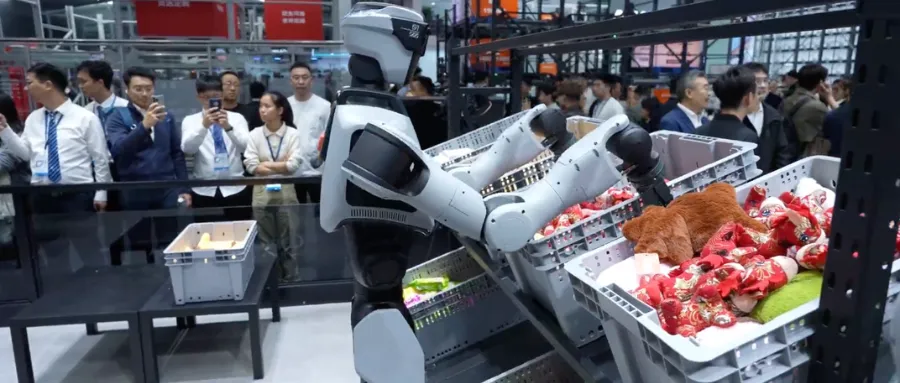
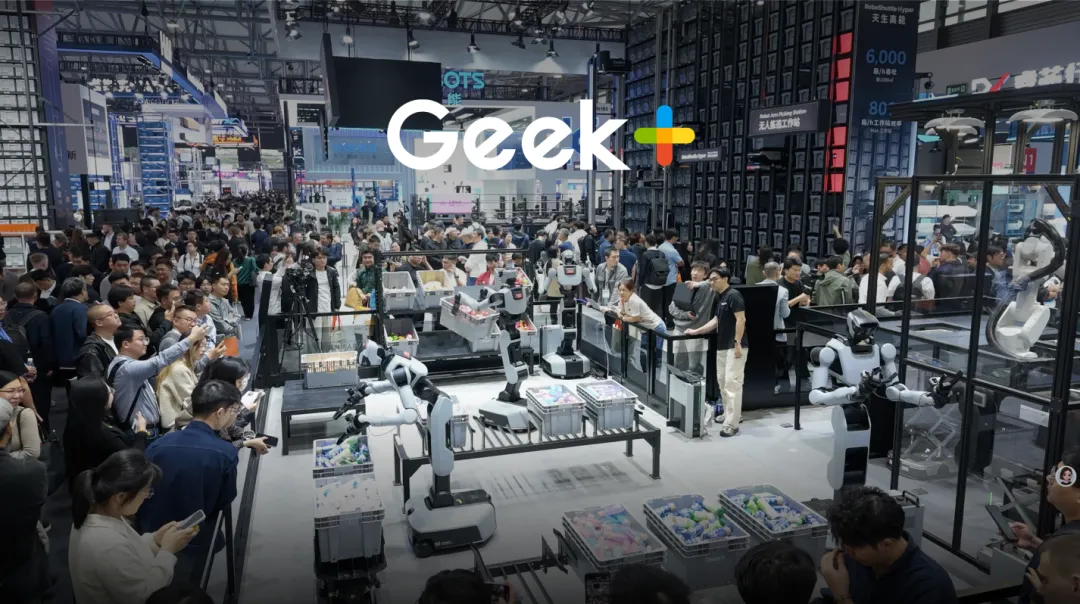
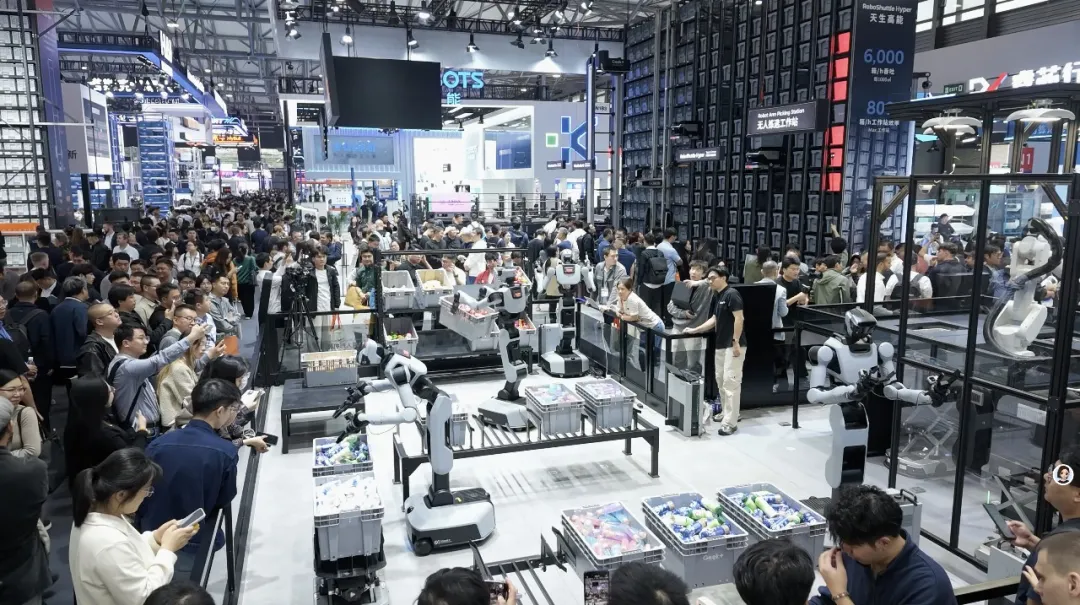
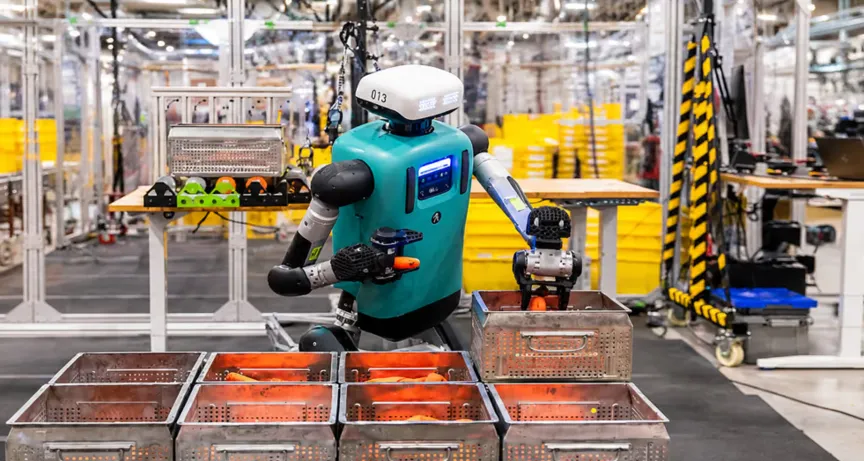
At the CeMAT site, Toshigawa demonstrated the general-purpose humanoid robot Gino 1, the RAPS unmanned pickup station, and intuitively demonstrated the landing power of physical AI in the warehouse scene.
For warehouses, the core demand is thatThe question of whether robots can continue to work steadily in the face of different categories of goods, which is underpinned by AI's self-development.GravityModels with physical intelligence• Multi-group presentations on the ground, intuitively demonstrating the core characteristics of the model.
First, it has the ability to predict movements and perform virtual projections before performing missions.The stand screen synchronizes the process of predicting the model with the actual movements of the mechanical arm, clearly demonstrates the ability of the mechanical arm of the Gravity body model to predict subsequent movements and interaction results, to put some trial and error ahead of the model simulation stage, to reduce ineffective attempts in physical operations, and to ensure the reliable completion of long-range multi-step tasks.
Second, the ability of the environment to adapt to change.When the position of the pan is changed and the original point grabbing fails, the model can re-perceive the position of the target, dynamically adjust the movements, and verify that its characteristics can still be continued to complete the task when the field conditions change.
Third, strong generalization capabilities supporting non-biological species without additional training in direct selection.In the presentation of the challenge of selecting non-organic goods, in the face of different shapes, materials, postures, the model autonomously identifies the pick-up point and the pick-up posture to complete the pick-up, directly hitting the warehouse scene SKU continues to generate business pain points.
In addition, Gravity's body-smart model is also included.Natural language correctionsWhen robots encounter out-of-distributed tasks, operators can complete corrections using natural language instructions, improving the success rate of tasks. This greatly reduces the deployment barrier, without the need for engineers to re-label, train models, and field operators can intervene in common language.
With this amplified, predictable, adaptable model capability, Gino 1 is able to access real storage environments, complete clutches, abnormal processing, and other flexible operating shortcuts. Depending on its Gravity capabilities, Gino 1 is able to handle complex flexible operating links in the warehouse, and collaborate with AMR, workstation compilation, generating storage, selection, and transportation of all processes, and building end-to-end warehouse productivity for all types, processes, and scenarios.
All types of AMR schemes are connected to the platforms, such as standplaces, trays to people, trays to cars, shelves to people.
The new generation of cargo-to-people plans for the RoboShuttle HyperThe exhibition marks the debut of the RS Hyper crawler robot cluster, which combines the ability to move at the level with vertical crawler capacities, relying on adjacent rows of parallel crawlers, combining in- and out-of-the-box crawlers, dual-directional high-throughput networks and intelligent scheduling to achieve 6000 crawler crawlers per hour in the space; supports Max workstations with dual-point continuous supply crawlers, with an efficiency of up to 800 crawler crawlers per hour. With 1.5 m/s of crawling speed, dual-train operation, dual-high-throughput networks and other features, the program also takes into account high storage density and hyper-throughput, and is suitable for high flow density scenarios such as MFC pre-storage and B2C.
SkyCube Tennis 4 to the carFacing the high-flow, high-density trash storage scenario, which improves storage capacity utilization and output efficiency through stereo storage and intelligent scheduling, a set of systems can simultaneously take over repair, complete trash, dismantle multiple types of operations, without partition switching, support for phased deployment, and can replace traditional stacking systems.
Newly released RoboPallet trolley sized minivan schemeFor the construction of medium-traffic new warehouses and the conversion of existing forklift warehouses, suitable for a net height of less than 13 meters, throughput of the need for a suitable trolley warehouse. The program is coordinated by RMS to coordinate the operation of the RP11 high-speed forklift with the RP2 low-speed forklift or the P-series robot, the parallel operation of high-speed access and ground transfer, the opening of the trolley access, supply and the selection of the entire chain of workstations.
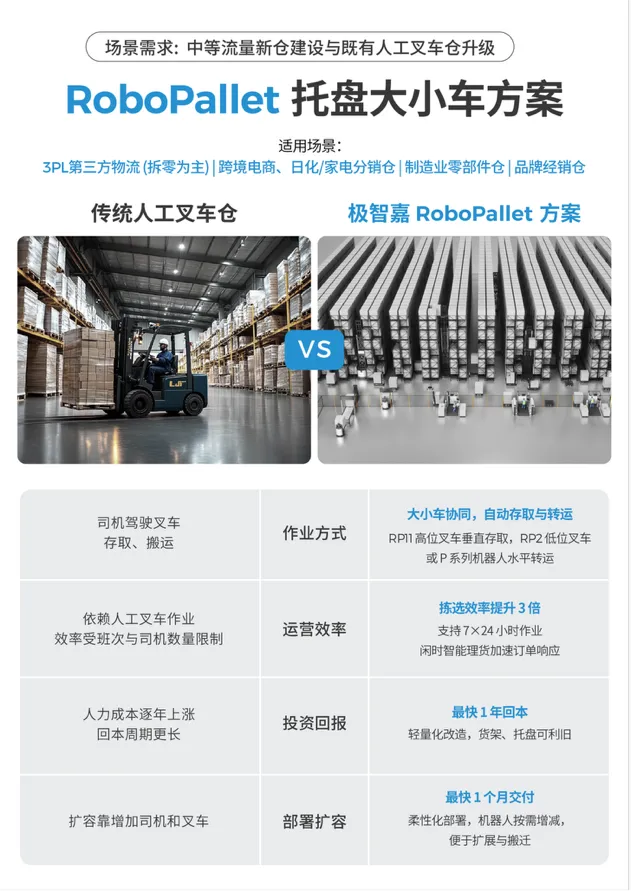
RoboPallet can directly replicate the original rear-wheel racks, is compatible with many types of trays, without the need for new mother trays, the old warehouse transformation scenario can be upgraded by up to one year; it improves the efficiency of picking up more than three times compared to artificial warehouses, supports 7×24 hours of operation, can also prepare pre-loading, reduces peak loading. The program uses standardized modules, without a large amount of structural transformation, one-month delivery, increased robotic flexibility, flexible adaptation to business growth and dynamics.
At present, Toshigawa has a complete system of end-to-end robotic storage solutions that can meet the needs of different storage processes and a wide range of operating scenarios. A full range of AMR programming combinations, comprehensive coverage of containers, trays, shelves, and other structured operations such as moving and picking in warehouses in different storage formats, to achieve efficient order fulfillment.
According to Liu Feng, the barriers to differentiation of Zhijia come fromSoftware-hardware integration capabilities, real warehouse data from thousands of customers around the world, complete warehouse operating systems● Continuous training of the warehouse brain, based on mass-in-place data, to implement continuous iteration of models in the warehouse scenario.
Self-evolution
Let's keep up the growth of full-blown intelligence
There are two distinct paths for the autonomous smart warehousing program to design new warehouses and convert old warehouses with storage of aluminum.
It's not.New warehouseIn the planning,In the planning phase, AI Native is used as the underlying logic of AI, optimizing robot selection, device layout, operation process from the source, pre-booking the location of robot deployments, and maximizing the value of full-service intelligence and robot synergies.
It's not.Restoration of the old warehouseIn the middle,Following the minimal modification of the silicon upgrading logic. Keeping existing robots, hardware such as shelves, focusing on picking, milling, etc. density disconnection of new equipment workstations, equipment such as Gino 1, overlapping IOP/WES/RMS software upgrades, iterative optimization on the basis of the original business processes, avoiding large-scale construction and equipment replacement.
At the commercial level, ZTE is completing a key transformation:From one-time delivery projects“I'm buying and selling.”In addition to this, there is a growing trend towards subscription-based smart operating services.Customers subscribe to warehouse brain services, the Intelligent Services team continues to diagnose bottlenecks in warehouses, modify operational strategies, and benefit customers based on efficiency improvements and cost savings.
In the past 11 years, Zhijia has demonstrated that robotics technology can achieve large-scale commercial applications in the field of global warehouse logistics. The next stage of the goal is to drive the entire warehouse to operate autonomously 7x24 hours and continue to evolve.
From automated warehousing to fixed-process unmanned warehousing to autonomous intelligent warehousing, the warehousing industry is undergoing a three-tiered leap: machine-replacement tasks→ fixed-scene unmanned operations→ autonomous perception, decision-making, learning, and business adaptation to continuous change.
Of course, autonomous evolution is not the end of a step-by-step process, but a long-term process of continuous iteration.Opening up the entire process, strengthening the smart loop, making autonomous smart warehouses scalable.。