I'm going to tell you something.The shadows
The first American robot is here!
On November 5th, the robot forecaster reported that just now, the American Robot Corp.Agility RoboticsOn the NASDAQ market, the clock is ringing and the stock code is AGLT.
Following the SPAC merger, the company closed its IPO yesterday at $5 per share (approximately RMB 33.34), the first day after the new merger, a 19 percent surge to $5.95 per share (approximately RMB 39.67), followed by a 79.8 percent rise to $8.99 per share (approximately RMB 59.95), a sharp decline as of 22:54, with the latest share price rising by 15.5% to $5.78 per share (approximately RMB 38.54).
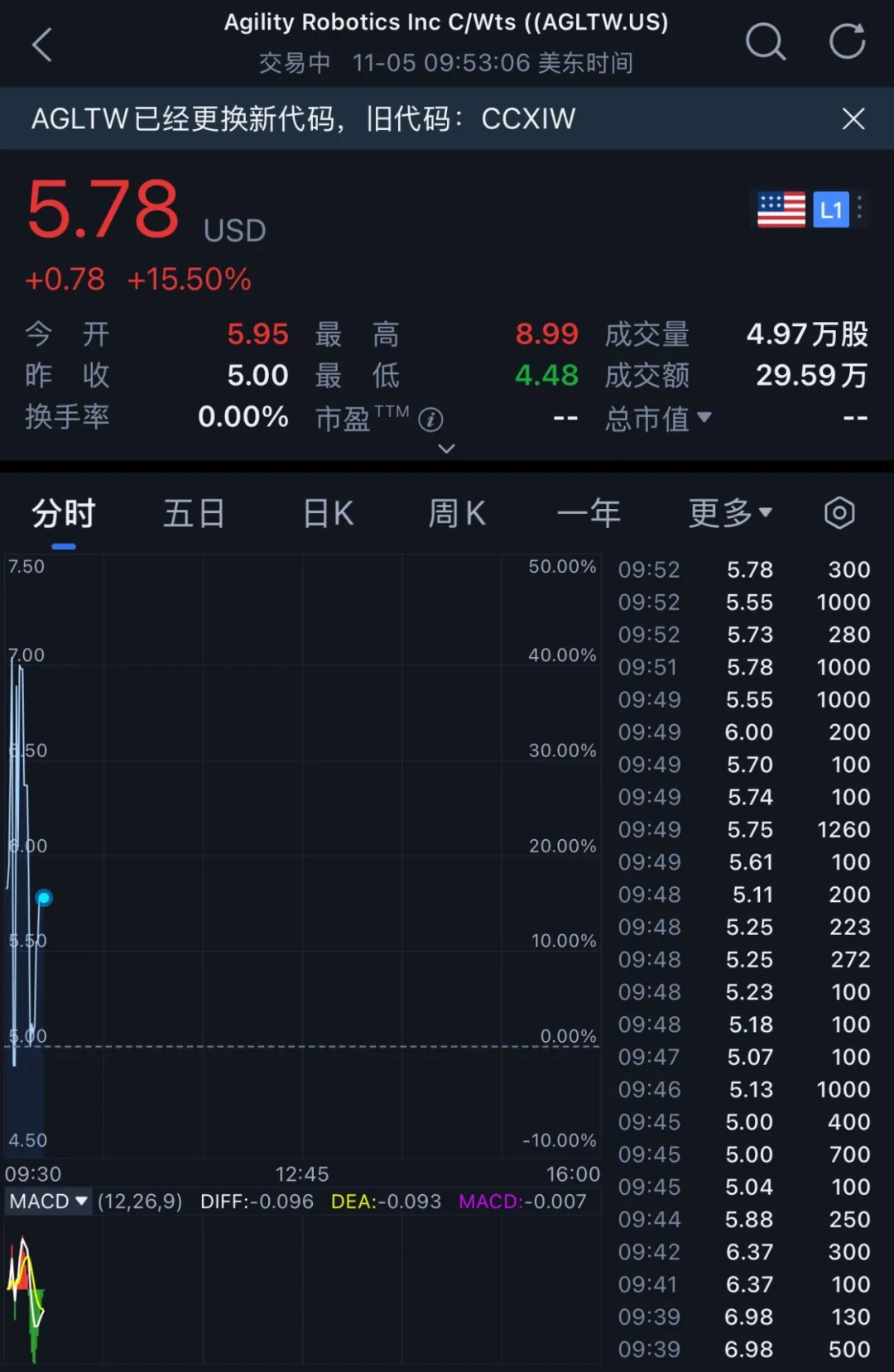
As a result, the company's stock price has dropped sharply.
Founded in 2015, Agility's main business is to build humanoid robots for manufacturing, logistics and distribution. The company signed a business merger agreement with Churchill Capital Corp XI, a publicly traded special purpose acquisition company, in June this year.
According to the announcement, Agility's pre-investment equity valuation of the corresponding shares in this transactionUS$2.5 billion (approximately RMB16.68 billion)The transaction was initially expected to raise over $620 million, assuming that SPAC's principal Churchill XI shareholders would not redeem shares; at the end of the redemption period, due to a large number of shareholders choosing redemption, the latest estimated total fundraising was reduced to about $465 million (approximately RMB 3.1 billion) (excluding transaction fees).Peggy Johnson, CEO of Agility, said in an interview with TechCrunch that the move was in order to take advantage of the industry's pioneers.
This family of humanoid robots presents two scenarios of venture capital and two lines of commercialization. According to the IPO, as of June 30, 2026, it primarily financed its business through preferred stock, with total cumulative financing of approximately $6 billion.US$40.8 billion (approximately RMB 26.74 billion)Investors' list of bright stars, includingIt's the first time that I've been able to do this.It is the world's leading industrial capital and financial investor.It also further encourages its humanoid robots to explore their commercial locations. Currently, its humanoid robot Digit has been commercially deployed in major companies such as global auto parts giant Schaeffler, global third-party logistics company GXO, Canadian automaker Toyota, with cumulative operating hours exceeding 65,000 hours.
However, under the bright landscape and the roster of luxury shareholders, Agility is still facing challenges.Severe profit pressuresAccording to Agility's financial statements, its total sales for 2024, 2025 and the first six months of 2026 were $310,000 (approximately RMB 206 million), $1782,000 (approximately RMB 1189 million), $17.40,000 (approximately RMB 116 million), and net profit for the same period was $70.552 million (approximately RMB 470 million), $1.38 billion (approximately RMB 922 million), and $362 million (approximately RMB 241.5 billion).
Commercialization of humanoid robots is still in its early stages, and after the launch of Agility, the pace of its commercialization, order size and cost control will continue to be tested in the market.01.
Abortion at the Dynamic Robot LabEarly two-legged robot Cassie sold only 10 unitsAgility aborted at the Oregon State University Robotics Institute.
In 2008, Agility co-founder and chief technology officer Jonathan W. Hurst founded the Dynamic Robot Lab at Oregon State University.
The laboratory initially studied the long-term theory of spring-mass dynamic walking, mimicking the leg mechanics of runners, as opposed to the slow, rigid, point-by-point controls of traditional robots.The two-legged robot prototype ATRIASEfficient dynamic two-leggedness has been verified, demonstrating that the legs can store energy like a spring, consume very little energy, can walk, can run, can adapt to uneven ground.
After that, he decided to start a startup in order to build real robot products.
In 2015, Hurst co-founded Agility with Dr. Damion Shelton of Carnegie Mellon University, a serial entrepreneur, and Dr. Mikhail Jones of the Dynamic Robot Lab.

From left to right are Jonathan W. Hurst, Michael Jones, Damion Shelton,
The company initially focused on building the first two-legged robot, Cassie. The robot's legs resembled birds of prey and could maintain balance through active and fluid movements. In September 2022, Cassie set the Guinness World Record for the 100-meter short run of a two-legged robot.
In order to give robots more practical value, they targeted the warehouse scene. In 2017, they started building the humanoid robot Digit V1, which in September this year had evolved into Digit 5.Digit 5 is the first step in the real evolution of Agility towards universal robotics.。
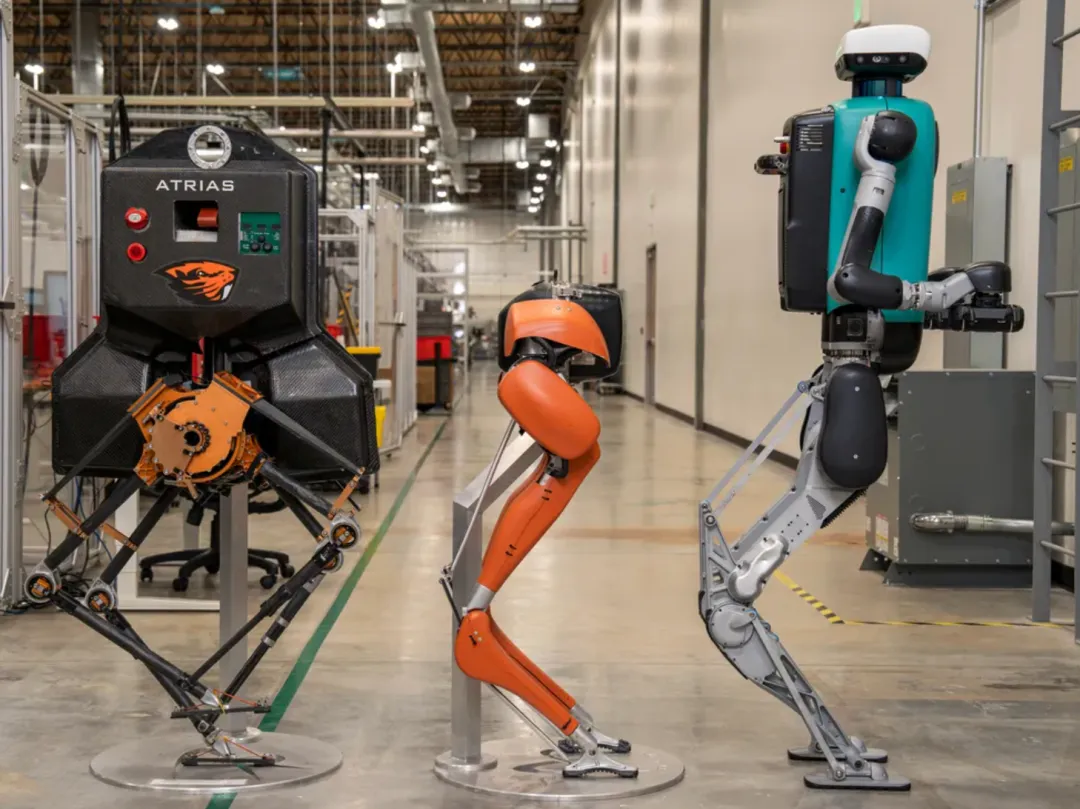
From left to right: ATRIAS, Cassie, Digit 4
02.
Accumulated losses of 4.5 billionR&D spending over 1.3 billion in the first half of this yearCurrently, Agility has developed a product matrix for Agility Arc, a cloud automation platform for deploying and managing a cluster of Digit robots, including multifunctional humanoid robots designed for logistics and manufacturing.
Its business model is based on a collaboration program for robot deployments and a two-modal asset-ownership landing at Digit Human Robot, where the company says the robot deployment model can continue to generate recurring revenue over the robot's expected five-year lifecycle while increasing customer retention.
In 2024, 2025, and the first six months of 2026, total sales were $310,000 (about RMB 206 million), $178.2 million (about RMB 118.9 million), $17.4 million (about RMB 116.6 million), net profit was $705.52 million (about RMB 470 million), $138 million (about RMB 920 million), $362 million (about RMB 241.5 billion), and $536.8 million (about RMB 356 million) and $916.44 million (about RMB 611.1 billion) and $200 million (about RMB 13.34 billion) for two and a half years respectively.
The total sales decline was attributed to revenues of $500,000 (approximately RMB 333.62 million) from the sale of one-off robots in 2025.
Its major investments in R&D include increased stock remuneration costs, increasing valuations, expanded R&D resources, and increased material costs and costs for external R&D services associated with the continued development of the Digit 5 robot.
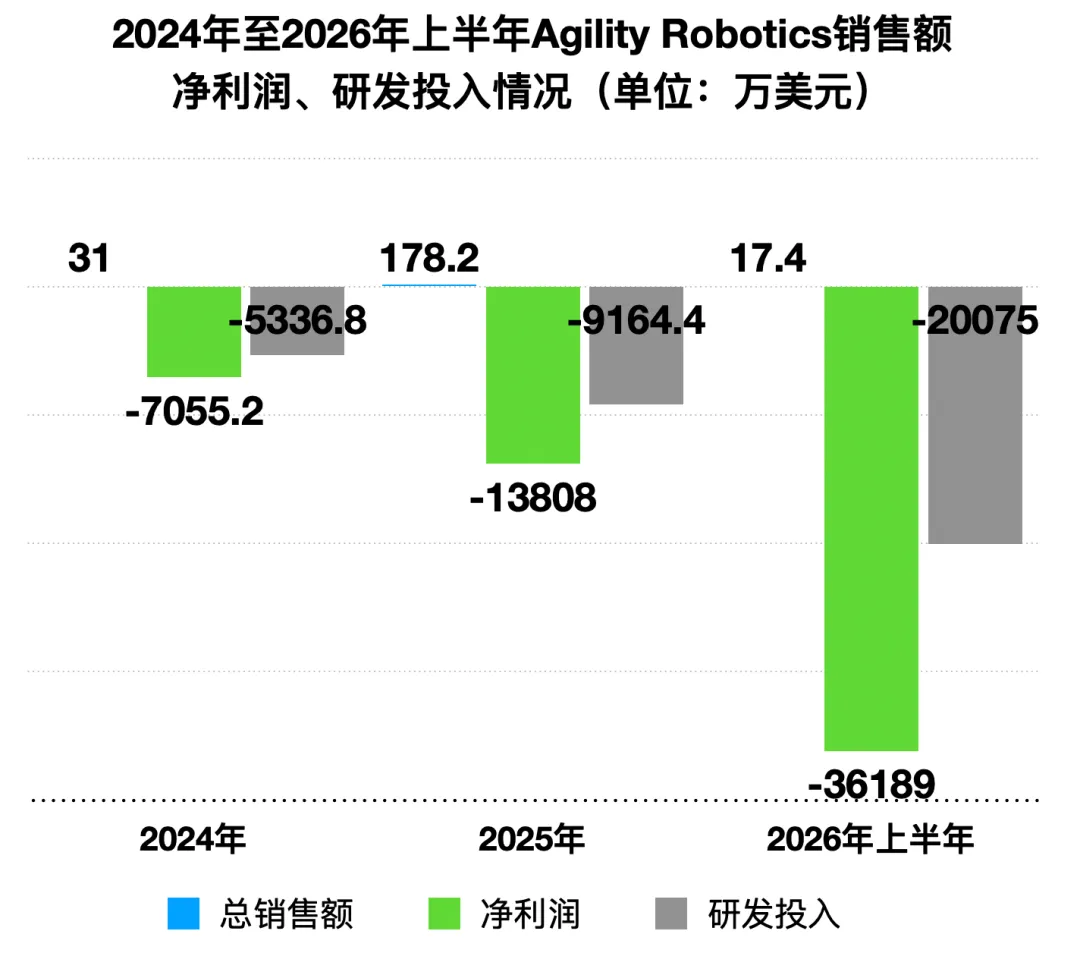
▲Agility Robotics net sales profit, R&D and investment in the first half of 2024-2026 (robot forecasting map)
In terms of gross profit, Agility's gross profit for the first half of 2024-2026 was $15.3 million (approximately RM102 million), $269.1 million (approximately RM179.6 million), and $371.5 million (approximately RM247.9 million), respectively.
Currently, the robotics industry is still in the money-burning phase. According to the IPO, Agility has spent $348.1 million (approximately RMB2.3 billion) on its operations since its inception.Total loss of $675 billion (approximately RMB4.5 billion)It expects continued losses in the future and further increases in operating expenses.
During the same period, cash and cash equivalents held by Agility amounted to $14.7 million (approximately RM98.8 million), long-term restricted cash amounted to $7.1 million (approximately RM47.7 million), and long-term restricted cash amounted to only specified uses.
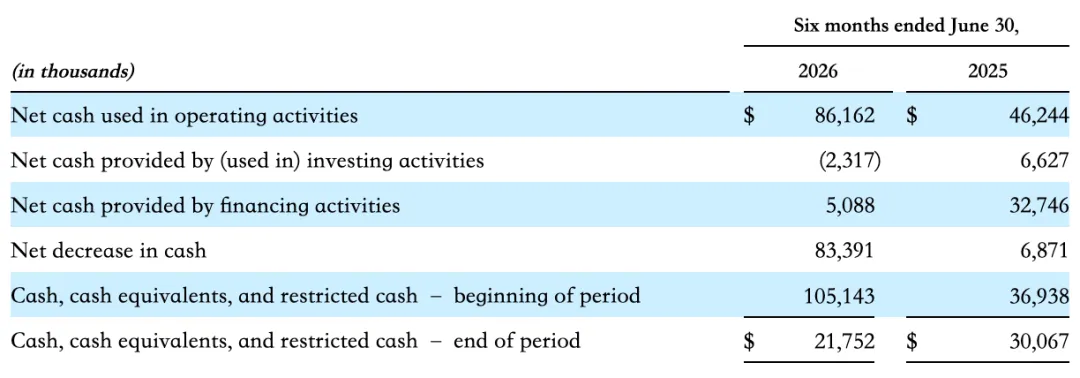
The cost of Agility's commodity sales increased year on year to $46.3 million ($308.9 million) and $447.3 million ($29.85 million) respectively over three and a half years. According to the tender book, this growth was mainly driven by the expansion of robot deployments.
03.
Digit 5 promises orders in excess of $300 millionUK's first security system partnerAgility's business is divided into two main segments: Digit, a humanoid robot, and Agility Arc, a cloud-based automation platform.
In September this year, Agility released the fifth generation of robotics.Digit 5It was the first humanoid robot designed specifically for large-scale collaborative safety operations.
At the hardware level, Digit 5 weighs 284 pounds (129 kg), is 5 feet 11 inches (1.81 m) tall, reaches a maximum of 7.2 feet (2.2 m) in height; depending on swinging line executor technology, Digit 5 can repeatedly lift loads of up to 50 pounds (22.7 kg); the new 90-minute battery life system can be charged in just 9 minutes, allowing the Digit 5's life and charging time to reach 10:1; support for manual task replacement tools.
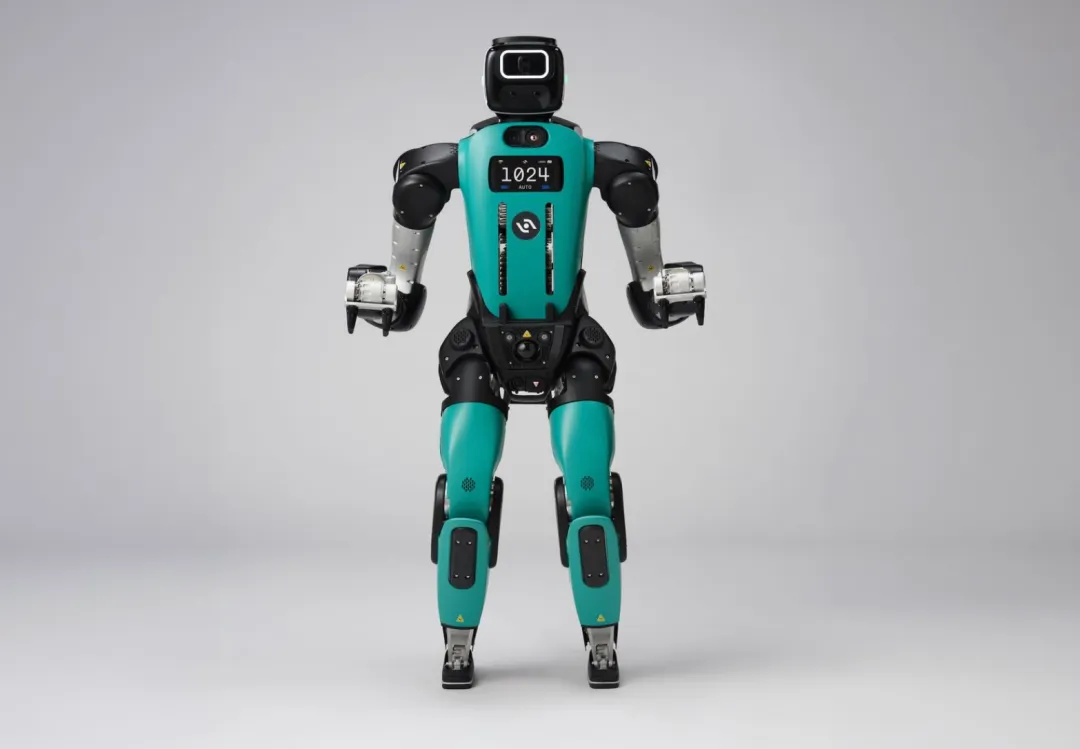
▲Digit 5
At the software level, Digit 5 is fully integrated with Agility Arc, a platform for deploying and managing Digit clusters of robots.
Agility Arc provides operational visualization of clustered critical performance indicators, including normal running time, throughput, and average failure intervals, while also connecting to existing warehouse management systems, warehouse execution systems, and manufacturing execution systems.
The company plans to start delivering the product to its first trial customers in the first half of 2027, with the goal of reaching full market cap by the end of 2027.More than $300 million (approximately 2 billion yuan)The long-term commitment order.
In addition, Agility has built its own robot assembly plant. The company's robot assembly facility, located at the 70,000-square-foot RoboFab plant in Salem, Oregon, is a dedicated facility dedicated to the mass assembly of humanoid robots. At full load, RoboFab designs a production capacity of 10,000 Digit robots per year.
In July, the company expanded a new hardware and physical AI development center in Fremont, California, as a supplement to the RoboFab plant.
According to the book, Digit is currently about75%The components are native to the United States. In its IPO, it revealed that the high-value hardware system was developed independently by Agility, including self-developed executors, modular end executors, full-body control platforms, sensor architecture, full-system security and long-life fast-charging battery systems. The company has also developed its own physics intelligent layer integration skills ("Skill Definition Layer"), real-time synchronization with control systems based on physical AI models.
04.
CEO to join in 2024He worked for Microsoft, Qualcomm, and Magic Leap.Following the merger of Agility and Churchill XI, Agility CEO Peggy Johnson will continue to serve as CEO and Chairman of the Board of the merged company, Chief Financial Officer and Operating Officer Jennifer Hunter will serve as Co-Founder and Chief Robot Officer, and Chief Legal and Human Resources Officer Ana Lang will continue to serve in the same role.
The board of directors of the merged company will consist of seven directors, up to a maximum of nine. The list of directors and senior executives proposed is as follows:
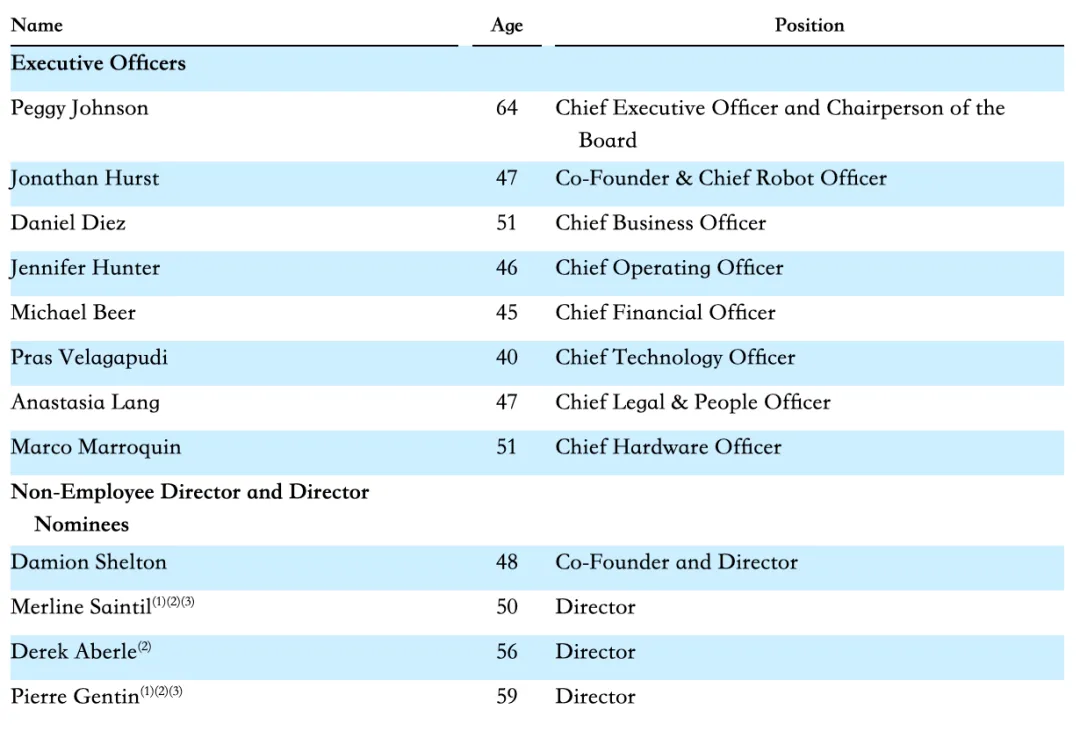
The company's executive team, which includes CEO Peggy Johnson, chief financial and operations officer Jennifer Hunter, chief legal and human resources officer Ana Lang, and the 2025 executive team, are as follows:
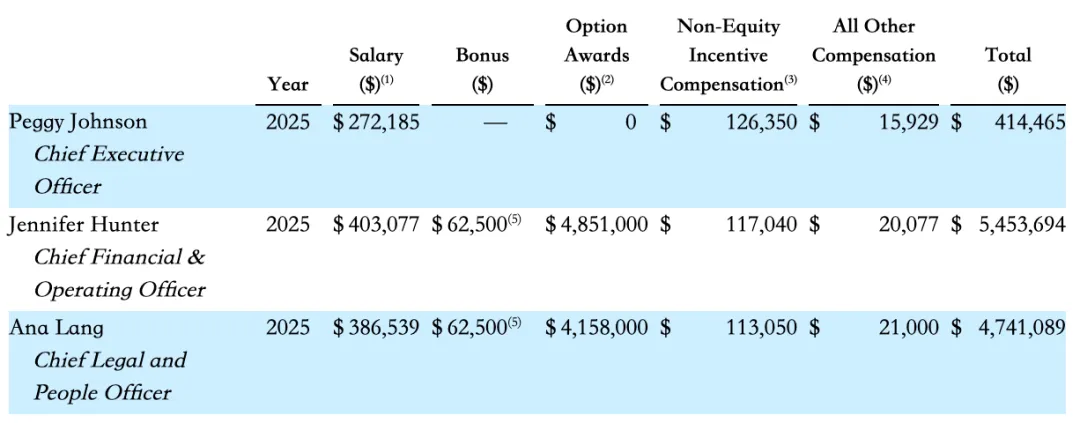
Johnson holds a bachelor's degree in electrical engineering from San Diego State University, and prior to joining Agility, she worked at Fox, Blade, Qualcomm, Microsoft, and Magic Leap. She joined Agility in March 2024 as CEO, leading the commercial deployment and expansion of the Digit humanoid robot.

This is the first time I've ever heard of this song.
Hunter holds a B.S. in mechanical engineering, an M.S. in robotics and a Ph.D. in robotics from Carnegie Mellon University. He co-founded the robotics program at OSU and has been a professor there for more than 17 years.
05.
This is the first time I've ever heard of a human-robot player's ability to survive.It's just a matter of cutting costs and making money.The launch of Agility is a shortened version of the Robotics Raceway, which is a capital grab for Physical AI and a commercialisation win-win. The Agility-represented robotics enterprise relies on demos, pilot orders, and project collaboration to verify the technological feasibility, but the commercialization cycle of stability, high returns, and continuous repurchases remains a huge gap. The momentum of the race is still unabated, but the rating system for the company has changed, and future survivors need to find new scenarios, keep pressing down on hardware costs, and make commercialization run-win.