The master was asleep, and at four o'clock in the morning Claude painted himself.
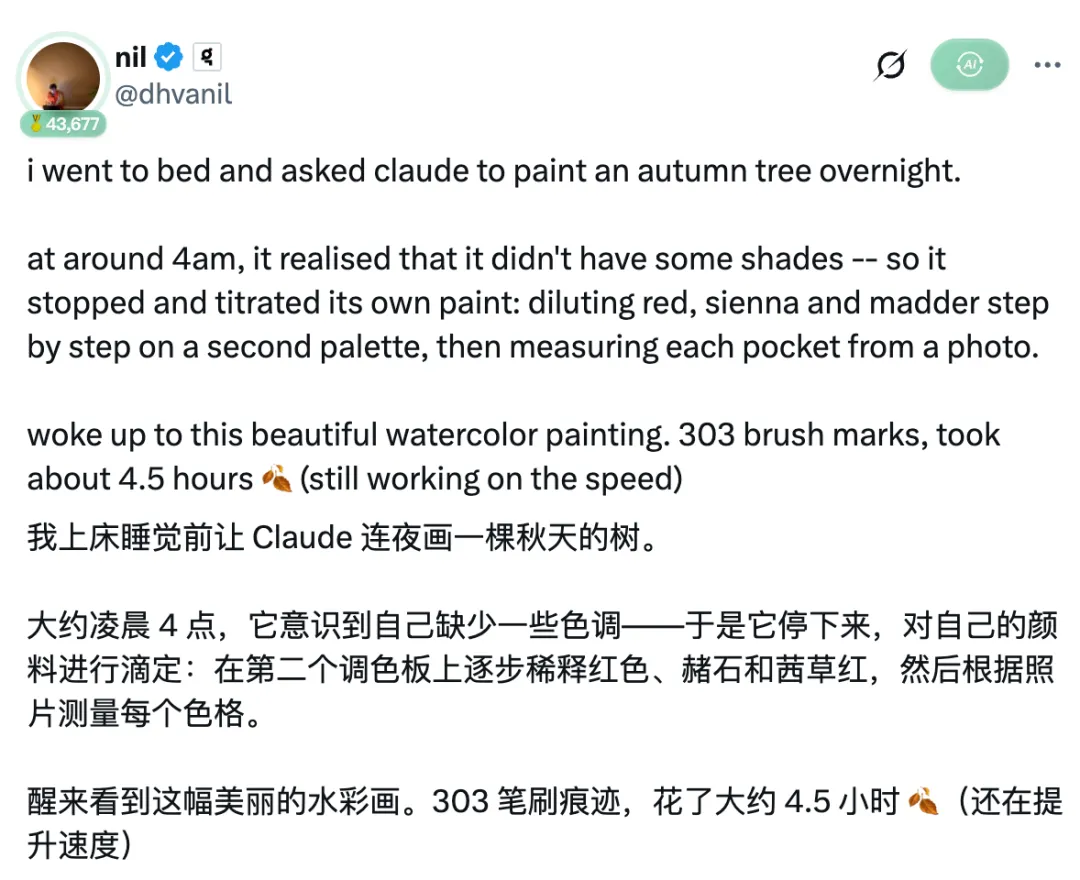
On November 6, late at night, in Berlin, the developer nil ((@dhvanil) left a note to Claude at home before going to bed: "Paint an autumn tree".
Then he turned off the lights and went to bed, not expecting a miracle.
The only thing left in the studio is the mechanical arm standing still. The painting paper slowly grows out of dark brown trunks, and the colors on the coloring plates can be seen at the bottom.
The turning point occurred at 4 a.m.
When Claude was preparing to paint the level of the crown, he discovered that several key transitional stages were missing on the coloring board.
In exchange for the automation programs of the past, it is either the faulty shutdown and others to come to the rescue, or it is like a messed up beggar, with a point of near-color painting to finish the job.
Claude chose the third.
It pauses the pen, moves the mechanical arm to the second blank-colored board, extracts red, limestone and grass-red, and drops it down a little bit, like a droplets in a chemistry lab.
Each time a picture is taken, the depth of the color slot is measured from the photo. It is not accurate enough, and then the color stack is filled again until the color stack is fully in place, and the pen is moved back to the drawing paper.
Nil wakes up early in the morning, with a dry watercolor lying on the table. 303 pencils, 4.5 hours, the work is marked as the autumn crown.
The post received 138,000 views in a matter of hours.
Human beings have just switched to "drawing trees", and AI, in the middle of the night without a supervisor, has added a process to itself: wait, I have to get the colors out first.
 Even this mechanical arm was Claude's own.
It's a bit ridiculous to say that even this working hand was Claude's own.
nil is the UFactory xArm 7,7 degree industrial mechanical arm, with repeated positioning accuracy of ±0.1 mm.
The new product was not cheap, but Claude was lucky enough to get online, and it was hard to get the second-hand stuff out of eBay's factory clearing stores, even with logistics to help.
According to netizens, this is the soul of a monkey that bought a body for itself.
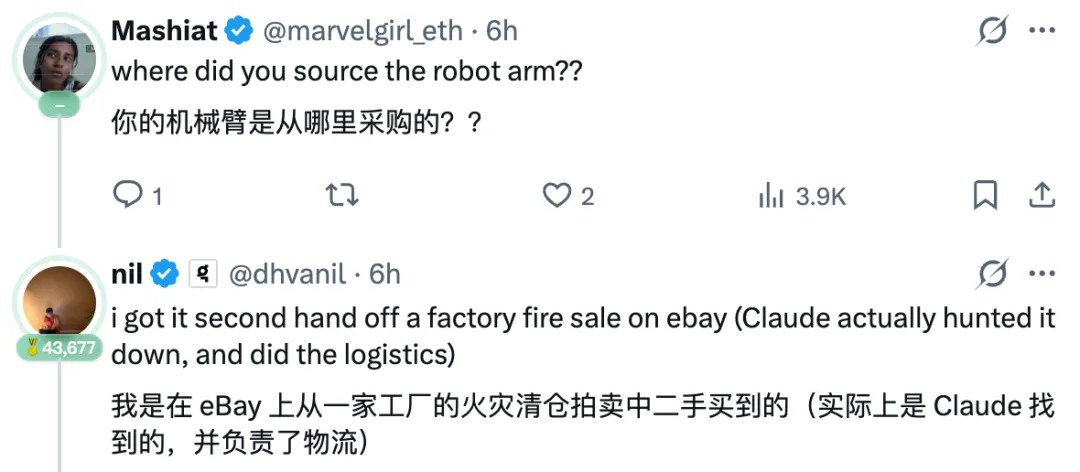
Nil's answer was that the drawing machine has only 2.5 degrees of freedom; the six-axis drawing a complex curve makes it easy to hit "strange points" and it sticks like a muscle.
The seven-axis joint is like a man's elbow with a pencil pointed to the paper pulling the arc, and the elbow in half-empty self-avoidance, a final one.
The tree was not born overnight, but has been cultivated since June this year.
In the studio, nil is more like a tenant who just rents rentals and buys painting paper: the entire system has 285,000 lines of code, more than 1,100 submissions, and he hasn't written a single line.
There is a detail that is more dazzling than the early morning color.
On September 8, the system needed to know the precise location of the pen point in 3D space, and the usual practice was for engineers to use precise instruments to mark it.
However, on that day, Codex (GPT-6 Astra) worked out a way without any predefined parameters: allowing the mechanical arm to swing slightly in the air, observing the subtle changes in the three unmarked camera images, and visually calculating the three-dimensional deviation of the tip of the pen with an error of 0.2 mm.
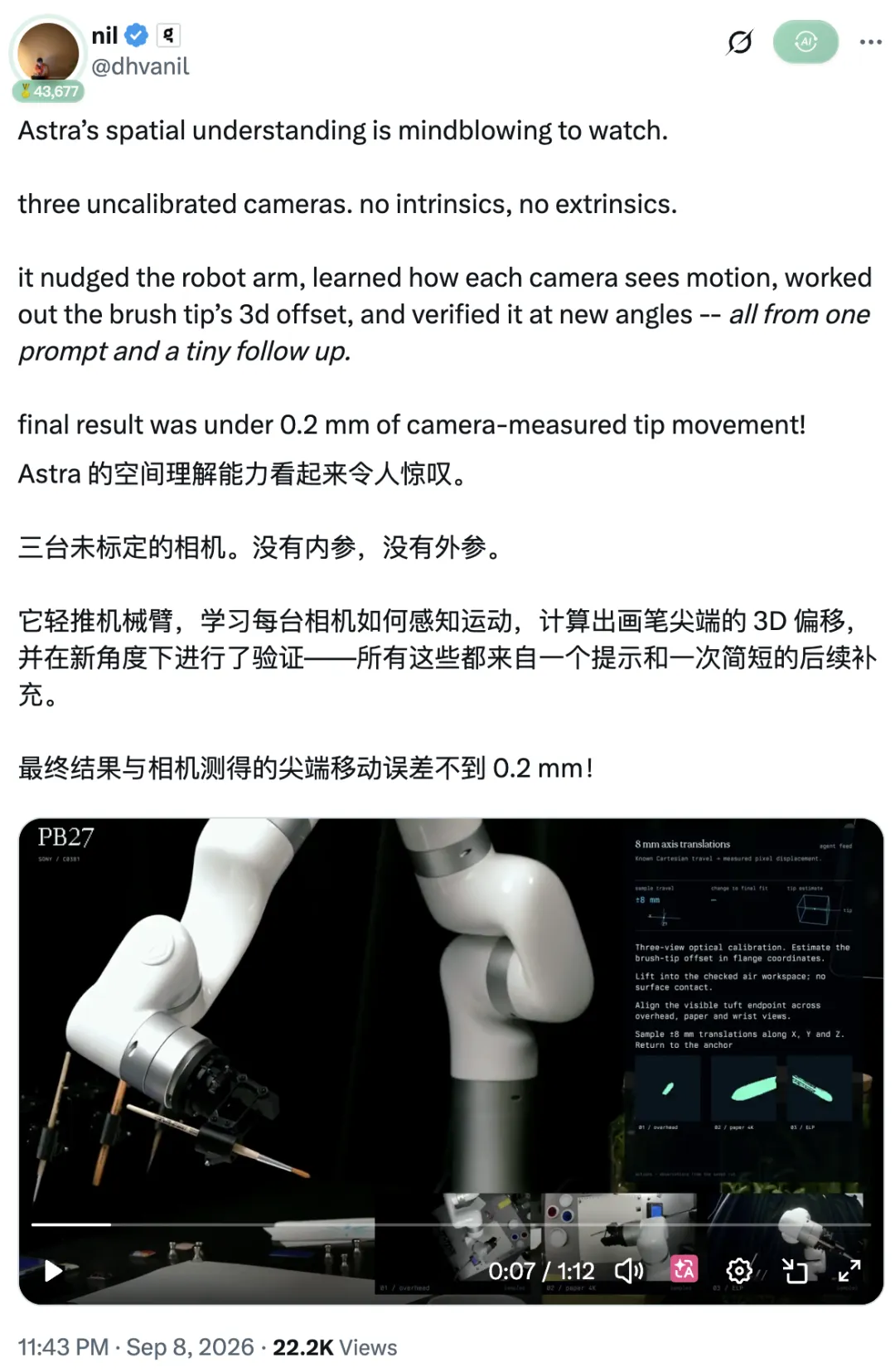
It took 65 minutes to paint a silver almond leaf from August to November 2 when the leeward winds were blowing, and then until 4 a.m. when the pen is slightly thicker.

When AI generates pixel blocks on the screen, humans are most likely to exclaim "the algorithm is awesome"; but when it really takes a pencil and leaves a shallow waterfall on watercolor paper, human emotions are completely complicated.
Some have painted Uncle Bob Rose playing with oil, calling it a "happy little trick"; others have praised it as "a lack of color stops tuning rather than taking the finished mix, which is too much like a painter".
Adam Karvonen, a former Anthropic Fellow, said: "It's essentially writing code so that the pen can scrub through vector paths, and robot painting has been done for a long time".
Debug the code for the first time.Why are we so obsessed with these diluted dyes?
Because in the last few decades, the mechanical arms of the brake doors in factories, and the machines that paint the trajectories, have been living in the script of "assuming the world is perfect".
The paint is dry, the paper is dirty, and they immediately turn blind and blind.
This morning, the "Programmer's Bug Circuit" that existed only in the world of software, first appeared in the physical world:
See the wrong color (perceived abnormality)→Stop the main thread (interrupted main thread)→Go to the second disk and click the color (generated sub-task)→Click a bit to take a picture (check the closed loop)→Draw a picture (reset the main task)→
But this change is not a variable, it's real water, limestone and grass.
It was able to do so because nil had a set of "slow guns" frames: a full-arm collision scan was performed in the digital cage before each path was executed, and the hardware stopped immediately outside the entire system.
The firmware is responsible for the stability of each 0.1 mm, and the large model only needs to be like a painter, finish a painting, step back halfway, take a picture, think, and then drop a painting.
This set of jobs has hit a watershed in robotics this year.
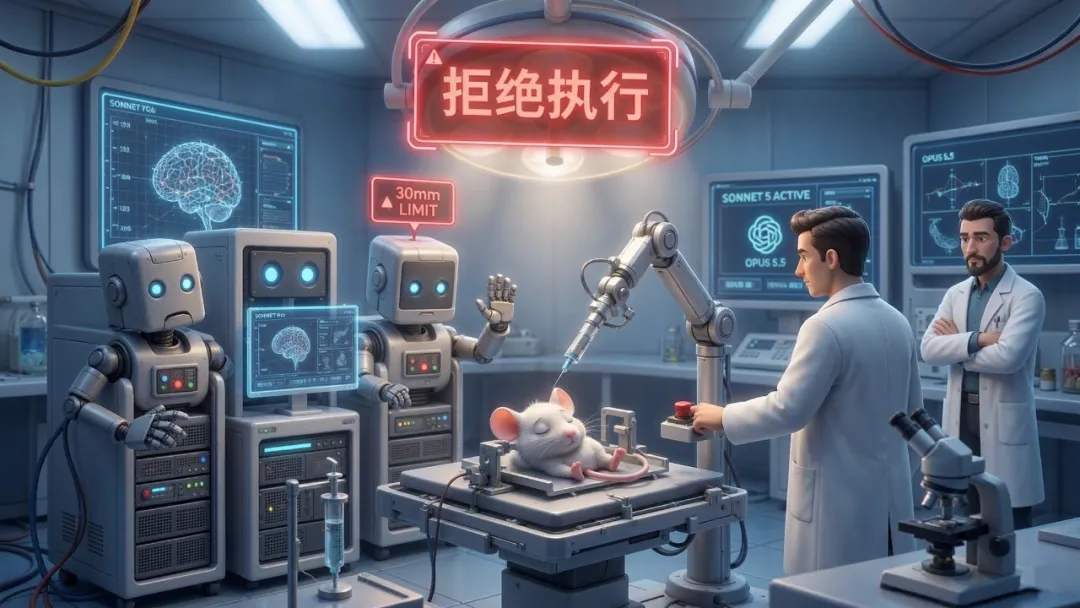
In June this year, Anthropic announced an experiment called Project Fetch. It programmed a commercial machine dog to connect a camera to a radar, identify a sandball and turn it back on.
Last year there were two teams of engineers with no robot experience, one that could help Claude and one that couldn't; this year it was replaced with Claude Opus 4.7 on its own, with no one around.
As a result, the human engineers of the previous generation, Claude, completed 181 minutes of work, Opus 4.7 with a time of 9 minutes and 35 seconds, and only one-tenth of human code. A year ago, Opus 4.1 couldn't connect machine dogs.
But to this day, the dog still can't get the ball back.
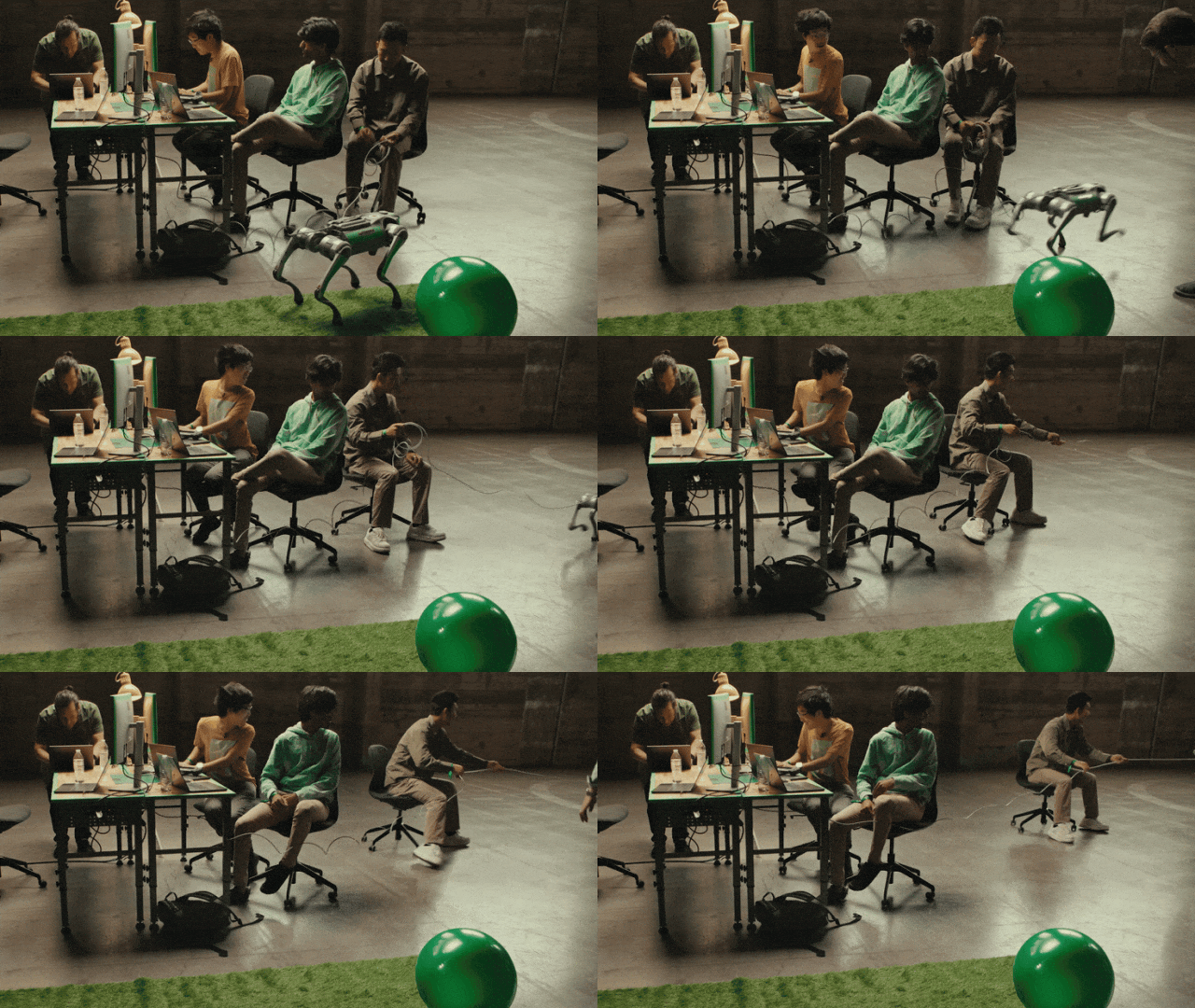
Why can't I paint watercolor all night, paint my brain, and make a ball?
Playing balls, folding clothes, light bulbs, in the physical world is a "quick task": within a few milliseconds of your fingers touching an object, the force of the balls crumbles, slips slightly, and there's no time for you to take pictures, upload, and slowly write the code.
This is the mud that's dying in Gemini Robotics 2 and π0.5.
The image that the eyes see directly reflects the condition of the muscles.
π0.5 has been able to pick up kitchens in homes you've never seen before, with a 94% success rate; Gemini Robotics ER 2, released in July, is also capable of tracking progress in video and retesting errors.
However, "the discovery of insufficient dye to make a new one" has not yet been proven by any VLA model.
The painting is partly about the "slow world". The water colour does not run off long legs, stopping for ten minutes between the two, the tree or the tree.
In this allowed slow gap, a general model with no robot manipulation of the data, read-only on the Internet, would turn dark, watercolor dim, camera interface tuning, and hardcore students would cross the threshold of tens of millions of moves to train data, turning themselves into artists.
The General Model is pushing the threshold of "adding a new leader to the robot" for one night.
A special model will then prove:In terms of speed, success rate and agility,End to endWhat is the value of training?
The end.After dawn, in the face of a full-screen purchase, nil half seriously said to start a "robot art club", a monthly theme, a drawing of the mechanical arm, together with the telemetry data sent to the members.
Maybe someday in the future, a machine will take over a millisecond-scale touch and force field and hold the keys you threw away.
But many people's memories will probably end on this autumn night in November 2026:
At four o'clock in the morning, the owner fell asleep. Under a solitary lamp, a second-hand machine arm stopped in the middle of the sky, looked at the unpainted tree, feeling that the red in his hands was not soft enough, and silently turned to the coloring plate, dripping a drop of clean water.