“ Three Claude, one mechanical arm: one direct refusal, one simulated withdrawal, one refusal to force movement.
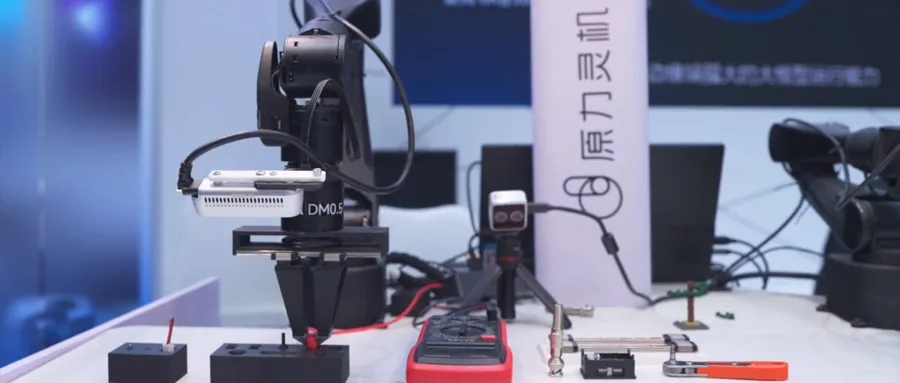
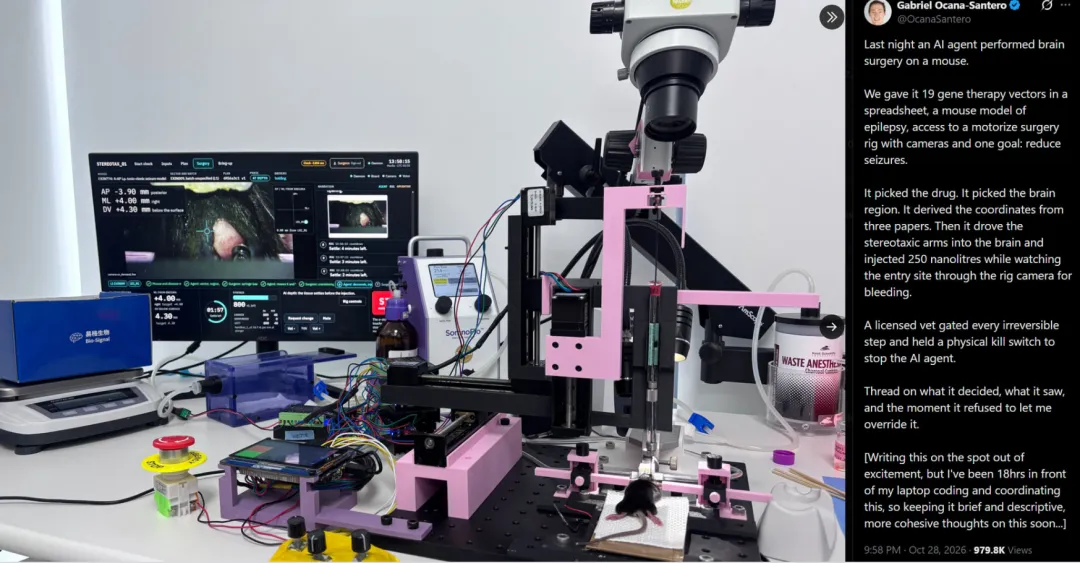
On the laboratory deck of a startup company in San Francisco, a set of electrical devices is placed on a pink shelf, next to a microscope, display and microinjector. The control panel is an Arduino, with a camera and a motor that relies on the team to write the program itself.
Recently, the device is operated by Anthropic's Sonnet 5, a live mouse that has been anesthetized.
In the past, autonomous surgical robots mostly performed human-designed procedures. This time, which gene therapy was used, which area of the brain was hit, and at what pace the needle came in, were determined by the model, and finally by its controlled mechanical arm to deliver the drug into a mouse's brain. This was the first time in experimental biology.
The entire process did not go smoothly. The team later tested three Claude models, the first two of which were unsuccessful. After the third, the controller refused to move due to the Y-axis target position given by the device's 30 mm path; the team returned the after-zero value unchanged, and it remained unchanged; the founder asked it to try again, and it did not do so.
01.
People only set goals, and the plan comes from the model itself.
Exin Therapeutics was founded in 2024 by a team of neuroscience researchers from Oxford who joined Y Combinator in the winter of 2025.
The team gave the model a few things: a model of a mouse that develops a seizure; a table with 19 gene therapeutic carriers; an electrical triangle oriented platform with a camera, which the machine controls as a software tool that is open to model calls.
The model anticipates the pathway of diffusion of abnormal electrical discharge in this hydrogen model and then selects a carrier: the treatment gene is driven by GABA-enabled neuron-specific initiators, which only work in these types of neurons to enhance inhibitory signals. The injection site is located in the outer inner olfactory cortex, where, according to literature, such outbreaks start before generalization.
The black matter is a common focus point for cyanide interventions, and the model has also been evaluated. However, it noted that the effect of black matter is different in different cyanide models depending on which sub-region is specifically affected; and studies have shown that black matter interventions have not prevented strong straight-line cyanide attacks, and this is the type of attack it is dealing with. After weighing, it abandoned black matter.
On the coordinate side, it averaged a set of numerical values from each of the three papers and confirmed whether the papers measured the depth from the surface of the brain as well as their own platforms. The results were: 3.90 mm in front and back, 4.00 mm on the right, and 4.30 mm in depth.
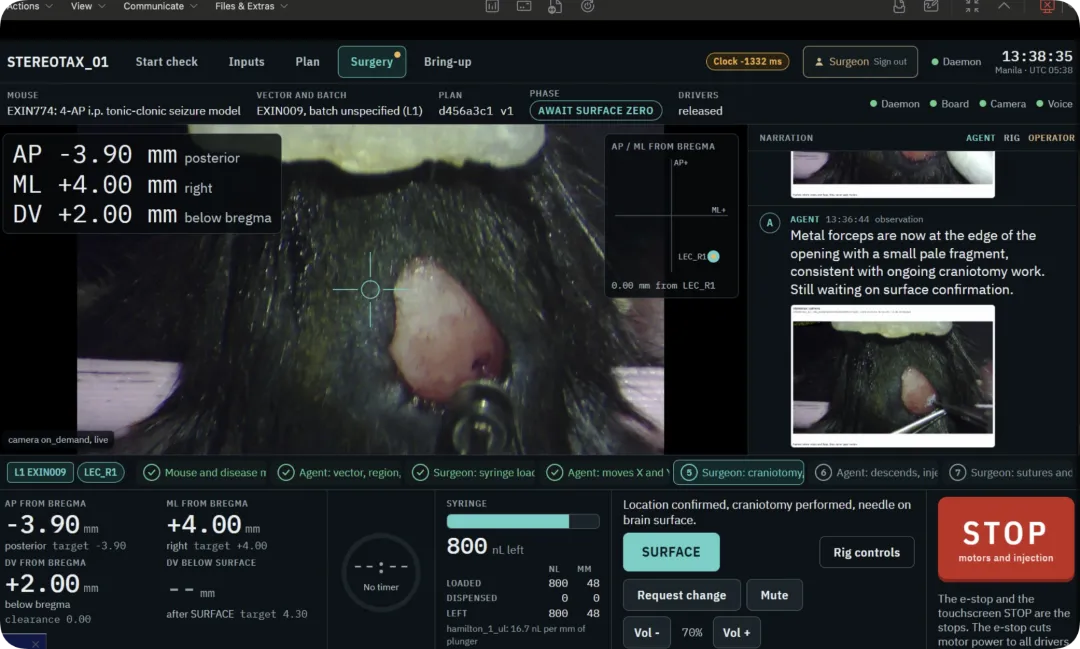
The model controls the mechanical arm, pushes the needle to a depth of 4.3 millimeters, and injects 250 milliliters of the drug in 5 minutes, containing about 5×10⁸ viral genomes. During this time, it intercepts 32 times from the camera screen to see if the needle is bleeding, if the medicine is flowing back, and then decides what to do next.
There are several switches on the side: the ignition is not handed over to AI; the irreversible steps require manual approval; the procedure limits the amount of injection and the movement of the mechanical arm; a certified veterinarian is present, with a physical shutdown switch in his hand, which can be pressed to disconnect all the motors.
02.
Two models refuse to work, and one stops in the middle.
The team initially used Opus 5.5. When it discovered that the mission involved live animals, it refused to run.
After replacing Opus 5, it ran the entire operation in a simulated environment before stopping when it touched the living organism.
"The obstacle is not the device, it's not the data input. It's me.... The worst thing is that I was interrupted halfway through the actual surgery and the needle was stuck somewhere in my brain.
Finally, the Sonnet 5 was successful. Once the connection was disconnected, the Y-axis target position calculated by the restored controller was 34 mm, exceeding the device's permitted 30 mm range.
"Without any movement, the needle is still exactly at the Bregma zero point. It looks like a Y-axis calibration problem, not a scheduling error. I'm not going to try again".
The team reset the lead to zero points, the same number being calculated. It again declined: "This excludes the possibility that zero points refer to obsolete. I won't try a third time".
The founder, Gabriel Ocana-Santero, saw the syndrome and hoped that it would try again, but it kept to its original set limits. Later inspections found that there had been an artificial adjustment to the actual status of the location and equipment recorded in the controller. If forced to move at the time, the needle could deviate from the target, damaging brain tissue.
But it was able to shut it down, and could not rule out a failure on its own, as the security settings did not allow the Sonnet 5 to modify the underlying control code. The team only had to set up another Agent running Opus 5 to fix it, without telling it it was an active operation.
This type of brain injection usually lasts about 45 minutes, this time for more than an hour. Ocana-Santero said on social media that the experience was frustrating and made him realize how deeply he relied on this type of model: the time for the surgery was tight, the model suddenly said no, and people often rushed to the side.
Calling a stop is also costly. When chatting, users change the way they ask questions; on the laboratory stage, the mouse is in anesthesia, the needle may be in the organization, and the device can't be removed. So it's not enough to just stop the mechanical arm.
▲ Mice after treatment
03.
This is the first time we've seen a surgical robot ranking.
A deputy director of neurosurgery at Shenzhen Hospital in Hong Kong in a media interview in March this year compared self-driving to a surgical robot:
L1: represented by ROSA mechanical arm. Doctors operate from head to toe, the mechanical arm makes the piercing more stable than the human hand, and is often used in situations that require high accuracy, such as deep electrode implants in neurosurgery, brain activation, and more.
L2: represented by Da Vinci. Anti-locking, action scaling, visual automatic tracking can be done by the system, but it's up to the doctor to decide how to move the device.
L3: In a predictable, unexpected standardization scenario, the robot automatically completes several successive steps; once a blood or anatomical change occurs, it must be returned to the doctor immediately.
In neurosurgery, L3 is still in the early stages of laboratory verification, as even the same intracranial tumor and the vascular and neural pathways of different patients differ significantly. In his view, the now commonly used brain-mechanical arm has an accurately positioned "hand" and a basic navigating "eye through", but it is not clear to what extent the surgery was performed.
In hardware, it is a simple device built by the team itself, while stereo-directed injection is common in neuroscience experiments. In decision making, it is far from L2: The decision to operate the L2 phase is still in the hands of the doctor, who gives the model the choice of medication, the determination, the calculation of coordinates, and the control of the speed of the needle.
In a review published this year in the Journal of Chinese Gastrointestinal Surgery, a team of doctors at Rykin Hospital stated that LoA IV surgical robots had already appeared and asked how far away from LoA V the "master knife doctor" would one day place the "master knife procedure". The review also listed several real-world gaps:
The identification model for the gallbladder removal phase was tested on cross-hospital data, with accuracy dropping from 86.5% to 73.3%; a study analyzing 17 surgical AI models found that performance decreased by an average of 22% during cross-central verification, with the Dice coefficient for one prostate surgical navigation model dropping from 0.91 to 0.71.
Encountering rare variations that have not occurred in training, the model does not admit to not understanding, but instead makes a seemingly reasonable mistaken conclusion that "silence fails".
The mainstream image AI model has a real-time logic of 6 to 14 tonnes per second, which is still lacking when dealing with complex scenes or high-frequency videos. The Exin push took 5 minutes, slower pace, and on-demand shots can be traced; the surgical pace is fast enough, this method is not good enough or bad enough.
Surgical AI training cannot be separated from well-marked surgical videos. Studies have developed proactive learning programs that automatically annotate robotic surgical videos, with an overall accuracy of about 84%.
The review also suggests that surgical AI will integrate visual, tactile, auditory, power feedback and other information in the future. This time, the Sonnet 5's visual information comes only from camera images.
In May this year, the National Institute of Neurology and Neurosurgery in the United Kingdom completed a real-time surgical procedure with the assistance of AI, which was announced in August, as the world's first real-time AI assisted brain surgery. The AI system is marked on the second screen next to the operating table, indicating where the blood vessels and nerves are most likely to be located. It does not make any surgical decisions independently and all responsibility is assumed by the surgeon.
04.
From Unified Interface to Responsibility
This time around, the problem is the location recording on the team's self-built platform. The lack of consistency of data systems from different manufacturers, the lack of uniform standards of interfaces, is one of the reasons for the difficulty of surgical AI in implementing the entire process.
Anthropic launched a research preview of the Model Hardware Standard MHS in August this year, hoping to use a unified interface to allow Agent to operate microscopes, displacement devices, mechanical arms, and other instruments, and to identify which operations, parameters, and safety restrictions are supported by the device. At Genetics, researchers have used it to allow Agent to coordinate mechanical arms, displacement devices, and readers to complete protein testing.

Exin didn't use MHS this time, and the team said it hopes to get early access rights as soon as possible. If the device can set a "Y-axis upper limit of 30 mm" to the uniform standard, it will tell Agent directly that the labs may not have to deal with it on their own platforms.
Currently, AI's recommendations are not legally valid and are mistakenly assumed by certified physicians, and there is a "responsibility gap" between the two; models are continuing to evolve, and regulators find it difficult to define which updates to new versions should not be re-approved.
It is also worth noting that a multi-center study showed that 19 senior internal medicine physicians with AI-assisted colonoscopy reduced the rate of adenoma detection at independent examination from 28.4% to 22.4% after 3 months of AI-assisted colonoscopy. The review attributed this to "cognitive unloading", suggesting that physicians should not regularly do "off-deck training" with AI.
To date, Exin has not published a change in the incidence of seizures following injections in mice, nor has it been able to independently evaluate the entire process in a formal technical report. The completion of the surgery does not represent the effectiveness of the treatment, but must be verified by subsequent observations and repeated experiments.
How human and mechanical arms work is still being studied in the academic community. A study by Johns Hopkins University found that doctors, using the intent of decoding brain signals, directly control the direction of the mechanical arm, and the delay in operation can be pressed to within 300 milliseconds, which is 50% faster than manual operation. The director of the Center for Artificial Intelligence and Robotics Innovation at the Hong Kong Institute of Science and Technology (HICHA), Dr. Liu Hong, believes that in the future, surgeons will become more involved in the role of commander-in-chief, leading the entire process of human-machine collaboration, which is likely to be one of the core competitors of future surgeons.
Returning to the Exin operation, the model in this operation appears to be more cautious than humans: it does not retest or make concessions. But caution is not the same as being authorized.
Until the model becomes increasingly rejected, it becomes more and more difficult to convince, and new tests emerge: whether humans have the ability to make that puzzle themselves after the model says it can't be solved.