Dreams from the Monastery of Phineas
QbitAI is public.
The streets are not alone.
DeepSeek's newly proposed Super-agent and its concept sparked a heated debate after its release.
It was also in this heated debate that the results of a Silicon Valley Chinese team began to be truly understood.
This trans-oceanic technological resonance is actually pointing to the underlying difficulties of the same man-craft collaboration.
At present, humanity is becoming a bottleneck for AI.
Imagine an AI that can do 1,000, 10,000, 100,000 tasks at the same time, so that everyone can't see what Agent is going to be like.
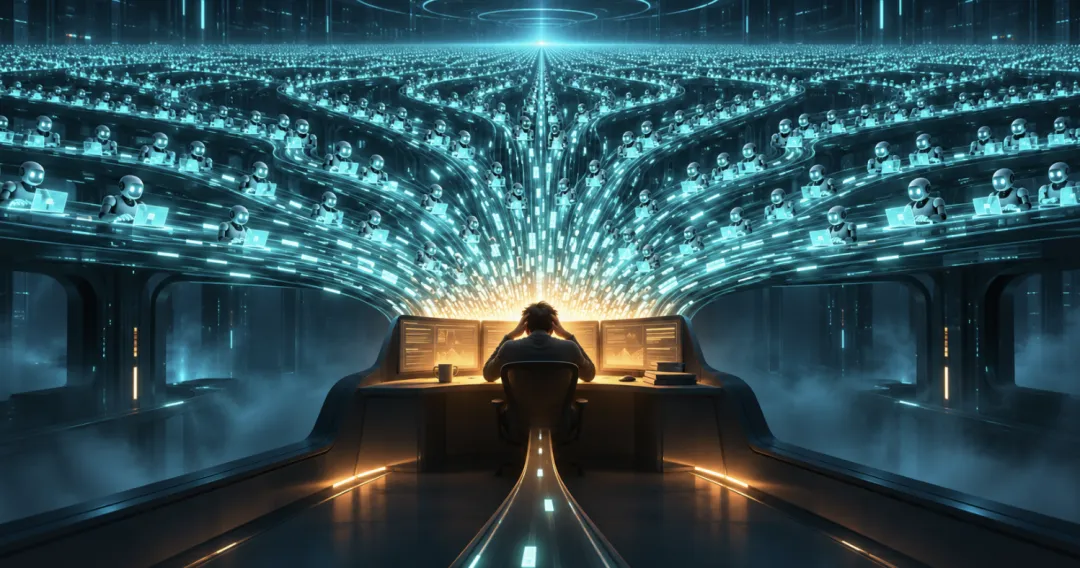 △A.I. generated
Just a few days ago, the DeepSeek Harness team came out with a landmark article that gave the next generation of Super-Agents an architectural idea of this pain point:
A person with a continuous context, capable of autonomously scheduling multiple Agents to work in parallel, or even a super-intelligent person online 24/7.
To unleash humanity's limited attention, let the Agents take over the massive missions and manage themselves.
The reality is so magical, and what many people don't know is that on the other side of the ocean, a team of Silicon Valley Chinese called AFK AI is working.
At the beginning of the year, the single-router+multi-worker architecture and four core features of the Super-agent underpinnings were rolled out to Comma.
They went even further, cursing the context directly after the single Session took over everything, allowing Agents to long-term memory, continuous learning, and always online:
More importantly, the system is now publicly available, and even the code is open source.
In the era of Personal Agent, a team of Silicon Valley Chinese brought Javis from the sci-fi movie into reality in advance.
It's a sad single-season long-running game in which two of the biggest Agent players are united.
I'm sure you're not all familiar with the scenes below.
You're making an AI modify a code, and it takes ten minutes to complete the test, sadly.
This is when customers suddenly come up with new requirements, prompting you to rush out of a project plan, you open another AI session window, and you start ordering tasks.
It's a coincidence that the boss raids and asks about the progress of yesterday's project in the workgroup.
So you keep going through the window, looking for historical conversations, looking back, full-screen Agent sessions, countless missions to follow, really big.

It's a "difficult" scene, and it's directed at the core pain points the DeepSeek Harness team mentioned in the Super-agent article.
According to the team's observations, the average person's attention span is usually limited to three to five active sessions at a time.
It is not that the agent itself is not large enough, the key reason being that the concurrent capabilities of the agent can expand indefinitely, but human attention has a hard "upper limit".
The idea of a super-agent's bankruptcy is also fairly straightforward: that sexuality directly outsources human attention and lets the agent manage the agent.
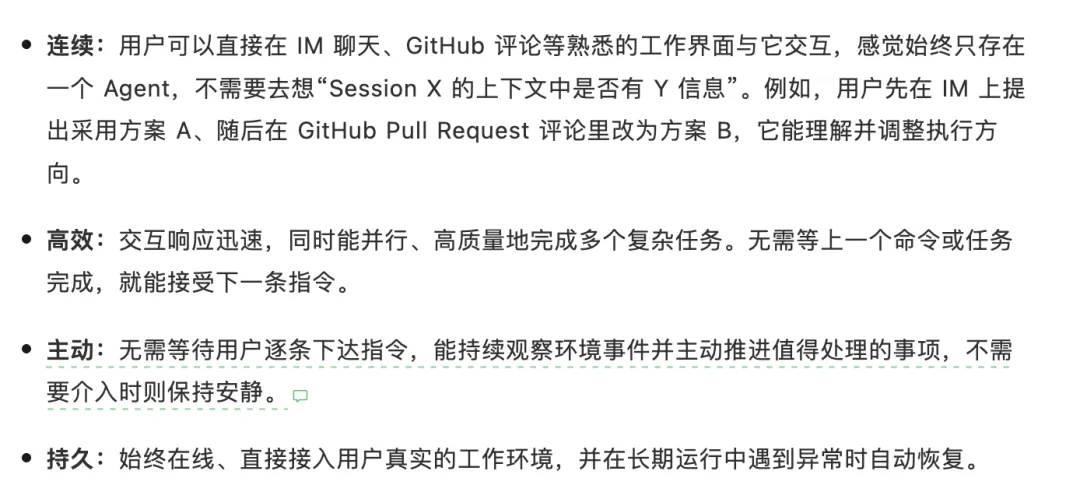
To this end, they also proposed the four main standards for Super-Agents: continuity, efficiency, proactivity, and durability.
Continuity represents the integration of memory with context, the efficient collaboration of multiple workers in parallel, the proactive representation of self-propelled tasks, and the enduring support of long-term online and self-repair.
The user uses a dialog input that allows the host agent to coordinate multiple agents to process bulk information in parallel, live across scenarios, and take only top-level decisions, ok:
DeepSeek Harness's judgement in the last few days has caused a lot of shock, but it's even more exciting when it comes to the monkeys.
The next-generation Agent blueprint depicted by DeepSeek, the Silicon Valley Chinese team AFK AI, has been working on Comma in a similar direction for six months.
The team has even come up with a visionary idea: a team, a dialogue.
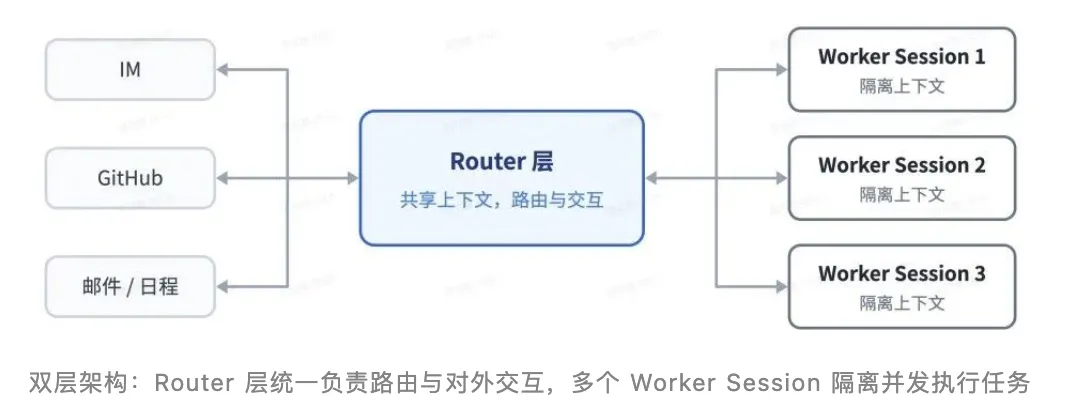
The user only has to face a long-standing main dialog, which is executed in parallel by the router's unifying task, scheduling the independent context-based Worker.
In the underlying architecture, two Agent players also form a default consensus: Single Session+Router (main brain) + Multi-Worker (executor).
Multiple Workers are simultaneously operating in an independent context and reporting results.
Even if dozens of Agents work at the same time in the background, users can only exchange things in a dialog box, accept results, and no longer have to open a full screen window, one step at a time.
Of course, there was a new problem, which was that when Agent began to take over the attention of humans, a trickier problem arose.
Who manages Agent's own memories?
It's important to note that the more things a session has to deal with, the more the windows in the context are ultimately limited.
When a long-running Session began taking over more and more work, the problem of human attention was solved, but Agent's own memory bottle emerged.
What's really hard is for Agent to have a system that can learn continuously, stay online, and retrieve critical memories at any time.
This is precisely what makes Super-Agent a deeper technical proposition:
A personal agent like Javis is everywhere, always online, and can even accumulate experience in long-term work.
The idea of the future Agent, which has in fact sunk into Comma, has become a real experience that every user can experience personally.
From architectural consensus to product landing, Super-agent runs into real products.
Continuity and Efficiency: A Dialogue for Agents to Work with Their Teams
I'd like to talk about continuity and efficiency first.
As previously mentioned, one of the architectural features of Super-agent is that it allows multiple isolated Worker tasks to be performed in parallel by multiple routers.
The emphasis here is not only on multi-tasking in a single session, but also on cross-environmental execution, understanding and responding to changes in user intentions, etc.
It sounds like an idealized way of interacting, and now in Comma, it's become a real product experience.
One of the things that I feel most comfortable about being a regular user is that I don't have to give Agents "tracking groups" every day to arrange tasks, one at a time.
A task is a meeting frame, a task is a queue, a task is a sequence, a task is a sequence, a task is a sequence, a task is a sequence, a task is a sequence, a task is a sequence, a task is a sequence, a task is a sequence, a task is a sequence, a task is a sequence, a sequence, a sequence, a sequence, a sequence, a sequence, a sequence, a sequence, a sequence, a sequence.

That's right, lately I've been addicted to playing the game of cooking in the kitchen, but I always thought it was too much, so the machine moved: directly order Comma to cook one.
But the problem is that I'm still busy with the week's paycheck, and the task of organizing recent AI model releases, and there's a lot more to be done.
Before that, it was time to open three Agent sessions, alternate backgrounds, arrange tasks, and move forward one by one.
This time, I'm stealing a mouse, holding onto the same dialog box as Comma, and I'm brainwashed into all three tasks.
As a result, I was able to complete three tasks assigned to different Workers.
I can even plug in, temporarily activate, and the backstage is just as full of fire, isn't it?
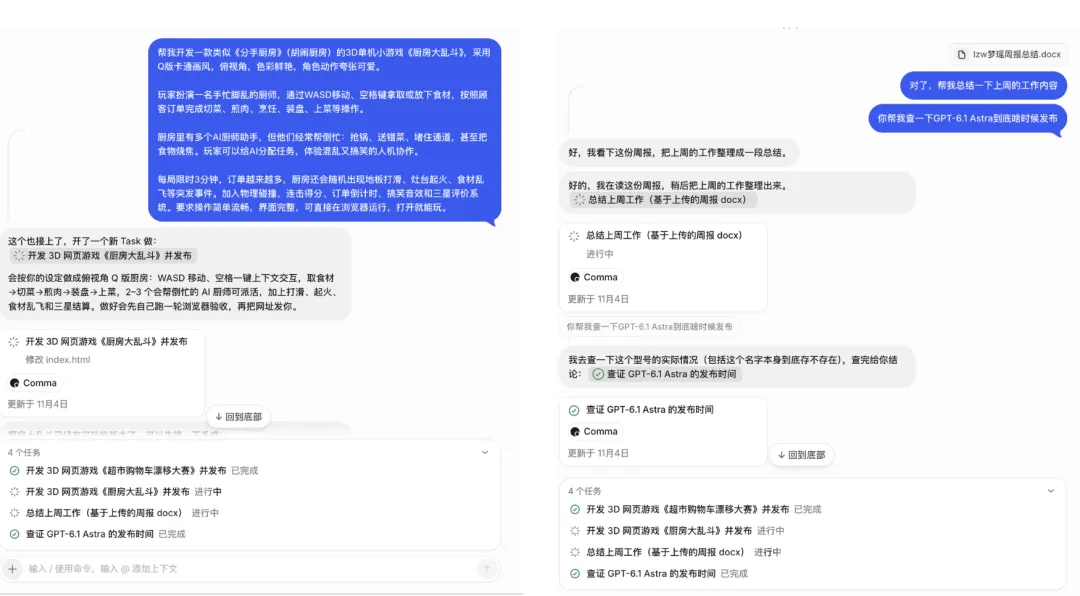
Of course, just looking at the back of the hot tub is not enough, and finally we have to talk about the results!
We're going to have to go straight to the kitchen and see what Comma has been doing for me for ten minutes.
WASD moves, three minutes of countdown, snatches, deliveries, blocking the corridor... all the required games were arranged, and 1:1 completely compensated for my request:
At the same time, the weekly reports on the other side are also fresh, the work content is well organized, the main progress and follow-up arrangements are well organized:
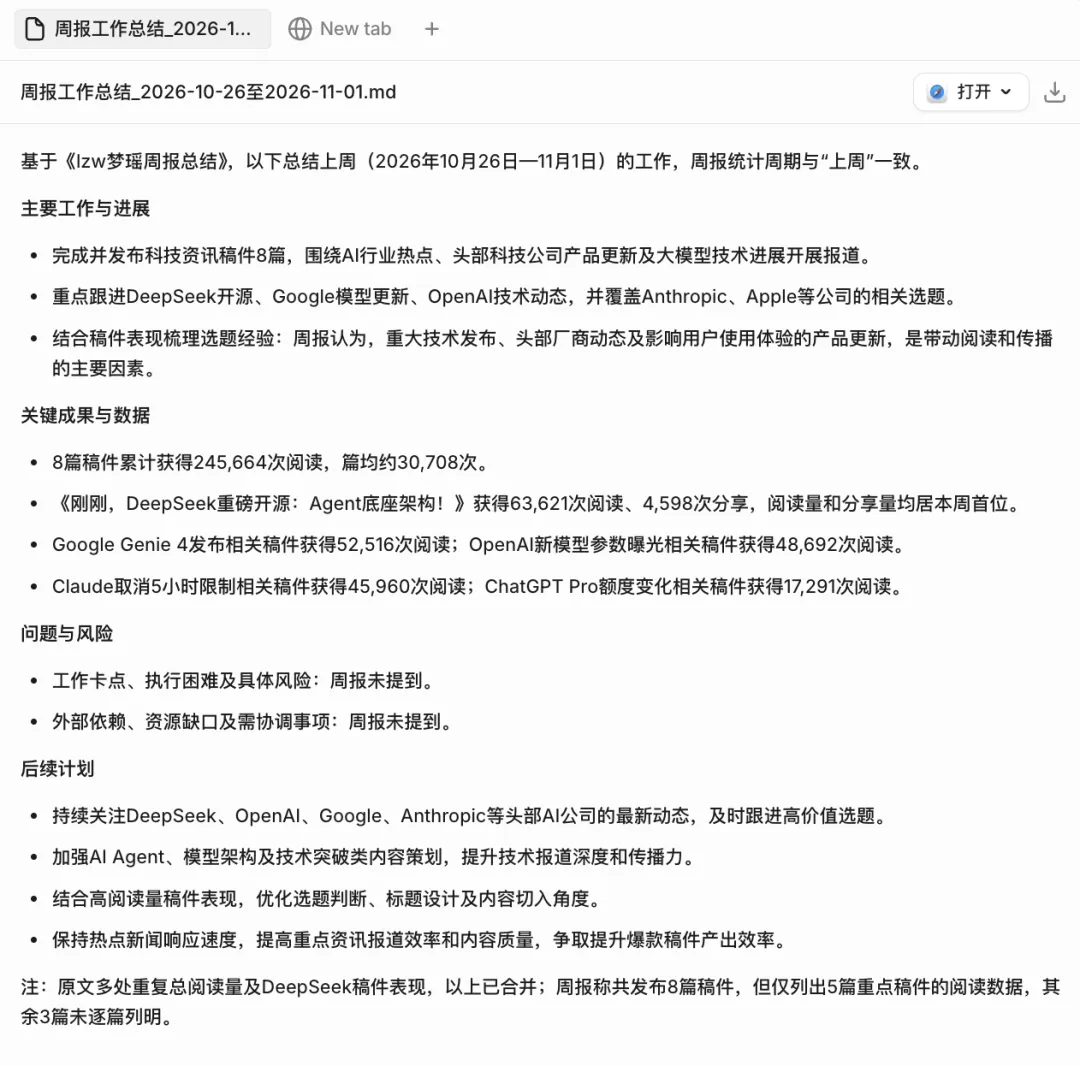
In the whole process, all I have to do is point out the needs, see the progress, accept the results.
The task division in the background, along with the execution and the state summary, is handled by Comma, and I'm a little out of step.
It was the first time I really felt, man, that I finally pulled away from multitasking and focused attention.
The management of the agent has finally changed from the "getting process" to the "getting out of it".
Cross-environments: cross-app connections, connections, connections, a dragon
However, it is only in the first half that you can work simultaneously in a dialog box.
When the user leaves the dialog box, it can't go back and forth.
This is precisely what the Super-agent's higher demands for "continuity" are: cross-environmental.
In the architecture proposed by DeepSeek, this relies on underlying multi-channel interaction mechanisms.
After receiving messages from different platforms, the Worker is executed independently in the background and returns the results according to the interaction habits of different channels.
One of the official examples they gave was that the same development task progressed seamlessly across IM and GitHub, with AI actively listening to group chats and automatically submitting PR, be like:
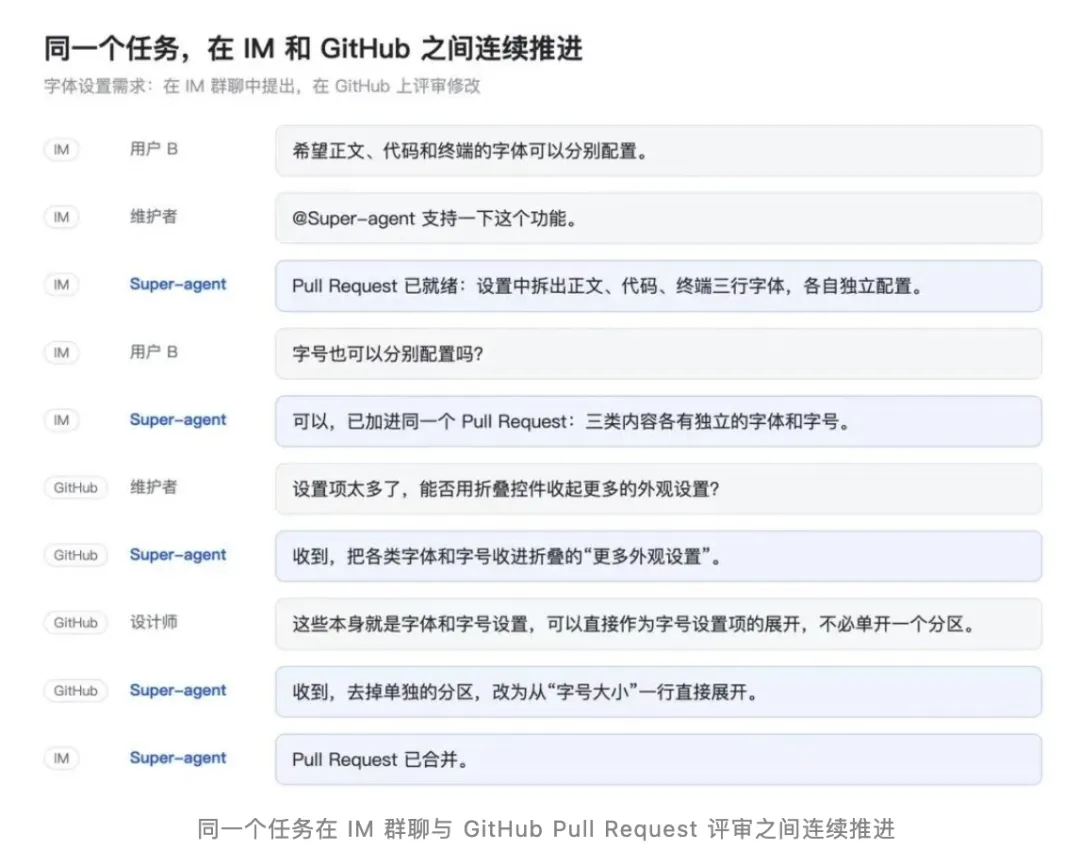
It is worth noting that in Comma, this efficient and sustained "cross-environment" capability has long been a user-perceived experience buffer.
It relies on the team's self-developed Distributed Agent Operating Framework Salix.
Through a third-party application connector, it is able to receive events from different platforms and is continuously monitored by a programmable Loop to wake up Agent processing when needed.
And Comma's scope is quite wide, and we all have access to communications channels like WeChat, Signal, iMessage, Linear.
Not only that, Comma also supports secure self-deployment, BYOK and access to the Codex, Claude Code, unified task supervision, and cross-end collaborative management.
Even in a corporate scenario, it can do tasks through the Comma Bot in IM, allowing the connected employee computer to provide the required local working environment, and controlling restricted access through permissions and information flows.
Since there are actually a little more manuscripts in hand lately, I also added Comma to Linear and directed the project needs to Linear in Comma:
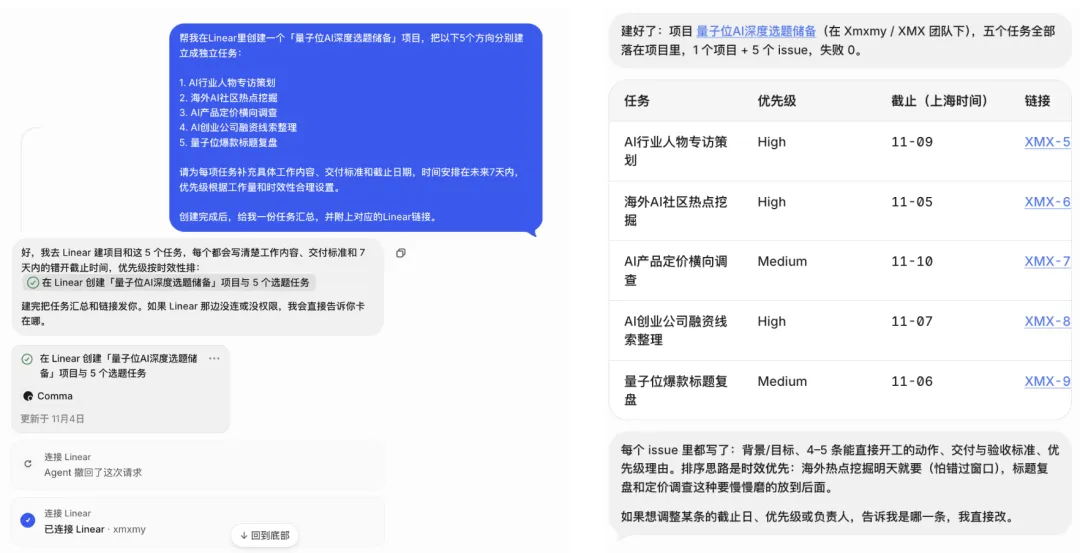
If you look back at the Linear, the Issue has been built, what specific tasks to break down, how to arrange the follow-up work, it makes me very clear:
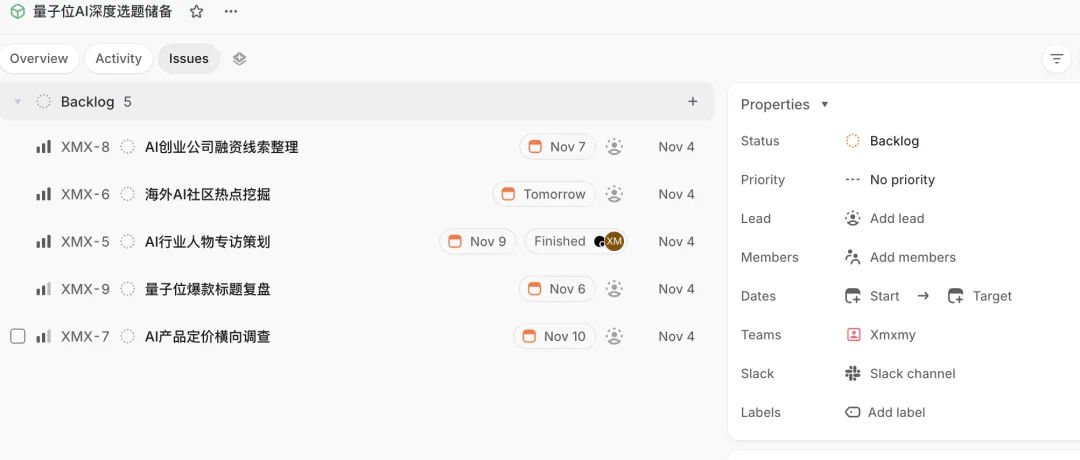
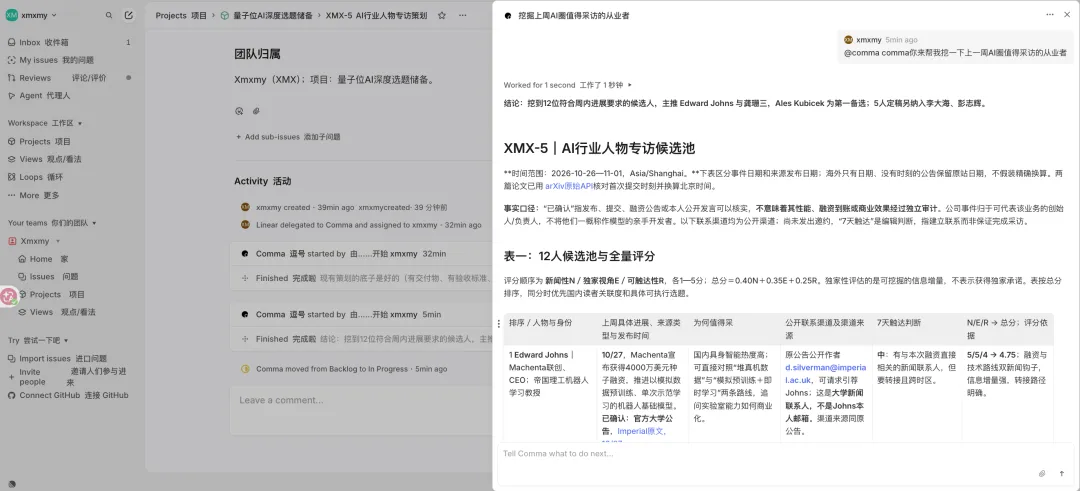
But what I really want to say is that the Issue in Linear can in turn be handed over to the Comma to synchronize execution, progress and results back to the original task!!
The comma switches live, the linear catches up, the linear mission, the comma can continue to work, and the information particles on both sides remain aligned.
The task can be done indirectly on different platforms, and now Liu is finally running away from all the big platforms and Agents, suggesting that the big factories should learn well:
A dynamic agent, a continuous learning memory system that is always online
In the conception of DeepSeek, Super-agent has two highly imaginative traits: "active" and "durable".
It's about letting agents go from being passive, evolving to actively discovering problems, finding their own way, and being online 24 hours a day.
Fortunately, Comma also has the oddities and oddities of being able to even get Agent to write his own work schedule, all day long.
Even if the big model doesn't work, the user leaves the client, the system is able to keep watch 24 hours a day and wake up the agent at critical moments.
Speaking of which, I've also recently handled Comma as an "AI theme editor".
It was given a long-term assignment at 12 noon and 9 p.m. daily to actively search for the latest AI news and organize a selection and send it to me.
At the end of the day, the news is on its own, with all the topics, the summaries, the sources of information, and no more worrying about not having the topics reported to the editor.

The real Jarvis, of course, is that it's everywhere.
Multidimensional memory is absolutely consistent, not tied to any single app, but controls all information flows.
Even if I ask about the progress of the Linear mission in the Comma client, the Comma can respond accurately, and the fact of the matter is that the cross-end memory doesn't have to say:
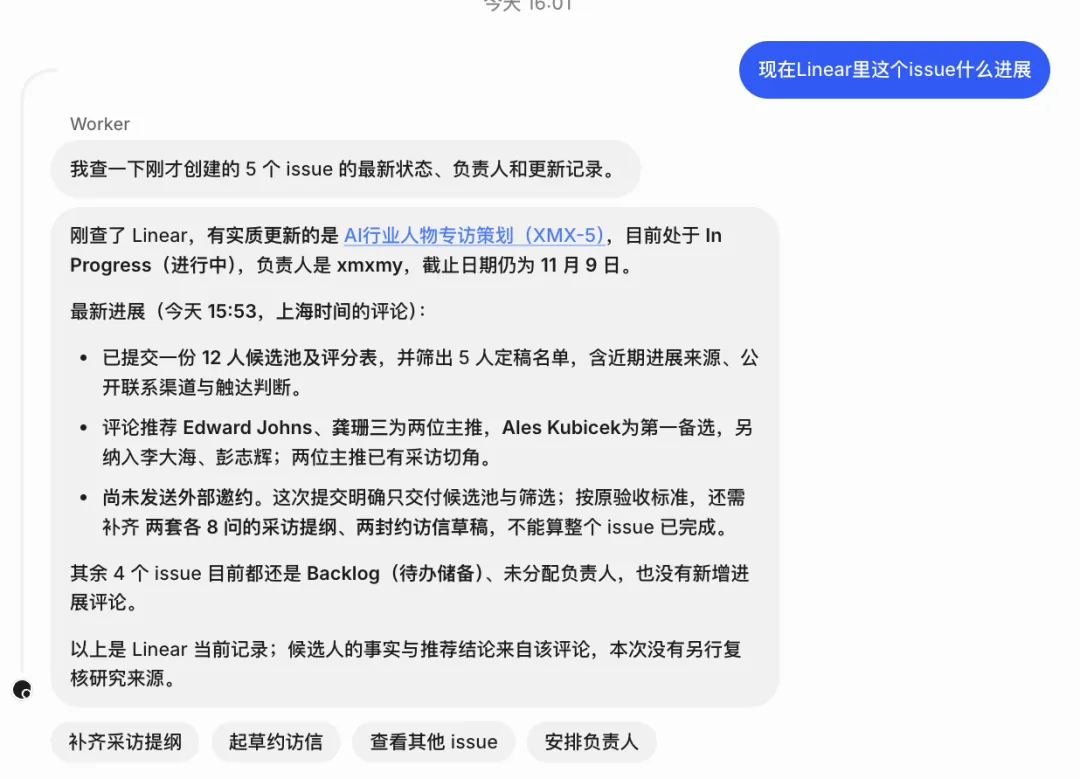
In the underlying design of memory management, Comma does indeed have something real in it.
It maintains its long-term status outside of the context of the model and through the separation of the router and independent worker, avoiding the continuous overwhelming of the main conversation by the details of bulk tasks.
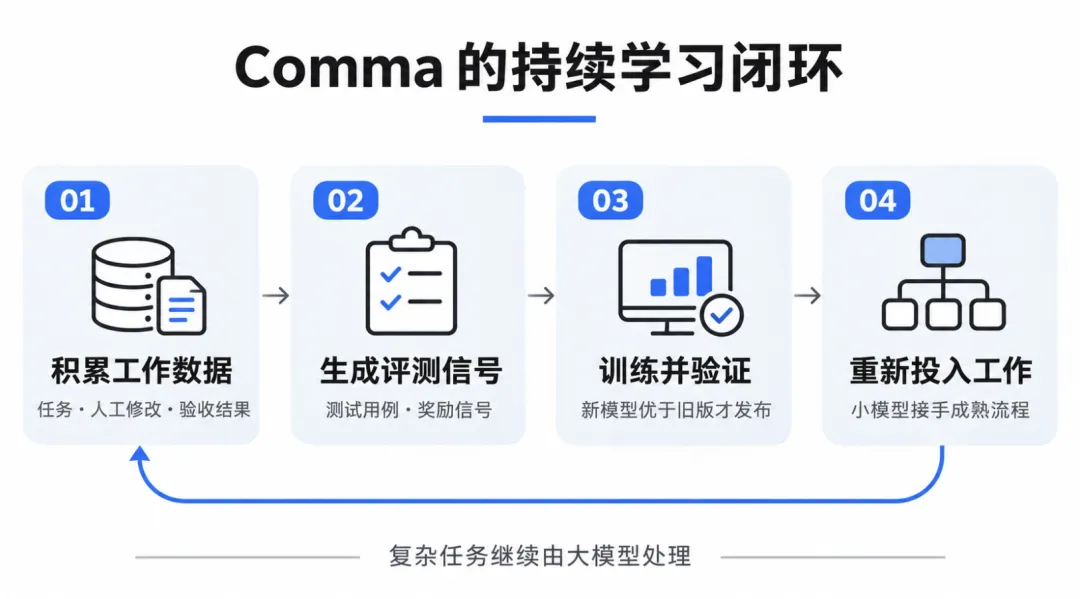
Furthermore, Comma has also built "continuous learning" into product depths, even allowing Agents to accumulate experience from each job.
Comma records the agent's mission results, artificial modifications, and receiving feedback, converting it into training signals and continuing to iterate on exclusive small models.
More interestingly, the new model must defeat the old version in the team's own tests before it can be officially uploaded.
For example, having misjudged a refund request to be a v3 model of Bug, upgrading to v4 correctly identifies the billing problem after learning the artificial correction.
 △A.I. generated
This mechanism, in fact, updates the evaluation data on a monthly basis, so that small models gradually take over the mature workflow, while complex tasks continue to be handed over to larger models.
It's the equivalent of an agent having the opportunity to turn the experience into the next real thing and actually achieve the smarter the agent is.
From Bridge to Comma, continuing to explore long-term autonomous agents
Finally, I would like to say that the Comma architecture was born earlier than many people thought.
Time to go back to April 2026.
At the time, Super-agent was not yet a hot topic in the industry, and Silicon Valley Chinese team AFK AI had already clarified its technical direction.
It allows a long-standing master agent to unify user tasks and schedule multiple independent worker executions.
On April 28, the team officially unveiled Comma's predecessor, Bridge.
In the presentation of the product at the time, the architectural design of the Lead Agent (main agent) and Subagents (sub agent) had already appeared.
Afterwards, the idea began to accelerate its decline.
On May 20, the team clarified "one Router Session per group"; on June 3, the fixed main dialogue with the mission delegation mechanism officially went live.
Coincidentally, just 20 days later, Anthropic also introduced a similar concept to Claude Tag, allowing a Slack channel to share the same Claude.
The search for AFK AI is ongoing.
In August, the team advanced Session switching capabilities.
In September, a shared Session flow control mechanism was introduced to address the sensitive flow of information in multi-person collaboration.
On September 30, Comma officially became open source, followed by the release of a Lean formalised verification-based security mechanism.
From a single main session, multi-worker collaboration, to cross-session management and security control, it took Comma nearly half a year to turn the original architecture into a real product.
Whereas DeepSeek describes a specific form of Super-agent for the industry, Comma gives a different answer with long-running products.
A truly personal agent that can accompany users for a long time, autonomously coordinating tasks, has come into existence a long time ago.
It's the first time I've seen it.
In retrospect, DeepSeek and AFK AI are architecturally united, essentially as two teams of penetrating surface applications, making consensus judgments about the underlying bottlenecks of multi-intelligent systems and the actual production side pain points.
The current wave of AI is coming to the present, and the industry's expectations of Agent Harness are undergoing a critical shift towards AI.
The industry is taking a critical leap forward in its expectations of Agent Harness, shifting its focus from task throughput to responsibilities and complex transaction volumes.
Comma, which has pioneered the practice model on this path, allows Agents to accumulate experience in long-term use and actually achieve the smarter use.
Former online co-creator Javis is no longer a science fiction dream.